Online Therapy for Anxiety in India: What Nobody Tells You Before You Start
Your anxiety has been speaking for long enough. Maybe it’s time to answer back
Online Therapy for Anxiety in India: What Nobody Tells You Before You Start
Your anxiety has been speaking for long enough. Maybe it’s time to answer back

Let me be honest with you.
Anxiety is not just “overthinking.” It’s not a personality flaw. And it’s definitely not something you can fix by just “staying positive” or going on a vacation.
Millions of people in India are living with anxiety right now — and a huge number of them have never spoken to a single professional about it. Not because they don’t want help. But getting help always felt complicated. Too expensive. Too far. Too exposing.
That’s exactly why **online therapy for anxiety in India** has become one of the most searched mental health topics in the country. People aren’t just curious. They’re looking for real answers — and they want them without having to sit in a clinic waiting room.
This article is for those people. It covers what online anxiety therapy actually involves, how to choose the right psychologist, what it costs, and why it genuinely works — explained simply, without any of the usual fluff.
Why Anxiety in India Is a Bigger Problem Than People Admit
Here’s something most people don’t know: India has one of the highest anxiety rates in Asia, yet fewer than 1 in 5 people who need mental health support actually receive it. That gap exists for very specific reasons.
The most common ones are:
- Stigma — “Log kya sochenge” is still a very real barrier for most Indian families
- Cost — In-person therapy in metro cities can cost ₹2,000–₹4,000 per session
- Access — Good psychologists are concentrated in Tier 1 cities; people in smaller towns have almost no options
- Time — Between work, commutes, and family responsibilities, fitting in a clinic visit feels impossible
- Awareness — Many people don’t even recognise what they’re experiencing as anxiety
Online anxiety counselling in India addresses every single one of these problems. But before we get into how — let’s make sure we’re talking about the same thing
What Does Anxiety Actually Feel Like? (Be Honest With Yourself)
Most people wait way too long to get help because they don’t think their anxiety is “bad enough.” They think therapy is only for people who can’t get out of bed.
That’s not true. Here are some signs that anxiety is affecting your daily life:
- You replay conversations in your head long after they’re over
- You feel a tight chest or shallow breathing in situations that aren’t actually dangerous
- You avoid certain situations — social events, phone calls, meetings — because of dread
- Sleep is difficult because your mind won’t stop running
- You’re irritable or short-tempered, and you don’t fully understand why
- You overthink decisions — even small ones — to the point of exhaustion
- You feel “on edge” most of the time, even when nothing is wrong
- Panic attacks — sudden intense fear, racing heart, dizziness, feeling like something terrible is about to happen
If you recognised yourself in even three or four of those, anxiety therapy online India is worth seriously considering.
Types of Online Therapy for Anxiety: Which One Is Right for You?
This is where most articles go vague. Let’s actually explain the main therapy types available for anxiety in India, and when each one works best.
1. CBT Therapy for Anxiety Online (Most Recommended)
Cognitive Behavioural Therapy is the gold standard for anxiety treatment. It’s structured, practical, and backed by decades of research.
CBT works by helping you identify the thought patterns that create and maintain anxiety — things like catastrophising, mind-reading, and all-or-nothing thinking. Then it gives you concrete tools to challenge and replace those patterns.
Best for: Generalised anxiety, social anxiety, OCD, exam stress, work-related anxiety
Most people see real improvement within 8 to 12 sessions.
2. Mindfulness-Based Therapy
This approach doesn’t try to change your thoughts. Instead, it teaches you to observe them without reacting. You learn to notice anxiety rising without immediately being consumed by it.
Best for: People whose anxiety shows up physically — tension, restlessness, shallow breathing, a constant sense of unease
3. Acceptance and Commitment Therapy (ACT)
Here’s the thing about ACT — it’s not about eliminating anxiety. It’s about changing your relationship with it. You learn to accept that anxiety exists while still moving toward what matters to you.
Best for: People who’ve been fighting anxiety for years and feel exhausted by it. When avoidance has become the default response.
4. Panic Attack Counselling Online India
Panic attacks are their own category. They’re terrifying in the moment — racing heart, feeling of doom, dizziness, shortness of breath. Many people end up in emergency rooms thinking they’re having heart attacks.
Specialised panic attack counselling uses three things:
- Psychoeducation — understanding what panic actually is (a misfiring of the nervous system, not a real threat)
- Breathing regulation — specific techniques to interrupt the panic cycle
- Gradual exposure — slowly facing feared situations in a controlled, safe way
Most people who commit to this process see a significant reduction in panic episodes within a few months.
How to Find the Best Online Psychologist for Anxiety in India
This is where people get overwhelmed. There are dozens of platforms and hundreds of therapist profiles. Here’s a practical filter:
Non-negotiables (don’t compromise on these):
- They must have a degree in clinical or counselling psychology
- RCI (Rehabilitation Council of India) registration is a strong positive signal
- They should have documented experience specifically with anxiety disorders
Things that matter more than people think:
- Do they understand the Indian cultural context? Family pressure, societal expectations, workplace dynamics in Indian companies — a therapist who gets this will give you far more relevant guidance than one using Western frameworks that don’t map to your life
- Do they explain their approach clearly? A good psychologist will tell you in the first session what method they use and why they think it suits your situation
- Do you feel comfortable? Sounds obvious, but this is genuinely the biggest factor in how well therapy works. If you feel judged or unheard, switch
What to do: Most platforms for online psychologist consultation India offer a free 15-minute consultation before you commit. Use it. It’s not just a sales call — it’s genuinely useful for assessing fit.
LYFsmile has a helpful breakdown of what to look for in a psychologist and how to choose the right therapy type, which you can read here: **Online Therapy for Anxiety in India — LYFsmile Guide**
The Honest Truth About Cost: Affordable Online Therapy India
Let’s talk numbers, because cost stops so many people before they even start.
Here’s a realistic picture of what affordable online therapy in India looks like right now:
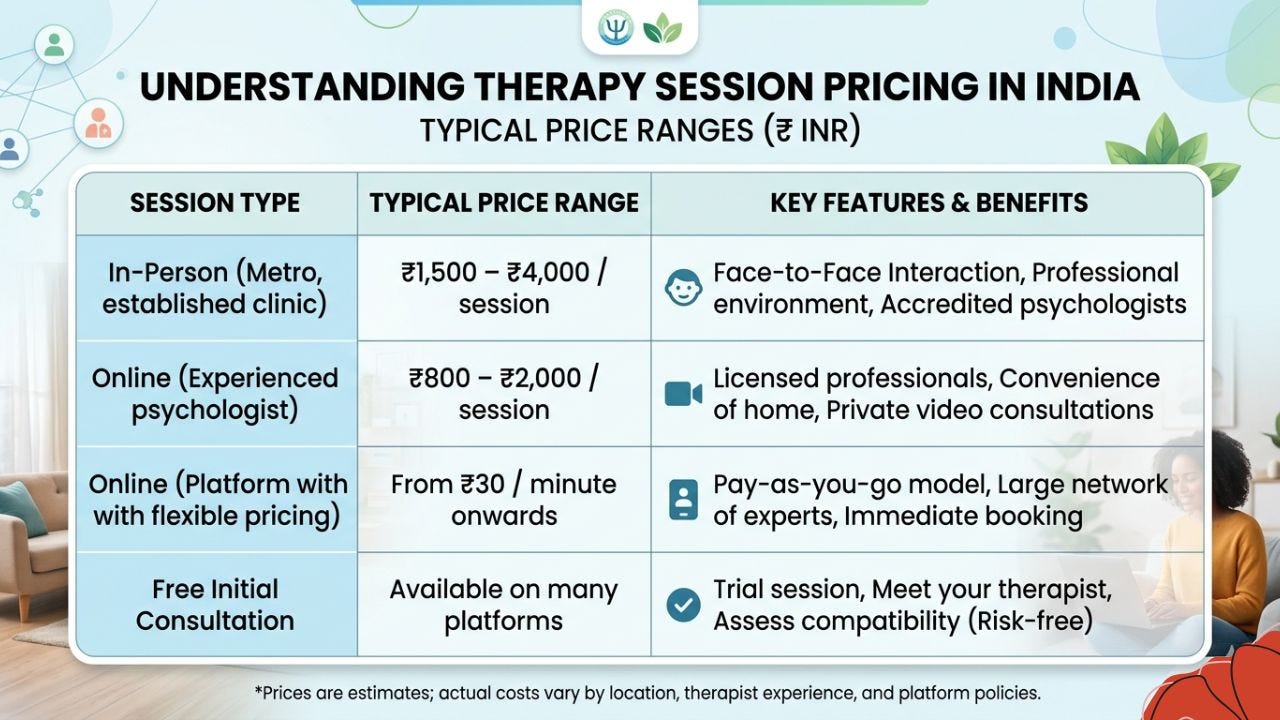
The per-minute model, in particular, has made therapy accessible for people who couldn’t justify a fixed session cost. You pay only for the time you use.
Here’s what actually matters though: consistency is everything in therapy. One session every two months when you hit a crisis point doesn’t build anything. Weekly or biweekly sessions over a few months — that’s when you start seeing real, lasting change.
Affordable online therapy makes consistency actually possible for most Indian households. That’s the real value.
What Actually Happens in Your First Online Session (Step by Step)
Most people are nervous before their first session. Here’s exactly what to expect, so there are no surprises.
Before the session:
- You fill out a basic intake form covering your main concerns, any previous therapy experience, and what you’re hoping to work on
- You get a link for the video call (or details for a phone session if you prefer)
- No preparation is required — you don’t need to have answers, just an open mind
During the first session:
- Your therapist introduces themselves and explains their approach briefly
- They ask what brought you to therapy and what’s been going on
- They ask about how long you’ve been experiencing anxiety, what triggers it, how it affects your daily life
- They may ask about sleep, relationships, work, and physical symptoms
- They listen — mostly. The first session is more intake than intervention
- Near the end, they’ll suggest what they think would help and what a plan might look like
After the session:
- You’ll usually feel lighter, even if nothing is “fixed” — because saying things out loud to someone who listens properly has its own value
- You’ll discuss frequency — how often to meet, what to work on first
- You can ask any questions you have about the process
The first session usually runs 45 to 60 minutes. **Online mental health counselling India** sessions on most platforms are structured the same way, whether you’re in Delhi, Pune, or a smaller city — the psychologist’s experience doesn’t change based on your location.
7 Types of People Who Should Seriously Consider Online Anxiety Therapy
Online anxiety therapy isn’t just for people in crisis. Here’s who it genuinely helps:
- Working professionals dealing with performance pressure, workplace stress, or burnout — especially in high-pressure industries like IT, finance, and consulting
- Students managing exam anxiety, fear of failure, or the transition stress of college and competitive exams
- New parents experiencing postpartum anxiety or the overwhelm of new responsibilities
- People who’ve “managed” anxiety for years but are tired of just managing it — and want actually to resolve the underlying patterns
- Those who avoid in-person therapy due to stigma concerns, privacy worries, or simply not wanting anyone to know they’re seeing a psychologist
- People in Tier 2 and Tier 3 cities who don’t have access to qualified anxiety specialists locally
- NRIs and expats who want to work with Indian psychologists who understand their cultural background
If you’re in any of these categories, anxiety therapy online India removes the practical barriers that usually get in the way.
FAQs
Q. Is online therapy as effective as in-person therapy for anxiety?
Yes — and research backs this up. Multiple clinical studies comparing online and in-person CBT for anxiety show comparable outcomes. The key variables are the quality of the therapist and how consistently you attend. Many people actually open up more easily from the privacy of their own home, which can make online therapy more effective for them personally.
Q. How long before I start feeling better?
Honest answer: it varies. Some people notice a real shift in perspective within 3 to 5 sessions. More complex anxiety — especially if it’s been there for years — may take 3 to 6 months of consistent work. CBT for anxiety typically shows measurable improvement within 8 to 16 sessions. The more regularly you show up, the faster the process tends to move.
Q. Can online therapy actually help with panic attacks?
Yes. Panic attack counselling online uses a structured approach — starting with helping you understand what a panic attack actually is physiologically, then teaching breathing and grounding techniques, then gradually working through what triggers your attacks. Most people who follow through with this see a significant reduction in frequency and intensity.
Q. Do I need a referral from a doctor to start online therapy?
No. You can book directly on any reputable platform without a referral. If your anxiety has a biological or psychiatric component, your therapist may suggest a parallel consultation with a psychiatrist — but this is separate from, and doesn’t block, the therapy itself.
Q. Is everything I say in therapy kept private?
Yes. Licensed psychologists are ethically bound by confidentiality. Reputable platforms also use encrypted communication to protect your data and session content. The only exceptions are situations involving immediate risk of harm, which the therapist will explain at the start.
Q. I’ve tried everything — meditation apps, journaling, self-help books. Why would therapy be different?
Self-help tools manage symptoms. Therapy addresses causes. Journaling helps you notice your thoughts. A trained psychologist helps you understand why those patterns exist, where they came from, and how to systematically change them. That’s a fundamentally different level of work.
Q. Where’s the best place to start for online anxiety counselling in India?
Platforms like LYFsmile offer verified psychologists who specialise in anxiety, flexible pricing, and a free initial consultation. Their full guide on online therapy for anxiety in India is genuinely useful if you want to understand your options before booking.
The Bottom Line
Anxiety that goes untreated doesn’t usually get better on its own. It tends to get more entrenched — more habitual, more limiting, harder to untangle.
Online therapy for anxiety in India has made it more practical than ever to actually do something about it. The cost is manageable. The access is real. The stigma barrier is lower when no one has to see you walking into an office.
The only thing standing between where you are now and actually feeling better is deciding to start. That decision doesn’t have to be dramatic. It can be as simple as booking a free 15-minute consultation and seeing how the first conversation feels.
Your mental health is worth that much.
For more on therapy types, psychologist profiles, and how to book, visit the full guide: ***Online Therapy for Anxiety in India — LYFsmile***
메타데이터
- post_id
- 20eab8f4e613
- slug
- online-therapy-for-anxiety-in-india-what-nobody-tells-you-before-you-start-20eab8f4e613
- url
- https://medium.com/@vivaanpatel8020/online-therapy-for-anxiety-in-india-what-nobody-tells-you-before-you-start-20eab8f4e613
- canonical_url
- https://medium.com/@vivaanpatel8020/online-therapy-for-anxiety-in-india-what-nobody-tells-you-before-you-start-20eab8f4e613
- author_url
- https://medium.com/@vivaanpatel8020
- status
- ok
- fetched_at
- 2026-06-23 06:34:20