AI Prompts for Entrepreneurs: Validate Ideas, Research Markets, and Plan Smarter Launches
AI Prompts for Entrepreneurs: Validate Ideas, Research Markets, and Plan Smarter Launches
AI Prompts for Entrepreneurs: Validate Ideas, Research Markets, and Plan Smarter Launches
AI Prompts for Entrepreneurs: Validate Ideas, Research Markets, and Plan Smarter Launches
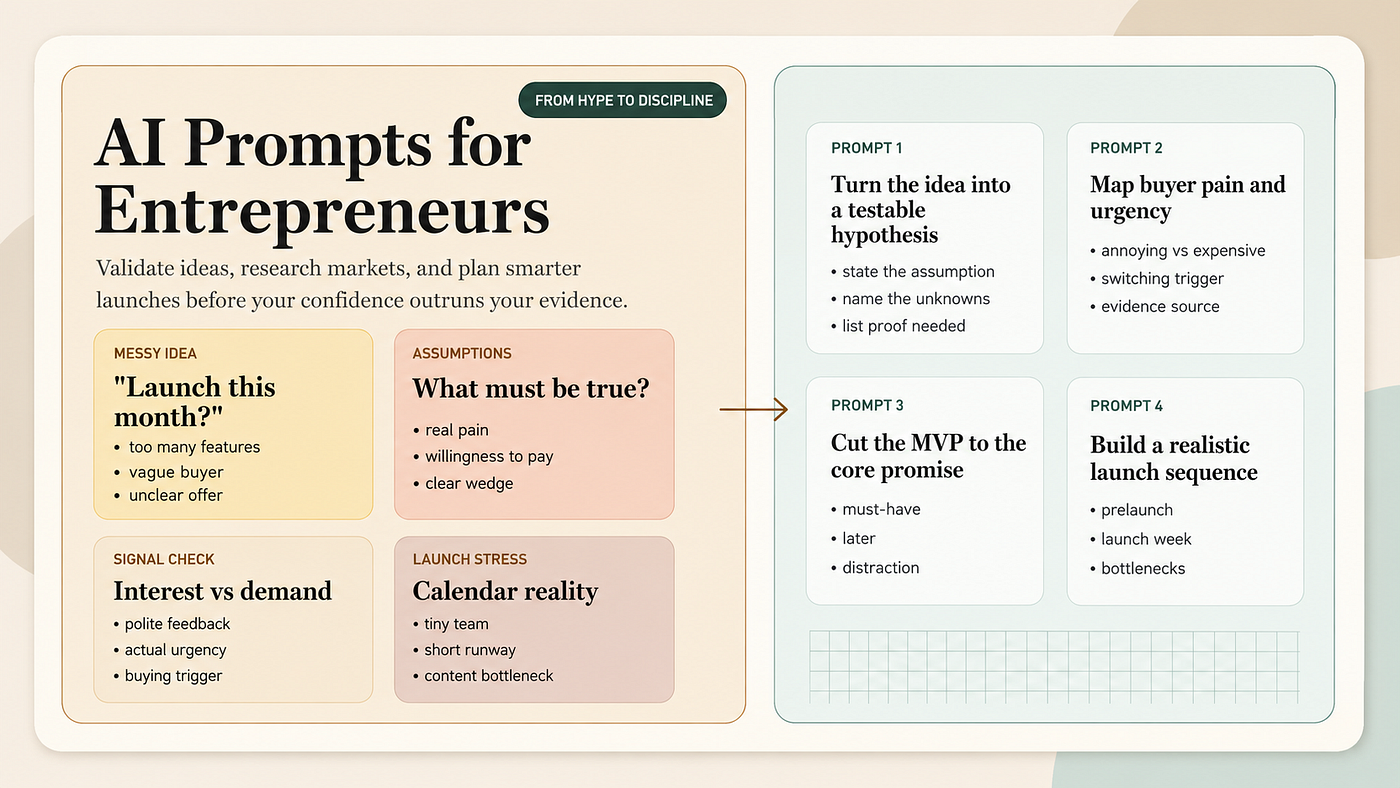
A practical prompt system for founders who want clearer decisions before they spend money, build features, or launch into noise.
Most entrepreneurs use AI the wrong way first.
They use it to make the idea sound better.
They ask for landing-page copy before they know what the market actually cares about.
They ask for launch plans before they have pressure-tested the offer.
They ask for a tagline when the bigger problem is that the business is still blurry.
That is backward.
The best use of AI is not hype.
It is friction.
It should make your assumptions easier to inspect before you burn a month building the wrong thing or launch into a market you barely understand.
That is where AI prompts for entrepreneurs become genuinely useful.
Not as magic.
Not as validation theater.
As a way to think more clearly, sequence decisions better, and stop treating confidence like evidence.
Here is how to use AI prompts for entrepreneurs in a way that actually helps.
What makes an entrepreneur prompt useful
Most prompt lists are too shallow to matter.
They give you instructions like:
“Validate my startup idea.”
That is not a serious prompt. That is a lazy handoff.
A useful entrepreneur prompt does four things:
- It gives the model context about the idea, customer, and constraint.
- It assigns a real business job: test the demand, inspect the positioning, compare alternatives, or sequence a launch.
- It asks for a structure that makes the output easier to evaluate.
- It leaves space for founder judgment instead of pretending the model can decide the business for you.
The point is not to get the prettiest answer.
The point is to make your thinking easier to challenge.
That is a much better use of AI than asking it to cheerlead your draft idea.
1. Turn a vague idea into a testable hypothesis
Many founders start with a sentence that sounds promising but means almost nothing.
“An AI tool for independent fitness coaches.”
“A platform for local service businesses.”
“A community product for creators.”
These are not yet businesses.
They are containers.
Before you brainstorm features, ask AI to help you sharpen the hypothesis.
Help me pressure-test this business idea.Idea:
- I want to build a lightweight AI assistant for independent fitness coaches.My current assumptions:
- coaches struggle to keep up with check-ins
- they want faster content creation
- they would pay for workflow help if it saved time weeklyI want you to:
- rewrite the idea as 3 clear business hypotheses
- identify what must be true for each hypothesis to hold
- list the biggest unknowns
- suggest 5 questions I should answer before building anythingDo not flatter the idea.
Point out what is vague, risky, or unproven.This works because it forces the model to break your idea into assumptions instead of polishing it into startup wallpaper.
That is useful.
A founder with clearer assumptions is already in a better place than a founder with a prettier pitch deck.
2. Use prompts to map buyer pain before you build features
A lot of entrepreneurs confuse possible interest with real pain.
Someone saying, “That sounds cool” is not the same as someone saying, “I would switch, pay, or act.”
This is where prompts can help you think like a buyer instead of a builder.
Act like a skeptical market researcher.Business idea:
- a simple planning tool for solo consultants who run multiple client projectsTarget audience:
- solo consultants with 3 to 10 active clientsHelp me map likely buyer pain by doing this:
- list the top 7 problems this audience already feels
- separate annoying problems from expensive problems
- explain which problems are urgent enough to trigger buying behavior
- identify which assumptions I should validate with interviews or observationDo not invent statistics.
If multiple interpretations are possible, show them.That prompt is useful because it pushes you away from feature fantasy and toward buying conditions.
Entrepreneurs often build for the thing that is visible.
Customers pay for the thing that hurts.
Those are not always the same thing.
3. Use prompts to research the market without pretending a competitor list is strategy
Most “market research” done by early founders is a shallow competitor scrape.
They collect logos.
They skim pricing pages.
They conclude the market is either too crowded or full of opportunity.
Neither conclusion means much on its own.
A better prompt helps you compare patterns, positioning angles, and possible whitespace.
Help me analyze the market around this offer.Offer:
- fractional retention strategy for subscription ecommerce brandsI want a structured market scan that includes:
- the main categories of competitors or alternatives
- how those competitors appear to position themselves
- what customer outcomes they emphasize
- common promises or clichés in the category
- possible angles that feel underused or more specificEnd with:
- 3 positioning directions worth exploring
- 3 reasons each direction could failAvoid generic advice like "differentiate with better service."This is helpful because it turns research into decisions.
You do not just want to know who exists.
You want to know how the category talks, what buyers probably expect, and where a sharper angle might live.
That is far more useful than a spreadsheet full of competitor names with no conclusion attached.
4. Use prompts to scope the MVP or first offer before it becomes bloated
Founders love extra features because extra features feel like progress.
They are usually delay wearing a product costume.
If you are building software, an MVP prompt can help you separate core value from speculative extras.
If you are selling a service, the same logic helps you define the first offer more cleanly.
Help me scope a first version of this product.Product idea:
- a client onboarding assistant for freelance designersMy target user:
- solo designers handling multiple projects without an operations teamPotential features:
- intake forms
- client briefing summaries
- onboarding checklists
- automated reminder emails
- proposal templates
- project timeline dashboardI want you to:
- group these into must-have, useful later, and likely distraction
- explain the user outcome each must-have feature supports
- identify what a credible first version could include in 2 to 4 weeks
- flag anything that adds complexity without strengthening the core promiseThis is one of the most valuable prompt types for entrepreneurs because it fights bloat.
You do not need AI to tell you that more features are possible.
You need help deciding which ones actually belong in version one.
5. Use prompts to shape launch plans around constraints, not fantasy
Launch plans usually look smart until they meet a real calendar.
A founder with one part-time designer, a tiny list, and limited attention should not be running the same launch playbook as a funded team with a content machine behind it.
That is why a useful launch prompt must include constraints.
Help me build a realistic launch plan.Offer:
- a paid cohort workshop for first-time newsletter creatorsConstraints:
- audience size: 1,800 email subscribers
- team: just me plus one freelance designer
- launch window: 3 weeks
- available channels: email, LinkedIn, and short-form video
- goal: fill 25 seats without burning outCreate a launch plan with:
- prelaunch, launch week, and post-launch phases
- the purpose of each phase
- key assets needed
- a simple content sequence
- the most likely bottlenecks or failure pointsKeep it lean.
Do not assume a giant team or paid ad budget.This prompt works because it forces reality into the plan.
A launch is not just messaging.
It is sequencing, capacity, asset production, and tradeoffs.
That is where many founders get sloppy.
AI can help make the plan clearer, but only if you tell it what world you are operating in.
6. Use prompts to pressure-test the launch message before you publish it everywhere
Many entrepreneurs write launch copy too early and too broadly.
They try to sound impressive to everyone instead of relevant to the few people most likely to care.
One of the smartest uses of AI is to stress-test the message before it gets sprayed across channels.
Help me pressure-test this launch message for clarity.Offer:
- a toolkit that helps solo founders validate product ideas before buildingCurrent message:
- "Use AI to launch faster and build smarter."I want you to:
- explain why this message is too vague or generic
- rewrite it for 3 specific buyer angles
- highlight which version is clearest, not just most exciting
- list 5 questions a skeptical buyer would still have after reading itFavor clarity over cleverness.This prompt is useful because weak messaging often survives simply because nobody slows down long enough to challenge it.
Founders fall in love with their own language fast.
A good prompt helps create distance.
Where AI should not replace your judgment
This part matters.
AI can help you frame the questions, sort the ideas, compare the angles, and pressure-test the plan.
It cannot do the real-world validation for you.
It cannot interview your market.
It cannot feel the hesitation on a sales call.
It cannot notice the difference between what people say sounds interesting and what they are actually willing to buy.
That is why the best entrepreneur prompts do not end the thinking process.
They improve it.
Use them to get sharper.
Then go back to reality:
- talk to prospects
- look at actual buying behavior
- test the message
- watch where people hesitate
- revise from evidence, not vibes
Final takeaway
The best AI prompts for entrepreneurs are not content shortcuts.
They are decision tools.
They help you turn loose ideas into testable hypotheses, translate markets into clearer patterns, cut bloat from early versions, and build launch plans that match the resources you actually have.
That is far more valuable than using AI to generate one more excited paragraph about a business nobody has really tested yet.
If you want a shortcut, a curated entrepreneur prompt pack can give you reusable starting points for validation, market research, positioning, and launch planning without the usual prompt-list fluff.
That is when prompts become worth keeping.
Not when they are endless.
When they make better decisions easier to repeat.
메타데이터
- post_id
- 20f1a9fca548
- slug
- ai-prompts-for-entrepreneurs-validate-ideas-research-markets-and-plan-smarter-launches-20f1a9fca548
- url
- https://medium.com/@kumawat/ai-prompts-for-entrepreneurs-validate-ideas-research-markets-and-plan-smarter-launches-20f1a9fca548
- canonical_url
- https://medium.com/@kumawat/ai-prompts-for-entrepreneurs-validate-ideas-research-markets-and-plan-smarter-launches-20f1a9fca548
- author_url
- https://medium.com/@kumawat
- status
- ok
- fetched_at
- 2026-06-14 13:58:26