Four AI Stories From This Week
and the Thing Each One Got Frames
Four AI Stories From This Week
and the Thing Each One Got Frames
Chinese models, AI scribes, Anthropic’s drug ambitions, and a “blip” that probably wasn’t one. The interesting question in each case isn’t the one the headline asked.
Four AI stories broke this week that got a lot of coverage. In each case the coverage picked a framing, and in each case I think the framing quietly points you at the wrong variable. Here’s each story, what it actually is, and the part I’d sit with instead.
Chinese LLMs and the attacker-defender asymmetry

[Dark Reading reported]) on two new models out of Chinese firms that now compete with top US frontier and mainstream models, and framed the question as: should defenders be worried?
The framing I’d push back on is “Chinese.” The nationality of the weights is not the interesting variable. What’s interesting is that capable models keep getting cheaper and more widely distributed, and that this asymmetrically benefits attackers.
Here’s the structural reason, and it’s basically a cost-of-error argument. An attacker needs one working exploit chain. A defender needs to be correct across the entire surface, monotonically, forever. Drop a capable model into that setup and you’ve added roughly the same raw capability to both sides, but the two sides have inherently different loss functions. The attacker gets to sample until something lands. The defender eats every false negative. So even a capability boost that’s symmetric in the lab is asymmetric in deployment, because the payoff structures aren’t. The model just has to lower the cost of the marginal attempt, and the attempt count on offense is unbounded in a way it isn’t on defense.
The catch, and the honest version has to include this: it cuts the other way too. Defenders get the same models, and defense has one thing offense mostly doesn’t, which is scale of legitimate telemetry. If you run the network, you have the logs, the baselines, the ground truth about what normal looks like. A model good at triage, correlation, and reducing analyst fatigue is a real defensive multiplier, and that’s a place where the defender’s data advantage compounds. So the gap widens on the exploit-generation axis and narrows on the detection-and-triage axis. Whether the net is “worse for defenders” depends on which axis dominates for your specific threat model, and I don’t think anyone has a tight bound on that yet.
Where “Chinese” does matter is supply chain and trust, not raw capability. Running an open-weight model of uncertain provenance inside your security tooling means you’re trusting a large opaque artifact with privileged access to your environment, and you can’t meaningfully audit it. That’s true of a lot of US models too. The nationality just makes people notice the thing they should already have been noticing.
Australia blinks at AI scribes
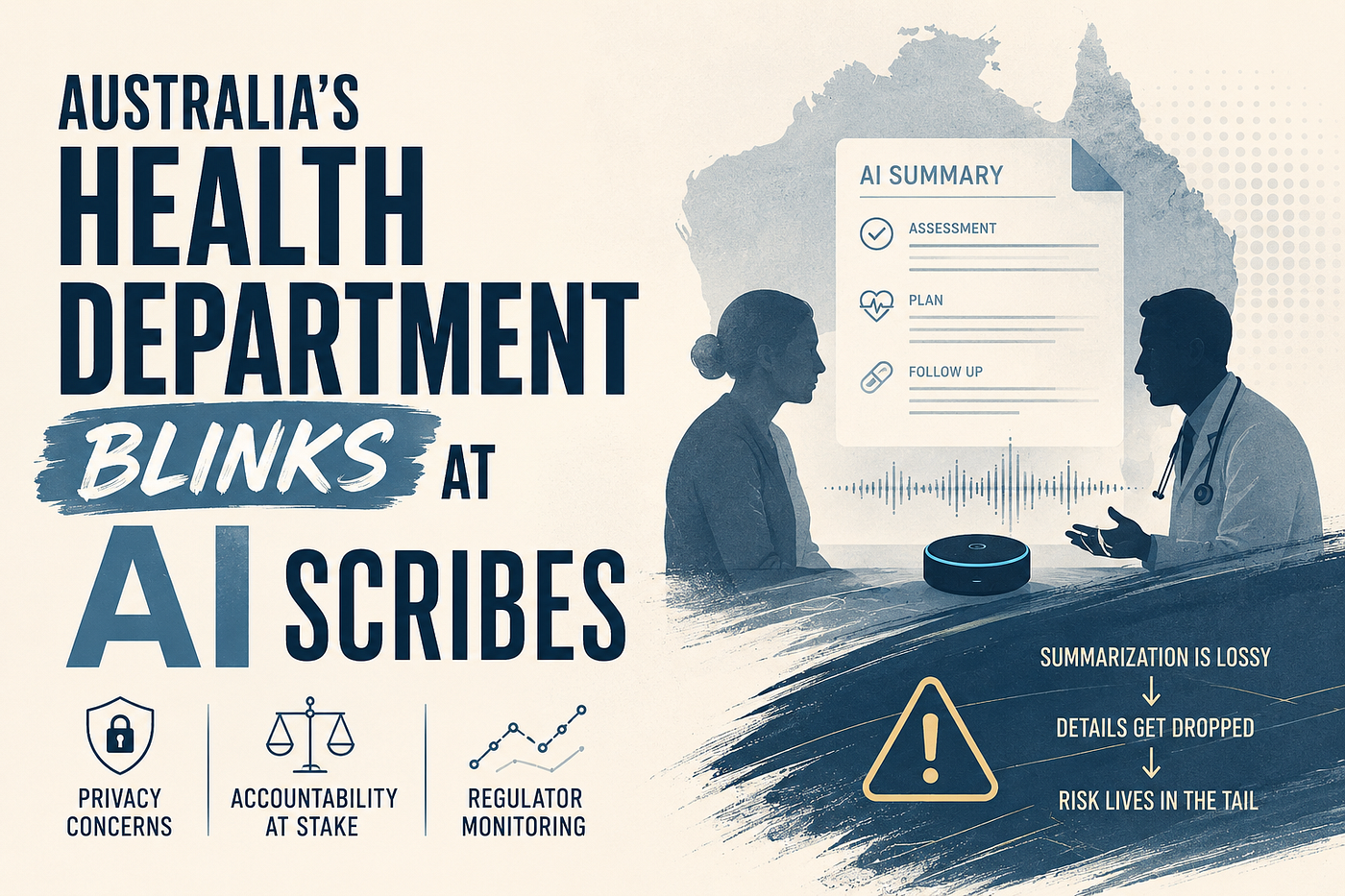
[The Guardian reported] that Australia’s federal health department flagged concerns over AI scribe tools, the ones that sit in the room, record the doctor-patient conversation, transcribe it, and hand back a structured summary. The tech is spreading fast through GP practices, and the regulator is weighing guardrails.
This one I find genuinely hard to feel one clean way about.
The efficiency case is real. Clinical documentation is a massive time sink and a known driver of burnout, and a tool that gives a doctor back attention to spend on the patient in front of them is not nothing.
The privacy story is where it gets uncomfortable, and the discomfort isn’t the obvious “your data goes to a server” one. That’s manageable, mostly, with contracts and regionalized storage. The part that unsettles me is the summarization step, because summarization is lossy and the loss is not uniform. A scribe model deciding what’s salient enough for the note is making a clinical judgment call dressed up as transcription. Which detail gets dropped is a function of the training distribution, and that distribution is fundamentally and inherently biased toward whatever was common in the data. For the median patient with a common presentation, the summary is probably fine. For the atypical case, the one where the important detail seemed off-hand, that’s exactly the tail the model is worst at, and exactly the case where getting it wrong matters most. The failure mode is correlated with severity. That’s the thing.
And there’s a liability question underneath. If the note is wrong because the scribe dropped something, who owns that? The doctor signed it. Did the doctor read the raw transcript or just the summary? At scale, they read the summary, because reading the transcript defeats the point. So you’ve built a system whose value proposition is that the human stops checking the thing the human is legally responsible for. It’s a category error to treat this as a privacy problem when a good chunk of it is an accountability problem. Regulators monitoring rather than mandating this early is, honestly, the reasonable move. I just don’t think they’re looking at the hard question.
Anthropic wants to make drugs

At an event called “The Briefing: AI for Science,” Anthropic announced Claude Science, [as The Verge covered], pitched as an “AI workbench for scientists” that pulls fragmented tools and datasets into one place and generates figures. The headline signal: Anthropic wants a hand in actual drug development, not just being the model under someone else’s pipeline.
My read is that the workbench framing is the honest part, and “develop its own drugs” is the ambition talking.
The workbench is a good bet for a boring reason. A huge fraction of the friction in computational science isn’t the reasoning, it’s the plumbing. Datasets in incompatible formats, tools that don’t talk to each other, the tax you pay just to get everything into one environment where you can ask a question. A model good at glue code and pulling heterogeneous data into a shared frame is solving a real and deeply unglamorous problem. To first order, “reduce the plumbing tax” is defensible and probably underrated.
“Develop its own drugs” is a different animal. The rate limiter in drug development has never been idea generation. It’s the physical world. Wet-lab validation, animal models, the years-long trials that exist precisely because predicting biology from first principles is bad. A model can propose a thousand candidate molecules. The bottleneck is still that you have to go find out, in physical reality, on a timeline no model compresses, whether any of them do the thing without killing anyone. AI moves the top of the funnel. The expensive part is the bottom, and it’s gated by biology and regulation, not compute.
So the useful version is “better tools for the people already doing the work,” which I’m reasonably bullish on. The version where the model is the drug company, I’d file under things to check back on in a decade, with the caveat that being wrong about AI timelines has been a losing bet lately.
The Fable blip is over.

Zvi Mowshowitz’s [Fable #6] lands on one line: “the blip is over.” He means it literally. Here’s the sequence: Amazon researchers showed they could get one of Anthropic’s frontier models to do cyber work by roughly asking it to “fix this code,” the White House reacted, the government put export controls on it June 12, and it came back online July 1. Three weeks, clean start and end. At the access layer, over.
So the line is true. The catch is what “blip” quietly asserts. Calling something a blip is a claim about the baseline: there was a normal, we deviated, we reverted, the mean didn’t move. That’s a much larger claim than “the model is serving traffic again,” because the thing that took it down was never the model. It was the mechanism. Frontier releases now apparently need interagency sign-off, Commerce and the Pentagon among the veto points, negotiated case by case with no standing rules. Anthropic’s restoration letter was addressed to its lead negotiator. Org charts don’t grow a lead negotiator for a blip.
The instance resolved. The generator didn’t. A blip is a fixed instance; a regime change is a persistent process that has produced exactly one visible instance so far, and from inside, at t equals now, the two are indistinguishable. “Blip” is just the word that lets you skip the update.
The honest caveat, which I won’t drop to look sharper: Zvi thinks the safeguards are at peak obnoxiousness and will loosen, and that this commits Anthropic to nothing beyond the risky releases. Maybe. We find out at the second instance, or when it conspicuously fails to arrive.
The recursion: his post is a victory lap, and the victory-lap frame is itself the blip move. So is this sentence.
메타데이터
- post_id
- 20f2c2572286
- slug
- four-ai-stories-from-this-week-20f2c2572286
- url
- https://medium.com/@penquestr/four-ai-stories-from-this-week-20f2c2572286
- canonical_url
- https://medium.com/@penquestr/four-ai-stories-from-this-week-20f2c2572286
- author_url
- https://medium.com/@penquestr
- status
- ok
- fetched_at
- 2026-07-10 14:51:46