What ‘Blue Chips’ Taught Us About Winning at All Costs
Four timeless lessons on pressure, accountability, and the value of your own integrity
What ‘Blue Chips’ Taught Us About Winning at All Costs
Four timeless lessons on pressure, accountability, and the value of your own integrity
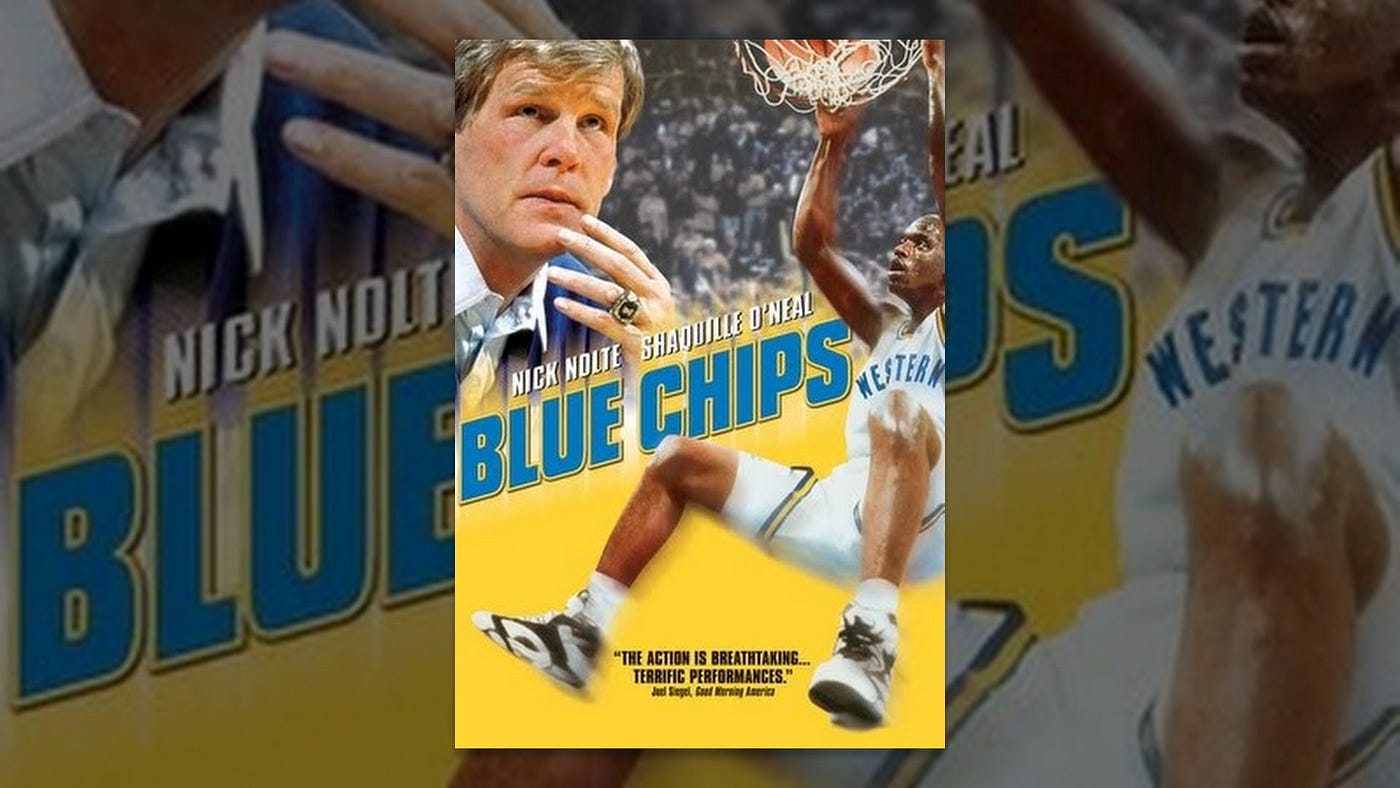
Image courtesy of YouTube
Usually, when it comes to sports films, I always bring up two: Remember the Titans and Glory Road.
Ultimately, I came up with many life lessons in both of those amazing films. But I also found many life lessons from the movie Blue Chips.
Before I get into this film, let’s clear something up: the title has absolutely nothing to do with the Taki Heat Blue chips you can find at your local gas station.
There are true meanings behind the words, and as you may or may not know, there is power in them.
What Does Blue Chips Mean?
In sports, a “blue-chip” athlete is an elite high school prospect who is heavily recruited by colleges and widely regarded as a can’t-miss talent. Landing one of these coveted five-star recruits is considered a major victory for a university, boosting not only its roster but also its prestige, recruiting momentum, and future expectations.
Released in 1994, the film Blue Chips is one of the most raw, honest, and prophetic sports dramas.
About the Movie
Directed by William Friedkin and written by Ron Shelton (who also wrote and directed Bull Durham and White Men Can’t Jump), the film shows an unfiltered look at the dark, transactional underbelly of college basketball.
The movie stars Nick Nolte as Pete Bell, a fiercely passionate, old-school head coach at fictional Western University.
Bell is a fundamentally clean coach who prides himself on running a program by the book.
However, after enduring his first-ever losing season, the intense pressure from wealthy boosters, the athletic department, and his own insanity pushes him to the breaking point.
To return to national prominence, Bell gives in to the dark side of recruiting. He allows a shady booster to illegally pay for top-tier high school prospects — the blue chips.

Image courtesy of YouTube
The NBA Cast of Blue Chips
What made the film so authentic was the casting.
Instead of using actors who could not play, Friedkin cast actual basketball phenoms to play the recruits:
- NBA center Shaquille O’Neal as Neon Boudeaux, a dominant but academically struggling center.
- NBA guard Anfernee “Penny” Hardaway as Butch McRae, a brilliant point guard whose mother is given a new house and a job to secure his commitment.
- NBA forward Matt Nover as Ricky Roe, a country boy whose father demands a brand new tractor and cash
As the team starts winning, Coach Bell is eaten alive by guilt, realizing he has traded his integrity for wins.
The film culminates in an explosive, emotional post-game press conference where Bell exposes his own sin and devious plan in the basketball program.
Ironically, both O’Neal and Hardaway had such incredible chemistry on the set of the movie that O’Neal actively campaigned for the Orlando Magic to trade for Hardaway in the 1993 NBA Draft.
It worked, creating one of the most iconic duos of the 1990s!
But what lessons could we learn from such an emotional movie?
Image courtesy of YouTube
4 Moral Lessons We Can All Learn from Blue Chips
I concluded that beyond the basketball court, Blue Chips serves up several takeaways on ethics, pressure, and obviously human nature.
1. The Slippery Slope of Integrity
Coach Bell did not start his career wanting to cheat. He was driven to it by a desperate fear of irrelevance and failure. The movie perfectly illustrates how compromising your values rarely happens all at once.
It starts with one small concession, which quickly snowballs until you look in the mirror and don’t recognize yourself.
Guarding your personal ethics requires vigilance in the small moments, not just the big ones. Once a boundary is crossed, it becomes a lot easier to justify the next violation.
2. The Compromise of ‘Winning at All Costs’
When a system prioritizes the end result (winning championships, hitting revenue targets) above the human element and the rules, corruption becomes inevitable.
The boosters in the film did not care about the kids or their education. They only cared about their status and the scoreboard. Bell realized that winning under false pretenses feels entirely depressing.
Remember, a victory achieved by compromising who you are is not a win–it’s just a debt you will eventually have to pay back with interest.
3. Systematic Exploitation vs. Real-World Needs
While this movie painted the booster payments as illegal under NCAA rules, it also added another layer of raw empathy. Neon Boudeaux came from nothing.
The film highlights the massive irony of a multi-million-dollar college sports industry built on the backs of athletes who were not legally allowed to see a dime of the wealth they generated.
Systems that resist fair evolution often create haunting black markets. Blue Chips was incredibly prophetic here.
It essentially predicted the modern NIL (Name, Image, and Likeness) era, proving that the pressure to compensate players was a pressure cooker that was bound to blow.
4. True Accountability Requires Pure Honesty
At the end of the film, Bell chooses truth over comfort. He does not wait to get caught by an investigation. He instead blows the whistle on himself. It costs him his job and his prestige, but it wins him back his own soul.
Owning your mistakes completely, without offering excuses or shifting blame, is the only real oath to redemption. It hurts in the short term, but it’s the only way to clear a toxic situation.
Thanks for reading.
메타데이터
- post_id
- 21154f20b80d
- slug
- what-blue-chips-taught-us-about-winning-at-all-costs-21154f20b80d
- url
- https://medium.com/beyond-the-scoreboard/what-blue-chips-taught-us-about-winning-at-all-costs-21154f20b80d
- canonical_url
- https://medium.com/beyond-the-scoreboard/what-blue-chips-taught-us-about-winning-at-all-costs-21154f20b80d
- author_url
- https://medium.com/@thedominator925
- status
- ok
- fetched_at
- 2026-07-14 16:06:22