Dina-Perla Portnaar: If De Telegraaf were a partisan actor on the far right…
…this story would never have been published
Dina-Perla Portnaar: If De Telegraaf were a partisan actor on the far right…
…this story would never have been published
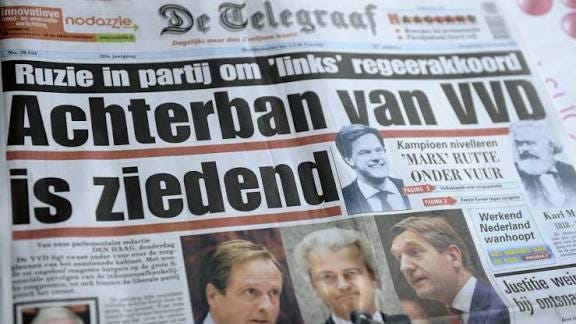
The recent reporting by De Telegraaf, the Dutch Telegraph, on Forum voor Democratie and the construction of networks that reach into the far right has triggered a predictable backlash. Subscriptions were cancelled, outrage was loudly voiced via social media, and familiar accusations resurfaced about bias, betrayal, and ideological drift.
Yet if one steps back from the response and looks at the journalistic act itself, this case reveals something different. It shows a newsroom that still operates within clear professional standards, that understands the difference between access and allegiance, and that is willing to publish uncomfortable findings even when they alienate part of its readership.
In the last years, De Telegraaf has been accused, particularly in the context of its foreign reporting and international commentary, of abandoning journalistic codes. Critics argued that the paper had become driven by right wing opportunism and propaganda rather than verification and discipline. Those claims have circulated widely under the left wing commentators and have hardened into something close to assumed truth in some circles. Now, this recent national case concerning Forum voor Democratie offers a concrete way to test those accusations against reality. When measured against observable practice rather than reputation, the narrative collapses.
The reporting on Forum voor Democratie didn’t emerge from impulse or moral panic. It was the result of sustained journalistic work, grounded in documentation, patterns of association, and verifiable links between individuals, platforms, and networks. That matters.
Journalism isn’t defined by whether its conclusions are liked, but by how those conclusions are reached. In this instance, De Telegraaf followed a method that aligns with core professional norms: investigate, corroborate, contextualize, and publish when the public interest outweighs discomfort. Plus, the outcomes are tangible for anyone who investigates independently. See for instance the networks via TikTok that are open to the public.
What makes this case especially telling is De Telegraaf’s history with Forum voor Democratie. No major Dutch media outlet has given the party more space, airtime, and opportunities to articulate its ideas and to prove that it still belongs within the framework of a civilization. Through interviews, commentary, and its television arm, the paper repeatedly offered Forum voor Democratie a platform long after other outlets refused. That generosity wasn’t naïve. It reflected a belief in exposure, scrutiny, and the possibility of political maturation, which unfortunately didn’t follow. It also reflected confidence in journalism as a process rather than a posture.
There is no political party in modern Dutch history that has been given more chances to refine its internal processes, distance itself from damaging elements, and demonstrate institutional responsibility than Forum voor Democratie. Those chances weren’t merely symbolic. They were real, visible, and sustained. When a party repeatedly fails to use that space to correct course, journalists aren’t obligated to preserve the fiction of neutrality by silence. At that point, critical investigation isn’t a betrayal of balance but an expression of it.
The anger of departing subscribers has to do with media consumption being bound up with identity and trust. When a publication challenges a political movement that readers feel aligned with, it can feel personal. Yet journalism isn’t a customer service operation designed to affirm beliefs. Its obligation runs in the opposite direction. It must interrogate power, trace influence, and surface dynamics that are otherwise obscured, even when that work carries a cost.
If De Telegraaf were merely a partisan actor on the far right, as some critics claim, this story would never have been published. It would have been softened, postponed, reframed, or ignored. Instead, the newsroom chose friction over comfort. That choice isn’t ideological but professional. It signals that editorial codes still function as a real constraint.
This is why this Forum voor Democratie case matters beyond the party itself. It provides a measurable example that contradicts the idea that De Telegraaf has abandoned journalistic standards in favor of tribal alignment. One can disagree with individual articles, tones, or editorial decisions, but it becomes difficult to argue in good faith that the paper no longer operates within recognizable journalistic codes. This reporting stands as evidence to the contrary.
Ultimately, journalism earns credibility by demonstrating it in moments where the incentives point elsewhere. This was such a moment. Obviously, this assessment is my own. Every opinion I publish is fully independent, fully journalistic, not marketing.
메타데이터
- post_id
- 21491b65b310
- slug
- if-de-telegraaf-were-a-partisan-actor-on-the-far-right-this-story-would-never-have-been-published-21491b65b310
- url
- https://medium.com/@Dina-Perla/if-de-telegraaf-were-a-partisan-actor-on-the-far-right-this-story-would-never-have-been-published-21491b65b310
- canonical_url
- https://medium.com/@Dina-Perla/if-de-telegraaf-were-a-partisan-actor-on-the-far-right-this-story-would-never-have-been-published-21491b65b310
- author_url
- https://medium.com/@Dina-Perla
- status
- ok
- fetched_at
- 2026-07-30 12:33:45