Everyone Is Watching How Epstein Died. Nobody is watching what didn’t Die With Him.
A predator and his accomplice were caught. The structure that made them possible was never the kind of thing a court is built to convict.
Everyone Is Watching How Epstein Died. Nobody is watching what didn’t Die With Him.
A predator and his accomplice were caught. The structure that made them possible was never the kind of thing a court is built to convict.
Everyone remembers the cell. The guards who did not make their rounds, the camera that malfunctioned, the morning in August 2019 when the most notorious prisoner in the country was found dead and his trial ended before it began. The argument that followed has never really stopped. Did he kill himself, or was he killed.
It is the wrong question, or at least the smaller one. The city medical examiner ruled the death a suicide, and the Justice Department’s own inspector general later documented the failures in the jail and called them negligence, not foul play. But settle that question whichever way you like, and you have still explained nothing that matters. Jeffrey Epstein’s death decided almost nothing. His fall decided almost nothing. Because when he fell, the thing that made him possible did not fall with him.
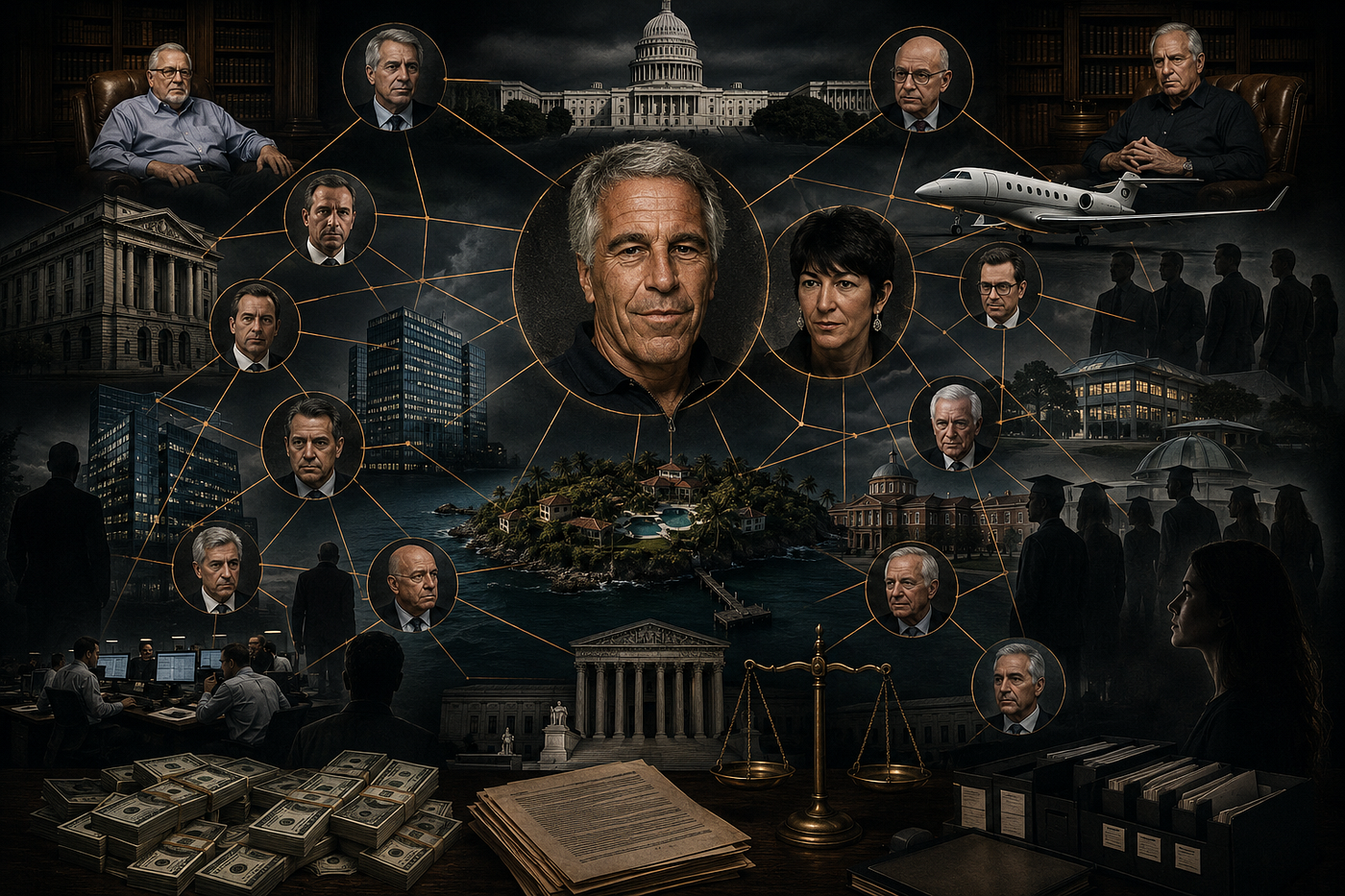
The banks that had held his accounts kept operating. The universities that had taken his money kept their endowments. The advisers, the foundations, the men who flew on his planes and posed in his photographs, almost all of them stayed exactly where they were. One associate, Ghislaine Maxwell, was convicted and is serving twenty years. Beyond her, the structure that had surrounded him for thirty years absorbed the shock and closed over the gap.
That closing is the story. Not the man. The closing.
This article is an adapted edition of a larger investigation. The complete version, including the evidence map, source notes, and full forensic analysis, is available free at The Manifest Archive.
The variable that was never the man
It is tempting to explain the survival of that world the way scandal always gets explained, by reaching for a hidden hand. A client list. A blackmail operation. A coordinated agreement among powerful people to protect one another. The appeal of that explanation is that it gives the outrage somewhere to go. If there is a ring, the ring can be exposed. If there is a list, the list can be subpoenaed.
But the documented record does not require any of that, and the reach for a secret ring usually weakens the case rather than strengthening it, because it rests on the one thing no one can produce. There is a simpler mechanism, and it is more durable than any conspiracy, because it needs no one to run it.
The determining variable was never the man and never a secret meeting. It was a structural fact about everyone who came near him. Proximity to Epstein had been converted into shared liability. Each institution that took his money, each bank that kept his accounts, each university that accepted his gifts and then hid them, had quietly acquired a stake in his not being examined too closely. To expose him fully was to expose what they had known, taken, or ignored. So the safest course for each of them, acting alone, in pure self-interest, was to look away.
No one had to organize that. It is what a network of separately self-interested institutions does when a single node becomes radioactive. The silence was not a plot. It was an equilibrium.
What he actually sold
Start with the question the official record never closes. Where did the money come from.
Epstein began as a teacher, joined Bear Stearns in 1976, left in 1981, and set up his own advisory firm. From there the public account thins to almost nothing. He marketed himself as a discreet money manager for a handful of billionaires. In 1991 the retail magnate Leslie Wexner granted him full power of attorney, a legal instrument that let Epstein sign checks, buy and sell property, and borrow money in Wexner’s name. Two decades later the financier Leon Black paid him a sum that an internal review put at one hundred and fifty-eight million dollars between 2012 and 2017, for tax and estate planning. A later Senate inquiry put the figure closer to one hundred and seventy million.
What is missing from that account is the rest of it. There is no public, audited explanation of how a man with a few clients assembled the fortune he displayed. That gap is not a place to insert a theory. It is itself the finding, because it tells you what the product actually was.
The product was not investment advice. The product was access. Epstein sold proximity to the people he already knew to the people who wanted to know them, and he sold the discretion that made the proximity safe. A man who can put you in a room with a head of state and ask nothing in writing is not selling a financial service. He is selling a position in a network, and a network is the one asset that does not appear on any balance sheet and cannot be audited after the fact.
Money is the least powerful form of wealth. Access is the real currency. Epstein understood that earlier and more completely than the institutions that dealt with him.
The oldest leverage
There is an older name for what bound the network to him, and it is not financial. His deepest leverage was appetite. He arranged for powerful people to be given what they wanted and were not supposed to want, and what some of them were given was access to the abuse of the very girls the law existed to protect, which is the part no analysis should soften.
Appetite binds harder than blackmail. A threat can be reported, resisted, refused. Appetite requires nothing. A man who has been given what he should be ashamed of has not been threatened. He has been implicated, and he implicates himself further with every return. The structure never had to hold a file over anyone. It only had to have served them once. Money buys silence by paying for it. Appetite buys silence for free, because the person who would have to speak is the person most exposed by speaking.
The banks that kept the client
The clearest proof that proximity becomes liability sits in the records of two banks.
JPMorgan Chase kept Epstein as a client for years, including years after his 2008 conviction. In 2023 the bank settled with his victims for two hundred and ninety million dollars, and with the United States Virgin Islands for seventy-five million more. Deutsche Bank, which took him on after JPMorgan dropped him, settled with victims for seventy-five million dollars in 2023, after already paying a hundred and fifty million dollar penalty to New York’s financial regulator in 2020.
Every one of those settlements was made without an admission of liability. That phrase is not a footnote. It is the mechanism in legal form. A settlement converts a question about what an institution knew into a number it agrees to pay. The bank does not say what it saw. It says what it will pay to stop the matter being adjudicated. The victims are compensated, which is real and not nothing, and the record of institutional knowledge is sealed in the same motion, which is the point.
The institutions endured, but the mechanism did claim individuals, and the way it claimed them is instructive. Jes Staley, the senior JPMorgan executive who had personally managed the Epstein relationship and later ran Barclays, was barred from holding senior roles in British finance after regulators found he had misrepresented how close that relationship had been. In his own emails he had described Epstein as one of his deepest and most cherished friends. The letter his bank sent the regulator said the relationship had not been close. A tribunal upheld the ban in 2025. The detail that matters is the asymmetry. The man was finished. The bank was fined and went on. An organization that can give up a person to keep itself whole is not failing to protect its own. It is protecting the only thing it was ever built to protect, which is itself.
The universities that hid the donor
The same pattern runs through the institutions supposed to be furthest from that world. In 2020 the Massachusetts Institute of Technology published its own report into Epstein’s donations. Between 2002 and 2017, after his conviction, he gave the university eight hundred and fifty thousand dollars, and the report documented something more telling than the sum. The gifts were deliberately concealed, logged as anonymous, recorded by initials, described in internal email as coming from a “VIP guest.” The director of the famous Media Lab resigned in 2019 once the depth of his ties became public.
Harvard’s own review found that the university had taken roughly nine million dollars from Epstein before his conviction, including a six and a half million dollar gift in 2003, and that while it took no money afterward, his access to the campus continued until 2018.
Notice what the concealment was not. It was not a single decision made in a single room. It was a series of separate small choices by separate people, each protecting the same thing, the institution’s reputation, each preferring not to ask the question that would make the money unspendable. The phrase “VIP guest” is the architecture caught in three words. No one needed to be told to write it that way. Everyone already knew what it was for.
A conspiracy has members, and members can be flipped. An equilibrium has only incentives, and incentives cannot be subpoenaed.
The legitimacy that vouched for itself
Epstein’s deepest entry into respectable power ran through a different channel, and it worked by the opposite logic from the banks. The banks concealed money. Science philanthropy displayed it. He funded laboratories and conferences, attached himself to physicists and biologists, and converted cash into something money cannot ordinarily buy, the appearance of being a serious person in serious rooms.
What turned this into a fortress was the way the associations compounded. A single tie can be a mistake. A web of ties becomes a credential. The scientists made the financiers comfortable, because a man who funds physics and dines with laureates cannot be merely a criminal. The financiers made the politicians comfortable. Every prestigious association became collateral for the one beside it, so that the question any single person might have asked, what is this man, was answered in advance by the company he kept. He did not have to persuade anyone he was legitimate. He only had to be seen beside enough legitimate people that doubt began to feel like an insult to all of them at once.
And the longer it ran, the harder it was to stop. An institution that had taken his money once could have returned it and walked away clean. Few did, because the cost of leaving rose the longer it stayed. Every concealed donation, every email that named him a guest rather than a donor, raised the price of disclosure, because disclosure now meant admitting the concealment too. The first silence is cheap. Each silence after it is paid for with the previous one.
The ones who were not told
The first time the structure could have been opened was 2008, and the way it closed is the template for everything after.
Florida prosecutors had built a case that could have put Epstein in federal prison. Instead he pleaded guilty to two state charges, one involving a minor, and served about thirteen months in a county jail with work release that let him leave during the day. A separate federal non-prosecution agreement, negotiated by the United States Attorney Alexander Acosta, ended the federal investigation and extended immunity even to unnamed co-conspirators. The victims were not told. The Justice Department’s professional-responsibility office later found Acosta had shown poor judgment but cleared him of misconduct.
The deal had a second set of authors who were never consulted, the girls whose accounts had built the case. Under the law the prosecutors were required to confer with them. They did not. One of them, Courtney Wild, who had been a teenager when it began, found out that the federal investigation into the man who abused her had been quietly closed, and found out largely on her own. For eleven years she and other victims fought in court to have the agreement thrown out. In 2019 a judge ruled their rights had been violated. By then Epstein had served his months, walked back into his houses, and resumed the life the deal had preserved.
That is the human edge of a mechanism the rest of this runs in the cool vocabulary of incentives. The cost was not abstract. It was a particular man’s years of freedom, bought with particular girls’ silence. A settlement can compensate a victim. It cannot give back the years in which a system quietly decided she was the cheaper party to disappoint.
How a scandal survives attention
By 2019 the outrage was total and the coverage was everywhere, and within a year the documentaries had been made and the season of attention had passed. This is usually described as the public losing interest. It is more accurate to say the system had a method for surviving attention, and the method worked.
Power of this kind does not fear exposure. It has learned to metabolize it. A scandal arrives, and the response is not denial but absorption. A settlement here, a resignation there, an internal report commissioned and published, one figure held up as the guilty party and convicted. Each of those acts looks like accountability, and each of them, in operation, is a way of ending the inquiry. The report closes the question by appearing to answer it. The settlement closes it by paying. The single conviction closes it by giving the story a villain, so that everyone else can be, by contrast, a bystander.
Ghislaine Maxwell’s twenty-year sentence is real punishment for real crimes, and it is also the clearest example of the mechanism. The conversation needed one person to carry the weight of a structure, and one person did. You can put a person in prison. You cannot put a network of incentives in prison, because it never broke a single law that any one member can be charged with breaking.
The settlement that admits nothing
The strongest objection to all of this is that there is no mechanism here at all, only an ordinary crime that was, in the end, ordinarily punished. A predator and his accomplice were caught. The accomplice is serving twenty years. Banks paid hundreds of millions. Victims received real compensation. By this reading the system worked, slowly and imperfectly, the way justice usually does.
That objection deserves full strength, because most of its facts are correct. Accountability did arrive. But look at exactly where it stopped. It reached the two people who could be charged and the institutions that could be made to pay, and it stopped at the precise line where it would have had to establish what the powerful knew. Every bank settlement was made without admission. The source of the fortune was never explained. The accountability was real and it was bounded, and the boundary was not random. It fell exactly where exposure of the individual would have become exposure of the structure.
And the instrument that drew that line is not even special to Epstein. In 2011 a federal judge in Manhattan, Jed Rakoff, refused to approve a settlement in which Citigroup would pay two hundred and eighty-five million dollars over allegations it had bet against its own customers, and would neither admit nor deny having done so. Rakoff called the deal neither fair, nor reasonable, nor adequate, nor in the public interest, because it asked the public to accept a punishment while being told nothing about the crime. A higher court overruled him. The same judge, twelve years later, approved JPMorgan’s two hundred and ninety million dollar settlement with Epstein’s victims. The continuity is not a coincidence. It is the architecture. Epstein’s enablers did not invent a private form of immunity. They used the public one, the same instrument that lets a bank pay for a financial crisis without ever stating what it did.
No participant was a victim
One narrative deserves a direct answer, because it surfaces every time a powerful name does. In it, the powerful person is the one who was trapped. Ensnared. Compromised. Caught in a honeytrap. It casts the participant as a kind of victim, and it is the most elegant move the immunity machine has, because it relabels complicity as misfortune.
It does not survive contact with the mechanism. Epstein did not create the desires he served. He found them, already there, in people whose power had taught them they were owed things. A structure that gives a powerful man what he wants is not entrapping him. It is serving him, and a willing participant is not a victim of the service he sought. When the documents were unsealed in 2024 and prominent names appeared, presidents among them, the courts and the press were right to repeat that being named is not an accusation, that a name is not a crime. Hold that, and hold its twin. Naming is not guilt, and participation is not victimhood. The only victims in this story are the ones the law already recognizes, the girls. To extend the word upward, to anyone who was given what those girls were forced to provide, is laundering in the vocabulary of harm.
The island and the throne
Epstein owned a private island, and it became the symbol of the whole affair, the place where the powerful went to be beyond reach. But the island was only the literal version of something the whole structure provided. Distance. The powerful live close enough to events to shape them and far enough away to escape their consequences, and every instrument of modern privilege, the offshore company, the encrypted device, the non-disclosure agreement, exists to widen that distance.
The man was the scandal, and the scandal was never the man. He was the visible node, the one the structure could afford to lose, and losing him allowed everything he had connected to present itself as having merely been in the wrong room at the wrong time. What he sold was access, and access is exactly the asset that implicates everyone who buys it and protects everyone once bought, because to expose the seller is to expose the transaction, and no buyer wants the receipt read aloud.
It would be easier if there were a list. A list could be entered into evidence. A structure cannot be, because it is not a thing anyone signed. It is the sum of a thousand separate decisions to look away, each one defensible on its own, each one made by someone protecting nothing more sinister than their own institution’s good name, and adding up, without a meeting or a plan, to the most effective protection money cannot openly buy. The worst outcome here did not require a single villain beyond the two who were caught. It required only that a great many ordinary institutions each do the narrowly sensible thing.
The island itself was sold, cleanly, its title clear, the new owner untroubled by what had happened on it. Courtney Wild is in her thirties now. She gave eleven years to making a court say the 2008 deal had wronged her, and by the time it did, the man was dead, the houses were sold, and the network had quietly reassembled. The vindication arrived into a world that had already moved the furniture. The throne was not for sale, because no one ever owned it. They only sat in it, one after another, and stood up when the room got bright, and sat back down when it dimmed.
Read the complete investigation, with the full forensic analysis and the evidence map, free at The Manifest Archive.
메타데이터
- post_id
- 2149bd2a8278
- slug
- everyone-is-watching-how-epstein-died-nobody-is-watching-what-didnt-die-with-him-2149bd2a8278
- url
- https://medium.com/the-geopolitical-economist/everyone-is-watching-how-epstein-died-nobody-is-watching-what-didnt-die-with-him-2149bd2a8278
- canonical_url
- https://medium.com/the-geopolitical-economist/everyone-is-watching-how-epstein-died-nobody-is-watching-what-didnt-die-with-him-2149bd2a8278
- author_url
- https://medium.com/@jerry71
- status
- ok
- fetched_at
- 2026-07-08 07:00:21