India’s Other Open Defecation
Tracing an unsettling connection between garbage, civic indifference & the rise of intimate violence as expression of morbid modernity.
India’s Other Open Defecation : Our disturbing modernity
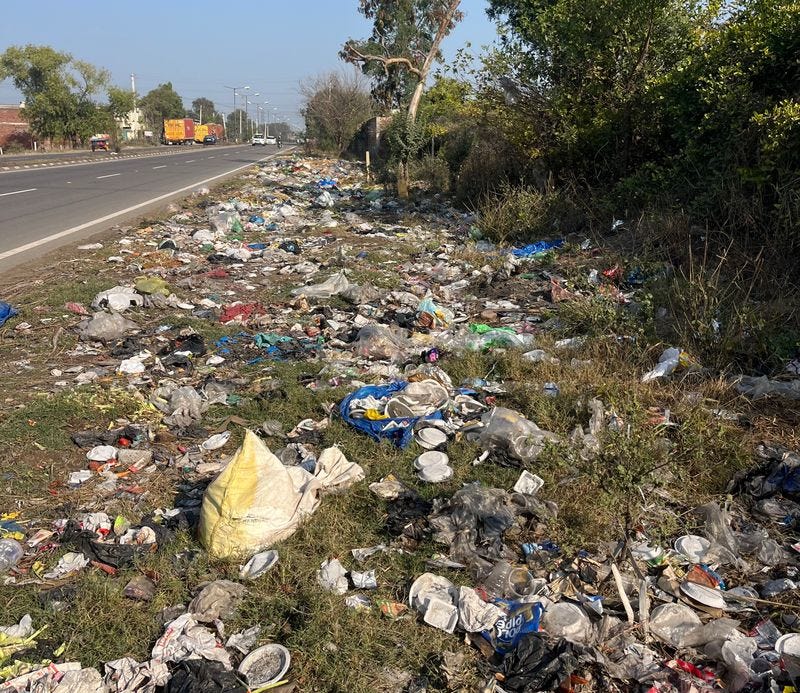
A drive on Indian highways has become unexpectedly stressful for me. Not because of traffic. I’ve made peace with motorcycles materialising from nowhere, buses overtaking from impossible angles and SUVs convinced that lane markings are merely decorative art.
As long as my eyes remain level with the horizon, the landscape is beautiful. Coconut groves, paddy fields, rocky outcrops, where hills dissolve into evening haze and monsoon clouds gathering with theatrical flourish. Such views are afforded even from our train travels. For a few moments one can almost believe all those tourism advertisements about Incredible India.
The stress and despair comes from another quarter.
I try hard not to drop my gaze but one has to navigating clogged roads or looking out of train windows. Then I see Haldiram, Kit Kat, Lays, Vimal, Bisleri, Pepsi. Snack covers, shampoo sachets, plastic cups, Gutkha pouches flanking along the railway tracks or our tolled roads . A civilisation announcing itself not through temples, skyscrapers or technology but through its excreta…not organic excreta, but inorganic!
It suddenly occurred to me that we have misunderstood garbage all along. Garbage is simply what comes out of industrial civilisation after consumption, much as faeces come out of the human body after digestion. We consume. We excrete. Only the materials differ.
Food enters the body and eventually leaves it. Houses consume cement, steel and sand before one day becoming debris. Smartphones become e-waste. Clothes become rags. Every object we proudly buy is merely waiting for its appointment with the dustbin. Or, as is more common in India, with the nearest roadside.
What fascinates me is not that we produce waste. Every civilisation does. What fascinates me is where we choose to relieve ourselves of it.
The Republic’s Other Open Defecation
Human societies have invested extraordinary effort in disciplining one kind of excretion. We teach children from infancy that bodily functions belong behind closed doors. Notions of privacy, shame, hygiene, decorum are nurtured and acuired. An entire civilisation rests upon ensuring that nobody decides to squat in the middle of a railway platform because nature called.
Yet, strangely, we have evolved almost no equivalent discipline for our inorganic excretion.
The chips are over. The wrapper has served its purpose. Why carry it for another kilometre? Flick. Out it goes through the bus window. Often right there under your seat. In flights guess many rue closed windows. Hence trash it right under your feet where you sit. Like placid pigs feeling at home in a dump!

Finished the water bottle? Drop it near the park bench. Construction debris? Dump it on the vacant plot. Or in the lake or stream near by.
Our public spaces have quietly become India’s other open-air toilets.
Sigmund Freud believed civilisation depended upon delaying and disciplining instinct. The child wants immediate release but adulthood consists largely in learning to postpone it. There is something faintly Freudian about littering. The wrapper becomes an irritant the moment its contents have been consumed. Keeping it is inconvenient. Discarding it produces immediate psychological relief. The road, the platform, the park receives what the hand no longer wishes to hold.
Except that unlike organic excretion, this one carries almost no social embarrassment. We may hesitate to spit inside our drawing room, but feel remarkably little hesitation in turning the street outside into an extension of our household dustbin. Cleanliness remains intensely private. Dirt, conveniently, is public.

When We Stop Seeing
This tragedy is not merely ecological. It is sociological.
Georg Simmel wrote that modern urban life produces a blase attitude, a protective indifference born of relentless sensory overload. Perhaps that explains why we no longer really see litter. The first wrapper offends. The hundredth disappears into the visual wallpaper. Eventually, one drives through landscapes where the ugliness has become so ordinary that noticing it begins to feel eccentric. And you too end up doing the same all normalised.
Henri Lefebvre would have recognised another loss. Space is never merely physical. It is socially produced. Streets, parks, lakes and pavements are not empty containers. They invite certain ways of living and discourage others. A well-kept public square encourages lingering, strolling, conversation, belonging. A littered one asks only to be crossed as quickly as possible.
The damage, then, is not simply to forests or beaches that unfortunate tourists photograph before proceeding to decorate them with disposable cutlery. It is equally to our towns and neighbourhoods. Every plastic wrapper quietly informs us that this place belongs to nobody in particular. In many ways garbage and filth reduces social intercourse and reproduces the many inequalities that mar our public sphere and our democracy.
Municipal inefficiency certainly deserves blame. But cleaner societies are not cleaner because their municipalities possess magical powers. Japan did not become tidy by appointing superhuman sanitation workers. Much of Europe remains clean because citizens experience the public realm as morally continuous with the private one. We, on the other hand, often perform an extraordinary feat of ethical compartmentalisation. The house gleams. The street is gangerened by garbage.
Whose Garbage Is It Anyway?
Wait. Before we congratulate ourselves for diagnosing litter as a civic failure, let us ask whose litter it actually is. For someone may rightly also link filth, garbage to poverty. Surely open drains, overflowing bins and squalid settlements have everything to do with poverty.
So, yes…Poverty has historically meant that millions had few dignified ways of dealing with their organic waste. Open defecation was less a cultural preference than an infrastructural failure. A toilet cannot be used if one does not have one. Or one available without water. Sanitation requires water, sewage, drainage and public investment before it becomes an individual virtue.

But the story changes dramatically once we move from organic to inorganic waste. Take a walk through any garbage dump on the edge of an Indian city. Look carefully. Whose lives are scattered there? The poor did not consume most of those branded wrappers, PET bottles, courier boxes, instant noodle cups, cosmetics, electronics or disposable cutlery. The garbage mountain is, in large measure, the archaeological record of middle-class aspiration which the poor inherit.
In one of the ironies of Indian modernity, those who consume the least often live amidst the greatest accumulation of waste, while those who consume the most outsource not merely the disposal of garbage but increasingly the moral responsibility for it. Entire communities earn their livelihoods sorting, washing and recycling what the rest of us have casually discarded. We call them informal workers. The sociologist Zygmunt Bauman had a name for this in Wasted Lives: he argued that modernity produces waste as the necessary by-product of turning anything into a consumable and that this logic does not stop at literal garbage. It extends to human beings too, rendering entire populations disposable: refugees, the poor, the obsolete.
Moreover the poor do not merely inherit the refuse of the affluent they also inherit their example. If the educated citizen throws a wrapper out of a luxury SUV, spits on a freshly painted wall or leaves a public toilet unusable for the next person, what civic lesson is available to those whose lives are already constrained by inadequate sanitation and overcrowding? The propertied classes produce not only a disproportionate share of inorganic waste but also produce behavioural norms. And those norms are often profoundly uncivic.
That is also why comparing India with Japan or parts of Europe can become intellectually lazy. Their relative cleanliness is not simply the triumph of efficient municipalities, stricter fines or superior technology. Those matter. But they rest upon something more elementary: a widely shared understanding that the street outside one’s home is not morally different from the floor inside it. Public space is treated as an extension of civic selfhood across demographics.
The Other Waste We Are Producing
Oddly enough, I have begun to notice another kind of ‘refuse’ accumulating and then discarded. The connection to garbage here is not metaphorical convenience for it emerges from the same condition, the same underlying mechanism. The dominant political economy of capitalism doesn’t just produce throwaway objects but it also cultivates a disposition.
This is a trained reflex to discard, destroy, kill (object or relation) once its utility is exhausted or its cost exceeds its yield. Litter is what happens when this disposition meets objects. But what happens when this disposition meets relationships and interactions too? For in late capitalism all relationship including kinship itself has been re-coded as an asset class.
Stories of son murdering his parents, a husband hiring assassins to kill his wife, a woman conspiring with her old flame against her husband, brothers dismembering parents, lovers becoming executioners and such ghoulish likes inundate news and social media. Crimes once associated with gangsters or hardened criminals now emerge from our homes dining tables and bedrooms.

Capitalism has retrained and extended the disposable calculus from things to people and relationships. (for as such one can cultivate relationship even with ‘things’) Modern relationships increasingly survive less on inherited obligations than on impulsive emotional negotiation. When relationships are sustained primarily by performance of status, role, image, convenience and carefully managed appearances, then they can become surprisingly brittle. The roles remain intact until the first serious stress. Then the mask cracks. Resentments, manipulations and violence erupt with frightening suddenness.
Just as our streets receive what we no longer wish to carry in our hands, our closest relationships sometimes are dumped for frustrations we no longer know how to contain. Actually the pathology is not just we are killing each other in our bedrooms. It is we are casually un-personing each other at our dining tables. We treat the emotional distress of our partners, the dependence of our elders or the vulnerability of our friends as inconveniences to be swept into the blind spots of our lives, much like the municipal waste piles we drive past!
Our living rooms are becoming spaces where human beings are casually discarded the moment they become financial or emotional inconveniences. The logic is identical: the hand merely dumps what it no longer wishes to hold.
In Freudian terms the urge for immediate, uninhibited release is not an inherent genetic defect. It is a psychological regression actively cultivated by capitalist modernity. Hyper-capitalism requires consumers, not citizens. It explicitly rewards the infantile impulse i.e. buy now, consume fast, discard instantly! An absent state and a fragmented collective conscience ensure there is no social friction, no shame and no penalty for externalizing the mess. We have built an economic apparatus that masterfully weaponizes our lowest instinctual impulses!
The claims I make is an uncomfortable. It is not however I think, a false one.
A further clarification is owed here. Capitalism and modernity are not unique to India. For the same market logic, the same disposable calculus, operates in Japan, Germany, South Korea. Yet littering has not reached Indian proportions there, nor has kinship violence assumed comparably grotesque or frequent forms. The difference cannot lie in capitalism alone. It lies in what stands between the disposition capitalism cultivates and the behaviour that results. So in India the culpability is more with institutions, policy and pedagogy that elsewhere absorb and discipline that disposition. The latter is universal but in India institutional and pedagogic interventions fail. And as a result matters metastasise into garbage-choked streets and blood-soaked inheritances.
Modernity, often wrongly equated with the West alone is not the culprit, as purists like to bemoan. It is our mistaken modernity: modernity pursued without the institutional scaffolding that disciplines it everywhere else. That is what assumes pathological character here.
A civilisation is known not only by what it produces. It is equally known by what it does not and wills not to throw away.
— — — — — — — — — — — — x — — — — — — — — — — — — — — — —
A disclosure before someone performs the now-obligatory AI forensic analysis. This essay was written with AI assistance. The assistance, however, was largely editorial, not intellectual. The observations, conceptual leaps, theoretical associations and argument are mine, developed over reading, placing several dots of ideas and then drafting to join them into a coherent narrative. AI helped improve structure and occasionally rescue my prose from its own excesses. The bots are not responsible for either the strengths or the weaknesses of the thinking presented here.
메타데이터
- post_id
- 2159a9f19c4f
- slug
- indias-other-open-defecation-2159a9f19c4f
- url
- https://medium.com/@samscriticandpracritic/indias-other-open-defecation-2159a9f19c4f
- canonical_url
- https://medium.com/@samscriticandpracritic/indias-other-open-defecation-2159a9f19c4f
- author_url
- https://medium.com/@samscriticandpracritic
- status
- ok
- fetched_at
- 2026-07-23 21:15:02




