The Future of Business Websites in an AI-Driven Internet
A shop owner asked me last month, dead serious, “Will my website even matter if AI is answering everything now?” And for a second, I…
The Future of Business Websites in an AI-Driven Internet
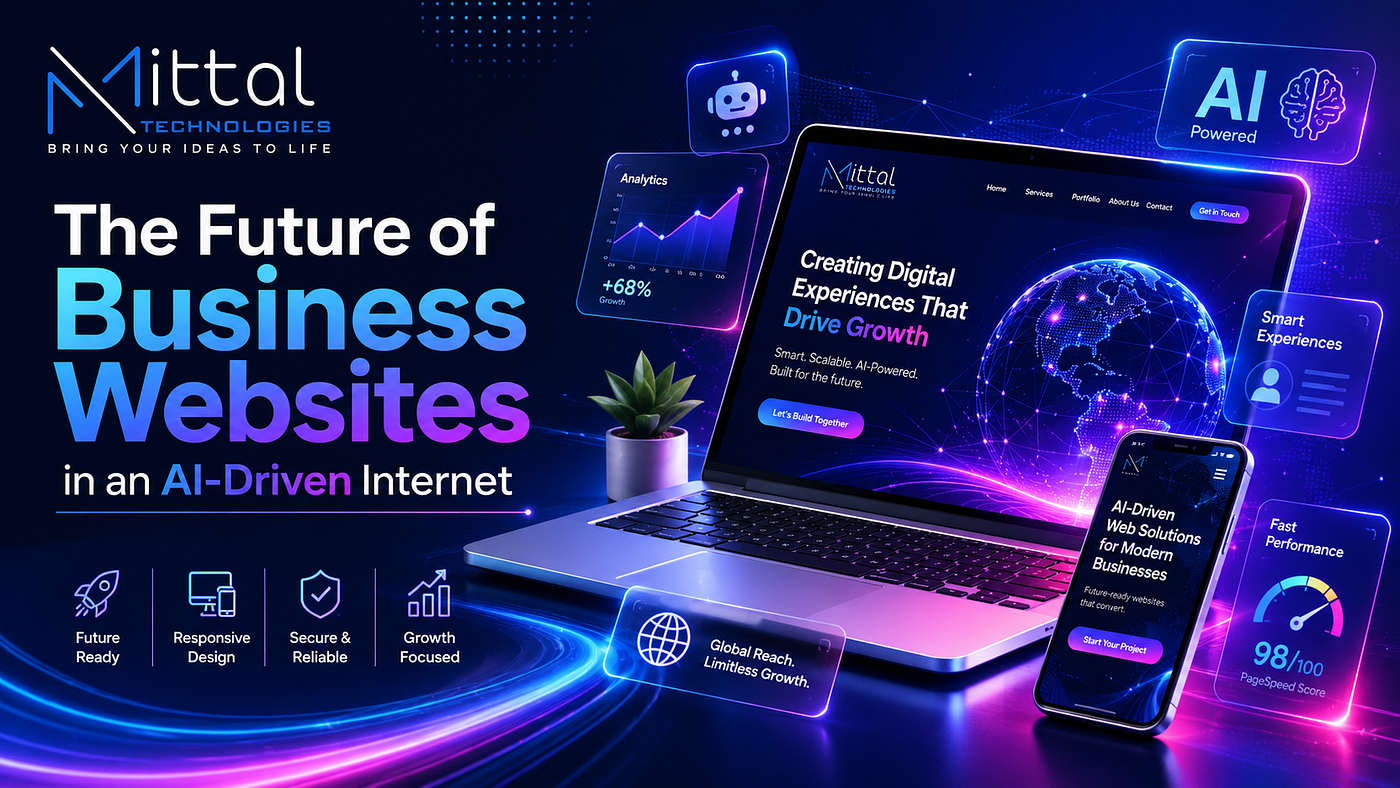
A shop owner asked me last month, dead serious, “Will my website even matter if AI is answering everything now?” And for a second, I genuinely didn’t have a clean answer ready. The future of business websites in an AI-driven internet isn’t really about whether websites will matter, they will, no question, it’s about what kind of website actually survives this shift. Because the internet of 2026 isn’t the internet of 2018, where a decent homepage and a working contact form could carry a business for years without much thought.
Search engines used to be the only gatekeeper standing between a business and its customer. Now there’s AI chatbots, AI-generated search summaries, voice assistants, and a handful of newer ways people find what they need without ever clicking a traditional blue link. If a website wasn’t built with any of that in mind, it’s not exactly broken, it’s just quietly becoming invisible to a growing slice of the audience, and most owners don’t notice until it’s already happened.
Why business websites need AI-ready structure, not just good design
Here’s something I keep running into across clients in completely different industries: a lot of business owners still equate a “good website” with a website that looks nice. Looks do matter, I won’t pretend otherwise, but structure matters more now than it ever used to. AI systems crawling a site need clean markup, clear headings, and content organized in a way a machine can actually parse without guessing.
This is exactly where working with an experienced website designing company in Ludhiana starts making a real difference, because the people building the site need to understand both the visual layer and the technical backbone that lets AI tools read and trust the content sitting on it. A pretty site with a messy underlying structure is a bit like a beautifully wrapped gift box that turns out empty inside, looks promising, and disappoints the moment you open it.
How AI search is reshaping what businesses need from their websites
This part genuinely interests me, and I’ll admit that’s a little nerdy of me to say out loud. AI search tools don’t browse the internet the way a human scrolls and skims. They extract. Facts, direct answers, the actual point, that’s what they’re after. Which means a website now has to answer the visitor’s question clearly and early, not bury the good stuff three paragraphs down after a long-winded introduction nobody asked to read.
Businesses investing in proper web designing services in Ludhiana earlier rather than later are setting themselves up far better for this shift than the ones waiting to “see how it plays out” first. Because by the time it’s obvious AI search dominates discovery, the early adopters will already own that visibility, and playing catch-up at that point is a much harder, slower climb.
The role of UI UX in AI-friendly websites
Something people rarely connect immediately, UI UX design and AI readiness are tied together more closely than most assume. A confusing layout doesn’t just frustrate a human visitor; it confuses the crawler trying to summarize the page too. If navigation is a mess, if content blocks aren’t logically grouped, both the human and the machine reading it get lost in roughly the same way.
Solid UI UX designing in Ludhiana practices, logical flow, clear sectioning, sensible visual hierarchy, genuinely help both fronts at once. It’s not extra effort tacked on top, it’s just smarter effort from the start.
What businesses should actually prioritize when rebuilding for 2026
If I had to give one piece of advice to an owner reading this and quietly panicking a little (don’t, by the way, there’s still time), it would be this, stop treating the website like a brochure and start treating it like infrastructure. It needs to load fast, organize information cleanly, answer real questions, and stay flexible enough to keep adapting as search behavior keeps shifting underneath everyone’s feet.
Partnering with a capable website development company Ludhiana, businesses already trust isn’t about chasing every shiny trend that shows up. It’s about not getting quietly left behind while competitors upgrade their digital presence and start showing up in places the laggards simply don’t anymore.
I’ve watched businesses delay this exact decision for years, telling themselves “It’s fine for now,” only to scramble later once they realize a competitor’s site is getting pulled into AI-generated answers while theirs barely gets crawled properly at all. Not a fun spot to be in, and entirely avoidable if the groundwork gets laid early.
What happens to businesses that wait too long to adapt
I want to talk about this part honestly because I don’t think enough people do. There’s a comfortable middle ground a lot of business owners sit in right now, they’ve heard about AI search, they know it’s “a thing,” but they haven’t felt enough pain yet to actually act on it. That gap, between knowing and acting, is exactly where competitors quietly pull ahead.
I worked with a clinic last year whose website hadn’t been touched structurally in nearly four years. The content was fine, honestly, nothing wrong with it on the surface. But their competitor two streets over had rebuilt their site eighteen months earlier with cleaner architecture and proper schema implementation. Guess whose service pages started showing up in AI-generated local search summaries first. It wasn’t close, and it wasn’t really about better content either, it came down to which site the AI systems could actually parse confidently without guessing.
The frustrating part for the clinic owner wasn’t the cost of fixing it eventually, it was realizing how much quiet, compounding ground they’d lost simply by waiting an extra year longer than they needed to.
Why this isn’t really about chasing every new trend
I’ll add a slight caveat here, because I don’t want this to read like “panic and rebuild everything immediately.” That’s not the right takeaway. A lot of what makes a website AI-ready overlaps almost entirely with what’s always made a website genuinely good: clear writing, fast loading, sensible structure, honest answers to real questions. AI search didn’t invent new principles so much as it raised the cost of ignoring the old ones.
So, the businesses that built solid foundations years ago, even without thinking specifically about AI crawlers at the time, are mostly fine with smaller adjustments. It’s the businesses that cut corners structurally, assuming nobody would notice, that are feeling this shift the hardest right now.
Final thoughts before the FAQs
The internet isn’t simplifying, its layering, traditional search, AI summaries, voice search, social discovery, all running at once now rather than one replacing the other cleanly. Businesses that treat their website as a living asset that evolves, rather than a one-time project finished and forgotten, tend to come out ahead almost every time I’ve watched this play out over the years. The ones that built their site once in 2019 and never touched it since? They’re the ones quietly bleeding visibility right now, and most of them genuinely don’t realize it yet.
FAQs
1. Will AI search completely replace traditional Google search for businesses?
Not entirely, at least not anytime soon. It’s more of a blend right now, traditional results still exist, but AI-generated summaries and direct answers increasingly sit above or alongside them, pulling attention in newer directions.
2. Does my website need a full rebuild to work well with AI search?
Not always. Sometimes it’s restructuring existing content and tightening technical SEO rather than starting from scratch. A full rebuild makes more sense if the current site is genuinely outdated, both visually and technically.
3. How long does it usually take to make a website AI and search ready?
It depends on size and condition, but most meaningful structural and technical improvements can be completed within a few weeks for a typical small or mid-sized business website.
4. Is UI UX design actually connected to SEO and AI visibility?
Yes, more closely than most people assume. Clean navigation and logical content grouping help both human visitors and crawling systems understand and trust a site, which feeds directly into visibility.
5. What’s the biggest mistake businesses make with their websites right now?
Treating it as a finished project instead of an ongoing asset. Sites left untouched for years tend to fall behind quietly, usually without the business noticing until traffic has already dropped noticeably.
메타데이터
- post_id
- 217b69d2936a
- slug
- the-future-of-business-websites-in-an-ai-driven-internet-217b69d2936a
- url
- https://medium.com/@mittaltechnologiespromotion/the-future-of-business-websites-in-an-ai-driven-internet-217b69d2936a
- canonical_url
- https://medium.com/@mittaltechnologiespromotion/the-future-of-business-websites-in-an-ai-driven-internet-217b69d2936a
- author_url
- https://medium.com/@mittaltechnologiespromotion
- status
- ok
- fetched_at
- 2026-06-26 21:52:29