What Makes End-to-End Camera Design Essential?
The camera industry has matured to a point where simply choosing a good sensor is no longer enough. Industry data from 2024 shows that a…
What Makes End-to-End Camera Design Essential?
End to End Camera Engineering
The camera industry has matured to a point where simply choosing a good sensor is no longer enough. Industry data from 2024 shows that a large percentage of camera-based product failures are not caused by faulty components, but by poor integration decisions made early in development. Market studies from embedded vision forums and semiconductor vendors consistently point to the same issue: teams underestimate how tightly connected camera components really are.
A camera is not a single technology. It is an ecosystem of optics, silicon, firmware, thermal behavior, radio performance, and regulatory constraints. When these pieces are designed in isolation, problems surface late, when fixing them is slow and expensive. This is exactly why end-to-end camera design engineering services matter.
To explain this clearly, we will use camera development as a practical example and walk through the key decisions that shape a successful product. What follows is not theory. It is a summary of the real choices engineers must make and the tradeoffs they must manage to deliver reliable camera design engineering solutions.
Why Camera Design Must Be Treated as a System
This is what I mean. Most camera projects start with good ideas and a list of things they want to do. High resolution, night vision, streaming over Wi-Fi, small size, and low power. On its own, each requirement seems fair. Things start to go wrong when those requirements clash.
Higher resolution means faster data rates and more memory. Night vision uses more power and adds thermal load. Wireless streaming adds problems with RF and limits on certification. Small enclosures lower the amount of thermal headroom and the efficiency of the antenna. There are no problems that exist alone. They only show up when the system works together.
End-to-end **camera design engineering **means recognizing these interactions early on and designing with them in mind, rather than reacting to them later.

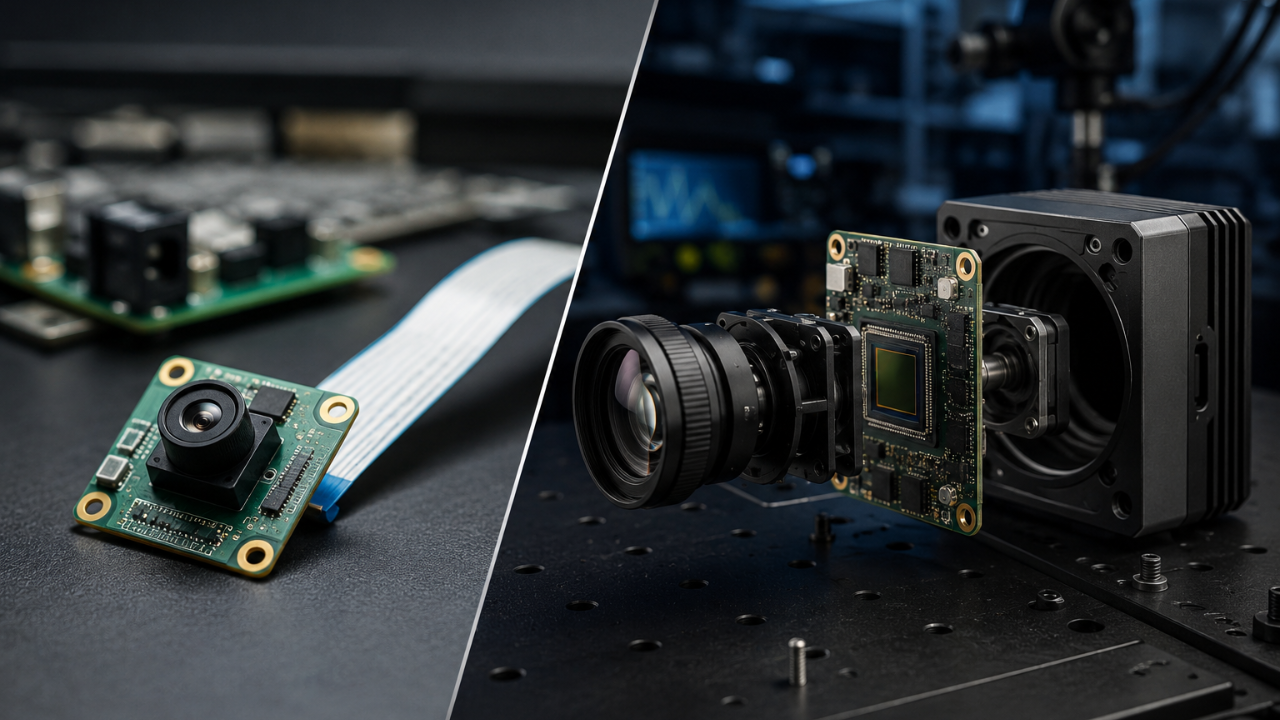
SOC, SIP and SOM for Camera
The Specification Loop: Preventing Late-Stage Surprises
Selecting components purely based on written requirements almost always leads to contradictions. Everyone wants maximum performance, minimum size, and minimum cost. Physics does not allow all three.
The specification loop exists to manage this reality. It is a structured way of revisiting requirements continuously as the design evolves. Mechanical, electrical, firmware, and industrial design decisions are evaluated together, not in silos.
A change in enclosure depth might force a lens change. That lens change might require additional distortion correction. That correction might increase ISP load and memory bandwidth. Suddenly, the original processor is no longer sufficient. Without a specification loop, this chain reaction is discovered far too late.
By validating priorities at each stage, teams protect themselves from decisions that look harmless early on but become unfixable later.
Planning a camera-based product? Let Silicon Signals evaluate your sensor, optics, and ISP pipeline and help you engineer image quality that holds up in the real world. — **Get a free consultation now**
Processing Modules: Choosing the Brain of the Camera
A processing platform is what every camera needs to handle sensor input, process image signals, encode data, access memory, and connect to other devices. This choice sets the product’s base.
Designers usually have to choose between separate parts or more integrated options like system on module, system on chip, or system in package. There are pros and cons to each choice. The system module is bigger and more expensive, but it’s easier to replace and faster to integrate. A system on chip is small and cheap when bought in large quantities, but it needs more knowledge about PCBs, power, and software. The system in a package is in the middle of the two.
There is also a business reality that plays a role in this choice. A lot of high-performance platforms need very high minimum order quantities before they can get meaningful vendor support. Third-party modules with mature SDKs can cut down on development time and risk a lot for smaller volumes or products that are still in the early stages, even if they cost more per unit.
At this point, peak performance numbers don’t matter as much as having a full SDK, good documentation, and a reliable evaluation platform. Teams can test their assumptions before they become commitments by getting early access to working hardware.
Image Quality Starts Before the Sensor Is Chosen
Many people think of image quality as one thing, but in reality, it is a group of choices that are all linked together. Resolution, frame rate, low-light performance, field of view, and distortion tolerance all affect one another.
Higher resolution uses more power and memory bandwidth. The ISP and encoder have to work harder with higher frame rates. Wider fields of view make optical distortion and correction harder to deal with. Better performance in low light often makes it harder to keep things cool and use less power.
Before choosing any part, teams need to figure out what image quality means for their specific use case. Do you really need ultra-high resolution, or is it more important that the picture is always clear? Is it more important for the motion to be smooth or for the details to be clear? These answers affect every decision that comes after them.
Camera design engineering services add value here by asking these questions early on, when trade-offs are still possible.
Image Sensor Selection: Matching Physics to Reality
Once the image requirements are clear, it is easier to choose the right sensor. Most new cameras use CMOS sensors, which are usually made by companies like Sony, Omnivision, or Onsemi. Brand reputation is important, but pixel size, sensor format, sensitivity, frame rate capability, and interface support are what really set them apart.
A sensor that looks great on paper can fail in real life if it gets too hot, isn’t available for long periods of time, or needs a lot of tuning. The best sensor for the job isn’t the one with the most features; it’s the one that works with the rest of the system without causing problems. This is one of the most underappreciated parts of camera design engineering solutions.
Optics: Where Mechanical and Optical Worlds Meet
After choosing the sensor, the next big choice is optics. The size, resolution, and field of view of the sensor all affect lens selection. The depth of the enclosure, the tolerances for mounting, and the consistency of the manufacturing also matter.
A lot of products use camera modules that are already put together, which means the sensor and lens are already together. Some people need custom optics to meet their size or performance goals. Teams often have to make custom solutions when they need ultra-wide lenses, short optical stack lengths, or strict distortion limits.
This is when working together becomes important. Mechanical tolerances have an effect on how stable the focus is. Software algorithms fix problems with optics. The way the hardware is set up affects stray light and reflections. Optics cannot be regarded as an independent option.
Night Vision: Choosing the Right Low-Light Strategy
Performance in low light adds another level of difficulty. Using infrared light with IR-cut filters gives you strong contrast and reliable night imaging, but it changes the design of the enclosure, the amount of power it uses, and the way it heats up.
Or, very sensitive backside-illuminated sensors with a wide dynamic range can take usable color pictures in low light, but they often have less contrast and more noise.
Neither method is better than the other. The choice depends on how you plan to use it, where you are, and what you expect from it. What matters is that the system was built with night vision in mind from the start.
Wireless Connectivity: More Than Just Adding Wi-Fi
Most modern cameras should be able to stream, sync, or connect to other devices. Sometimes, the processing platform has built-in wireless connectivity. In many cases, it needs its own Wi-Fi, cellular, or Bluetooth modules.
Choosing pre-certified modules with good SDK support lowers the risk of development, but it also creates RF layout and antenna problems that need to be fixed right away. Wireless choices affect the materials used in enclosures, power budgets, and the paths that must be followed by regulations.
If you think of connectivity as a late-stage feature, it will almost always hurt performance.
Antenna Integration: Invisible but Critical
Antennas are one of the most delicate parts of a camera system. How well they work depends on their size, where they are, how far away they are from high-speed signals, and how far away they are from the ground.
Poor antenna integration means shorter range, less stable connections, and more power use. These problems often come up during validation, and fixing them means making big changes to the design.
By thinking about antennas from the beginning of the design process, teams can check performance before the mechanical and electrical layouts are set in stone.
Thermal Optimization: Protecting Image Quality and Reliability
More features on a camera means more heat. Thermal load comes from things like live streaming, encoding, and wireless transmission.
Temperature affects image sensors a lot. The noise level goes up and the picture quality goes down as the temperature goes up. The battery life gets shorter. It can be uncomfortable to touch metal surfaces.
Thermal analysis during design lets teams figure out how heat will move and make the best use of layout, materials, and dissipation paths before problems happen. This is about controlling behavior, not cooling it down too much.
Water Resistance: A Design Multiplier
People often don’t give enough credit to water resistance. Higher ingress protection levels have a big effect on the design of the enclosure, the sealing methods, the connectors, and the buttons.
Every time the protection level goes up, it gets harder to design and test. Before you agree to certification testing, you need to prototype and test it internally.
If you plan for water resistance from the start, you won’t have to spend money on redesigns later in the project.
Certification: Planning for the Finish Line Early
All camera products must follow rules about safety, the environment, and the law. Design choices are affected by regional certifications, wireless approvals, and optional industry standards.
If you don’t get certified early, it can take a long time to launch your product. End-to-end camera design engineering makes sure that compliance needs shape design choices instead of getting in the way at the last minute.

Why Component Selection Is a Strategic Decision
Choosing components is often seen as a purchasing task, but in camera design, it is a strategic engineering choice. Specifications are not the only thing that matters. Availability, lifecycle, vendor support, and the quality of the documentation are also important.
If lead times get longer, documentation is poor, or long-term availability is unclear, a sensor or module that looks great today could become a problem. These risks don’t show up very often in datasheets, but they affect how well the product does throughout its life.
End-to-end camera design engineering services take these facts into account and find a balance between technical performance, supply chain resilience, and manufacturability.
Struggling with inconsistent image quality across lighting and environments? Talk to our camera design engineering team and get clarity before your next design decision locks in. — **Contact us today**
Conclusion: Why End-to-End Engineering Matters
The best way to develop a camera is to have a dedicated, cross-functional team own the system from start to finish. Losing information between stages makes things take longer and raises the risk.
We use this full-system approach to camera design engineering services at Silicon Signals. This includes defining specifications, choosing components, tuning ISPs, optimizing RF and thermal performance, and getting ready for certification. We help product teams get predictable performance, stable image quality, and smoother paths to production by seeing the camera as a system of parts that work together.
That’s why end-to-end camera design engineering solutions are so important, and why doing it right the first time makes a big difference.
메타데이터
- post_id
- 21882bfee45b
- slug
- what-makes-end-to-end-camera-design-essential-21882bfee45b
- url
- https://medium.com/@siliconsignals.io/what-makes-end-to-end-camera-design-essential-21882bfee45b
- canonical_url
- https://medium.com/@siliconsignals.io/what-makes-end-to-end-camera-design-essential-21882bfee45b
- author_url
- https://medium.com/@siliconsignals.io
- status
- ok
- fetched_at
- 2026-07-21 23:13:50