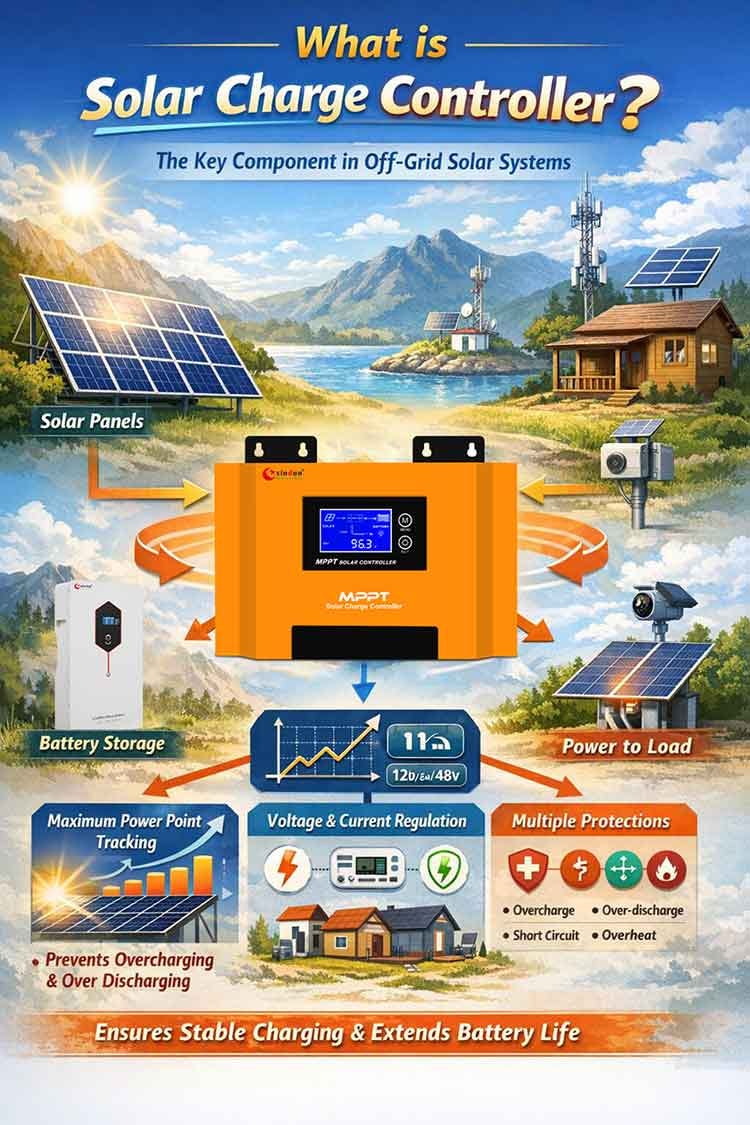
What Is MPPT solar controller in Solar Inverter?
A common problem in solar projects is that while the nominal power of the modules is not low, the actual output of the inverter is not…
What Is MPPT solar controller in Solar Inverter?
A common problem in solar projects is that while the nominal power of the modules is not low, the actual output of the inverter is not ideal; the power generation efficiency of the same array varies significantly under different weather conditions. The key factor behind this is the MPPT solar controller function of the solar inverter.
So what exactly does MPPT solar controller play in solar inverter? Xindun Power will guide you through this in depth article.
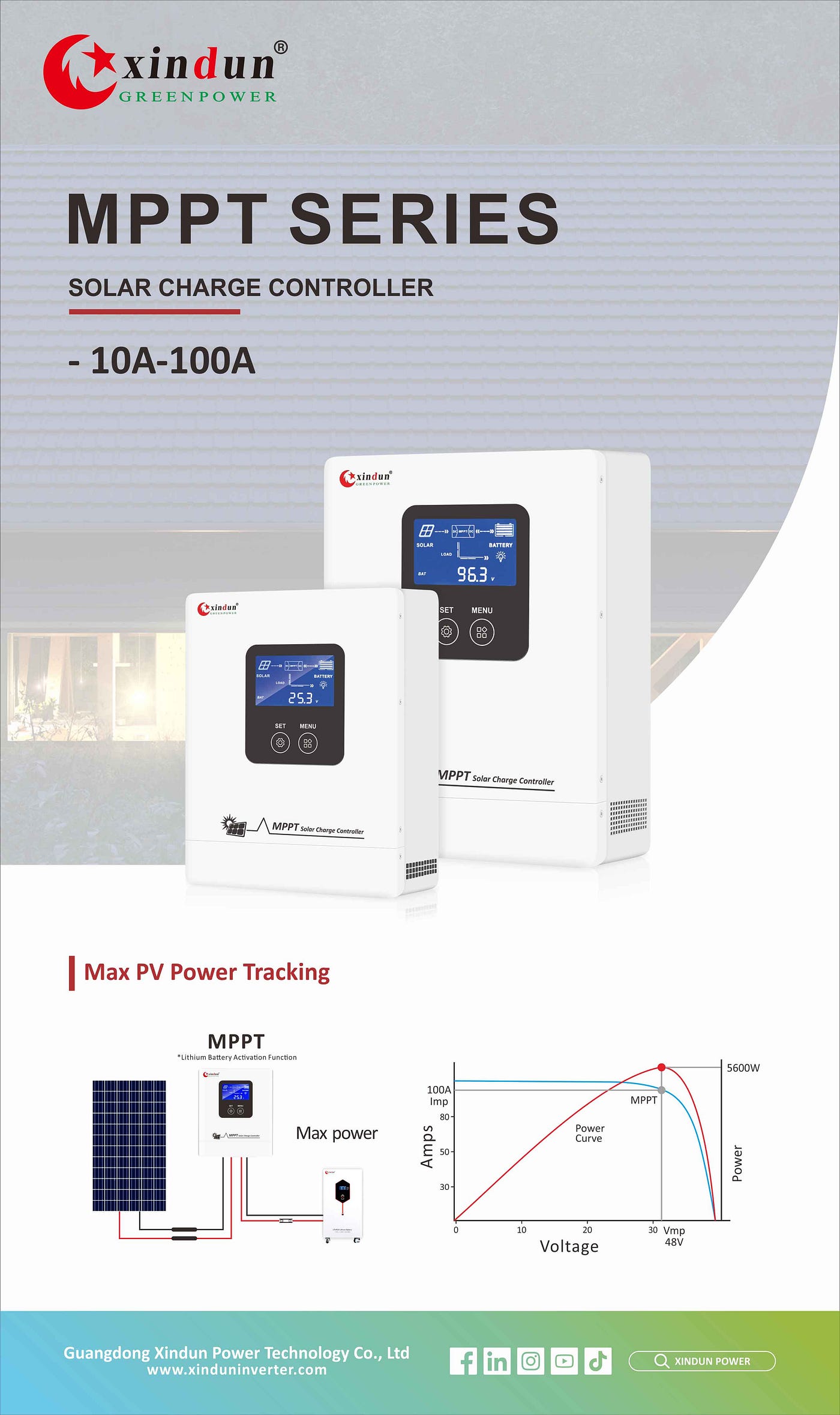
I. What exactly does MPPT solar controller do? MPPT stands for “Maximum Power Point Tracking,” which defines the power generation characteristics of solar panels: module power is greatly affected by sunlight and temperature, and the output power has non-linear relationship with voltage and current, with a “max power point”- deviating from this point, the power will drop significantly.
The solar panel is like a well; voltage is the water level, and current is the water flow. Only at a specific water level is the flow rate maximized. MPPT solar controller is like a “smart regulating valve,” monitoring the array’s output characteristics in real time and dynamically adjusting circuit parameters to ensure that the modules always operate at their max power point. Modules cannot be directly connected to inverters: Modules have a wide output voltage range, while the inverter’s DC input needs to be stable within a specific range. Without MPPT (Multi-Level Photovoltaic Detector), modules are prone to voltage anomalies, leading to wasted energy. For a 10MW power plant, 1% deviation in MPPT tracking accuracy can result in annual power generation loss exceeding 100,000 kWh.
Some might ask, “Can’t the solar panels be directly connected to the inverter?” No. Solar panels have a wide output voltage range, while the inverter’s DC input needs to be stable within a specific range for efficient conversion. Without MPPT solar controller, modules will either trigger protection due to overvoltage or the inverter will under utilize the power due to undervoltage, resulting in significant energy waste. In a 10MW solar power plant, a 1% deviation in MPPT tracking accuracy can lead to an annual power generation loss exceeding 100,000 kWh, which is substantial for project profitability.
II. The Three Core Functions of MPPT solar controller Based on the actual conditions of the power plant, the core functions of MPPT controller are mainly reflected in three aspects: responding to environmental fluctuations and stabilizing energy capture. Even subtle changes in sunlight and temperature can cause the max power point (MPPT) of a module to shift, and MPPTs can respond and adjust in milliseconds. Data shows that inverter equipped with high efficiency MPPTs generate 5% to 8% more power than ordinary inverter in cloudy weather. They balance string differences, overcoming the “weakest link” effect. Shading and tilt deviations can lead to uneven string performance; a single MPPT can be dragged down by the weakest string, while a multi-MPPT design can independently control each string, increasing power generation by over 10% in shading scenarios. They adapt to a wide voltage range, improving compatibility. Module rated voltages have evolved from 36V to over 150V; the wide voltage adaptability of MPPTs (e.g., 200V~1000V) can meet the needs of different series connection numbers, eliminating the need for frequent inverter replacements and improving design flexibility.
III. Common MPPT solar controller Types and Applicable Scenarios Mainstream MPPT technologies fall into three categories: Perturbation and Observation (P&O), Incremental Conductivity, and Fuzzy Logic Control. The first two are the most widely used and should be selected based on the specific scenario. The perturbation and observation (P&O) method is simple in structure and low in cost. It determines the optimal operating point by “fine tuning the voltage and observing the power,” similar to tuning a radio. However, it is prone to power oscillations when the light is stable and experiences tracking lag when the light changes abruptly. It is suitable for open, unobstructed ground-mounted or rooftop power plants. Inverter of this type only need a tracking accuracy of 99% or higher to meet the requirements, making it a cost effective choice. The incremental conductance method offers higher tracking accuracy and faster response. It utilizes the characteristic that “the power derivative with respect to voltage is zero at the maximum power point” to locate the optimal value and avoid power oscillations. It is suitable for mountainous or shaded environments with variable light conditions, but the circuitry is complex and the cost is slightly higher. Fuzzy logic control offers the best accuracy and speed, but it has a high technical threshold and is expensive, and is only used in large power plants or special projects. The number of MPPTs also needs to match the scenario: a single MPPT is suitable for unobstructed scenarios with consistent module characteristics; dual/multiple MPPTs are suitable for distributed projects with partial shading and different string orientations. Although the initial cost is higher, the long term power generation benefits are more considerable.
IV. Three Techniques to Optimize MPPT solar controller Efficiency In daily operation and maintenance, three techniques can optimize MPPT solar controller efficiency:
-
Regularly clean components to eliminate “false shadows.” Dust, bird droppings, etc., can cause uneven component power, interfering with MPPT solar controller judgment. Clean monthly in windy and sandy areas, and quarterly in rainy areas; if available, use a cleaning robot. 2. Check for wiring hazards. Loose terminals and oxidation can cause voltage instability, reducing tracking accuracy. During inspections, use a multimeter to measure the open-circuit voltage of the strings. If the voltage of a string is more than 10% lower than similar strings, it needs to be addressed promptly. In high-temperature and high-humidity areas, a comprehensive inspection should be conducted at least once a year.
-
Locate anomalies using a monitoring platform. Use real time data to determine: If an MPPT’s power is consistently low and there is no obstruction, the module may be faulty; drastic power fluctuations require checking string contact issues, and timely handling can prevent further damage.
The above is our in depth analysis of MPPT solar controller, hoping to help you choose and use them correctly. Xindun Power’s MPPT solar inverters offer a range of 10A-100A, feature max power point tracking, and boast an efficiency of up to 99%. Compared to ordinary PWM algorithms, they can improve power generation efficiency by 20%, and offer an ultra wide solar input voltage range for more flexible system configuration. What MPPT solar controller issues have you encountered in your projects? Please leave a comment below.
메타데이터
- post_id
- 21886e8163e7
- slug
- what-is-mppt-solar-controller-in-solar-inverter-21886e8163e7
- url
- https://medium.com/@xindunpower/what-is-mppt-solar-controller-in-solar-inverter-21886e8163e7
- canonical_url
- https://medium.com/@xindunpower/what-is-mppt-solar-controller-in-solar-inverter-21886e8163e7
- author_url
- https://medium.com/@xindunpower
- status
- ok
- fetched_at
- 2026-06-09 15:37:30