Beyond standard LLMs: Why Spatial AI is the Missing Piece in Space Exploration
Introduction: The Limits of Text and Pixels in the Cosmos
Beyond standard LLMs: Why Spatial AI is the Missing Piece in Space Exploration
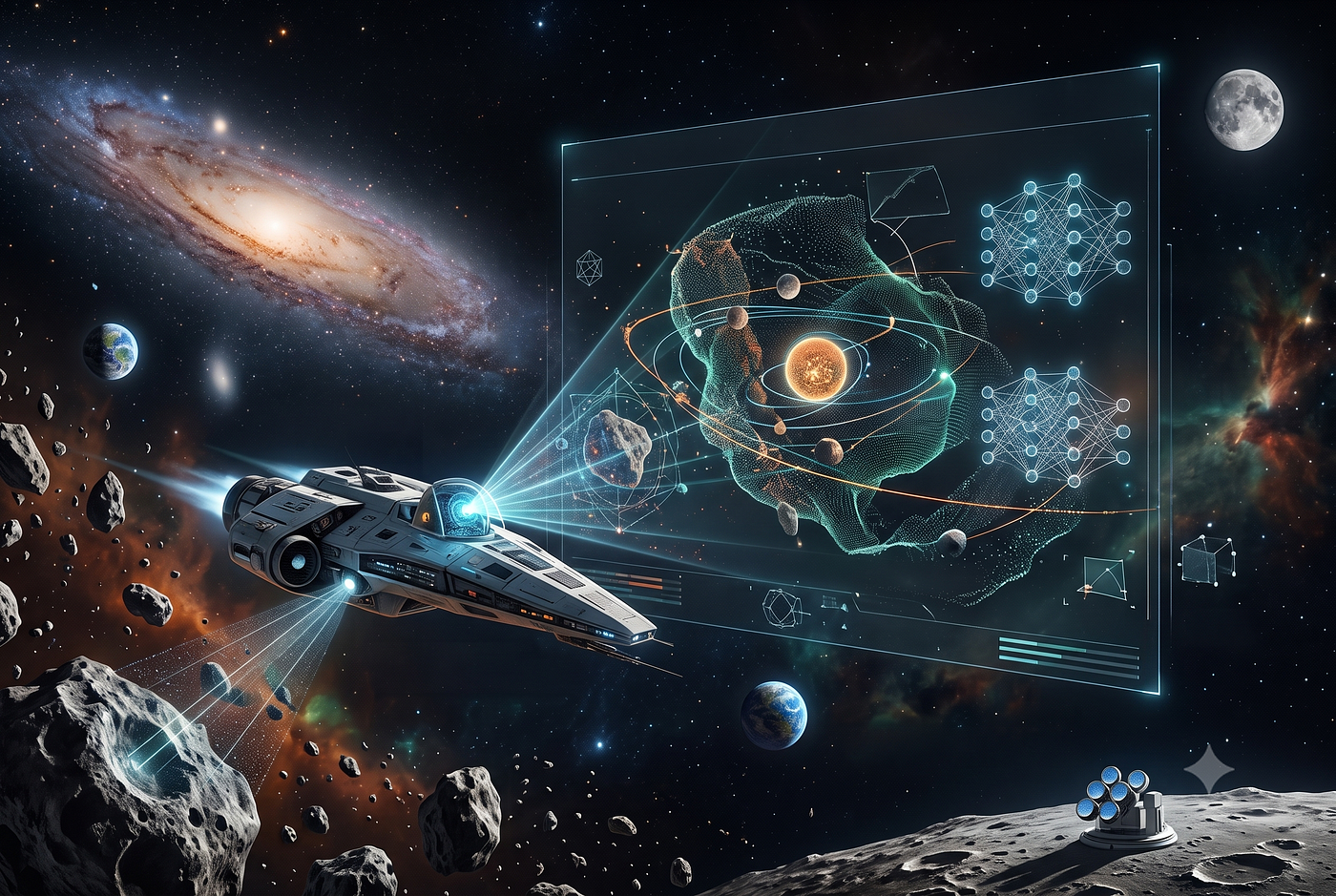
Introduction: The Limits of Text and Pixels in the Cosmos
For years, artificial intelligence has excelled at processing unstructured data converting text into vectors and images into pixel grids. While Large Language Models (LLMs) and standard Computer Vision architectures have transformed modern software engineering, deep space exploration presents a radically different set of constraints.
Deep space is not flat, linear, or predictable. Navigating autonomous probes through unstructured asteroid fields, predicting dynamic atmospheric turbulence for ground-based optical telescopes, or analyzing three-dimensional galactic structures requires more than pattern recognition it demands spatial intelligence.
To push the boundary of aerospace engineering and observational astronomy, we must move beyond static 2D computer vision and equip neural networks with real-time physical and geometric understanding.
What is Spatial Intelligence in AI?
Spatial AI goes beyond traditional image classification. Rather than treating an image as a static two-dimensional matrix of pixel intensities, spatial models infer physical geometry, depth, topology, and dynamic environmental vector fields.
When applied to space science and deep learning architectures, spatial intelligence enables models to:
- Construct 3D Volumetric Models: Translating dynamic 2D astronomical observational data into true 3D spatial representations.
- Predict Real-Time Environmental Disturbances: Modeling atmospheric distortion and gravitational interaction vectors before optical instruments capture them.
- Execute Edge Autonomy: Allowing deep-space probes to calculate real-time spatial trajectories without waiting for long-latency signals from Earth.
The Architectural Blueprint: Beyond Standard Convolution
Standard Convolutional Neural Networks (CNNs) are translation invariant, but they lack explicit geometric reasoning. When processing complex astronomical frames or dynamic sensor telemetry, conventional architectures often fail to preserve faint, extended low-surface-brightness features — such as distant galactic arms or subtle orbital debris — filtering them out as noise.
To build true Spatial AI for aerospace applications, the underlying software architecture relies on three primary pillars:
- Spatial Attention Mechanisms: Focuses compute resources dynamically on critical geometric structures (such as galactic cores or structural contours) while rejecting uncorrelated background sky glow and sensor noise.
- Graph Neural Networks (GNNs) for Topological Mapping: Represents spatial relationships between celestial bodies, satellites, or point-cloud data as nodes and edges, preserving relational geometry regardless of coordinate rotations.
- Implicit Neural Representations (INRs): Models continuous 3D scenes and dynamic physical fields directly within the weights of the network, enabling high-resolution rendering and spatial reasoning without memory-intensive voxel grids.
The Edge Computing Challenge: Balancing Latency and Accuracy
Deploying spatial AI in space exploration introduces strict resource constraints. Whether processing high-frequency observational data on ground-based systems or running onboard models on deep-space hardware, high computational latency can compromise mission outcomes.
In practice, high-performing spatial pipelines must be optimized using techniques like:
- Post-Training Quantization (PTQ): Converting floating-point model weights to INT8 precision without losing critical structural accuracy.
- ONNX Execution Optimization: Exporting neural graphs to lightweight runtimes designed for real-time edge execution.
- Adaptive Preprocessing Pipelines: Dynamically segmenting high-signal topological structures using hysteresis thresholding to prevent high-frequency background fluctuations from reaching downstream attention layers.
The Convergence of Deep Learning and Deep Space
As we build the next generation of software systems for aerospace and astronomy, integrating spatial reasoning into neural networks becomes essential. The future of space systems will not be driven by models that simply generate text or classify pixels, but by autonomous, spatially aware systems capable of perceiving, reasoning, and navigating through the vast geometry of the universe.
What are your thoughts on spatial AI’s role in autonomous deep space systems? Let’s discuss in the comments below.
메타데이터
- post_id
- 21cde5f2a35f
- slug
- beyond-standard-llms-why-spatial-ai-is-the-missing-piece-in-space-exploration-21cde5f2a35f
- url
- https://medium.com/@mehmetaliesmer/beyond-standard-llms-why-spatial-ai-is-the-missing-piece-in-space-exploration-21cde5f2a35f
- canonical_url
- https://medium.com/@mehmetaliesmer/beyond-standard-llms-why-spatial-ai-is-the-missing-piece-in-space-exploration-21cde5f2a35f
- author_url
- https://medium.com/@mehmetaliesmer
- status
- ok
- fetched_at
- 2026-08-09 07:44:01






