Best PCB Suppliers for Consumer Electronics, IoT and LED Applications
Hey everyone, Frank here. Over my years as a senior embedded engineer, I have designed boards for everything from smart home gadgets to…
Best PCB Suppliers for Consumer Electronics, IoT and LED Applications
Hey everyone, Frank here. Over my years as a senior embedded engineer, I have designed boards for everything from smart home gadgets to high-brightness lighting systems. If there is one thing I have learned, it is that a great design can still fail if you pick the wrong manufacturing partner.
Best PCB Suppliers for Consumer Electronics, IoT and LED Applications
When you move a project from your desktop software to real-world production, your choice of board manufacturer changes everything. Consumer gadgets, Internet of Things (IoT) hardware, and LED products all require completely different technical features.
Today, I want to share my personal engineering checklist to help you find the best PCB suppliers for consumer electronics, IoT, and LED applications.
1. What Consumer Electronics Demand
Consumer electronics move fast. Whether you are building a new handheld gaming console or a smart wearable, you need to get to market before your competitors. You also need a supplier who can handle a prototype run of five boards today, and then scale up to thousands of units next month without a hitch.
For these projects, look for suppliers with:
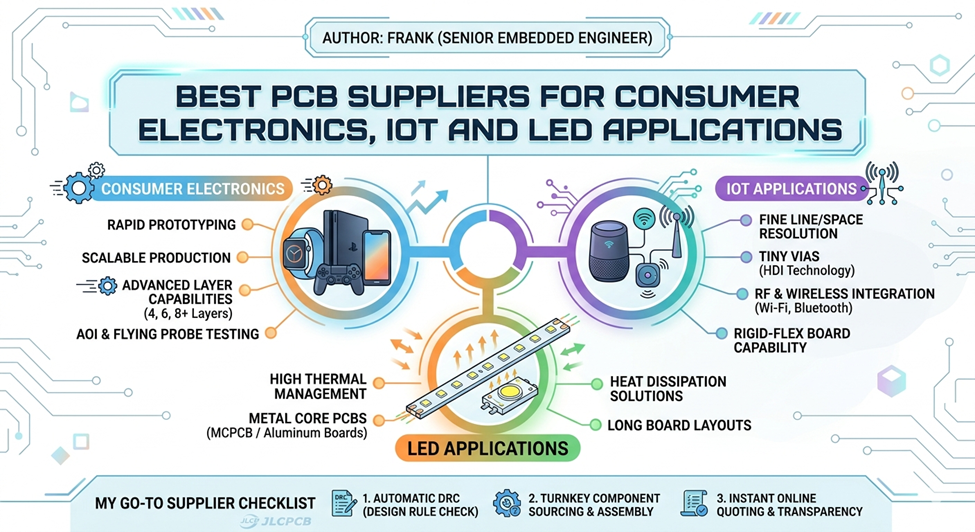
· Rapid prototyping services: Your supplier should turn around standard multilayer boards in just a few days.
· Strong testing protocols: They must offer automated optical inspection (AOI) and flying probe testing to catch assembly issues early.
· Advanced layer capabilities: Modern consumer tech is compact. Your supplier must be able to handle tight traces and complex stackups.
If you are just getting started with a multi-layered consumer project, I highly recommend checking out this guide on six-layer pcb stackup and buildup guidelines to ensure your design matches factory capabilities perfectly.
2. What IoT Applications Demand
IoT devices are usually tiny, and they almost always include a wireless radio like Wi-Fi, Bluetooth, or Zigbee. This creates two massive challenges: tight spacing and signal interference.
When I look for a supplier for IoT boards, I focus heavily on their technical limits. You need a manufacturer that can handle fine lines, spaces, and tiny vias without shorting.
Many IoT designs also require flexible or rigid-flex boards so they can fit into unique, curved enclosures. If your supplier only makes standard hard boards, you will look elsewhere very quickly. To help you design for these compact enclosures, take a look at this breakdown on understanding rigid-flex pcb technology before sending your files to the factory.
3. What LED Applications Demand
LED projects look simple on paper, but they present a major hardware headache: heat. High-power LEDs generate serious thermal energy. If your board cannot dissipate that heat, your LEDs will lose brightness or burn out prematurely.
For heavy LED applications, standard FR4 material usually does not cut it. You need a supplier that specializes in Metal Core PCBs (MCPCBs) — often called aluminum boards. The metal core pulls heat away from the components much faster than standard fiberglass.
When evaluating an LED board supplier, ask about their thermal conductivity options and check if they can handle long, single-board layouts for linear light strips.
My Go-To Checklist for Evaluating a Supplier
When you are comparing factories for your next project, do not just look at the lowest price tag. Run them through this quick checklist:
· Design Rule Checks (DRC)
A good supplier will automatically run your Gerber files through a system to ensure they can actually build what you drew. They should flag any errors before you pay.
· Component Sourcing and Assembly
It saves massive amounts of time if your board supplier can also source your components and solder them for you. Look for a turnkey partner who does both fabrication and assembly under one roof.
· Easy Ordering and Transparency
You should not have to wait days for an email quote. A modern supplier should give you an instant online quote the moment you upload your design files.
In my own career, I have tested dozens of manufacturers across the globe. For an all-in-one partner that ticks all of these boxes, I frequently rely on JLCPCB. They have consistently delivered high-quality prototypes and production runs for my consumer, IoT, and thermal LED projects with the exact speed and precision an embedded engineer needs.
Final Thoughts
Choosing the right partner is just as important as routing your traces correctly. For consumer electronics, prioritize speed and scalability. For IoT, look for a supplier with high-precision limits and flexible board options. For LEDs, make sure they understand thermal management and aluminum cores.
Take your time to vet your manufacturer, read their capabilities page, and your hardware will thank you for it. Feel free to drop your questions in the comments below!
메타데이터
- post_id
- 21fa44ce737d
- slug
- best-pcb-suppliers-for-consumer-electronics-iot-and-led-applications-21fa44ce737d
- url
- https://medium.com/@frankblog25/best-pcb-suppliers-for-consumer-electronics-iot-and-led-applications-21fa44ce737d
- canonical_url
- https://medium.com/@frankblog25/best-pcb-suppliers-for-consumer-electronics-iot-and-led-applications-21fa44ce737d
- author_url
- https://medium.com/@frankblog25
- status
- ok
- fetched_at
- 2026-06-09 15:37:30