The Flexibility Paradox: Why NTPC’s Pivot to Sub-Critical Coal Is a Masterclass in Grid Resilience
The Indian power sector is witnessing a fascinating, counter-intuitive plot twist. For the past decade, the script was clear: retire old…
The Flexibility Paradox: Why NTPC’s Pivot to Sub-Critical Coal Is a Masterclass in Grid Resilience
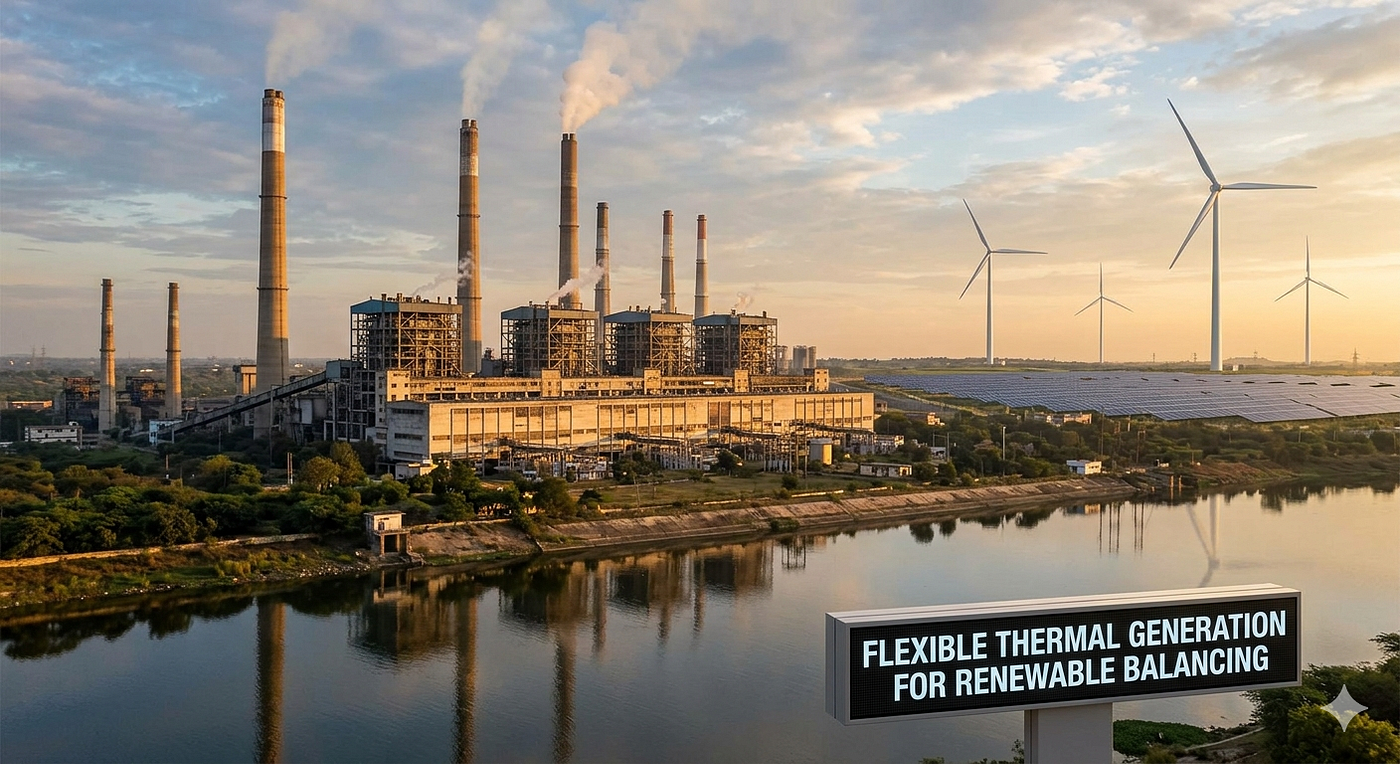
NTPC Limited is India’s largest power generation utility
The Indian power sector is witnessing a fascinating, counter-intuitive plot twist. For the past decade, the script was clear: retire old, inefficient sub-critical thermal units and replace them with massive, high-efficiency supercritical and ultra-supercritical behemoths.
Yet, NTPC’s global invitation for an Expression of Interest radically flips this narrative. By seeking technology partners and engineering vendors to design highly flexible, sub-critical thermal power units in the 150 to 250 Megawatt range, India’s largest power producer is signaling a major shift in how the industry views grid management.
This strategy is not a step backward for emissions; rather, it is a pragmatic, technically sound maneuver designed to solve the structural vulnerabilities of a greening grid. For power sector executives, system operators, and policy architects, this move provides a masterclass in balancing green ambitions with physical grid reality.
To understand why NTPC is looking backward to move forward, one must look at the mechanical limitations of modern boiler metallurgy. India’s rapid deployment of renewable energy has fundamentally altered the net-load curve. Solar generation regularly satisfies a massive chunk of daytime electricity demand on a clear day, only to vanish completely at sunset. This creates a severe drop in midday net demand followed by a steep evening peak, requiring thousands of megawatts of balancing power to ramp up rapidly when the sun goes down.
Currently, the burden of absorbing this volatility falls squarely on India’s coal fleet. NTPC’s existing thermal assets already operate at a flexible technical minimum load of 55 percent during low-demand midday hours, aggressively participating in ancillary services like Automatic Generation Control. However, pushing large-scale supercritical and ultra-supercritical units below this threshold introduces severe operational risks.
Modern high-efficiency plants operate under extreme pressures and temperatures. Deep cycling or dropping these units to ultra-low loads causes massive swings in steam temperature. The resulting thermal stress cracks boiler tubes, warps turbine casings, and shortens the operational lifespan of multi-billion-dollar assets.
Furthermore, at low throughput, maintaining a stable flame without expensive, highly polluting oil support becomes a precarious balancing act. There is also an inefficiency trap: running an 800 Megawatt ultra-supercritical plant at 40 percent capacity severely degrades its heat rate, effectively erasing its carbon-saving advantages.
NTPC’s operational experience has yielded a clear insight: sub-critical units offer greater resilience under frequent cycling. Because they operate at lower temperatures and pressures, their internal parameter variations are far less severe. They experience lower thermal fatigue, adapt smoothly to frequent start-stop operations, and handle rapid load adjustments with significantly fewer maintenance setbacks.
The technical requirements laid out in NTPC’s initiative outline a specialized class of mechanical assets. The utility is not simply looking to rebuild vintage 1980s power stations; it is aiming to build a highly agile, modern iteration of sub-critical technology. The capacity scaling of 150 to 250 Megawatts is small enough to minimize financial exposure and fuel overhead when idle, yet large enough to provide meaningful injection capacity to localized transmission pockets. The target of a 25 percent minimum technical load is a remarkable benchmark.
While standard coal units risk trip-outs or flame failures below 55 percent, these new units are designed to turn down to a quarter of their rated capacity without requiring oil support. This allows them to stay synchronized to the grid during peak solar hours, consuming minimal fuel while awaiting dispatch instructions. Furthermore, the design must withstand the structural stress of two-shift operations, meaning it can handle being entirely shut down and restarted twice a day to align directly with morning and evening solar generation curves.
A legitimate question emerges as to why coal should be used for flexibility when the world is looking toward grid-scale batteries, pumped hydro storage, and gas turbines. The answer comes down to domestic supply realities and economic scaling. Gas-based generation in India is severely constrained by a lack of affordable domestic gas, and international fuel prices are too susceptible to geopolitical spikes to run gas plants for routine grid balancing.
Pumped hydro is highly reliable but suffers from long gestation periods and strict geographical dependencies, making it difficult to construct near flat, solar-heavy landscapes like Rajasthan. Meanwhile, battery storage, though critical for short-duration frequency regulation, cannot yet economically support long-duration, multi-hour balancing during extended periods of low renewable output.
The consequences of this balancing deficit are already evident, as transmission bottlenecks and a lack of flexible backing power regularly force system operators to curtail gigawatt-hours of clean generation during peak solar hours. By deploying small, fast-ramping coal units, NTPC is establishing a dependable, cost-effective intermediate buffer.
This strategic pivot forces a complete rewrite of traditional power sector financial metrics. Historically, the health of a thermal asset was evaluated through its Plant Load Factor, where higher utilization meant higher profitability. In this new paradigm, these sub-critical units will explicitly operate at low annual utilization rates. Their value will not be measured by the total volume of energy they churn out, but by their dependable capacity and fast ramp rates. They will essentially serve as grid insurance.
This evolution will require Indian regulators to accelerate the adoption of robust ancillary services and capacity markets. Tariffs for these balancing units cannot be based on a simple flat rate per unit of energy. Instead, they must feature dual-structure mechanisms: fixed availability charges to guarantee readiness, alongside premium, time-of-day variable payments that reward rapid ramping capabilities during grid stress events.
NTPC’s strategy is bound to face scrutiny from environmental advocates. On paper, building new sub-critical coal infrastructure sounds contradictory to India’s long-term decarbonization goals. Sub-critical units naturally emit more carbon dioxide per kilowatt-hour generated than ultra-supercritical alternatives.
However, a holistic emissions analysis reveals a different perspective. By keeping these small thermal units online at an ultra-low 25 percent load during the day, system operators can prevent the massive curtailment of large-scale solar farms. The marginal carbon penalty of running an efficient 200 Megawatt sub-critical unit at low load is vastly offset by unlocking gigawatts of zero-carbon solar power across the rest of the network.
Furthermore, these units will prevent the highly inefficient, high-emission emergency ramping of massive 800 Megawatt supercritical stations, which are poorly suited for sudden load changes. To make this approach publicly and politically viable, NTPC and its engineering partners must equip these new units with state-of-the-art environmental control systems to strictly limit local air pollutants like sulfur and nitrogen oxides.
NTPC’s sub-critical initiative serves as an important reality check for energy transition planning globally. It proves that the path to a clean energy future is rarely a straight line from old technology to new. For equipment manufacturers and engineering contractors, this opens up a brand-new market segment: creating specialized, cyclical thermal components that prioritize flexibility over raw scale. For grid operators, it provides a much-needed tool to maintain system frequency amid rising levels of intermittent green power.
Ultimately, NTPC is demonstrating that achieving true grid reliability requires a diverse mix of assets. By cleverly repurposing the flexible characteristics of sub-critical engineering, India’s power giant is building a sturdy thermal foundation capable of supporting its massive renewable energy ambitions.
메타데이터
- post_id
- 220e86dfdca9
- slug
- the-flexibility-paradox-why-ntpcs-pivot-to-sub-critical-coal-is-a-masterclass-in-grid-resilience-220e86dfdca9
- url
- https://medium.com/@ranjitsingh_85319/the-flexibility-paradox-why-ntpcs-pivot-to-sub-critical-coal-is-a-masterclass-in-grid-resilience-220e86dfdca9
- canonical_url
- https://medium.com/@ranjitsingh_85319/the-flexibility-paradox-why-ntpcs-pivot-to-sub-critical-coal-is-a-masterclass-in-grid-resilience-220e86dfdca9
- author_url
- https://medium.com/@ranjitsingh_85319
- status
- ok
- fetched_at
- 2026-06-15 20:49:13