AI Is Not Killing the Entry-Level Job Market — But Work From Home Might Be
The economy is not great right now. In the last year the US added 260,000 jobs, 680,000 of which are healthcare jobs. So… yeah, if you…
Photo by Andrea Stuart on Unsplash
AI Is Not Killing the Entry-Level Job Market — But Work From Home Might Be
The economy is not great right now. In the last year the US added 260,000 jobs, 680,000 of which are healthcare jobs. So… yeah, if you removed healthcare, the US labour market actually shrank.
Also there is a lot of uncertainty around the economy right now, especially around tariffs. And high oil prices are not helping things. Then there’s just general overhiring in the post-pandemic boon.
But the reason on the tip of everyone’s tongue is AI. Recently there have been many commencement speakers who have all discussed AI being booed.
[embed]
I was a little surprised. What is that famous article? Everyone Is Cheating Their Way Through College. University students use AI a lot. But it seems as though they also don’t like it. Partly because it’s devaluing their education experience. But more importantly, it’s going to make finding a job harder. Or will it?
I’ve previously argued that AI would remove entry-level jobs. Not by replacing workers, but automating simple tasks. I called the idea ‘partial replacement’. That is, even if AI can only automate 50% of your job, that still reduces the demand for programmers.
So what would we expect to see if my hypothesis is correct? Decreased hiring in positions most exposed to AI. That is a decrease in tech and junior jobs. And surprise, surprise. That is exactly what we see:
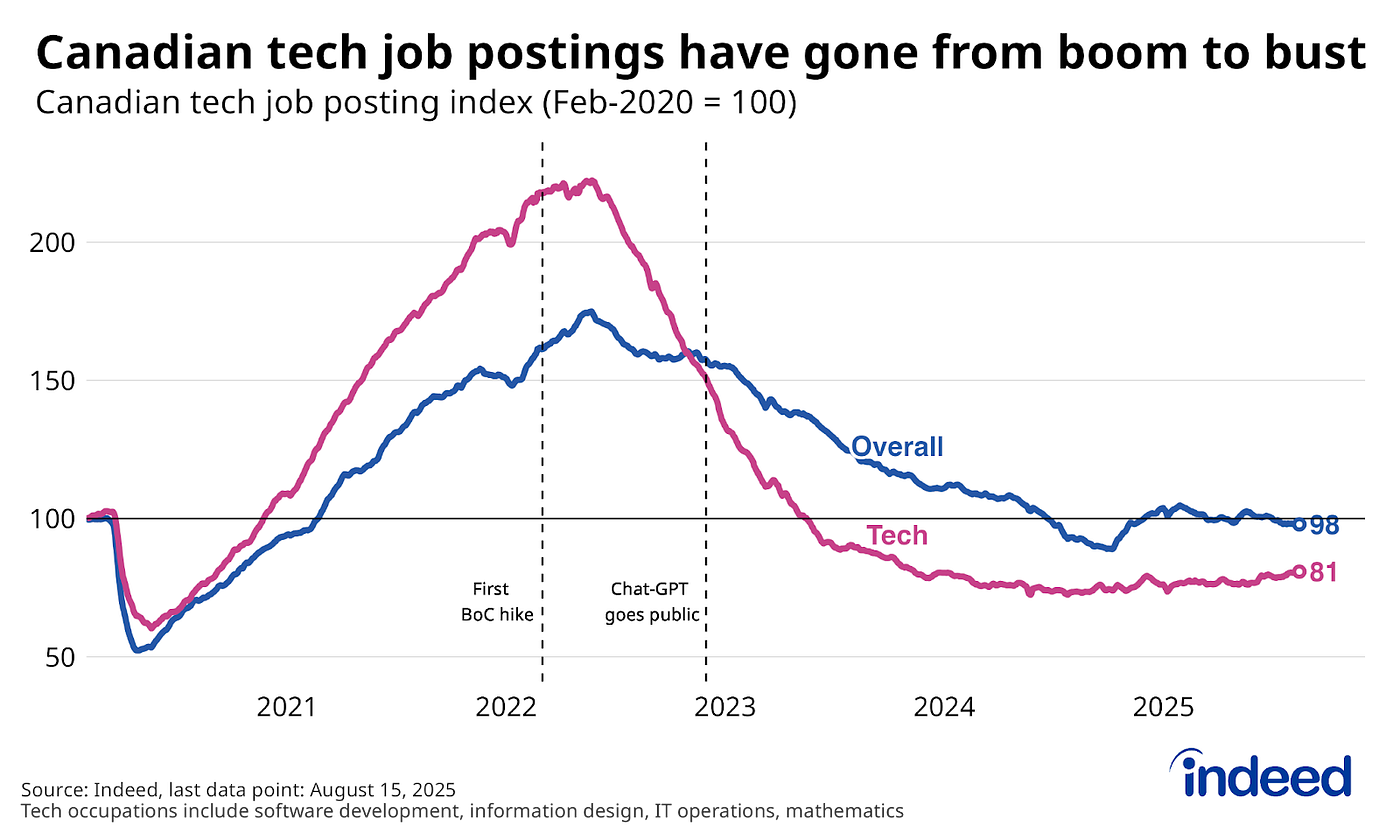

So open and shut case right? AI is killing junior tech jobs. I originally thought so, but maybe that’s not 100% correct. Maybe there’s some other factor that could explain the decline in hiring.
I recently read the paper The Broken Ladder: AI, Remote Work, and Early-Career Hiring and the authors say that this job decline is actually better explained by Work From Home (WFH) and not AI.
It’s quite the confounder. WFH and AI exposure is highly correlated as seen in this figure.

However, the paper points out that once you control for WFH exposure, AI does not appear to have an impact on entry-level jobs. But if you control for AI exposure, WFH is still significant.

So was I wrong? Well, my post never actually discussed this junior or senior dynamic. It only said the absolute number of jobs would go down. So both can be true.
Although the paper definitely contradicts my thought process. My thinking when I wrote that post, although it was never explicitly said, was that AI would automate tasks starting with some junior tasks and slowly moving its way up. Then this automation of tasks would cause a collapse in hiring. There is nothing in the paper to contradict the conclusion. But how I got there, it does contradict.
First, the removal of juniors. The paper argues that this is happening, but it’s not because of AI, it’s because of WFH. This is primarily for two reasons: it’s harder to train new hires if they work from home and it’s also harder to manage them. So rather than hire a junior, which you have to train and spend more time managing, you can just hire a senior who presumably is less likely to have these problems.
Now there are some companies that are very good at remote work. GitLab is one. As is Medium. However these are mostly smaller companies. Larger companies haven’t figured out remote work yet because there’s more inertia to overcome and there’s little incentive to do so. Just throw more senior talent at the problem. For the companies that can figure it out, though, there is an opportunity, especially as AI is making juniors more capable.
Yeah, that’s another interesting finding in the paper. It’s shown in this table.

Now this table is very dense, but you only have to look at the highlighted sections. It shows that when looked at in isolation, jobs with AI exposure saw a larger difference between junior and senior salaries and a decreasing percentage of juniors. But when you control for WFH exposure, AI was actually associated with a smaller difference in salaries and an increasing percentage of juniors.
This may appear surprising, but once you think about it, it makes sense. Juniors are hurt by WFH because they are less competent. Well, AI makes juniors more competent, so naturally, it would have an opposite effect.
And this is not a new finding. Other studies have found that AI use significantly improves productivity in juniors while having little improvement on seniors. And this has caused the salary gap between seniors and juniors to shrink.
So it turns out that AI might not be the source of catastrophic job loss we thought it was. And this is great news. Both for new grads who will be able to use AI to be more productive and for companies that learn to embrace remote work. The losers will be the large companies that just cannot adapt.
메타데이터
- post_id
- 222846592689
- slug
- ai-is-not-killing-the-entry-level-job-market-but-work-from-home-might-be-222846592689
- url
- https://medium.com/@impure/ai-is-not-killing-the-entry-level-job-market-but-work-from-home-might-be-222846592689
- canonical_url
- https://medium.com/@impure/ai-is-not-killing-the-entry-level-job-market-but-work-from-home-might-be-222846592689
- author_url
- https://medium.com/@impure
- status
- ok
- fetched_at
- 2026-07-29 09:46:26