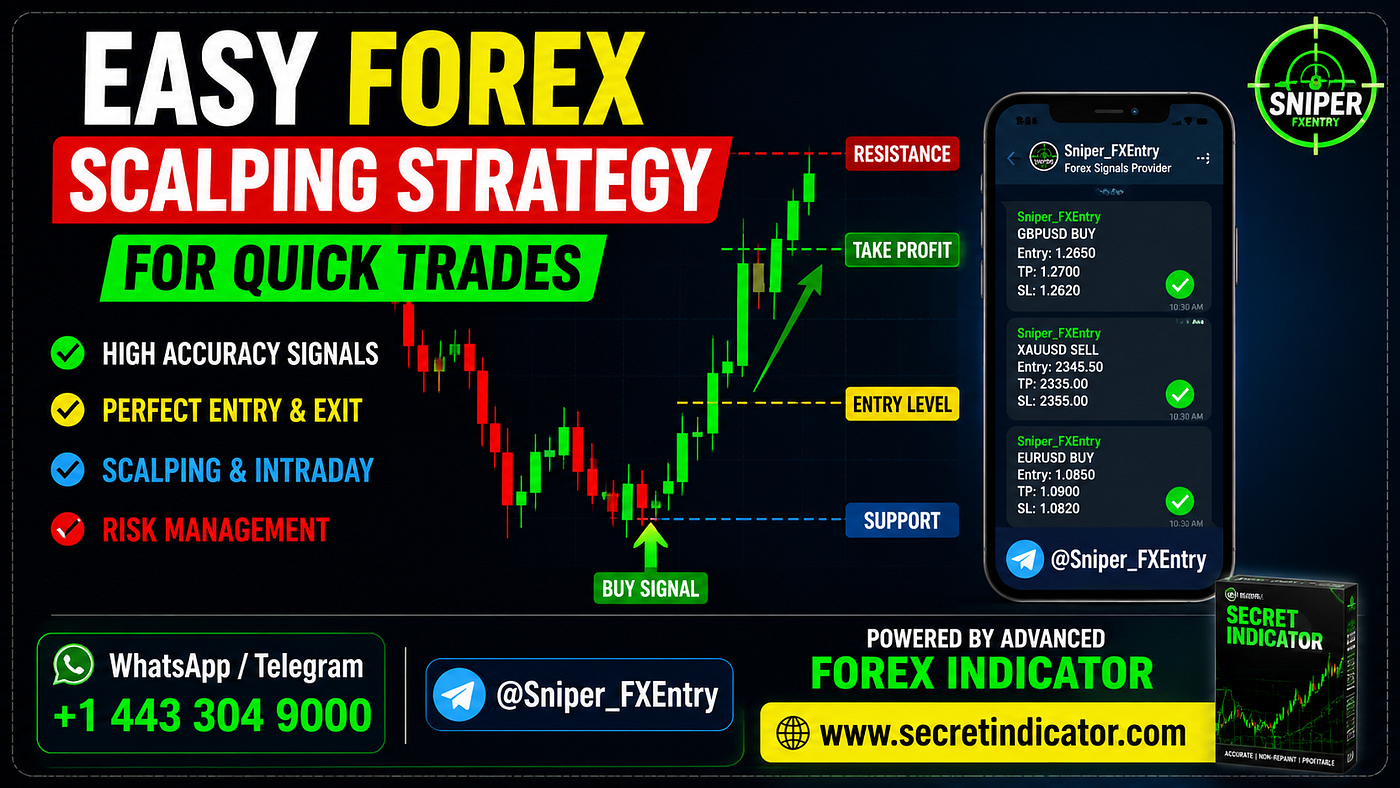
Powerful Forex Trading Framework for 2026
The Forex market continues to evolve, and 2026 is no exception. With improved trading platforms, faster market execution, and increased…
Powerful Forex Trading Framework for 2026
The Forex market continues to evolve, and 2026 is no exception. With improved trading platforms, faster market execution, and increased participation from retail traders, having a clear trading framework is more important than ever. Many beginners enter the market searching for the best Forex strategy or the most accurate indicator, only to discover that long-term success depends on much more than a single tool.
**https://secretindicator.com/product/powerful-true-mt4-scalping-indicator/**

**https://t.me/Sniper_FX_Entry**
A strong Forex trading framework combines market analysis, disciplined risk management, patience, and consistent execution. Instead of chasing every market movement, experienced traders follow a structured process that helps them identify quality opportunities while protecting their trading capital.
This guide explains how to build a practical Forex trading framework that can help traders make better decisions in different market conditions. Whether you trade major currency pairs, scalp lower timeframes, or prefer swing trading, these principles can help create a more organized approach.
What Is a Forex Trading Framework?
A Forex trading framework is a step-by-step process that guides every trading decision. Rather than entering trades based on emotions or random signals, traders use predefined rules to evaluate market conditions before placing an order.
An effective framework usually includes:
- Market trend analysis
- Key support and resistance levels
- Price action confirmation
- Risk management rules
- Trade execution plan
- Exit strategy
- Performance review
Following a consistent routine helps reduce emotional trading and encourages better decision-making over time.
Step 1: Understand the Overall Market Trend
Before looking for trade entries, identify the dominant market direction. Trading in the direction of the higher-timeframe trend often provides better probability setups than trading against momentum.
Common methods include:
- Higher highs and higher lows for uptrends
- Lower highs and lower lows for downtrends
- Moving averages for trend confirmation
- Multi-timeframe analysis
Many experienced traders begin with the daily or four-hour chart before moving to lower timeframes for trade entries.
Step 2: Mark Important Support and Resistance Zones
Support and resistance remain among the most valuable concepts in technical analysis.
These areas often represent locations where buyers and sellers previously became active.
Important levels include:
- Previous day’s high and low
- Weekly support and resistance
- Monthly key levels
- Psychological round numbers
- Strong historical reaction zones
Instead of drawing too many lines, focus only on levels that have clearly influenced price multiple times.
Step 3: Wait for Price Action Confirmation
Successful traders rarely enter trades simply because price reaches a level.
Instead, they wait for confirmation through price action.
Examples include:
- Bullish engulfing candles
- Bearish engulfing candles
- Pin bars
- Inside bars
- Break-and-retest patterns
Waiting for confirmation often helps filter weaker trade setups.
Step 4: Build a Risk Management Plan
Risk management protects trading capital during losing periods.
Many professional traders risk only a small percentage of their account on each position.
A simple framework includes:
- Define maximum risk per trade.
- Always use a stop-loss.
- Maintain a favorable risk-to-reward ratio.
- Avoid increasing position size after losses.
Protecting capital allows traders to remain active long enough to benefit from future opportunities.
Step 5: Choose High-Quality Trade Setups
Not every chart presents a trading opportunity.
A quality setup often includes several factors aligning together, such as:
- Trend confirmation
- Strong support or resistance
- Price action signal
- Healthy risk-to-reward ratio
- Stable market conditions
Patience can often improve trade quality more effectively than taking additional trades.
Step 6: Control Trading Psychology
Even the best strategy can struggle if emotions drive trading decisions.
Common psychological challenges include:
- Fear of missing out
- Revenge trading
- Overtrading
- Closing profitable trades too early
- Holding losing positions too long
Creating a written trading plan can help maintain consistency during changing market conditions.
Step 7: Keep a Trading Journal
A trading journal allows traders to review decisions objectively.
Record information such as:
- Currency pair
- Entry price
- Exit price
- Stop-loss
- Take-profit
- Reason for entry
- Market conditions
- Lessons learned
Over time, this information can highlight strengths and areas for improvement.
Common Mistakes to Avoid
Many new traders repeat similar mistakes:
- Trading without a plan
- Ignoring risk management
- Using excessive leverage
- Switching strategies frequently
- Chasing every market movement
- Trading during emotional periods
- Depending entirely on indicators
Avoiding these habits can improve consistency over the long term.
메타데이터
- post_id
- 222f4b586eae
- slug
- powerful-forex-trading-framework-for-2026-222f4b586eae
- url
- https://medium.com/@secretforexstrategies/powerful-forex-trading-framework-for-2026-222f4b586eae
- canonical_url
- https://medium.com/@secretforexstrategies/powerful-forex-trading-framework-for-2026-222f4b586eae
- author_url
- https://medium.com/@secretforexstrategies
- status
- ok
- fetched_at
- 2026-07-10 20:09:57