The AMOC Is Weakening But It Won’t Collapse
A wound that you can see from the coastline is also a refusal to die
The AMOC Is Weakening But It Won’t Collapse
A wound that you can see from the coastline is also a refusal to die
The AMOC Is Weakening But It Won’t Collapse (photo by author)
Two thousand meters under the sea off the coast of Africa, a yellow float the size of a beach ball waits at the end of a Cinderella sleep. The Discovery sits above it, and scientist Ben Moat watches the water through binoculars, waiting for it to surface. When it does, it will carry two years of measurements from a line of instruments strung across the Atlantic at the latitude of the Canary Islands. That line, RAPID, has been for more than twenty years the closest thing we have to a stethoscope on the largest heat-moving system on Earth.
The system is the Atlantic Meridional Overturning Circulation (AMOC).
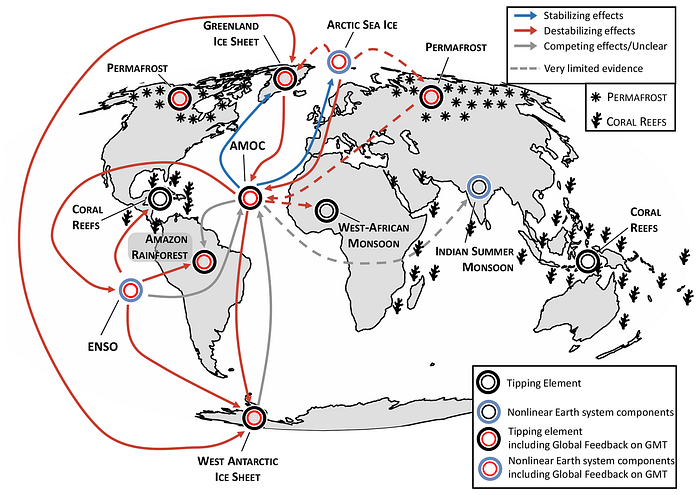

Large-scale circulation in the North Atlantic. A system of warm, northward flowing currents and cold southward flowing currents is known as the Atlantic Meridional Overturning Circulation or Gulf Stream System. (Source)
Almost nobody outside oceanography calls it that. Most people met it, if they met it at all, through the 2004 film *“The Day After Tomorrow,”* in which it stops over a long weekend and freezes Dennis Quaid to death inside the New York Public Library. The AMOC carries warm tropical water north along the surface, hands its heat to the air over Europe, cools, grows dense, sinks near Greenland, and slides back south along the ocean floor. It is the reason Norwegian ports stay open in winter while towns at the same latitude in Canada freeze solid. It is the reason my grandmother grew tomatoes further north in Swedish Lapland than tomatoes have any business growing.
For a decade, the headline about this current has been a single word, getting louder: collapse. This year, the science got more interesting than the headline, and harder to fit on a magazine cover. Because two numbers came back from the ocean, and they seemed to contradict each other — but they don’t.
[embed]
The Ocean Gave Two Different Answers
In May, Professor Stefan Rahmstorf (probably the real-life version of Dennis Quaid) and his colleagues pinned down the cause of the cold patch south of Greenland, the one blue smudge on a warming planet, and confirmed what a over decade of fingerprints had suggested: the AMOC is losing strength.
Weighting climate models by how well they match the real Atlantic pushes the projected weakening to somewhere between 42 and 58 percent by 2100. Rahmstorf, who spent thirty years putting the odds of a shutdown near one in twenty, now puts them closer to a coin flip. Iceland has begun treating a possible collapse as a national security problem. That is the scary number, and it is real.
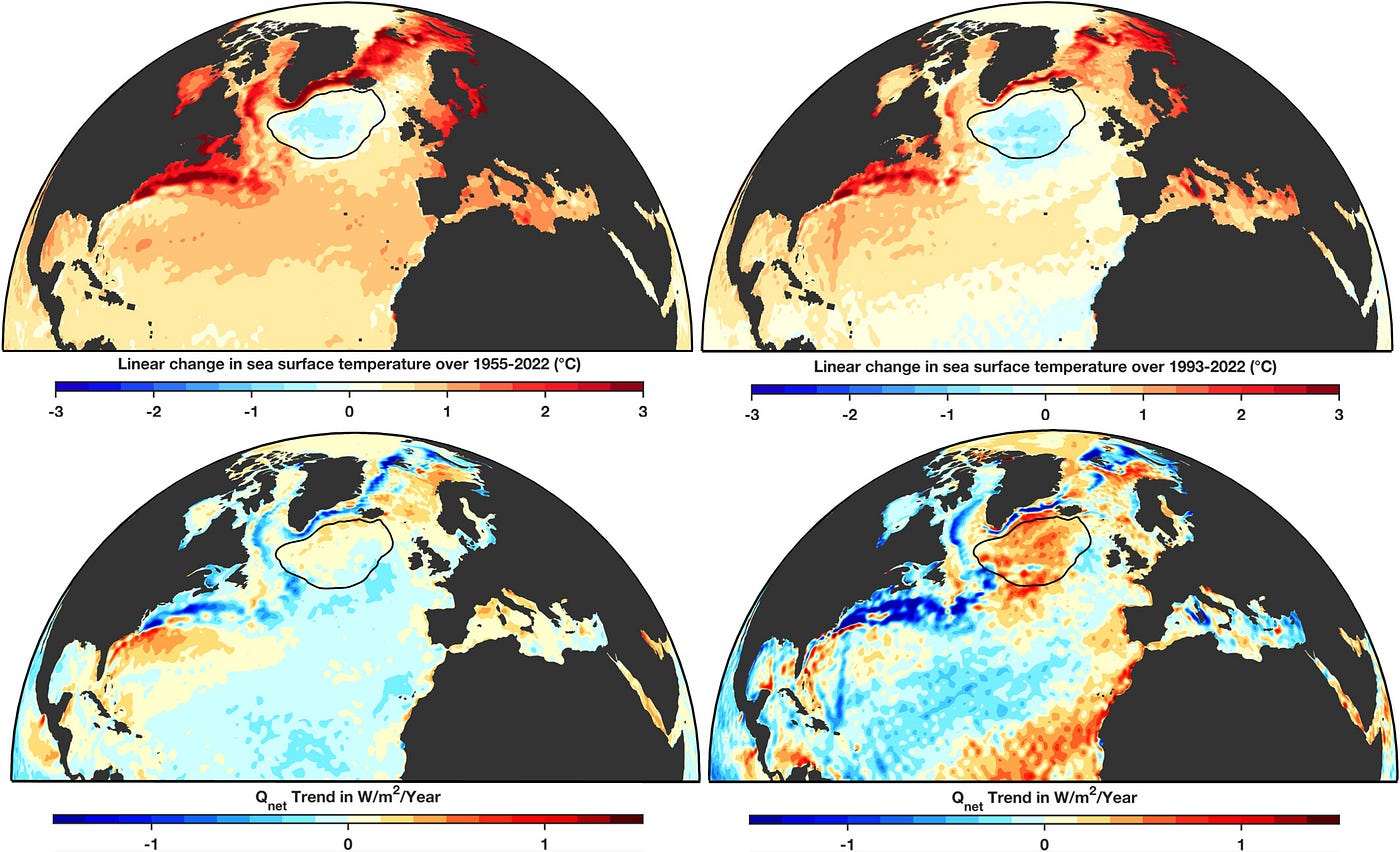
Trend in sea surface temperature over 1955–2022 and 1993–2022 (top panels), and trend in surface ocean heat flux over the same periods (bottom) (Source: Multidecadal Atlantic “Warming Hole” Heat Content Variations Are Caused by Ocean Heat Transport, Not by Surface Fluxes)
But there’s a second number, coming from the same ocean.
A team led by Jonathan Baker at the UK Met Office ran the current through 34 climate models and hit it with everything the century could throw at it: quadrupled carbon dioxide, torrents of Greenland meltwater, forcing well past anything we expect. The AMOC weakened in every run. It collapsed in none of them. Across every model, something kept a wounded version of the current alive. That is the reassuring number, and it is also real.
A weakening that you can see from Iceland’s coastline is also a refusal to die across three dozen models.
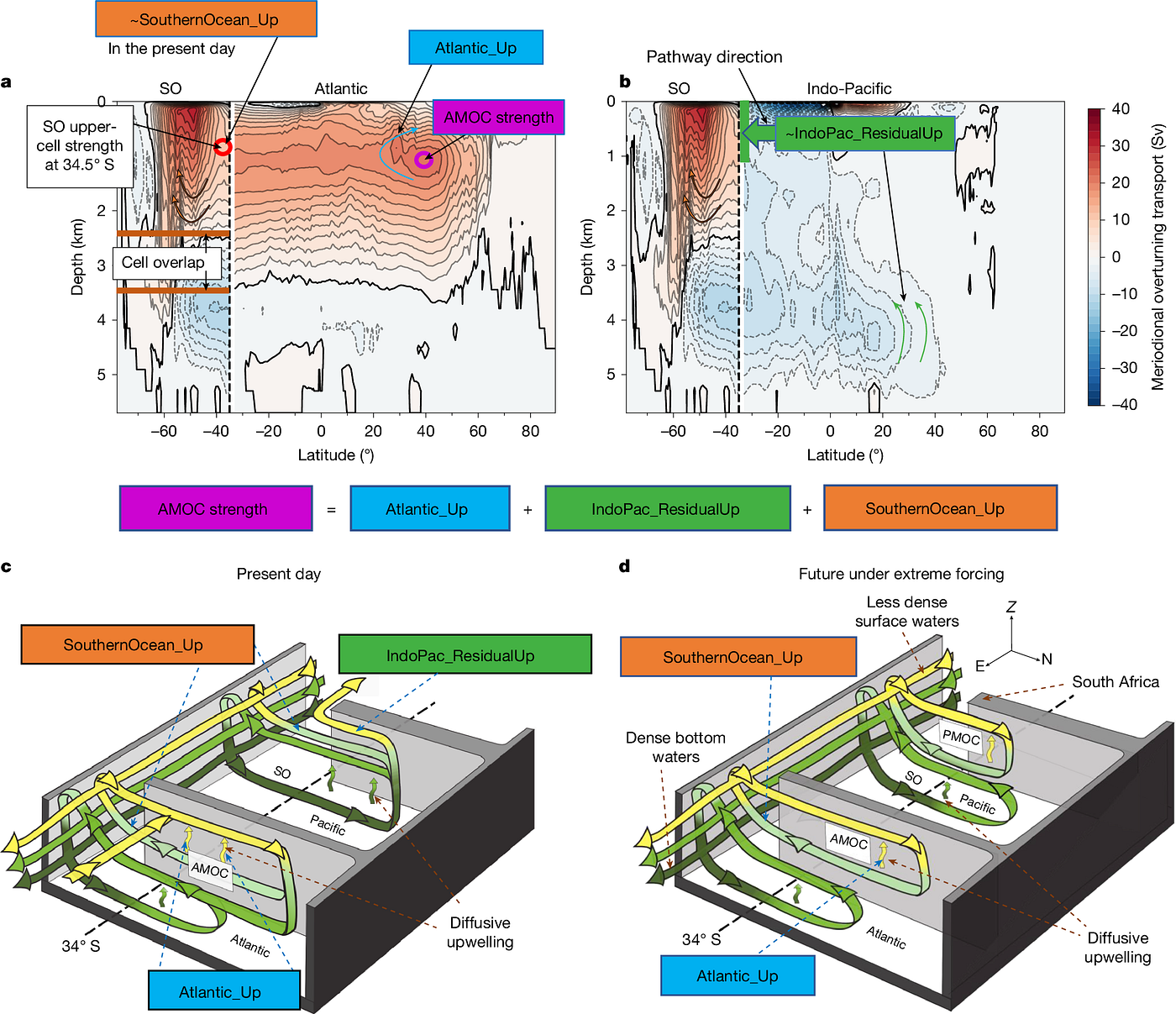
Schematic and analysis method for AMOC upwelling pathways (Source: Continued Atlantic overturning circulation even under climate extremes)
For more than twenty years since Hollywood’s premiere, the public story could only hold one of these at a time, alarm or dismissal, and the loudest voices picked whichever one paid better that week. The actual answer is that the current is being wounded and held up at the same time, by two different forces, at two different ends of the planet.
Something Has To Keep Sinking
The collapse story is a northern story, and it runs like this:
Greenland melts. Freshwater floods the North Atlantic. Freshwater is lighter than salt water, so it sits on top and refuses to sink. Since the sinking near Greenland is the engine that pulls the whole conveyor north, kill the sinking and you kill the current.
It is clean, it is frightening, and it treats the North Atlantic as the only switch in the current.

Planetary wave adjustment mechanism (Source: Weakening of the Atlantic Meridional Overturning Circulation driven by subarctic freshening since the mid-twentieth century)
Baker’s team found the switch has a second wire, and it runs to Antarctica:
Around the bottom of the world, a ring of ferocious westerly winds circles the continent with no land to slow them down. Those winds drag surface water away from Antarctica, and to replace it, water has to rise up from the deep ocean. This upwelling is a suction pump at the far end of the Atlantic, and it does not care about Greenland at all. It pulls on the whole global circulation from the south. As long as those winds blow, water keeps getting pulled up in the Southern Ocean, and that water has to be replaced by water sinking somewhere else. The models say it can only be replaced from the North Atlantic or the North Pacific.
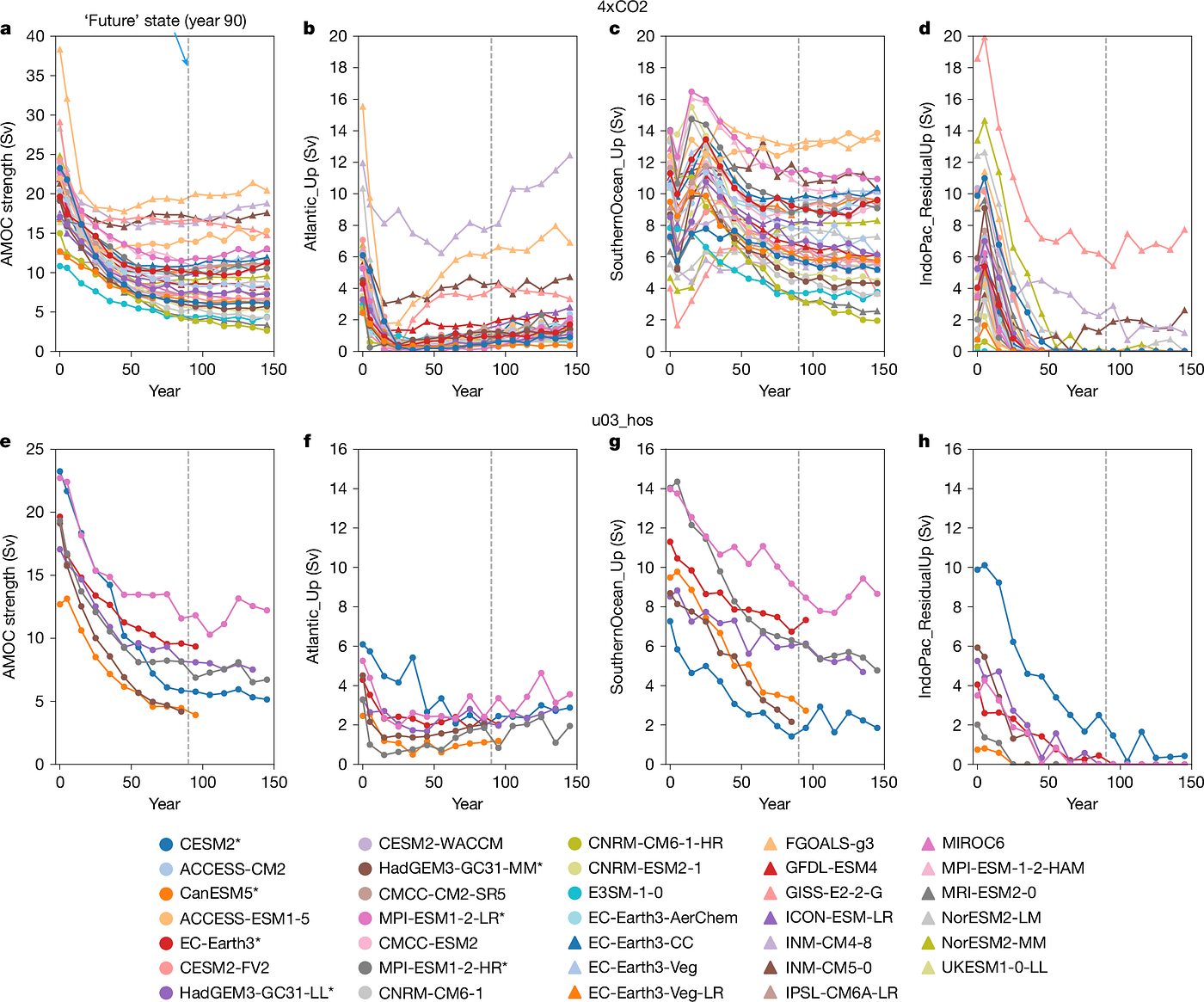
SO upwelling sustains future AMOC strength: Decadal-mean evolution of AMOC strength and upwelling pathways under extreme-forcing scenarios (Source: Continued Atlantic overturning circulation even under climate extremes)
Choke the northern sinking with meltwater, and the southern winds still pull. Something in the north has to keep sinking to feed them.
Baker’s team checked whether the Pacific could grow a matching pump and take over, letting the Atlantic die entirely. In almost every model a Pacific version tried to form. In none of them did it grow strong enough. So the current cannot flatline. The southern pump won’t let it. It can drop to a fraction of its strength, a slow bleed rather than a clean decapitation, but the Southern Ocean winds hold a thread of it open from fourteen thousand kilometers away.
And the past confirmed it. The whole collapse fear rests on a story from the ice ages: massive freshwater pulses hit the North Atlantic, the current switched off, the cold came. In January, a team led by Jack Wharton and David Thornalley pulled sediment cores from the seafloor five hundred miles east of New York and read the temperature of the deep water during the last ice age, twenty thousand years ago, the exact moment the current was supposed to have died. The deep water was 1.8°C colder than today, far from the near-freezing sludge the collapse story requires.
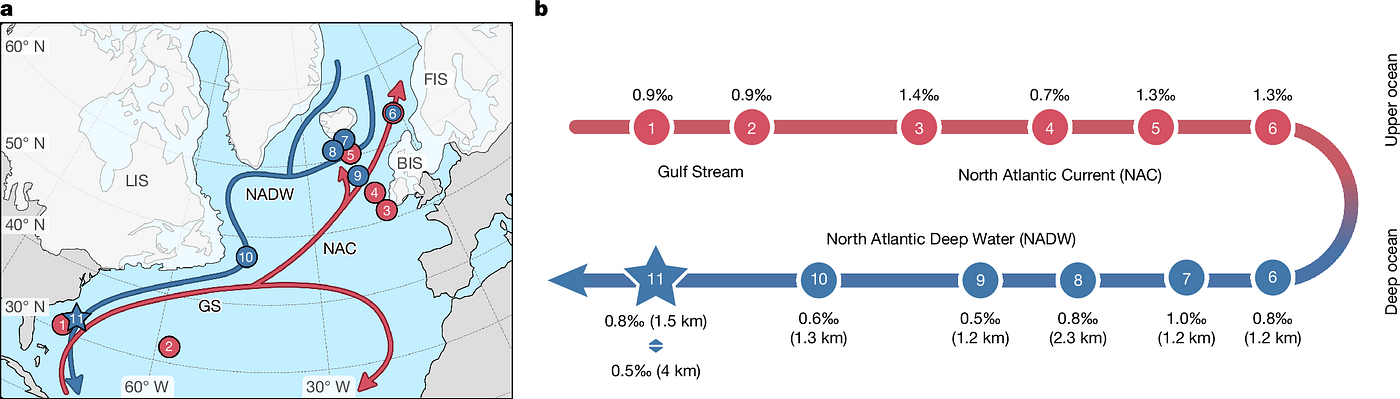
Map showing the location of core sites used to reconstruct surface-ocean (red filled circles) and deep-ocean (blue filled circles) from the glacial North Atlantic (Source: Relatively warm deep-water formation persisted in the Last Glacial Maximum)
It was still forming, still sinking, still filling the same depths it fills now. The off switch that the whole nightmare depends on may never have been thrown at all.
And the freshwater we fear most turns out to be a smaller hammer than the story needs. A separate team led by Oliver Mehling ran a fine-grained ocean model with realistic Greenland melt through 2100. The extra weakening from all that meltwater came to about 0.6 Sverdrup, a rounding error next to the weakening from warming alone. What was thought to be the trigger barely moves the needle inside the century.
A Wound Is Not Nothing
To be clear: none of this is permission to relax and perpetuate this pointless system of overconsumption and pollution, and the same scientists making the reassuring case are the first to say so.
A current at half strength is not a healthy current. Baker’s own definition of collapse is a drop below six Sverdrup; staying above that line is survival, not health. A weakened AMOC still shifts rain belts, still speeds up flooding along the US southeast coast, still hardens winters in parts of northern Europe — all as the planet cooks. The last time this current stalled (four hundred thousand years ago in a climate a little warmer than ours) the North Atlantic region cooled by up to 7°C while the world around it warmed. Thornalley even calls that period the poster child for where we might be heading.
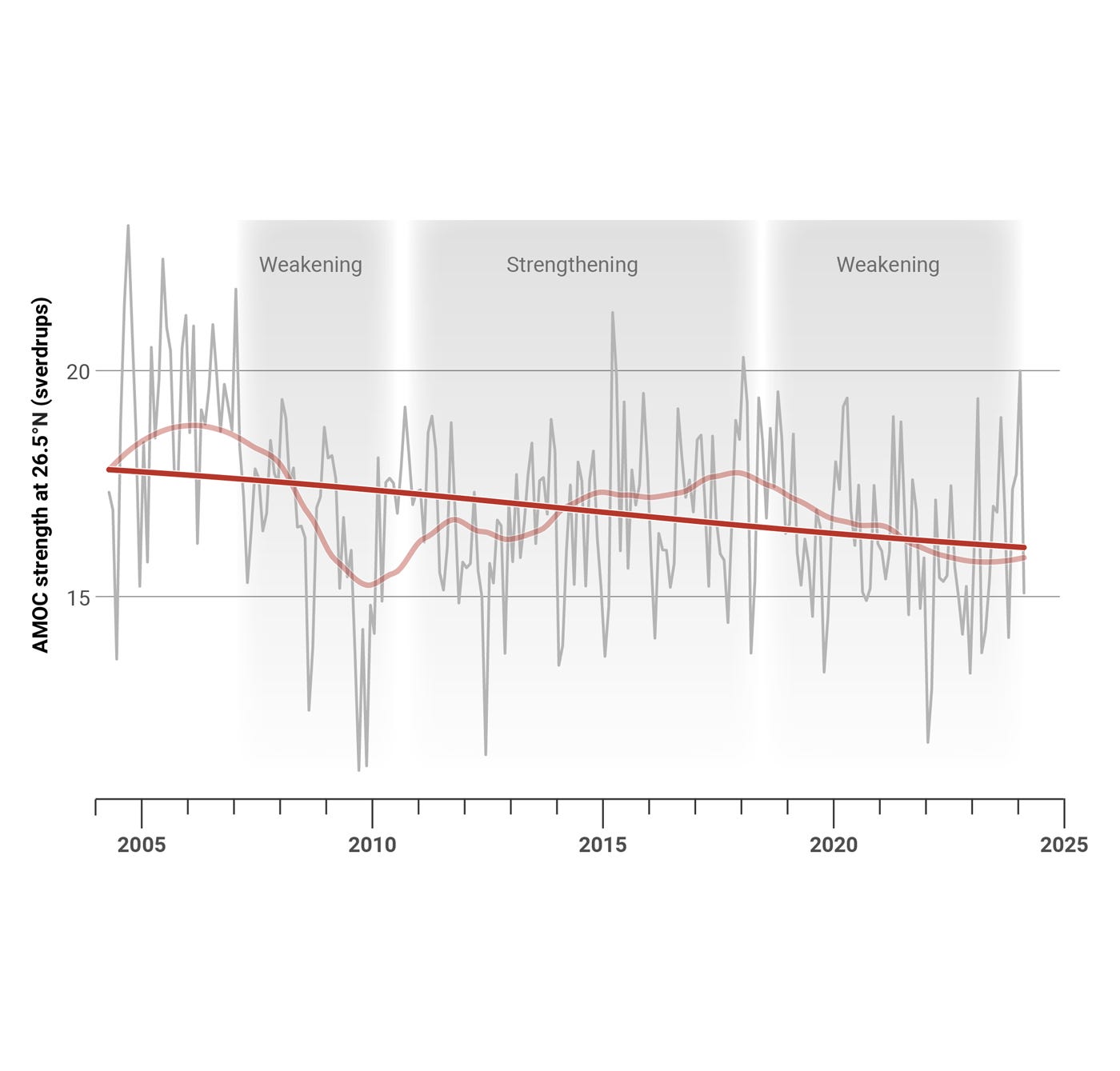
Source
Half a current is enough to reorganize the weather of a continent. It just isn’t the frozen library.
However, the thread holding the current open, the Southern Ocean winds, is not a fixed law of the universe. Those winds have been strengthening and migrating south as the planet warms and the ozone hole heals, faster in the last 60 years than at any point in the previous 140, and what a warmer century does to them over the long run is its own open question.
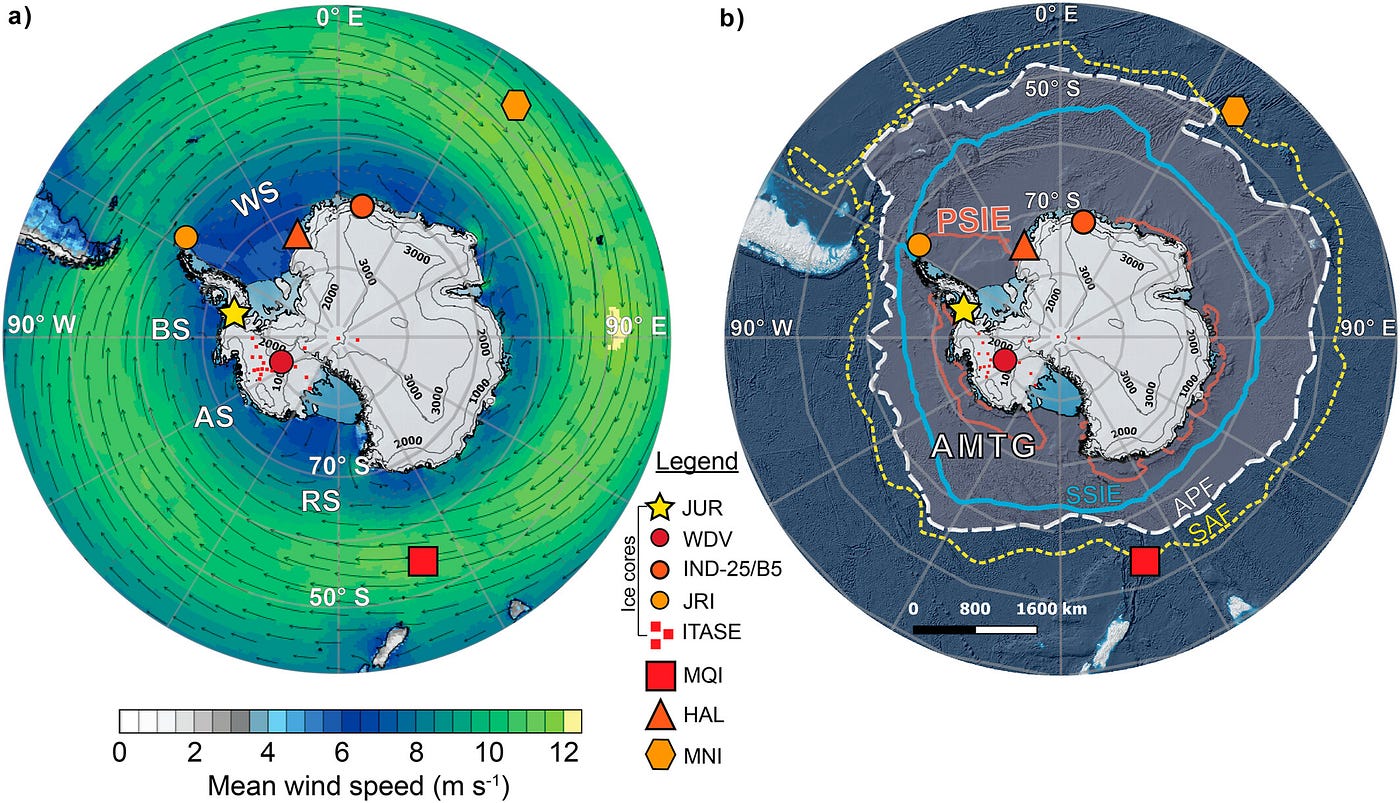
(a) The JUR site in relation to the Southern Hemisphere Westerly Winds belt. (b) The JUR site in relation to oceanographic zones around Antarctica. (Source: Timing of the Recent Migration and Intensification of the Southern Hemisphere Westerly Winds)
This Is What It Looks Like When Science Works
Rahmstorf’s team confirmed the current is weakening. Baker’s showed it probably won’t collapse. Wharton and Thornalley read the ice age and found the historical collapse may never have occurred, and Mehling checked the meltwater and found it too small to matter much this century. None of them cancels the others. Stacked together, they resolve into a single, more accurate puzzle: wounded, not dead, held up by two different forces, at two different ends of the planet.
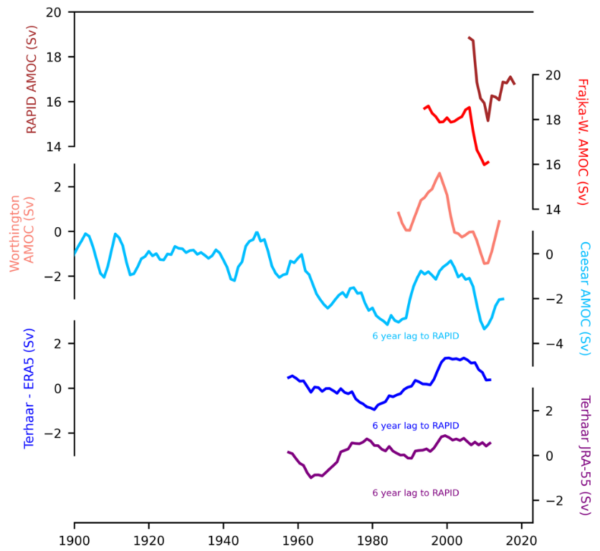
Several (convenient) AMOC reconstructions, with the RAPID measurements on top (Source: High-resolution ‘fingerprint’ images reveal a weakening Atlantic Ocean circulation (AMOC))
That is the scientific method doing exactly what it is built to do. A frightening early signal gets tested, narrowed, corrected, and complicated by the next study and the next, until the crude first alarm becomes a truer and stranger map. Each paper is an argument the others have to answer. The puzzle pieces get harder to fit together because people kept measuring, and kept disagreeing in print, and kept pulling cores out of the seafloor ten hundred miles from anywhere.
Compare that to how the same finding travels once it leaves the ocean. A weakening current becomes a FROZEN STATUE OF LIBERTY. A stabilizing mechanism becomes a CLIMATE HOAX. A retired emissions scenario becomes a president typing *WRONG WRONG WRONG* into a phone. The ocean does not deal in single words shouted in capital letters. It gives back gradients, thresholds, competing pumps, numbers that only make sense next to other numbers and that may never for a complete puzzle in front of our eyes. The science that studies it has learned to speak the same way, in claims that expect to be corrected.
Ben Moat is still on that ship, waiting for the next float to surface, and the data it carries won’t settle the argument either. It will sharpen it. Somewhere below him a current that has warmed my half of the world for eight thousand years is running slower than it used to, and faster than the frightened story said it would, and it will keep doing both while people who never went to sea decide which single word to scream about it this week.
The float breaks the surface. The instruments come up crusted in barnacles. Someone downloads two more years of readings that will correct the last two, and be corrected in turn.
M.
Here’s **where you can directly support my work. I am deeply grateful! And if something’s on your mind, reach out. [My inbox is always open.](mailto: martinah.awanderer@gmail.com)**
메타데이터
- post_id
- 2232b45862ed
- slug
- the-amoc-is-weakening-but-it-wont-collapse-2232b45862ed
- url
- https://medium.com/southern-winds/the-amoc-is-weakening-but-it-wont-collapse-2232b45862ed
- canonical_url
- https://medium.com/southern-winds/the-amoc-is-weakening-but-it-wont-collapse-2232b45862ed
- author_url
- https://medium.com/@martinah.awanderer
- status
- ok
- fetched_at
- 2026-07-09 03:40:04