Generative Adversarial Networks (GANs), Variational Autoencoders (VAEs), and Transformers
Generative Adversarial Networks (GANs), Variational Autoencoders (VAEs), and Transformers are all powerful models in the field of machine…
Generative Adversarial Networks (GANs), Variational Autoencoders (VAEs), and Transformers
Generative Adversarial Networks (GANs), Variational Autoencoders (VAEs), and Transformers are all powerful models in the field of machine learning and AI, but they are used for different purposes and have distinct architectures. Here’s a breakdown of the differences between them:
Generative Adversarial Networks (GANs)
Purpose: GANs are primarily used for generative tasks, such as generating realistic images, videos, or other data.
Architecture: GANs consist of two networks:
- Generator: Creates fake data (e.g., images).
- Discriminator: Tries to distinguish between real and fake data.
How It Works: The generator produces fake data, and the discriminator evaluates it against real data. The two networks are trained in a competitive process, where the generator improves to create more realistic data, and the discriminator gets better at detecting fakes.
Applications: Image generation (e.g., deepfakes, art generation), style transfer, super-resolution of images.
Key Advantage: Produces high-quality samples of data (e.g., very realistic images).
Challenge: Training GANs can be unstable due to the adversarial nature, and they may suffer from issues like mode collapse, where the generator produces limited variety in the generated samples.
Variational Autoencoders (VAEs)
Purpose: VAEs are also used for generative tasks, but they focus on learning a latent representation of the data, which can be used to generate new data points or reconstruct the input. The latent representation in a VAE is a compressed, low-dimensional encoding of the original data that captures the important underlying structure. It’s a way to summarize complex information using fewer numbers, making it easier to store, process, and use for various tasks like generating new data. It’s not a perfect representation, but a good approximation that preserves the most essential characteristics.
Architecture: VAEs consist of two networks:
- Encoder: Maps input data to a latent space (compressed representation).
- Decoder: Reconstructs the input data from the latent space.
How It Works: The encoder learns a probabilistic distribution (often Gaussian) in the latent space. The decoder samples from this distribution to generate new data. VAEs minimize the reconstruction error while ensuring the latent space is structured (using a loss function that includes both reconstruction loss and a regularization term for the latent space).
Applications: Image reconstruction, anomaly detection, data compression, and generating new samples similar to the training data.
Key Advantage: VAEs provide a smooth latent space where interpolation between points is meaningful (e.g., blending two images together).
Challenge: While VAEs are easier to train than GANs, the quality of generated data is often lower (more blurry, less sharp) compared to GANs.
Transformers
Purpose: Transformers are primarily used for sequence modeling tasks, such as natural language processing (NLP), but they have also been applied to tasks like image generation. Their key advantage is handling long-range dependencies in sequential data.
Architecture: Transformers are built around the self-attention mechanism, which allows the model to weigh the importance of different elements in the input sequence when making predictions.
- Encoder: Processes the input sequence and learns its representation.
- Decoder: In generation tasks (like machine translation), the decoder generates the output sequence.
How It Works: Transformers use attention mechanisms to focus on different parts of the input, allowing them to handle long dependencies in data. The model computes attention weights that decide which parts of the input are more important when generating the output.
Applications: Language models (e.g., GPT, BERT), translation, summarization, image processing (e.g., Vision Transformers), speech recognition.
Key Advantage: Transformers are highly effective at capturing dependencies in data, handling long sequences better than traditional recurrent neural networks (RNNs) or convolutional networks (CNNs). They are scalable and have become the dominant architecture in NLP.
Challenge: Transformers are computationally expensive due to the large number of parameters and attention computations, especially for very long sequences.
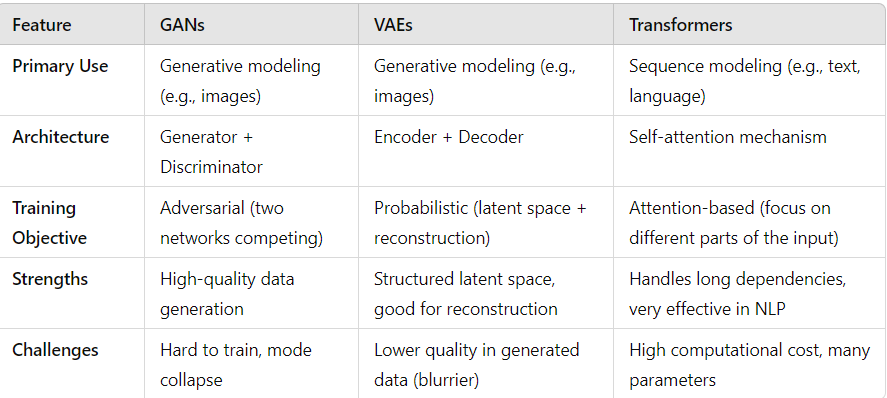
Conclusion:
- GANs are great for generating realistic data, particularly images, through an adversarial training process.
- VAEs are used for generative tasks with a focus on a structured latent space, making them useful for interpolation and reconstruction.
- Transformers excel at sequence-based tasks like language modeling and have revolutionized NLP, but they are also expanding into other domains like image processing.
메타데이터
- post_id
- 225528564544
- slug
- generative-adversarial-networks-gans-variational-autoencoders-vaes-and-transformers-225528564544
- url
- https://medium.com/@ajayverma23/generative-adversarial-networks-gans-variational-autoencoders-vaes-and-transformers-225528564544
- canonical_url
- https://medium.com/@ajayverma23/generative-adversarial-networks-gans-variational-autoencoders-vaes-and-transformers-225528564544
- author_url
- https://medium.com/@ajayverma23
- status
- ok
- fetched_at
- 2026-06-26 03:39:16






