Singapore’s model for scaling AI in healthcare
Trust starts with rules
Singapore’s model for scaling AI in healthcare
Trust starts with rules
Singapore is showing an interesting direction for the development of AI focused on building the conditions needed to scale technology. These conditions include clear rules of responsibility, risk assessment, transparency toward patients and a division of roles between algorithm developers, healthcare organizations and medical professionals.
In March 2026, Singapore’s Ministry of Health and the Health Sciences Authority published updated guidelines Artificial Intelligence in Healthcare Guidelines 2.0, referred to as AIHGle 2.0. The document builds on the earlier 2021 framework and responds to new challenges, including the development of generative AI and the increasingly deep integration of algorithms into clinical practice. Singapore’s regulator emphasizes that AI should strengthen the work of healthcare professionals, improve patient care and operate in an environment where patient safety remains central.
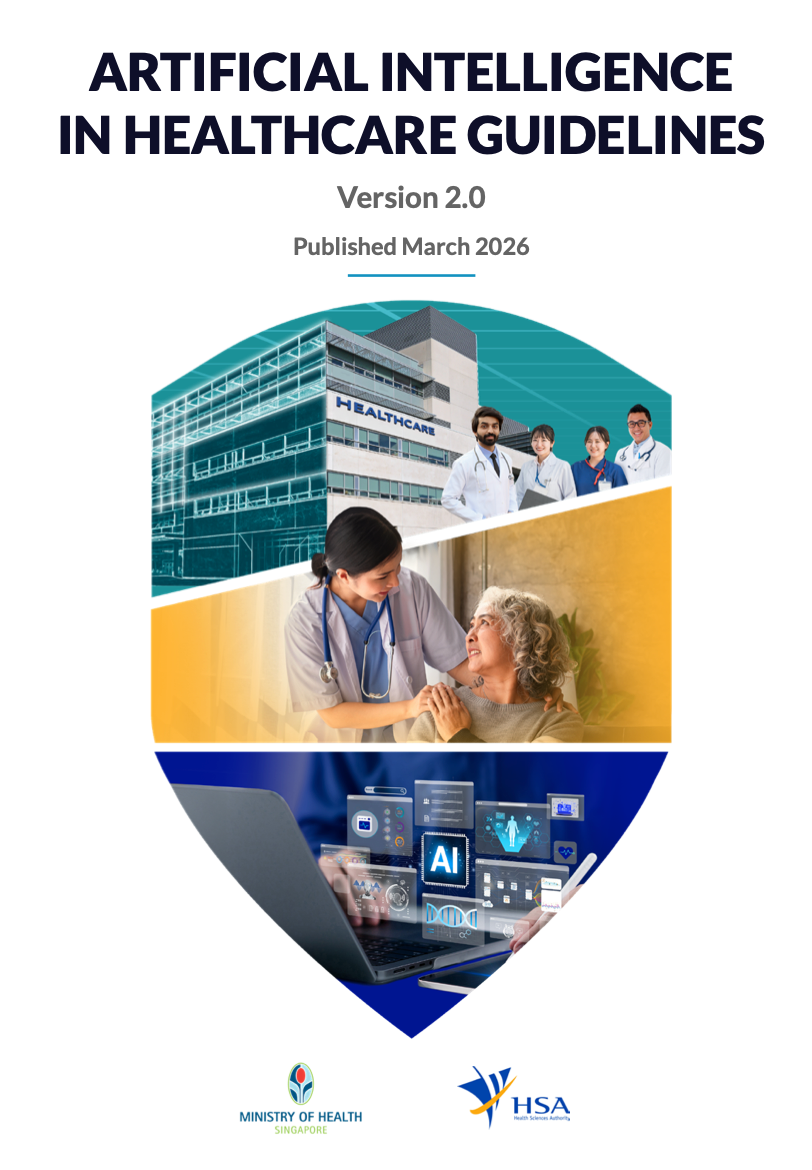
https://isomer-user-content.by.gov.sg/3/7c8046e3-0bbf-4f68-bd94-d9e0b67e1efa/AIHGle%202.0.pdf
The most important change concerns the operationalization of responsibility. AIHGle 2.0 specifies the roles of three groups:
- developers, meaning the creators and manufacturers of AI solutions;
- deployers, meaning healthcare organizations implementing these solutions
- and users, meaning medical professionals using AI in practice.

This division is highly significant because it reduces one of the main implementation barriers: uncertainty over who is responsible for the quality of training data, validation, integration with the clinical process, monitoring model performance, staff training and responding to adverse events.
Singapore treats AI risk as an issue spanning the entire technology life cycle. The guidelines identify risks at the stages of development, deployment and use. These include already well-known challenges: poor quality of training data, bias affecting treatment outcomes, insufficient testing on diverse populations, problems integrating AI with technical infrastructure and workflows, lack of monitoring, insufficient staff training, misinterpretation of results by users, delayed detection of model degradation, hallucinations in real-world clinical settings and unclear accountability frameworks.

In this approach, trust in AI does not come from the technology provider’s declarations, but from governance. A healthcare organization deploying AI must know how to assess the solution, how to monitor its performance, how to train users and how to respond when the system begins to generate risk. For this reason, AIHGle 2.0 complements regulations on software as a medical device and provides practical guidance on the safe development, deployment and use of AI in healthcare.
Singapore, however, does not limit itself to documents. In practice, it is developing AI solutions in areas that directly affect the quality of care and system efficiency. One example is the ENTenna project at Ng Teng Fong General Hospital. The project combines patient-reported data, AI analytics, chatbots and clinical support to personalize treatment, improve adherence and support the transfer of patients to the appropriate level of care. Early evaluations based on hospital electronic medical records indicated a 45% increase in appropriate transfers of patients from specialist outpatient care to primary care, as well as up to a 25% increase in adherence and patient engagement.
This example clearly shows where Singapore is looking for value from AI, not only in diagnostics, but also in organizing patient flow, directing patients to the right levels of care, relieving pressure on specialist services and improving continuity of care. With an ageing population and growing demand for medical services, such applications can have truly significant impact.
[embed]
메타데이터
- post_id
- 227fec8880e8
- slug
- singapores-model-for-scaling-ai-in-healthcare-227fec8880e8
- url
- https://medium.com/digital-health-brief/singapores-model-for-scaling-ai-in-healthcare-227fec8880e8
- canonical_url
- https://medium.com/digital-health-brief/singapores-model-for-scaling-ai-in-healthcare-227fec8880e8
- author_url
- https://medium.com/@karolinatadel
- status
- ok
- fetched_at
- 2026-06-14 11:28:49