The Hidden Trap of “Fair AI Over Time”: Why Your Self-Learning Agent Can’t Fix Its Own Bias
Your AI assistant promises to learn and adapt. But new research proves that fairness across user groups has a hard mathematical limit that…
The Hidden Trap of “Fair AI Over Time”: Why Your Self-Learning Agent Can’t Fix Its Own Bias
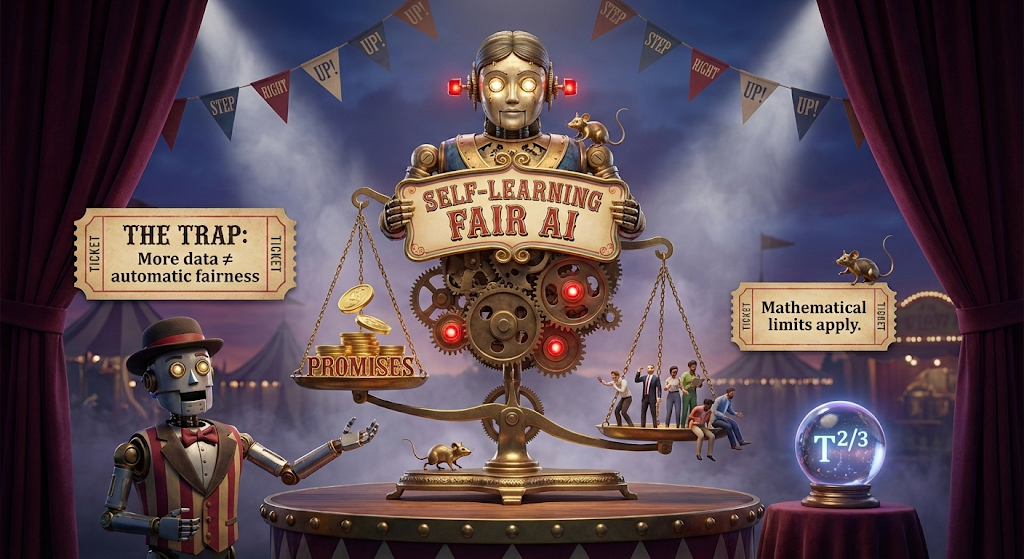
all images generated with nano-banana-pro and agents
Your AI assistant promises to learn and adapt. But new research proves that fairness across user groups has a hard mathematical limit that no algorithm can overcome.
As CES 2026 showcases AI agents embedded in everything from smart TVs to wearables, engineering teams are making a dangerous assumption. They believe that as these systems learn from more interactions, fairness issues will simply “calibrate themselves” over time. After all, more data equals better performance, right?
Not so fast. A groundbreaking paper released in January 2026 proves something that should make every AI product team pause: ensuring fairness across multiple user groups in real-time has a fundamental mathematical limit. No clever algorithm can overcome it. And if your team is promising that your AI will “learn to treat everyone fairly,” you might be walking into a trap.

The Promise That Sounds Too Good
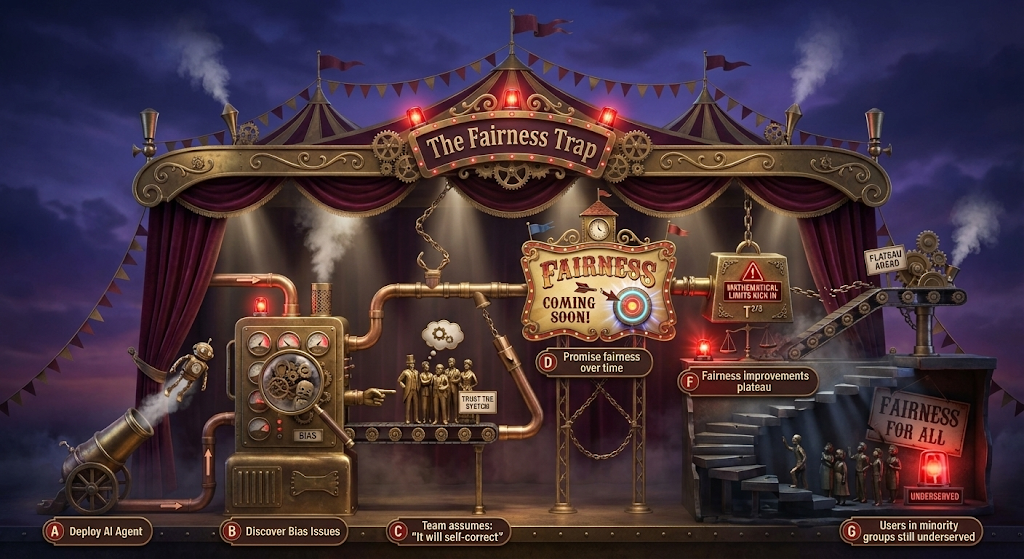
Picture this scenario. A team deploys a voice assistant for smart homes. Early testing reveals biases: the system understands some accents better than others, works great for adults but struggles with children’s voices. The team’s response? “No problem. Our system learns continuously. The more people use it, the fairer it gets.”
This intuition feels right. We know machine learning improves with more data. We know systems can adapt. But here’s the catch: online multicalibration (ensuring fairness across many groups simultaneously while learning in real-time) is fundamentally harder than simple overall accuracy improvement.
Understanding the Core Problem: Marginal vs. Multicalibration
Before diving deeper, let’s clarify what calibration actually means. A model is calibrated when its predicted probabilities match reality. If a system predicts “80% chance of rain” across many days, roughly 80% of those days should actually see rain.
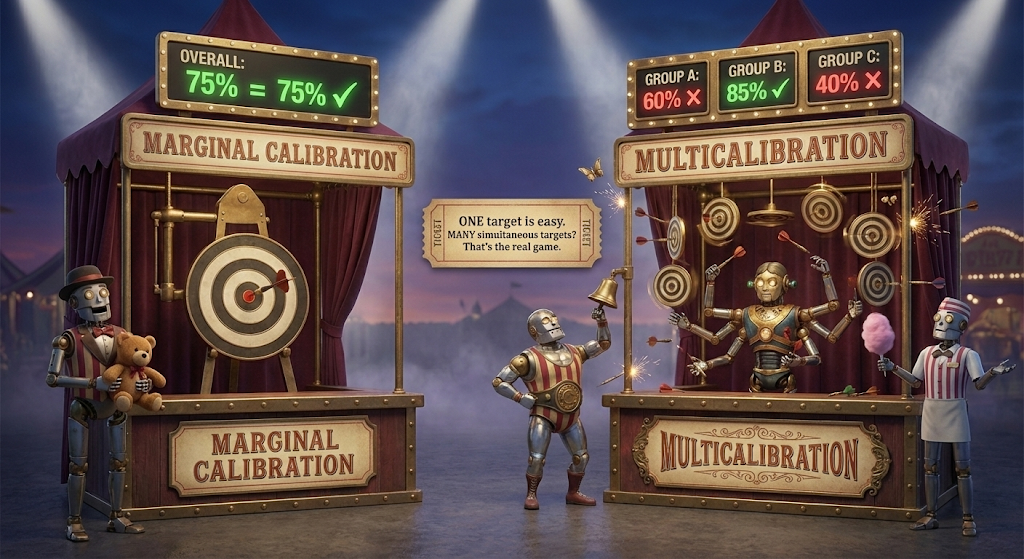
Marginal calibration (also called single-group calibration) only requires this alignment overall. It’s a one-dimensional target: match your predictions to actual outcomes across your entire user base.
Multicalibration is far more demanding. The model must be calibrated for every relevant subgroup simultaneously: different age groups, accent types, locations, device types, times of day, and every meaningful intersection of these attributes.
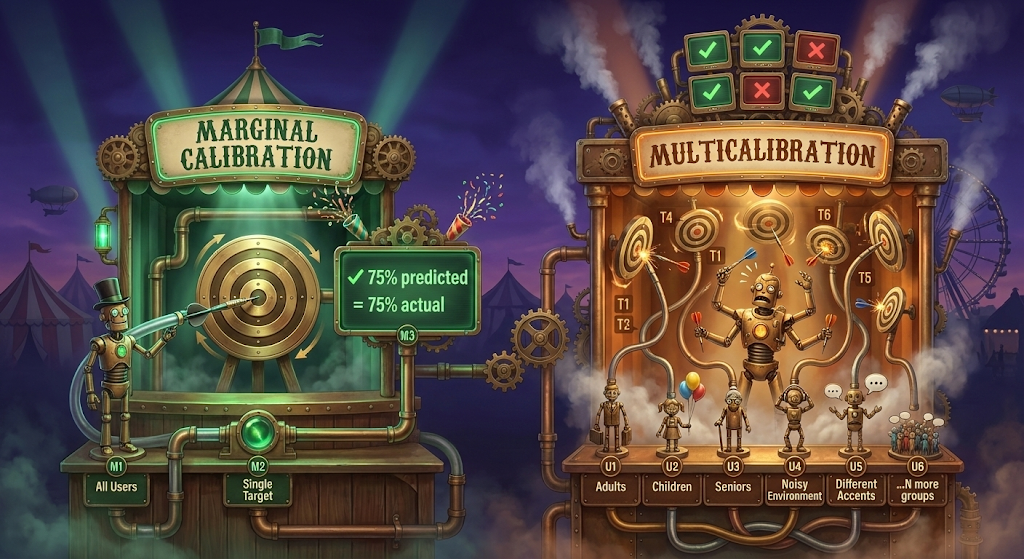
Here’s where the trap springs: a predictor can appear perfectly calibrated overall while remaining severely miscalibrated on specific groups. Your dashboard shows green metrics across the board, but certain user populations are getting a systematically worse experience.

The Hard Mathematical Limit
The January 2026 paper by Collina et al. proves something engineers need to internalize: there is a tight lower bound on how quickly multicalibration error can decrease. In plain terms, no online algorithm can guarantee fast fairness calibration across groups.
The math works out to roughly a T^(2/3) cumulative error rate. This means if you measure calibration error over T interactions, the best possible algorithms still see error terms that scale with T to the power of 2/3. Compare this to marginal calibration, which can achieve faster convergence closer to T^(1/2).
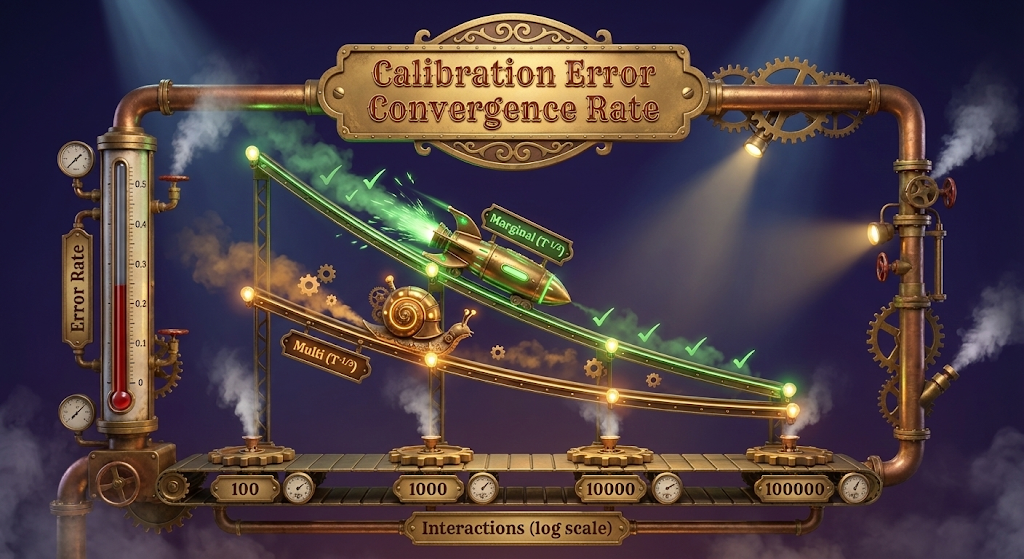
What does this mean practically? To halve your multicalibration error, you need roughly eight times more data (since 2³ = 8). Engineering teams that set quarterly OKRs expecting quick wins on multi-group fairness are setting themselves up for disappointment.
Even more striking: these lower bounds hold with as few as three groups when those groups are defined adversarially. You don’t need hundreds of demographic intersections to hit this wall. Even a “simple” case forces the slow convergence rate.
Seeing the Problem in Code
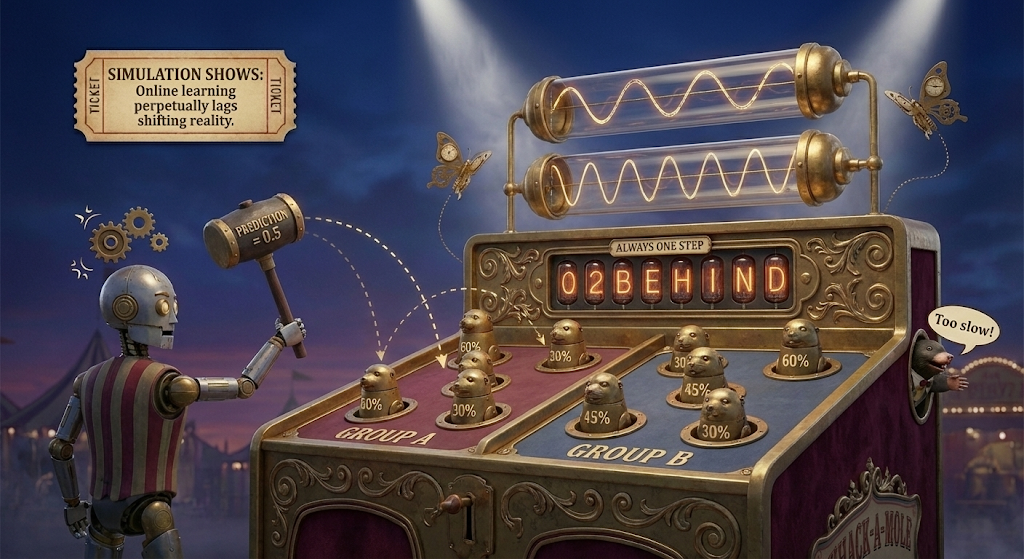
Let’s make this concrete with a simulation. We’ll create two user groups with different and changing outcome probabilities, then watch how a naive online calibration approach struggles.
Setting up the simulation:
import math, random

T = 1000  # number of rounds
groups = ["A", "B"]

# True probability functions for each group (varying over time)
true_prob = {
    "A": lambda t: 0.6 + 0.3 * math.sin(t / 50.0),  # Oscillates around 60%
    "B": lambda t: 0.3 + 0.2 * math.sin(t / 30.0 + 1.5)  # Oscillates around 30%
}

# Initial predictions (uninformed)
pred = {"A": 0.5, "B": 0.5}
Both groups start at 50% predicted probability, but their true rates differ significantly. Group A hovers around 60%, Group B around 30%. The model is immediately miscalibrated.
Running the online calibration loop:
alpha = 0.05  # learning rate
calib_errors = {"A": [], "B": []}

for t in range(1, T + 1):
    group = random.choice(groups)
    outcome = 1 if random.random() < true_prob[group](t) else 0

    # Track calibration error
    error = abs(pred[group] - true_prob[group](t))
    calib_errors[group].append(error)

    # Online update
    pred[group] = pred[group] + alpha * (outcome - pred[group])
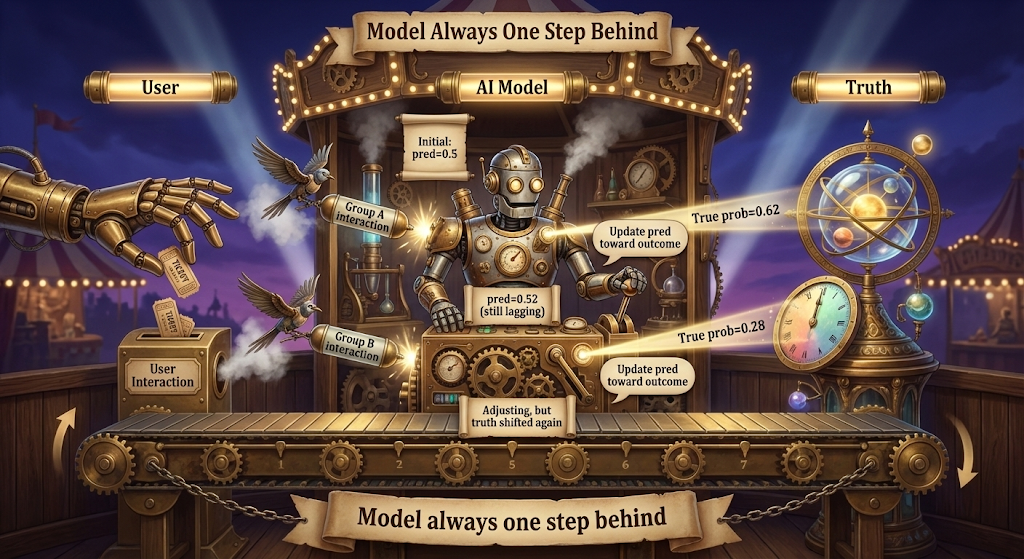
The result? The model’s predictions perpetually lag behind the oscillating true probabilities. Because groups alternate and their true rates shift, the model never “catches up.” The calibration error shrinks, but slowly, and never reaches zero.
The Combinatorial Explosion Problem
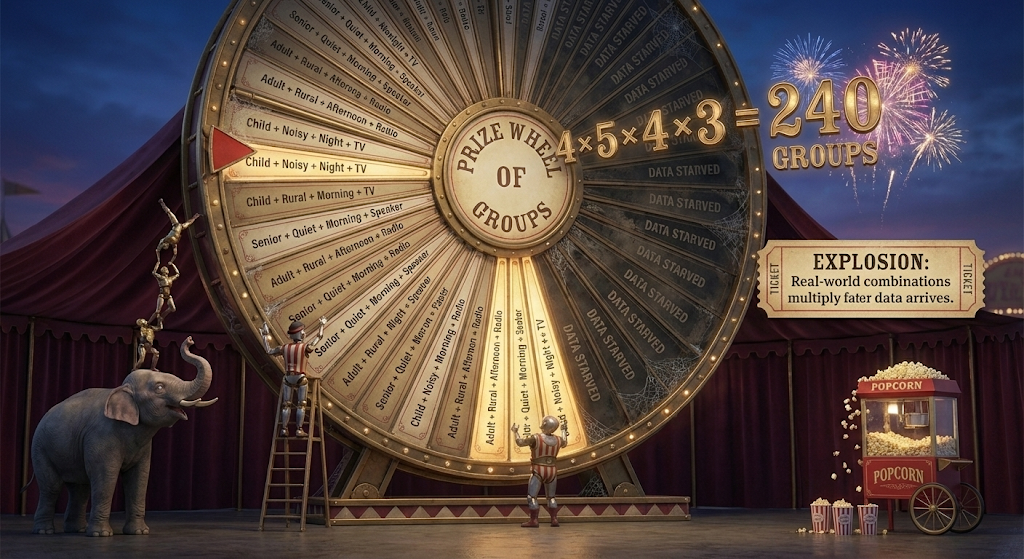
Real-world complexity makes this worse. Consider a voice assistant interacting with multiple family members. The system needs calibration for adults, children, teenagers, and seniors. But then add environmental context: quiet rooms, noisy kitchens, outdoor areas. Add time of day: morning routines, late-night queries. Add device types: smart speaker, TV, car system.
Each combination creates a potential group. A child speaking in a noisy kitchen at night becomes its own calibration target. The number of groups grows combinatorially.
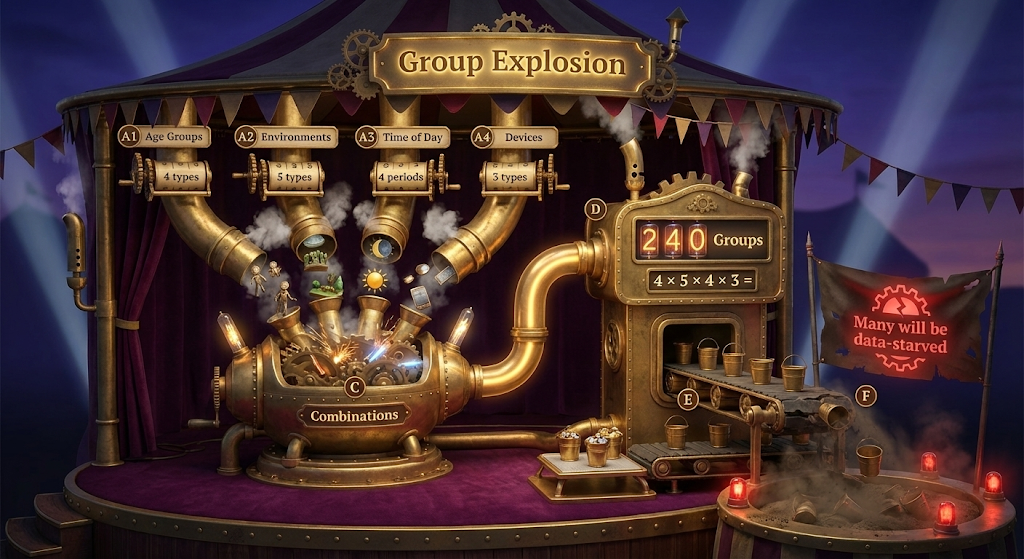
Teams that promise “the AI will adjust for everyone over time” are stepping into a statistical minefield. Some combinations will simply never have enough data for proper calibration during any reasonable deployment timeframe.
Building a Fairness Monitoring System
Since we can’t eliminate the problem, we must make it visible. Here’s an architecture for continuous fairness monitoring:
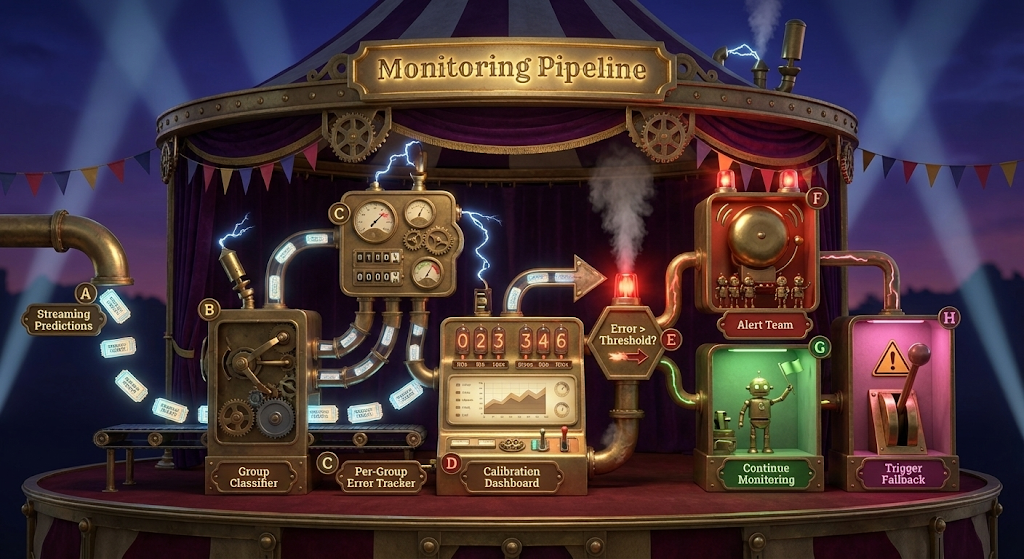
Every prediction gets tagged with relevant group attributes. A monitoring module tracks calibration error for each group in real-time. When any group’s error exceeds a threshold (say, 10%), the system alerts engineers and can trigger fallback behaviors.
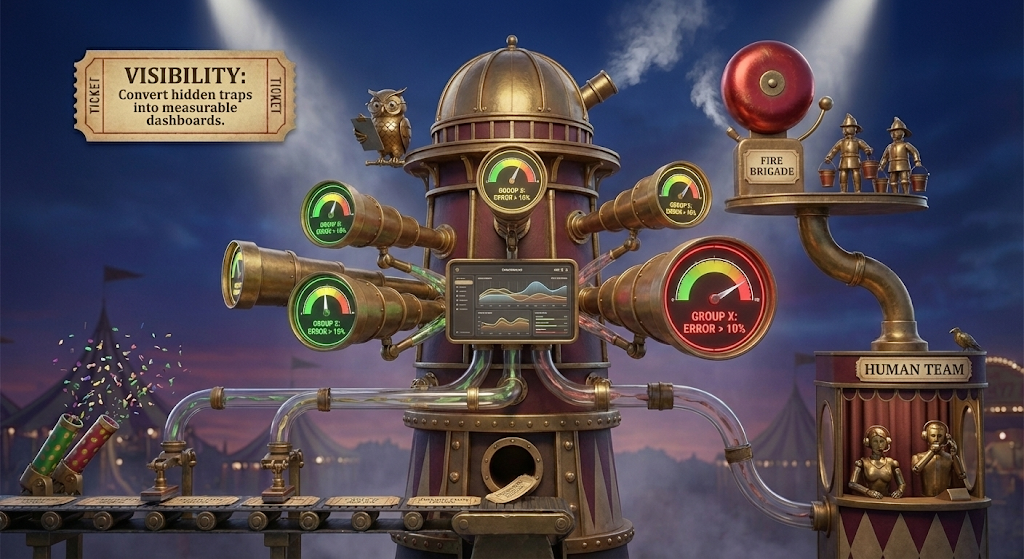
This approach converts the hidden trap into a visible dashboard. Instead of assuming “it’s learning, all is good,” teams get data on exactly where fairness is failing.
What You Cannot Promise (And What You Can)
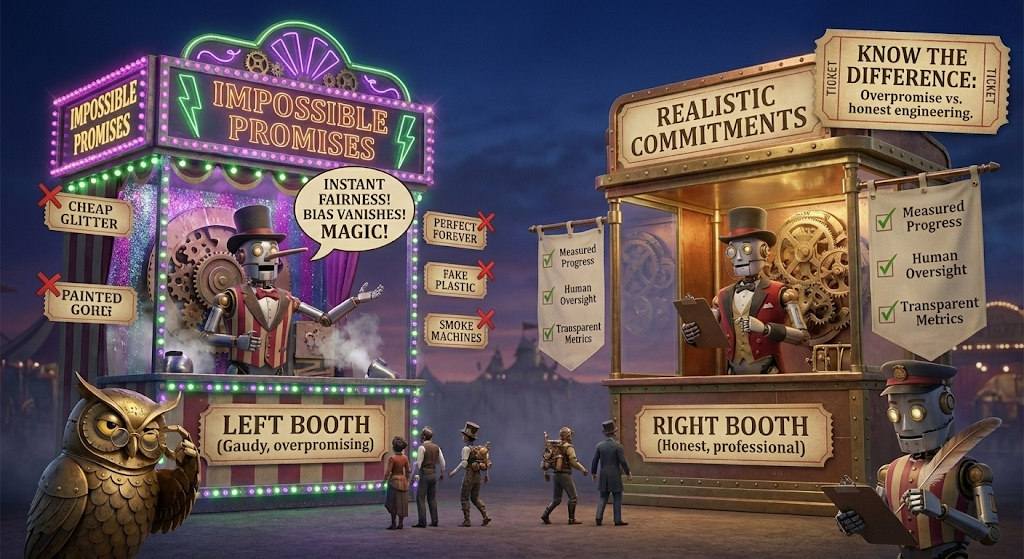
Let’s be direct about what guarantees are mathematically impossible:
Impossible: “Our AI will learn to be fair to everyone in real-time.”
Impossible: “After a month of data, the AI will treat every subgroup fairly.”
Impossible: “Bias will automatically disappear as we scale.”
What you can commit to:
Realistic: “We measure and progressively reduce bias with human oversight.”
Realistic: “We have fallback policies for groups where calibration is insufficient.”
Realistic: “We maintain transparency about current fairness metrics.”
Designing Fallback Policies
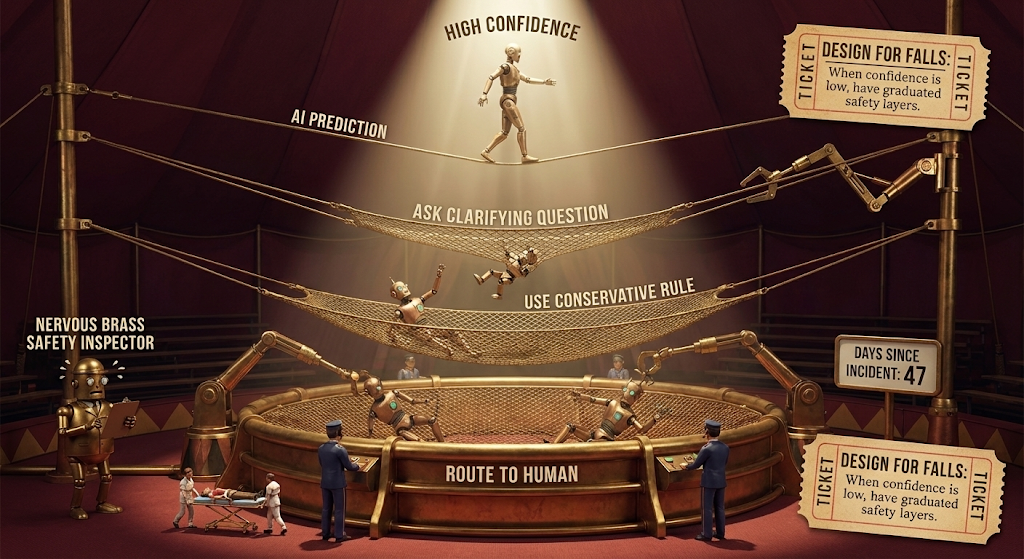
Because some fairness gaps won’t auto-fix quickly, design your system in layers:
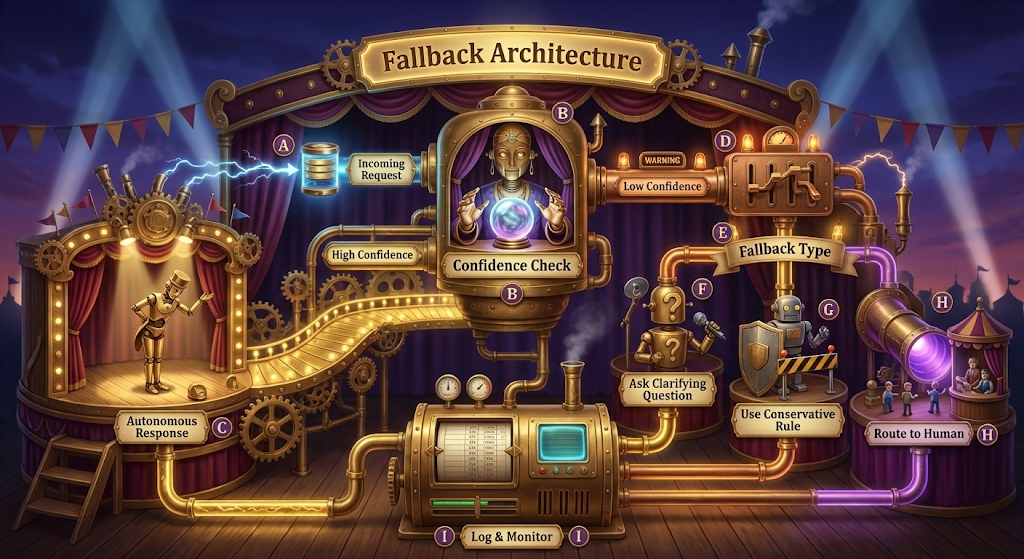
Confidence-based routing prevents the AI from making egregious errors in areas where it hasn’t learned enough. If the model is uncertain (often correlating with novel or underserved inputs), it takes a safer path: asking questions, using simpler rules, or escalating to humans.
Periodic offline recalibration complements online learning. Pure online updates might not catch up, but you can periodically pull data into offline retraining with stronger fairness constraints. Batch multicalibration techniques can achieve what online methods cannot.
User feedback loops help identify groups the system missed. When complaints cluster (users with particular accents reporting poor understanding), treat that as a new group definition for monitoring. Don’t assume your AI will automatically discover these patterns.
The Expert Pitfall: Self-Fulfilling Group Definitions
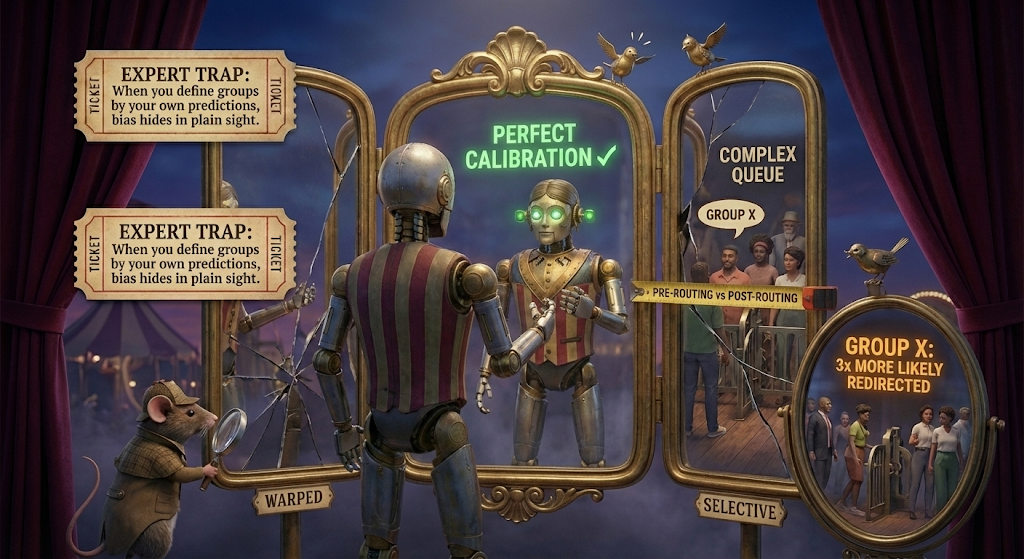
Here’s a subtle trap that catches even experienced teams. If your group definitions depend on the model’s own predictions, you can get a warped picture of calibration.
Consider a helpdesk AI that routes “simple” queries to automation and “complex” ones to humans. These categories are defined by the model’s own confidence scores. Measuring calibration only within these groups might show perfect results: high accuracy on “simple” (because the model only keeps cases it was confident about) and no errors on “complex” (humans handle those).
But this masks a fairness problem. The model might disproportionately flag certain users’ queries as “complex.” Minority dialect users might always get shunted to the human queue. Everything looks calibrated, but some groups are systematically treated differently.
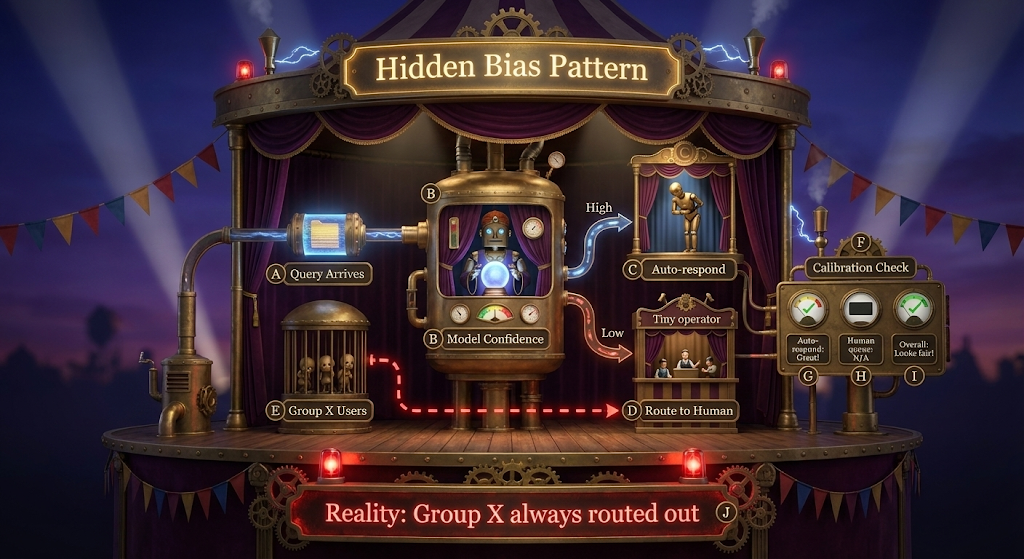
The fix: Log both pre-routing and post-routing predictions. Track how often different groups end up in each category. If one population is overrepresented in the “low confidence” bin, that’s a fairness gap, even if your calibration metrics on handled queries look fine.
Conclusion: Fairness as an Operational Challenge
The narrative at CES 2026 positions AI agents as teammates in daily life. For that relationship to be trustworthy across a diverse user base, we must recognize where online learning hits its limits.
The key insights from recent theoretical work on multicalibration:
Continuous learning does not guarantee continuous fairness improvement at an acceptable rate. There are proven mathematical limits on convergence speed. More data helps, but the returns are diminishing and slower than intuition suggests.
This doesn’t mean abandoning fairness in online systems. It means changing our approach:
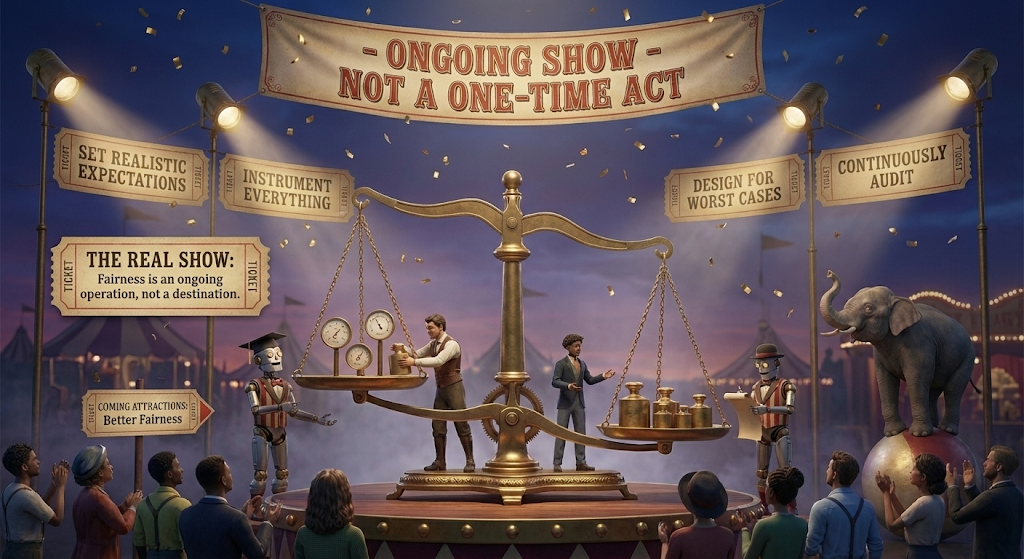
Set realistic expectations. Acknowledge the gradual nature of fairness improvement. Don’t overpromise.
Instrument everything. Treat fairness metrics as first-class monitoring signals. Surface them in real-time dashboards.
Design for worst cases. Assume some group will be hardest to serve. Build fallbacks and human oversight for when calibration isn’t good enough.
Continuously retrain and audit. Use incoming data for periodic offline retraining with fairness objectives. Audit decisions across groups regularly.
Fairness is not a one-time training goal but an ongoing operational challenge. It won’t solve itself with more data. It requires engineering rigor, mathematical humility, and honest communication with users. With the right approach, we can avoid the trap of false confidence and build AI agents that truly benefit all users.
References:
- Collina et al. (2026). “Optimal Lower Bounds for Online Multicalibration.” arXiv:2601.05245
- Gupta (2026). “Everything AI at CES 2026.” Times of AI
- Kim et al. “Multicalibration: Towards Fair Decision Making.” Simons Institute
- Quanta Magazine. “The Question of What’s Fair Illuminates the Question of What’s Hard.”
What fairness challenges have you encountered with learning systems? Share your experiences in the comments.
메타데이터
- post_id
- 2285782f6db4
- slug
- the-hidden-trap-of-fair-ai-over-time-why-your-self-learning-agent-cant-fix-its-own-bias-2285782f6db4
- url
- https://medium.com/@Micheal-Lanham/the-hidden-trap-of-fair-ai-over-time-why-your-self-learning-agent-cant-fix-its-own-bias-2285782f6db4
- canonical_url
- https://medium.com/@Micheal-Lanham/the-hidden-trap-of-fair-ai-over-time-why-your-self-learning-agent-cant-fix-its-own-bias-2285782f6db4
- author_url
- https://medium.com/@Micheal-Lanham
- status
- ok
- fetched_at
- 2026-06-10 08:17:25