A Proposal to the Board of Directors of Erythros Explorations, Inc.
Re: Authorization of the Erythros Prime Permanent Settlement Initiative
A Proposal to the Board of Directors of Erythros Explorations, Inc.
Re: Authorization of the Erythros Prime Permanent Settlement Initiative
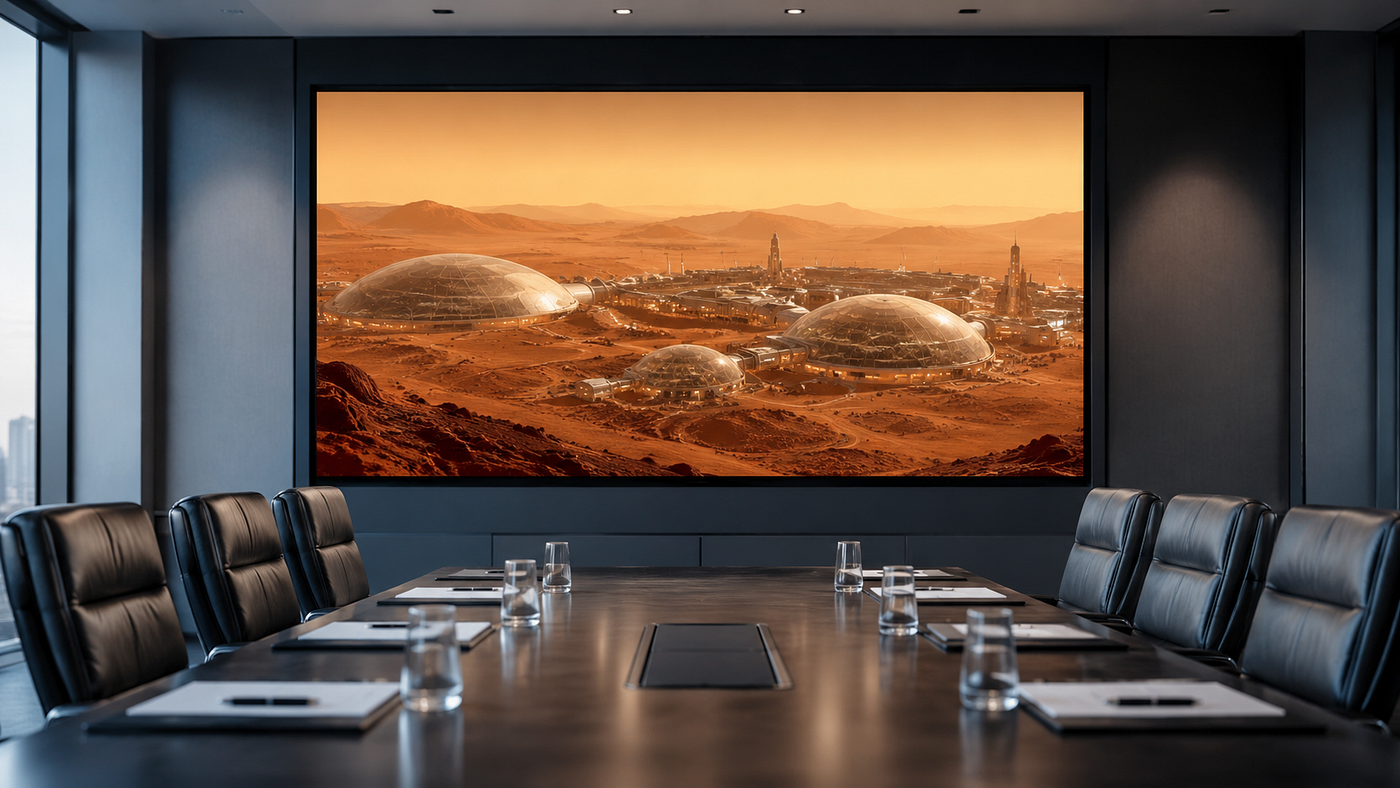
Prepared by the Office of the Chief Executive (image generated for the author)
Executive Summary
Management requests board authorization to proceed with Erythros Prime, a permanent human settlement on Mars. This proposal presents the operating environment, personnel strategy, logistics model, and financial requirements with complete candor.
We believe the board will find, as management has, that every obstacle described below is merely an engineering problem, and that engineering problems yield to capital.
We project a founding cohort of six settlers, expanding to a genetically self-sustaining population of several hundred to several thousand over subsequent decades. Total program cost for the initial phase is estimated in the tens of billions of dollars.
Management considers this a bargain, for reasons developed in Section 8.
1. Site Assessment
The selected site offers abundant carbon dioxide, substantial subsurface water ice, and no competing land claims of any kind. Certain site conditions merit disclosure.
Atmospheric pressure at the surface is less than one percent of Earth’s, and the atmosphere is nearly pure carbon dioxide. At this pressure, the water in an unprotected employee’s blood and saliva boils at body temperature. Loss of consciousness occurs in approximately fifteen seconds, with death following in one to two minutes.
Management wishes to emphasize that this is not a hazard in the conventional sense — a hazard implies an event. This is simply the ambient condition of the property, everywhere, at all times. Our mitigation is straightforward: no employee will ever be outside a pressure vessel or pressure suit for the duration of their employment, which is expected to be the duration of their life.
The site receives 200 to 300 millisieverts of cosmic and solar radiation annually, against the 2 to 3 millisieverts typical of our Earth offices. Mars lost its magnetic field when its core cooled billions of years ago, and no line item in our budget restarts a planetary core.
Multi-year exposure at these levels is associated with elevated cancer incidence and possible central nervous system effects, and solar flares can raise the dose to acutely dangerous levels within hours. Accordingly, the settlement will be constructed underground or beneath several meters of regolith. Renderings depicting glass domes should be understood as marketing materials.
Mean surface temperature is minus 62 degrees Celsius, with daily swings exceeding 56 degrees — a range no terrestrial desert approaches. These cycles embrittle metal, drain batteries, and flex every seal in the facility twice per sol. Nighttime heating will be among the settlement’s largest continuous energy expenditures, which management prefers to characterize as an anchor demand supporting our power investment.
The *regolith* itself is a fine, electrostatically charged powder of sharp, unweathered particles laced with perchlorates, which are toxic to the human thyroid. It clings to suits, infiltrates airlocks, abrades fabric and machinery, and over years of exposure presents a respiratory risk profile comparable to silicosis. Dust management will be a permanent operational department rather than a startup task.
Roughly once every few Martian years, dust storms encircle the entire planet for weeks to months, darkening the sky at midday. A storm of this class ended the career of NASA’s *Opportunity rover* in 2018 by starving its solar panels. Management has taken the lesson: our power strategy does not depend on the sun. Section 5 addresses this.
Finally, the board should be aware that the thin atmosphere admits meteoroids that would burn up harmlessly over Earth, that NASA’s *InSight lander recorded more than 1,300 marsquakes, and that the Martian day runs 39 minutes longer than the human circadian rhythm was built for — a permanent, unresolvable jet lag that [JPL’s](https://en.wikipedia.org/wiki/Jet_Propulsion_Laboratory)* “Mars time” rotations have already documented in ground crews.
None of these items is individually disqualifying. Management asks the board to resist the temptation to sum them.
2. Habitat and Life Support
Settlers will live inside a nested series of barriers — habitat shell, suit, and every hose, valve, and gasket in between — each of which stands between an employee and the ambient condition described in Section 1. A pinhole leak in a glove is an emergency that unfolds in real time.
We anticipate that personnel will adapt to checking seals before every meal and sleep period, and that this vigilance will become second nature, in the sense that it will never be permitted to lapse for the remainder of their careers.
Water exists on site as polar and subsurface ice. Extraction and purification constitute our first industrial operation, after which the settlement runs closed-loop reclamation at better than ninety percent recovery, consistent with *International Space Station* practice. The margin for waste is zero, and any degradation in the reclamation chain is best understood as a slow-motion emergency with a countdown attached.
Hygiene allocations reflect this arithmetic: sponge bathing, no-rinse cleansers, and durable antimicrobial clothing worn well past terrestrial norms, since a washing machine is an indefensible use of water. The habitat air will be kept dry to protect these systems, producing chronic chapped lips, irritated sinuses, and persistent static discharge, which employees will come to regard as the local weather.
Native soil cannot be planted; the perchlorates see to that. Food will be grown in sealed hydroponic modules under continuous LED lighting drawn from the same power budget as everything else, pollinated by hand with brushes or by imported insects that we will endeavor to prevent from becoming pests. A single fungal outbreak can eliminate a large share of production at a stroke, with replacement seed a minimum of one launch window away.
Early-phase nutrition will therefore rely on shelf-stable engineered rations. Management describes the cuisine as consistent.
3. Personnel Strategy
Transit requires six to nine months each way, and orbital mechanics open a return window approximately once every 26 months. A minimum engagement is therefore two to three years; most settlers, however, will not return at all, an outcome that materially improves our return-fuel obligations.
Radio latency to Earth runs from 4 to 24 minutes each way, making conversation impossible and correspondence the norm. Bandwidth limits will keep video contact short, scheduled, and low-resolution, and message traffic may be reviewed by mission support. Settlers will miss every wedding, birth, graduation, and funeral that occurs on Earth for the balance of their lives, learning of each by delayed transmission.
We consider candidates who have fully internalized this fact to be our strongest applicants.
The psychological research is well developed and we will not soften it. Antarctic *winter-over* crews reliably exhibit a mid-deployment collapse in morale — the third-quarter phenomenon — together with irritability, disrupted sleep, and magnified interpersonal conflict.
The *HI-SEAS* analog missions in Hawaii, run with rationed supplies and a 20-minute communication delay, saw tensions accumulate until some missions ended early.
Russia’s *Mars-500 confinement study documented the same decline over 520 days. [Biosphere 2](https://en.wikipedia.org/wiki/Biosphere_2)* produced oxygen shortfalls and interpersonal ruptures severe enough that some crew reportedly stopped speaking to one another.
Each of these experiments retained an exit. Erythros Prime removes it, which management regards as a decisive improvement in data quality.
Gravity on site is 38 percent of Earth’s. Astronaut data predict bone loss, muscle atrophy, cardiac remodeling, vision changes, immune suppression, and kidney stones; no human has lived under partial gravity for years, so the long-term numbers are unknown and our settlers will generate them. Two hours of daily harnessed exercise will be a condition of employment.
The effects of Martian gravity and radiation on pregnancy and childhood development are entirely uncharacterized, and early-phase family planning will accordingly be managed by policy — a sentence management recommends the board read twice.
Population geneticists place the minimum viable, genetically healthy settlement in the hundreds to low thousands, which defines our Phase III recruitment target and guarantees Earth dependence for decades.
4. Operations and Supply Chain
Every kilogram delivered to the surface — water, valves, antibiotics, socks — arrives at extraordinary cost and on a 26-month cadence. There is no local vendor, no expedited freight, and no substitute for a spare part that was not stockpiled.
Three-dimensional printing will cover many contingencies but cannot yet reproduce specialized electronics, precision seals, or pharmaceuticals. Each cargo manifest is therefore a wager, and a wrong guess on a minor component can idle a subsystem for over a year.
On the favorable side, the settlement will develop a repair culture of wartime intensity, in which nothing is discarded and everything is patched, and management notes that this thrift compares favorably with the disposal habits of our terrestrial divisions.
Return propellant will be manufactured on site from atmospheric carbon dioxide and local ice via the *Sabatier process, a technology demonstrated at small scale by [NASA’s MOXIE experiment](https://en.wikipedia.org/wiki/Mars_Oxygen_ISRU_Experiment)*. Scaling it requires power-hungry industrial plant running flawlessly for months before any departure.
If the plant underperforms, the departure does not occur. There is no secondary supplier.
5. Power
The settlement’s continuous load for a six-person outpost is projected at 25 to 40 kilowatts with zero tolerance for interruption, since a power loss is simultaneously a heat loss, an oxygen loss, and a water loss, cascading in that order.
Given the dust storms of Section 1 and sunlight already weakened by orbital distance, solar power is a supplement, not a foundation. The baseline is small nuclear fission reactors on the *Kilopower* model, with their attendant shielding, cooling, and maintenance obligations.
Management is confident the board will agree that operating nuclear reactors with a six-person staff, no external regulator, and no possibility of outside assistance is the kind of responsibility that builds organizational character.
6. Medical and Fire Risk
On-site care will handle fractures and routine illness. A cardiac event, complicated surgery, or unusual infection may exceed the crew’s training, and evacuation is not a concept that applies. Pharmaceuticals degrade under radiation and thermal cycling and may lose potency before resupply.
Every settler will be cross-trained in medicine and supported by AI diagnostics; experimental telesurgery, with movements pre-planned around the communication lag, remains unproven and is listed in this proposal as an aspiration rather than an asset.
To hold structural pressure requirements down, the habitat atmosphere may be oxygen-enriched. The board is reminded of *Apollo 1*, which demonstrated in 1967 how materials burn in such an atmosphere. In a sealed structure with no fire department and no open air to escape into, fire is the single fastest path to total loss of the facility.
Our materials selection reflects this precedent, which management has found instructive.
7. Governance
The *Outer Space Treaty* bars territorial sovereignty while leaving property rights, dispute resolution, and law enforcement unaddressed.
Erythros Prime will therefore function as a very small nation-state from its first sol, improvising institutions among a handful of people who cannot leave, cannot summon outside authority, and were selected primarily for technical skill. The literature on isolated communities indicates that survival depends as much on cohesion and kindness as on oxygen generation.
Management has allocated no budget for kindness but expects it to emerge.
8. Financial Overview and Recommendation
Phase I cost runs to the tens of billions of dollars, with each seat representing an extraordinary investment riding on the resilience of a single individual. Against this, management notes the intangible return: research on human well-being consistently finds that a strong sense of meaning sustains people through hardship that would otherwise be unbearable.
Our settlers will possess meaning in quantities unavailable at any terrestrial posting.
Terraforming, for completeness: a 2018 study concluded that Mars lacks accessible carbon dioxide sufficient to meaningfully thicken its atmosphere with current technology, and that any gains would in time be stripped away by the solar wind the planet’s dead core no longer deflects.
The board should therefore evaluate this proposal on the understanding that no settler, nor any descendant of any settler, will walk unprotected under the Martian sky.
Management recommends approval. The executive team will monitor the settlement’s progress closely from headquarters.
Respectfully submitted for the board’s consideration.
Author’s disclaimer
To the best of the author’s knowledge, Erythros Explorations, Inc. and Erythros Prime are fictitious names and represent no legally constituted corporation or protected mark.
Any resemblance to an actual enterprise proposing to send human beings to Mars is coincidental, though not, regrettably, implausible.
This piece is offered as a humorous perspective on a vain endeavor. The figures and findings it cites, however, are real.
메타데이터
- post_id
- 22a8d55a536d
- slug
- a-proposal-to-the-board-of-directors-of-erythros-explorations-inc-22a8d55a536d
- url
- https://medium.com/the-polis/a-proposal-to-the-board-of-directors-of-erythros-explorations-inc-22a8d55a536d
- canonical_url
- https://medium.com/the-polis/a-proposal-to-the-board-of-directors-of-erythros-explorations-inc-22a8d55a536d
- author_url
- https://medium.com/@dick-dowdell
- status
- ok
- fetched_at
- 2026-07-08 16:17:31