On Antisemitism, Feminism, and Blind Spots
When empathy becomes politically expensive
On Antisemitism, Feminism, and Blind Spots
When empathy becomes politically expensive

Photo by Etienne Girardet on Unsplash
Content note: This essay contains non-graphic discussion of sexual assault, coercive relationships, exploitation, sex trafficking, victim-blaming, and sexual violence in the context of war.
I have been thinking a lot lately about blind spots. Not the obvious kind. The convenient kind. The kind that appears when empathy suddenly becomes politically expensive. When believing a survivor threatens a community’s preferred narrative. When human suffering stops being universal and starts being filtered through ideology, tribe, usefulness, symbolism, and social identity.
I noticed it in feminist and progressive spaces that publicly insist on being trauma-informed, survivor-centered, intersectional, and morally consistent.
Until consistency costs something.
Then empathy suddenly becomes conditional.
After October 7, I watched some feminist spaces that had spent years insisting that we “believe women” hesitate, deflect, minimize, reinterpret, or entirely avoid discussions of sexual violence when the victims were Israeli or Jewish women.
Not all feminists. Not all activists. But enough to reveal a rupture.
What unsettled me was not political disagreement itself. Humans disagree politically all the time. It was the mechanism beneath the disagreement: the way empathy seemed to fluctuate according to political identity, symbolic usefulness, and social cost.
How quickly suffering became sorted into ideological categories.
Which victims felt narratively useful?
Which forms of violence threatened a preferred worldview?
Which stories became emotionally inconvenient?
The psychology of conditional empathy
I had already encountered a disturbingly familiar version of this moral instability in my intimate life, where progressive language and moral self-image coexisted with harm. At one point in my life, while caught in a cycle of exploitation and instability, someone entered my life positioning himself as a savior.
He spoke the language of progressive politics fluently: trauma awareness, consent, emotional safety, feminism, power dynamics. His fluency in that language lowered my defenses because it made him appear conscious of those dynamics.
What I desperately wanted to believe was friendship — perhaps mentorship or protection — began to feel disturbingly similar to earlier dynamics in which my vulnerability and trust had been used against me.
When someone is vulnerable and drowning, being seen, believed, and offered a way out can feel like oxygen.
Later, he became another source of harm. The same power imbalance that had made his protection feel necessary also narrowed my ability to exercise genuine choice. He also carried a public redemption narrative: someone once perceived as dangerous who had transformed himself into an ally.
People can change.
What unsettled me was that, in every version of the story, he remained morally centered. First as danger. Then as redemption. Then as living proof that transformation itself was possible.
I began noticing how easily narratives of harm, redemption, allyship, and protection could all become structured around preserving the moral identity of the central figure rather than confronting the vulnerability of the person harmed.
When we need to believe that transformation is possible, we may reorganize our perception around protecting that belief.
At one point, he introduced me to another survivor within his social world. Before meeting her, while the relationship was still new, I interpreted her association with him as evidence that he was safe and morally conscious. By the time we were formally introduced, however, I had begun to feel a sense of dread. The introduction no longer felt reassuring. I experienced it as strategic, deeply unsettling, particularly perverse.
I began to understand that her trust did not necessarily reflect intimate knowledge of how he behaved in private. I braced myself for the possibility that my reality would be denied. That was precisely the point. Years later, when his conduct was questioned, I saw how quickly “believe survivors” could become conditional — especially when believing one meant questioning a charismatic, trusted ally.
Although I had mentally prepared myself for that possibility, witnessing it still led me to an uncomfortable realization: Believing that someone you are emotionally invested in seeing as “good” can harm you is psychologically expensive. Especially when that person has become tied to your sense of safety, stability, belonging, recovery, or even your ability to imagine a future.
Sometimes a survivor feels unable to afford the loss of an ally.
Because losing the person positioned as “safe” can feel like losing reality itself.
The more someone becomes symbolically associated with safety or redemption, the harder it becomes to hold contradictory realities about them at the same time.
When identity determines whose pain counts
As someone with a mixed identity and a complicated relationship to belonging and Jewishness itself, I understood how powerful that mechanism could be. Even more so as someone with an “imperfect” victim profile who has lived at the intersection of immigration and survivor-hood.
The political dimension of these contradictions became impossible for me to ignore after October 7, when questions of empathy, loyalty, fear, and symbolic identity intensified publicly.
I spoke publicly about antisemitism and Jewish fear for the first time. It was also the first time I openly discussed my Jewish identity.
I found nuanced spaces attempting to condemn sexual violence consistently, including the ways women’s bodies become collateral damage and symbolic battlegrounds during political conflict.
At the same time, I watched women become hypersexualized symbols in ideological wars.
Like many other Jews, I was deeply disturbed by the dismissal of documented reports and credible allegations of sexual violence against Israelis.
I could not understand why acknowledging one was so often treated as requiring the denial of the other.
I am aware that some UN bodies have been criticized — including by a former UN Secretary-General — for subjecting Israel to disproportionate scrutiny compared with other states. That history is precisely why I do not treat institutional authority as proof and look for corroboration beyond the UN, including from Israeli human-rights organizations. Concern about bias warrants scrutiny; it does not justify automatically dismissing every testimony or allegation those bodies report.
War creates conditions in which human beings commit cruelty, including sexual violence. No nation, army, religion, political community or group is inherently incapable of such acts. Acknowledging credible allegations involving members of Israeli forces — and condemning specific conduct when the evidence supports it — does not require demonizing Jews, Israelis, or Israel as a whole. Accountability for particular acts is not collective guilt.
Women’s bodies as political territory
I also saw it in the public sexual shaming of Mia Khalifa on social media. Whatever one thinks of her statements, some of the response turned her history in pornography into a weapon against her — as though a woman’s sexual past determined whether she was entitled to political speech.
I also watched a pro-Israel influencer use sexualized images of Greta Thunberg’s sister to mock Greta’s activism — turning a woman who was not involved in the political dispute into a bodily prop.
I found the tactic particularly low and shameful. How far must an argument sink before a woman who has nothing to do with it is reduced to her body? Choosing to show her body or express her sexuality does not mean consenting to have that body conscripted into an ideological war she never chose to enter.
Women’s bodies repeatedly became symbolic territory through which political conflict, punishment, and tribal loyalty were expressed.
In those moments, concern for women seemed less important than the political usefulness of their bodies.
Punished.
Instrumentalized.
Weaponized.
My own experiences also resisted convenient political categorization.
I was safe in Dubai, although many women are not. Women from Central Asia, South and Southeast Asia, East Africa, North Africa, Eastern Europe, and elsewhere have been subjected to sex trafficking in the UAE, while migrant domestic workers face heightened risks of abuse and exploitation. My relative safety did not erase theirs. My experience was shaped by the support system, advantages, and choices available to me at the time; it was not evidence that Dubai is inherently safer for women than Western societies.
My first major sexual assault happened in Europe during my first semester of university living away from home. But the United States remains where I experienced the most sustained intersection of gender-based violence and immigration/expat vulnerability. None of those realities cancels the others.
I rarely spoke publicly about some of these experiences because I immediately understood how they would be politically interpreted.
Would this story strengthen anti-immigrant rhetoric?
Would it feed anti-Muslim narratives?
Would it threaten progressive identity?
Would it empower conservatives?
Would it damage the “wrong” ally?
I knew that my relative safety in the Middle East could be appropriated to support an anti-Western, idealized narrative about Islamic societies — just as violence committed by an immigrant or Muslim man could be appropriated to support anti-immigrant or anti-Muslim politics.
Most of the gender-based violence I experienced in the United States was perpetrated by white American citizen men. It was not always expressed through obvious threats. Much of it was structural.
Some used structural power as leverage while my options narrowed, gradually coercing me into unwanted and increasingly corrosive relationships.
Others first earned the position of “friend,” then waited for moments of intoxication and lowered defenses.
What made discussing any of this more difficult was how quickly suffering became politically categorized according to who had caused it and which narrative the story threatened.
Nuance Is not tribalism
Too often, people do not simply listen to suffering. They sort suffering.
I noticed similar reflexes even in conversations supposedly unrelated to war or assault. Again and again, nuance collapsed as soon as identity and symbolism entered the discussion.
I once commented that bras can function in many Western societies almost like a secularized system of bodily discipline: socially compulsory even when not legally mandated. I was not saying bras and hijabs are identical. Comparison is not equivalence. Compulsory veiling may be enforced through state law, while bra-wearing is more often enforced through social norms, workplace and school dress codes, sexualization, and harassment. The mechanisms and potential penalties differ, sometimes radically.
But both reveal how societies regulate women’s bodies, decide which parts must be concealed, and produce shame, conformity, punishment, and social enforcement around those expectations.
The reactions proved the point almost immediately.
Outrage over compulsory hijab in Iran. Mockery of “free the nipple” feminism in America. No nuance, only tribal reflexes.
That is the blind spot I keep returning to.
Over time, the pattern began to feel larger than any single ideology, community, or political camp. Progressive spaces often believe survivors — until the accused is useful.
Useful politically.
Useful socially.
Useful symbolically.
Conservative spaces often defend women — until doing so threatens patriarchal structures from which they benefit. The language changes. The mechanism often does not.
What frightens me most is not hypocrisy itself. Hypocrisy is human. Humans are contradictory.
What frightens me is how quickly an entire moral framework can collapse once empathy carries a social, emotional, or political price — once it threatens identity, tribe, status, desire, ideology, or belonging.
The survivor is believed in theory.
Until belief demands sacrifice.
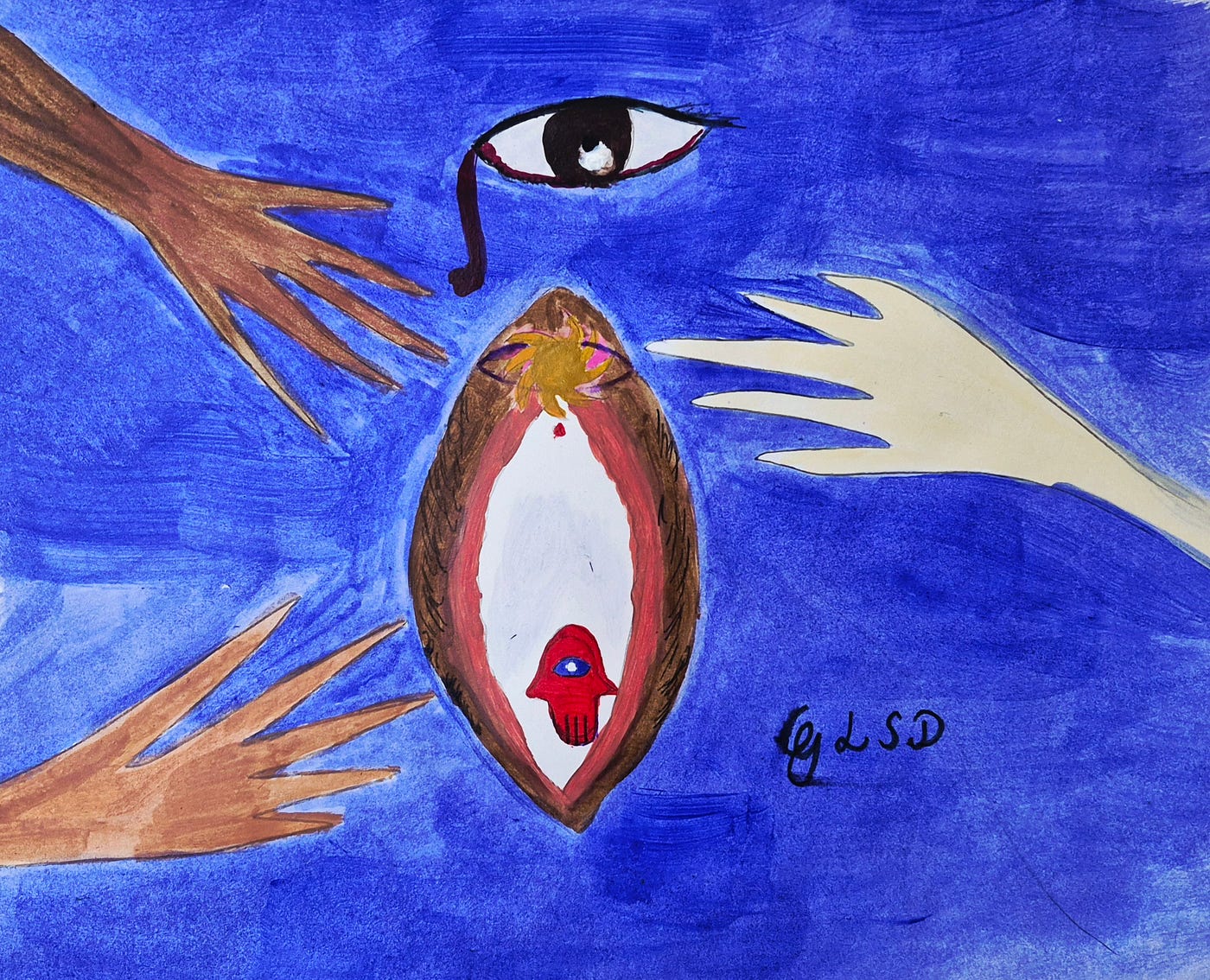
Conceptual painting work by author. The technique is not advanced (I do not have time to practice painting as regularly as I would like) but the style is intentionally naive. The concept remains strong imho.
Coda: when pain becomes politically useful
This brings me back to the first rape I survived, during my first semester of university in Europe.
During midterm break, a girl from my class persuaded me to travel with her and two older male students. We drove several hours to a European capital, where we stayed with a family member of one of the senior students.
After our host assaulted me, I did what I believed I had to do to survive the remainder of the trip and return safely to campus. I was far from school and dependent on the group for both housing and transportation. What may have looked like compliance was a survival response under constraint.
The incident became widely discussed at school. The gossip and humiliation affected my ability to function and contributed to my failing the year and having to repeat it. Afterward, I said as little as possible.
Part of my silence came from shame. Part of it came from a culture that had little understanding of trauma responses and routinely blamed victims whose behavior did not conform to an idealized script.
But there was another reason.
Young and naïve as I was, I was perceptive enough to understand that what had happened to me could be weaponized in anti-immigrant and anti-Muslim rhetoric.
And frankly, I was having none of it.
I refused to let my experience become ammunition for somebody else’s agenda. Nobody wants that.
The irony was that cultural familiarity had helped lower my guard in the first place. I had felt safer traveling with these students partly because of shared attitudes toward alcohol abstinence, overlapping values, and North African backgrounds. What had felt familiar therefore appeared less threatening.
I did not want my pain, my survival, or the violence inflicted on me to be recruited into a political narrative I did not support or any political narrative for that matter. So I remained quiet through the rest of my time at that school. In later semesters, surrounded by new faces, almost nobody knew. I did not speak about it when I moved to Dubai to continue studying. I did not speak about it when I returned to Europe for graduate school. I did not speak about it after moving to the United States.
I am speaking about it now partly because processing such an experience can take that long. But time also gave me a wider frame through which to understand it.
During the decade I have spent on the American continent, whether in the United States or Costa Rica, most of the severe gender-based violence I experienced was perpetrated by white American men — although not exclusively. Alcohol was frequently involved as a facilitator of vulnerability, an opportunity, or an excuse. It was never the source of the entitlement itself.
I also began noticing another contradiction.
When the accused man is poor, racialized or an immigrant, some people are immediately willing to recognize a woman as a victim-survivor. Not necessarily because they care deeply about women, but because believing her costs them nothing. Her story confirms a narrative they already wanted to tell.
When the accused belongs to a socially dominant group — or possesses status, credibility, connections, or symbolic usefulness — the same certainty often disappears. Suddenly there is endless nuance. Endless hesitation. Endless concern for context, reputation, and everything the accused person might lose.
The more socially powerful an abuser is, and the more the abuse is embedded in structures such as housing, immigration status, professional credibility, or institutional belonging, the more difficult it becomes for others to acknowledge. Structural abuse may be less immediately visible than a single opportunistic act, but it can narrow a person’s choices over months or years.
Believing the survivor then carries a price. It may require questioning someone respected, surrendering a useful political symbol, or admitting that power was operating inside a space believed to be safe.
Some people believe survivors only when our pain is politically useful. When believing us threatens someone valuable to their community or worldview, the burden of proof suddenly becomes much heavier.
That is not solidarity.
It is convenient allyship.
That is how pain becomes politically useful: not when it is heard on its own terms, but when it can be recruited into somebody else’s story.
© Grazi L. S. 2026
Follow Grazi’s work on Medium or Substack, or support it by buying me a coffee.
Grazi L. S. is a writer and artist exploring identity, trauma, power, migration, language, and belonging through personal essays and fiction.
Postscript — Author’s Note
I first submitted this essay to a Jewish publication with an explicitly feminist mission. It was declined. The response offered an explanation, but I was left wondering whether two choices in the essay had also made it more difficult to publish: acknowledging credible allegations of sexual violence against Palestinians, and writing about the dissonance between public allyship and my private experience of harm.
I cannot know whether either consideration influenced the decision, and I do not present my suspicion as fact.
Yet even the possibility changed my behavior. I chose not to submit the essay to other Jewish publications that had previously accepted my work because I anticipated similar discomfort — and possibly the same outcome.
That calculation — deciding which victims can be named in which spaces without making empathy too expensive — is exactly why this essay matters.
For more stories about power, feminism, identity, and the uncomfortable blind spots that shape how we understand harm, justice, and empathy, follow Fourth Wave. Also check out our Livestreams and sign up for our Newsletter. Let’s grow the community! Have you got a story or poem that focuses on women or other targeted groups? Submit to the Wave!
메타데이터
- post_id
- 22c3f6865afd
- slug
- on-antisemitism-feminism-and-blind-spots-22c3f6865afd
- url
- https://medium.com/fourth-wave/on-antisemitism-feminism-and-blind-spots-22c3f6865afd
- canonical_url
- https://medium.com/fourth-wave/on-antisemitism-feminism-and-blind-spots-22c3f6865afd
- author_url
- https://medium.com/@grazileroysultan
- status
- ok
- fetched_at
- 2026-08-15 13:48:04