Before Preservation Was Ever a Question A Japanese Festival That Is Still Being Lived
The Shiromi Kagura of Miyazaki, Japan
Before Preservation Was Ever a Question
A Japanese Festival That Is Still Being Lived
The Shiromi Kagura of Miyazaki, Japan
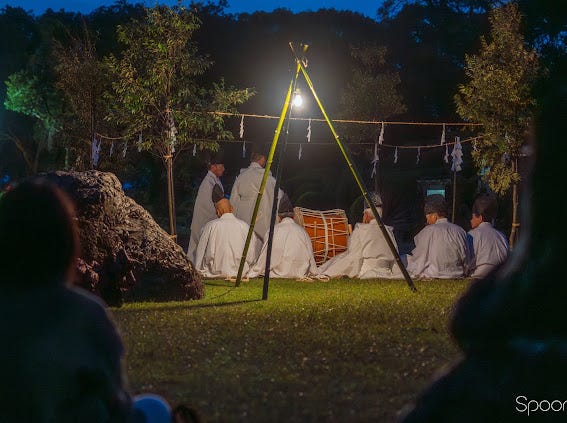
In Miyazaki, a region often described as the birthplace of Japanese mythology, there is a kagura that has been danced deep in the mountains for over five hundred years.
Through the night, in the heart of winter, people gather — not to perform for an audience, but to pray with their whole bodies.
Those who encounter this ritual often say the same thing: it is beyond words.

What unfolds there is not simply a cultural performance or a designated heritage. It functions as something far more essential — a living source through which a community continually decides what it will protect, and what it will refuse to submit to, across generations.
All over Japan, there are festivals where humans and deities are said to meet. But among them, Shiromi Kagura stands out — not because it has changed to survive, but because it has chosen, again and again, not to change.
And yet, paradoxically, it is not rigid at all.

A Mountain Village and a Winter Night
Even today, more than 350 kagura traditions remain in Miyazaki Prefecture alone.
On a bitterly cold night just before the winter solstice, I was invited for the first time to one of them, in a small mountain settlement called Shiromi.
At the altar, offerings were laid out: the severed heads of wild boar.
In some regions, deer or rabbits are offered. Here, the presence of the boar carries a strong sense of animism — something older than written history, something that unmistakably evokes a Jōmon sensibility.

People in Shiromi say this plainly:
“If we forget that we are a hunting people, this will no longer be Shiromi Kagura.”
When the ritual was designated a national cultural property some fifty years ago, what drew attention was precisely this point: the way hunting culture had been preserved, not symbolically, but practically.
The shrine priest explained it to me like this:
“It’s not just about hunting. We offer life, we share it by eating together, and then we return it — so that the mountains may be nourished again.”
The presence of the boar heads alone seemed to shift the space into another dimension, emitting a vibration rarely encountered in modern life.
Beginning with the Stars
Shiromi Kagura begins on the afternoon of the thirteenth day, with the first ritual dance known as Hoshi Kagura — the Star Dance.

To a distinctive, steady rhythm, two men dressed in white begin to move.
This is not a dance meant to be seen. It is an act of offering itself. There is no clear separation between performer and observer; watching, one feels drawn into the movement, as if dancing together.
Later, I understood why. This kagura is not performed as a presentation. It exists as prayer.
Why the Tears Came
At one point, boys in their early teens took the stage.
They danced with quiet seriousness, without embarrassment or hesitation — so natural it was almost startling. As I watched them, tears began to flow, without warning.
I found myself wondering: How does the meaning of standing here get passed on to children so young? What kind of education allows this to be embodied so seamlessly?

One of the leaders who teaches the children later said this:
“We’re not particular about religion. People can believe whatever they want. But in Shinto, gods are everywhere. We see ourselves as being kept alive by nature.
We are the people of this land, so we serve the local deities in a Japanese way. If we protect that properly, livelihoods naturally emerge from it.
What we teach the children isn’t doctrine — it’s gratitude. Not asking for favors, but giving thanks. Somehow, through that, things come together. The children feel joy. And they grow up with a sense that their homeland matters.”
This, I realized, is the heart of the kagura — and of Shinto as a lived worldview.
A Night Where Everything Coexists
As the hours pass and the space is purified through continuous movement, beings known as men-sama — deities embodied through powerful masks — begin to appear. Emerging at the boundary between darkness and firelight, they carry an overwhelming presence.

Figures from Japanese mythology also make appearances. History is included, acknowledged — but it is not the center.
The overwhelming emphasis is on animism: prayer to the mountain, to the forces that sustain life. One senses a worldview formed over an unimaginably long span of time, by people who lived with the mountains, not above them.
To experience the entire ritual — from night into dawn — is to witness elements that would never coexist in daylight blending together seamlessly in the dark. Human and divine, solemnity and humor, order and chaos — all held within the same space.
It becomes clear: this is prayer not only for daily life, but for the cosmos itself.

Something That Is Already Alive
Keeping such a ritual alive, every winter, with only the villagers, is no small feat.
If it existed merely because it was labeled “tradition,” it would have vanished long ago.
One of the leaders laughed as he said:
“Kagura is beautiful art. But being born into it — well, whether that’s fortunate or not is debatable. There’s no option to quit.”
In a modern society that measures value by profit, continuing something that produces no money requires extraordinary resolve.
And yet, here, tradition is not preserved — it is lived.
Through the ritual, people receive something their ancestors could never fully put into words, and they carry it forward. Hearts gather around that effort.

This is what a living festival looks like. Not something to be saved — but something that has never stopped breathing.
메타데이터
- post_id
- 22c7c5522fa4
- slug
- before-preservation-was-ever-a-question-a-japanese-festival-that-is-still-being-lived-22c7c5522fa4
- url
- https://medium.com/@sriamrita/before-preservation-was-ever-a-question-a-japanese-festival-that-is-still-being-lived-22c7c5522fa4
- canonical_url
- https://medium.com/@sriamrita/before-preservation-was-ever-a-question-a-japanese-festival-that-is-still-being-lived-22c7c5522fa4
- author_url
- https://medium.com/@sriamrita
- status
- ok
- fetched_at
- 2026-07-30 05:22:37