Choosing Between a Developer Platform and a Ready‑Made Business Phone System: Twilio vs Talkroute
Two Very Different Paths To A “Business Phone”
Choosing Between a Developer Platform and a Ready‑Made Business Phone System: Twilio vs Talkroute
Two Very Different Paths To A “Business Phone”
Many teams start with the same simple need. They want a professional way to talk with customers, route calls, and keep communication organized. Yet the path they choose can look completely different. One path leans into engineering and custom software, where you assemble programmable building blocks into a tailored communication engine. The other path focuses on speed, simplicity, and a turnkey phone system that runs almost out of the box.
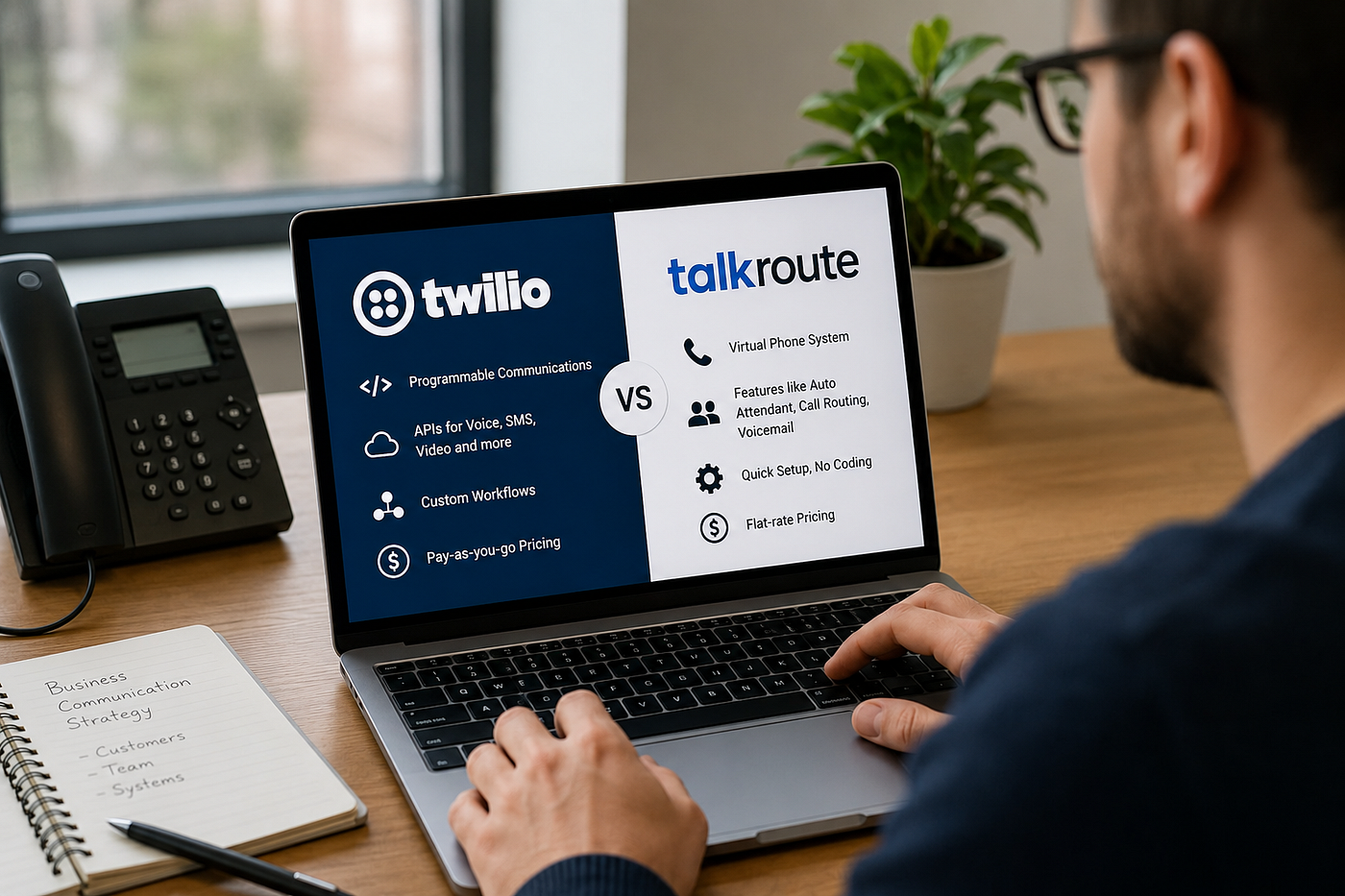
Twilio and Talkroute sit on opposite ends of that spectrum. Twilio is a communications platform that gives developers APIs for voice, SMS, email, and more, so they can build custom experiences and integrate communications directly into the company’s applications. Talkroute is a cloud phone system that turns your existing phones and devices into a unified business phone service, complete with desktop and mobile apps, business numbers, auto attendants, voicemail, and call routing, without any coding at all.
Understanding this fundamental difference is where smart evaluation begins. This article is written primarily for founders, small business owners, operations leaders, and product teams who are deciding whether they need a fully programmable communication platform or a straightforward virtual phone system.
Key Insights Before You Decide
Before diving into the details, it helps to zoom out and notice three big themes that tend to drive the Twilio versus Talkroute decision. Twilio is fundamentally an infrastructure and API platform, so it shines when you have either an internal engineering team or a technical partner who wants deep control over customer communication flows. It is designed for situations where communications are embedded into software experiences, integrated with proprietary systems, or scaled across multiple regions and channels.
Talkroute, on the other hand, is much closer to a traditional business phone system, except that it lives fully in the cloud and works with the phones and computers you already own. It is optimized for non‑technical teams who want to get a professional business number, routing, voicemail, and texting live in under an hour, and then manage everything in simple apps rather than code. The real question is not “Which is better?” but “Which philosophy of communication fits how your business actually operates?”
Twilio In Plain Language
What Twilio Really Offers
Twilio is a Communications Platform as a Service that exposes core communication capabilities, such as voice calls, SMS messages, email, and increasingly AI‑driven conversation tools, through developer friendly APIs. Instead of giving you a physical desk phone or a fixed softphone app, Twilio gives your team programmable building blocks. Those building blocks can be combined to create custom contact centers, notification systems, appointment reminders, authentication flows, or marketing campaigns that automatically trigger messages based on data and events inside your own systems.
From a developer’s perspective, Twilio feels like a toolkit that plugs directly into the codebase. Official SDKs and examples make it possible to send a text, initiate a call, or orchestrate a conversation in a matter of minutes once credentials are set up. Over time, many companies stitch these capabilities together into more complex flows, such as dynamic call routing based on CRM data, multi‑language workflows, or AI augmented customer support where bots and humans collaborate in the same conversation stream.
How Twilio Handles Pricing And Control
Twilio uses a pay‑as‑you‑go model. You are billed based on actual usage, such as per message, per minute of voice, or per interaction with specific APIs, with rates that vary by channel and country. This structure tends to work well for organizations that either have predictable volumes they can model or want to start small and scale over time. It also makes it easier to experiment, because you can prototype a new communication flow without committing to a full phone system contract.
The tradeoff is that the complexity lives with you. Someone must design, build, and maintain those flows. Twilio has been repeatedly recognized as a leader in CPaaS by firms such as Gartner and others, which signals strong capabilities and reliability at scale. Yet the platform is not a plug‑and‑play phone system. If you are a solo founder without developer support, Twilio can easily feel like too much tool for what you need today.
Talkroute In Plain Language
What Talkroute Really Offers
Talkroute is a virtual phone system that provides business phone numbers, call forwarding, auto attendants, extensions, texting, video meetings, voicemail, and more, all delivered through cloud apps that run on desktops, browsers, and mobile devices. In practice, this means you can keep using your existing smartphones or landlines, but wrap them inside a professional business phone presence. Clients call your business number, encounter branded greetings and menus, and reach your team through configured routing rather than personal numbers.
The service combines traditional phone features with modern digital capabilities. Unlimited calling in the United States and Canada, business SMS and MMS, and simple video meetings are handled through the same app, so teams can talk, text, and meet inside one consistent environment. Voicemail is accessible via apps, email, and browser, with options for custom greetings and transcription so messages can be read instead of only listened to. For many small businesses, this becomes the central hub of day‑to‑day communication without needing any custom code.
How Talkroute Approaches Setup And Plans
Talkroute focuses on quick, non‑technical setup. You can choose toll free, local, vanity, or 800 numbers, or port your existing business number, and then configure routing, menus, hours, and greetings through a graphical interface. Because it is built as a ready‑made phone system, most teams can go from sign up to functional business line in a short period, often in the range of minutes instead of days. The apps support common platforms including MacOS, Windows, Linux, iOS, Android, and browser, which makes deployment across a remote or hybrid team straightforward.
Pricing is structured around plans that include features and unlimited calling rather than per‑message or per‑minute API usage. Talkroute publicly promotes simple, flat rate business phone service and emphasizes that you can avoid buying special hardware. Exact pricing and inclusions can change over time, so it is important to check current plan details on the official site before making a decision, and note that specific rates and limits may vary by promotion or region.
Twilio Versus Talkroute
It is tempting to compare Twilio and Talkroute like two versions of the same product, but that quickly leads to confusion. Twilio is not trying to be a small business phone plan. It is trying to be the programmable communications backbone underneath whatever experiences you want to create. Talkroute is not trying to be a developer platform. It is trying to be the simple, reliable, all‑in‑one phone system for businesses that just want professional calling, texting, and routing.
A helpful mental model is to imagine Twilio as the engine room and Talkroute as the finished office space. Twilio provides the engines, gears, and wiring that you can use to power highly customized operations. You decide how calls are handled, how messages are triggered, and how data flows, and your developers translate those decisions into code. Talkroute provides the desks, phones, and signage already arranged. You move in, set your preferences through settings, and start working without needing to understand how the plumbing works underneath.
Practical Scenarios That Reveal The Difference
Consider a software startup that is building a proprietary telehealth platform. They need video visits, automated appointment reminders, two factor authentication via SMS, and secure messaging, all tightly integrated into their app and electronic health record system. In this world, Twilio’s APIs can serve as the communication backbone. The engineering team can build routing based on appointment status, send transactional messaging triggered by database events, and create custom escalation flows for urgent cases, all within their existing tech stack. The cost is the engineering effort, but the payoff is a deeply tailored experience that competitors cannot easily replicate.
Now picture a small law firm with five attorneys and one office manager. They want a single business number with a professional greeting, options to route callers to different practice areas, voicemail by department, and the ability for attorneys to take business calls on their mobile phones without exposing personal numbers. They also want text messaging with clients and occasional video calls for consultations. In this case, Talkroute’s virtual phone system aligns much more closely with their needs. They can sign up, pick a number, configure menus and extensions, install the apps, and be live quickly, with minimal technical overhead. The communication flows they need already exist inside the product, which reduces complexity and lets them focus on legal work rather than software.
A third scenario sits in the middle. Imagine a growing ecommerce brand that starts with a Talkroute number to manage customer calls and texts, then later decides to build a custom support platform that blends chat, messaging, and automation. They might begin on Talkroute to get a phone presence in days, then gradually layer in Twilio or similar APIs behind the scenes as their technical maturity and requirements grow. In practice, many businesses evolve over time, and the “right” tool at one stage may give way to a more programmable approach later.
How To Choose For Your Business
The most useful way to decide is to match the nature of your communication needs with your available resources and long term strategy. If your business model depends on integrating communication deeply into proprietary workflows, such as custom CRMs, logistics systems, or AI‑driven customer engagement, then a platform like Twilio is worth serious consideration. The ability to orchestrate conversations across channels, embed voice and messaging directly into applications, and use APIs to adapt flows as your products evolve is a strategic asset when you have the engineering capacity to use it well.
If your primary requirement is to have a professional business phone presence, with clear menus, call forwarding, voicemail, and simple texting and meetings, and you do not want to hire developers just to manage phone routing, then Talkroute is an attractive fit. Its strengths show up when you value simplicity, predictable plans, and out of the box features that can be configured by office managers or founders themselves. In many small businesses, the opportunity cost of building and maintaining a custom communication stack outweighs the theoretical flexibility that APIs offer.
One practical exercise is to write down the top five communication experiences you want customers to have over the next twelve months. If most of them sound like “standard business phone” needs, such as a clean greeting, extensions, voicemail, and SMS updates, you are probably squarely in Talkroute territory. If they sound like “embedded product features,” such as dynamic notifications tied to product usage, multi‑channel engagement driven by behavior data, or AI agents that collaborate with human agents, then you are leaning toward Twilio. This simple thought experiment often reveals whether you are choosing a phone system or a communications platform.
Lessons For Founders And Teams
One nuanced observation that often emerges in practice is that technology ambition should be proportional to organizational maturity. Early stage founders sometimes fall in love with the idea of building a completely custom communication stack, only to discover later that managing phone routing and message delivery distracts from product and customer development. For those teams, starting with an out of the box system like Talkroute can create breathing room, while still delivering a professional experience to customers. As the business grows and the need for tailored communication increases, the team can revisit whether a programmable platform belongs in the roadmap.
On the other side, larger enterprises can occasionally underestimate the cultural and process impact of moving to a platform like Twilio. Having infinite flexibility does not automatically translate to better experiences. Success requires clear ownership, thoughtful flow design, ongoing monitoring, and cross functional collaboration between engineering, operations, and customer support. The organizations that benefit most from Twilio are those that treat communication flows as product features and invest accordingly.
Actionable Recommendations You Can Use Immediately
If you are deciding right now, a few concrete steps can make the choice clearer without any commitment. First, map your current communication stack. Capture how customers reach you today, which numbers and channels you use, and what frustrations your team experiences. Second, visit the official Twilio and Talkroute sites, and review their product pages and documentation with that map in hand. Notice which platform seems designed for your kind of problems rather than trying to force fit your needs into their model.
Third, simulate a pilot in your mind. For Twilio, imagine who would design and implement your flows, how they would integrate with your existing tools, and how you would measure success over time. For Talkroute, imagine how quickly you could migrate your current phone numbers, train your team on the apps, and configure greetings and routing. Finally, factor in your next eighteen months of growth. If you anticipate needing advanced automation, deep integration, and multi‑channel orchestration, prioritize platforms that excel there. If you primarily anticipate needing stable, easy to manage calling and texting, prioritize simplicity and reliability. These steps turn an abstract “Twilio versus Talkroute” question into a grounded decision aligned with your actual roadmap.
Matching Tool To Story
Every business is telling a story through its communication system. Twilio lets you write that story at the code level, weaving voice, SMS, email, and AI into the fabric of your products and internal tools. Talkroute lets you present a polished, professional phone story to customers with far less technical effort, giving you consistent calling, texting, and meetings in an environment your team can manage directly. Both approaches are valid. The art lies in choosing the one that matches both the chapter your business is in now and the chapters you intend to write next.
When you align your communication tools with your actual capabilities and customer journey, you reduce friction, lower operational stress, and create a more coherent experience for the people you serve. The choice between Twilio and Talkroute is not a test of technical sophistication. It is a reflection of where custom engineering adds true value versus where straightforward, dependable infrastructure is enough.
Questions To Spark Discussion
How does your current communication setup help or hinder the way customers experience your brand, and where do you see the biggest gaps?
If you adopted a platform like Twilio, what specific customer flows or product features would you build first that you cannot realistically create today?
If you moved to a virtual phone system like Talkroute, how would that change daily life for your team in terms of answering calls, managing messages, and staying reachable on the go?
Looking at your next twelve to eighteen months, do you expect your biggest communication challenges to be technical integration, or simply having a reliable, easy to manage phone presence?
메타데이터
- post_id
- 22ca1ad6dfd2
- slug
- choosing-between-a-developer-platform-and-a-ready-made-business-phone-system-twilio-vs-talkroute-22ca1ad6dfd2
- url
- https://medium.com/@mrkarthikkn/choosing-between-a-developer-platform-and-a-ready-made-business-phone-system-twilio-vs-talkroute-22ca1ad6dfd2
- canonical_url
- https://medium.com/@mrkarthikkn/choosing-between-a-developer-platform-and-a-ready-made-business-phone-system-twilio-vs-talkroute-22ca1ad6dfd2
- author_url
- https://medium.com/@mrkarthikkn
- status
- ok
- fetched_at
- 2026-07-15 04:06:43