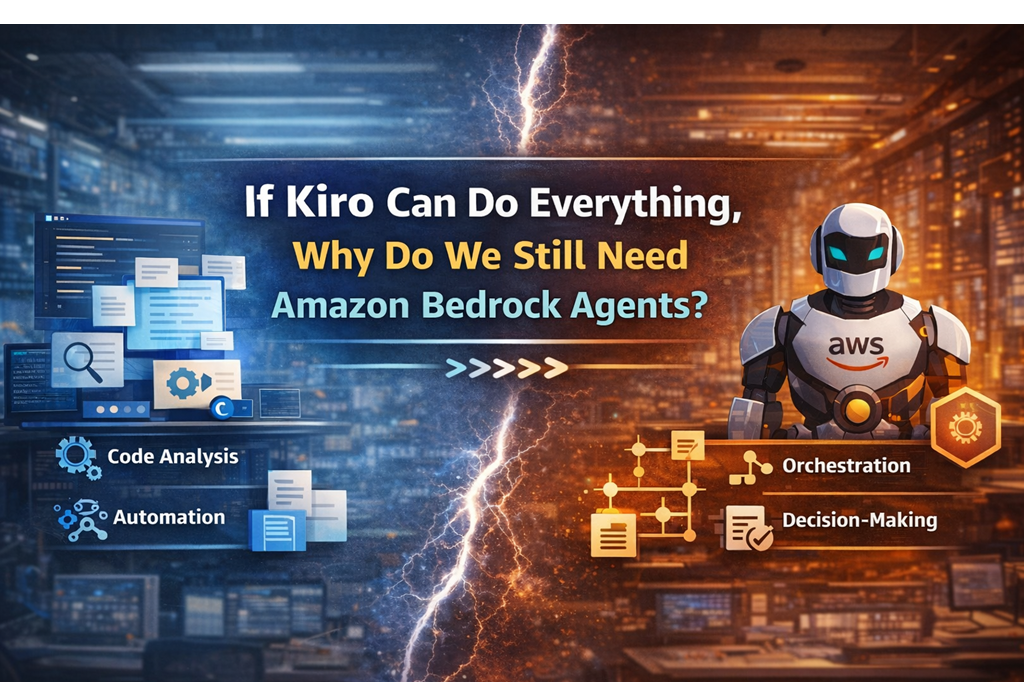
Do We Really Need AI Agents for Migration? When to Use Amazon Bedrock vs Code Tools Like Kiro
Discover when to use AI agents in cloud migration and modernization. Understand how Amazon Bedrock agents handle multi-step, decision-heavy…
Do We Really Need AI Agents for Migration? When to Use Amazon Bedrock vs Code Tools Like Kiro
Discover when to use AI agents in cloud migration and modernization. Understand how Amazon Bedrock agents handle multi-step, decision-heavy workflows beyond code automation tools like Kiro.

I recently found myself stuck on a very practical question while thinking about migration and modernization.
“If tools like Kiro can analyze code, rewrite it, and even run parallel agents to complete tasks — why do we even need to build agents using Amazon Bedrock?”
It sounded like a fair question. In fact, the more I thought about it, the more it felt like we might be overengineering things.
The First Question: Isn’t migration a one-time activity?
Yes when you look at a high level, migration is a one-time goal.
You move from legacy → cloud, monolith → containers, old stack → modern stack. Done, right?
Not exactly.
In real-world systems, migration looks more like this:
- Migrate a module
- Test it
- Find issues
- Fix and retry
- Partially roll back
- Move the next piece
So while the goal is one-time, the execution is iterative. That’s the first shift in thinking.
The Second Question: If I ask Kiro to analyze the code, won’t it give me everything?
Yes — and this is where tools like Kiro shine.
Kiro is incredibly powerful at:
- Analyzing codebases
- Rewriting code
- Generating tests
- Running parallel tasks
You can literally say: “Analyze this system” and get a detailed breakdown.
So what’s missing?
The answer: continuity and decision-making.
Kiro gives you a snapshot of understanding, but migration needs an ongoing understanding that evolves as changes happen.
Think of it this way
Kiro answers questions; An agent owns the problem.
The Third Question: If Kiro can already do everything, why build an Analyzer Agent?
This is where the confusion becomes clearer.
Let’s say Kiro analyzes your system and tells you:
- Service A depends on Service B
- Module X is tightly coupled
- These APIs are critical
Great.
Now what happens next?
You still need to decide:
- Which module to migrate first?
- What happens if Service B breaks?
- Should this be refactored or replaced?
Kiro doesn’t own those decisions.
An Analyzer Agent, on the other hand:
- Keeps track of dependencies over time
- Understands past decisions
- Feeds insights into the next step of the workflow
It’s not about better analysis — It’s about analysis that participates in a system.
The Realization: Migration Is Not Just “Code Rewrite”
Initially, I was thinking:
“Migration = rewrite + containerize.”
But in practice, it becomes:
Understand → Decide Strategy → Rewrite → Validate → Deploy → Monitor
Only step 3 is pure “code work,” and that’s exactly where Kiro excels.
Where Kiro Fits Perfectly
Kiro is your execution powerhouse.
Use it for:
- Code transformation
- Refactoring
- Parallel task execution
If your migration is small, straightforward, and low-risk, Kiro alone is often enough.
Where Agents (with Amazon Bedrock) Start Making Sense
Agents are not there to “rewrite code better.”
They come into play when the problem becomes:
- Multi-step
- Decision-heavy
- Interconnected
- Evolving
With a system built on Amazon Bedrock, agents can orchestrate the workflow, decide next steps dynamically, and integrate with CI/CD or monitoring.
Kiro does the work; Agents decide and coordinate the work.
Example 1: Multi-Step Workflow
Consider migrating a legacy application to microservices.
The process involves:
- Analyzing dependencies
- Breaking modules
- Refactoring code
- Generating tests
- Deploying
- Validating
Kiro can execute each of these steps.
But an agent can:
- Track which step is completed
- Decide the next step automatically
- Retry failures
- Maintain workflow state
This is where orchestration becomes critical.
Decision-Heavy Scenarios
메타데이터
- post_id
- 22e2bd5f028f
- slug
- do-we-really-need-ai-agents-for-migration-when-to-use-amazon-bedrock-vs-code-tools-like-kiro-22e2bd5f028f
- url
- https://towardsaws.com/do-we-really-need-ai-agents-for-migration-when-to-use-amazon-bedrock-vs-code-tools-like-kiro-22e2bd5f028f
- canonical_url
- https://towardsaws.com/do-we-really-need-ai-agents-for-migration-when-to-use-amazon-bedrock-vs-code-tools-like-kiro-22e2bd5f028f
- author_url
- https://medium.com/@sudhass
- status
- ok
- fetched_at
- 2026-06-09 15:37:30