Why Most Outbound Teams Are Building on Sand (And How to Fix It)
Most outbound programs fail not because of bad messaging - but because of broken fundamentals.
Why Most Outbound Teams Are Building on Sand (And How to Fix It)
There’s a pattern I keep seeing in outbound programs that quietly die.
The product is solid. The market is real. The team is motivated. And yet — reply rates hover near zero, pipeline dries up, and everyone starts blaming the messaging.
But it’s rarely the messaging.
It’s the infrastructure underneath it. The fundamentals that nobody audited because everyone was too eager to launch.
Outbound isn’t a campaign. It’s a system. And systems fail at the weakest link, not the most visible one.
Here’s what actually separates teams with durable pipelines from those perpetually starting over.
Before You Write a Single Word — Fix This
Nobody talks about email deliverability until it’s already broken. By then, the damage is done.
SPF, DKIM, DMARC — these aren’t technical niceties. They’re the gatekeepers deciding whether your email lands in the inbox or disappears entirely. I’ve watched teams invest weeks into perfecting their copy, only to scratch their heads at near-zero open rates. The culprit? Authentication settings nobody had touched since the domain was registered.
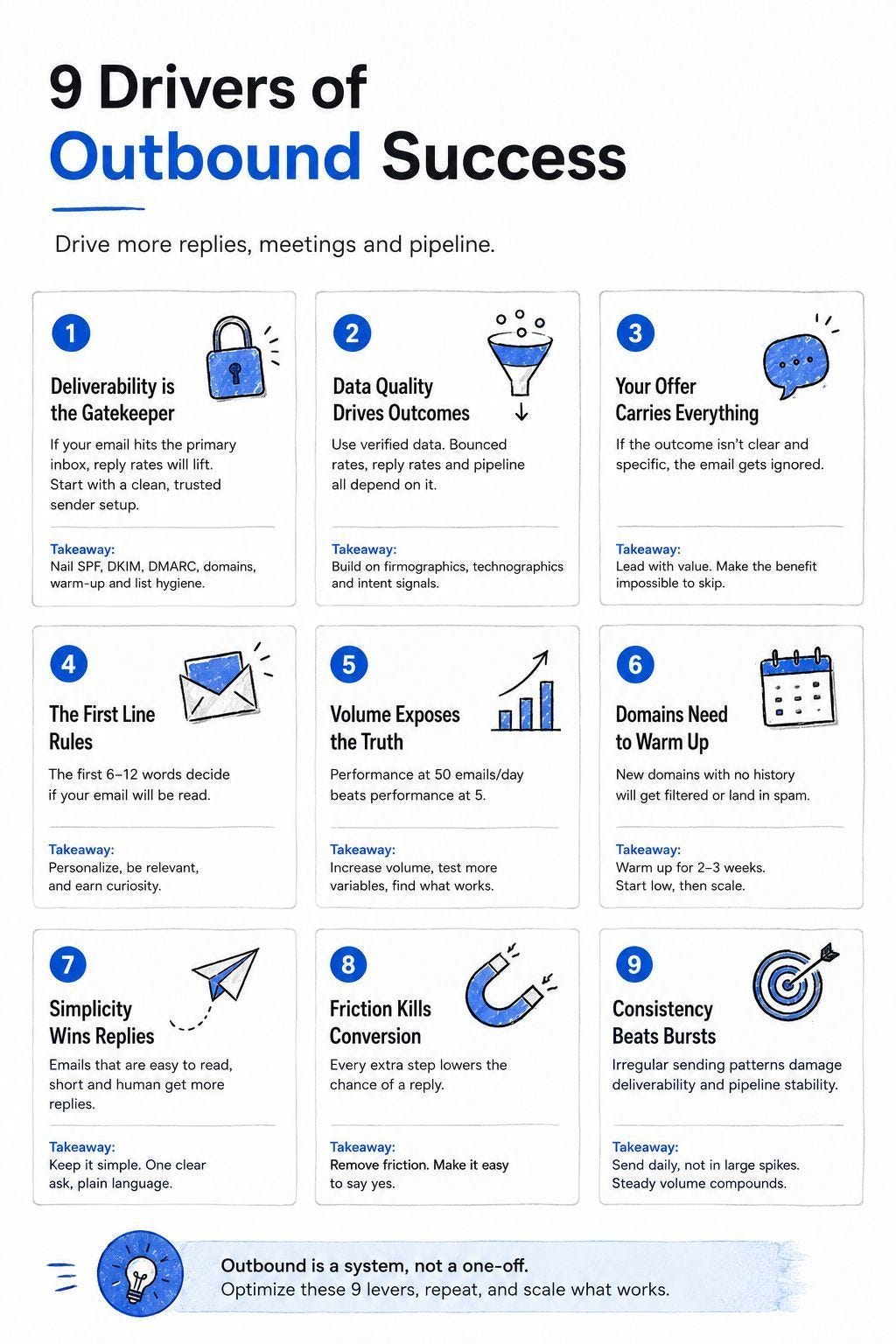
Clean your list regularly. Protect your sender reputation like a business asset. Deliverability isn’t a setup step — it’s an ongoing practice.
Your Data Has a Ceiling. You Built It.
Think of poor data quality as a tax on every campaign you run. High bounce rates don’t just waste time and money — they actively crater your sender score, making every subsequent send harder.
The real unlock is layering firmographic and technographic data with intent signals. When you know a company is actively researching solutions in your space, you’re not guessing anymore. That context alone — without touching a single word of your email — can dramatically shift your reply rates.
Verified, enriched data isn’t a premium feature. It’s the baseline for running outbound that doesn’t embarrass you.
The One Question Every Prospect Asks (That Most Emails Never Answer)
“What’s in it for me?”
That’s the only question that matters in the two seconds someone gives your email. If your message doesn’t answer it immediately and specifically — you’ve lost the conversation before it started.
The most common mistake I see? Teams writing about themselves. Their product features. Their process. Their awards. Meanwhile, the person reading is thinking about their own deadlines, their own headaches, their own targets.
Lead with the outcome. Name a real problem. Promise something concrete. The strongest outbound emails don’t describe what you do — they describe what changes for the person reading.
The First Line Is Doing More Work Than You Think
Your email is judged before it’s fully opened — first by the subject line, then by the preview text, and finally by the opening sentence. That first line carries enormous weight.
Generic openers are trust-destroyers. They signal: this was sent to ten thousand people, and you’re just one of them.
Personalization signals the opposite. A specific reference to the company’s recent news, the prospect’s role, or something timely in their market communicates that a real human paid attention. That signal — subtle as it is — changes how everything that follows gets read.
Write your first line last. It should earn its place.
You Can’t Optimize What You Haven’t Actually Tested
Sending five emails a day feels productive. It isn’t — at least not for learning.
At that volume, you can’t distinguish signal from noise. One reply might be a fluke. Zero replies might mean nothing. You need enough data to see patterns: which subject lines open, which angles land, which segments respond.
Fifty sends per day starts to produce usable signal. But here’s the trap most teams fall into — they either test at low volume and get false confidence, or they scale before they’ve found what works and burn their list in the process.
The sequence matters: build the system, test at meaningful volume, scale what’s proven.
New Domains Are Not Ready to Send. Respect the Timeline.
Launching outbound from a brand new domain is one of the fastest ways to kill a program before it generates a single meeting.
Email providers don’t trust new senders. There’s no history, no engagement, no credibility. Jumping straight to volume from a cold domain is like applying for a mortgage the day you open your first bank account.
A two-to-three week warm-up period — starting small, increasing gradually — builds the engagement history the system needs to trust you. Skip this, and you’re not just slowing things down. You’re risking a sender reputation that takes months to recover.
Build the domain before you need it.
Long Emails Are Not More Persuasive. They’re Just Ignored.
Every additional paragraph is a new opportunity to lose the reader.
Dense emails with multiple asks and formal language exhaust people before they’ve decided whether they care. The goal of a cold email isn’t to close a deal. It’s to earn a reply. That’s a much smaller ask — and it requires a much lighter touch.
Short. Human. One clear ask. This formula consistently outperforms the alternatives. Emails that sound like they came from a real person — not a content committee — get more replies.
Resist the urge to explain everything. Give them just enough to want the conversation.
Every Step Between Them and “Yes” Costs You
There’s a direct correlation between friction and conversion — and it’s not subtle.
Every unnecessary step in the response path is a dropout point. A confusing call-to-action. A form that asks for ten fields. A link that requires creating an account. Each one reduces the likelihood that someone who was mildly interested follows through.
The ask should be obvious and low-commitment. “Book a 20-minute call.” “Reply with yes and I’ll send details.” That’s it. The simpler the path, the more people take it.
Consistency Beats Intensity Every Time
The teams with the most resilient outbound pipelines aren’t the ones who ran massive blitzes twice a quarter. They’re the ones who sent every single day — even at modest volume — and never stopped.
Irregular sending damages more than open rates. It creates gaps in your pipeline that take weeks to recover from. It signals unpredictability to inbox providers. It breaks the momentum that compounds over time.
Outbound success isn’t built in sprints. It’s built in habits. The discipline of daily, steady execution — combined with continuous optimization — is what separates programs that last from programs that restart every six months wondering what went wrong.
The uncomfortable truth is that most outbound failures aren’t strategic. They’re operational. The foundations weren’t laid, the basics weren’t maintained, and volume was mistaken for momentum.
Fix the system. Respect the fundamentals. Then scale.
메타데이터
- post_id
- 22e3dfd6b5fc
- slug
- why-most-outbound-teams-are-building-on-sand-and-how-to-fix-it-22e3dfd6b5fc
- url
- https://medium.com/@Khomichenko/why-most-outbound-teams-are-building-on-sand-and-how-to-fix-it-22e3dfd6b5fc
- canonical_url
- https://medium.com/@Khomichenko/why-most-outbound-teams-are-building-on-sand-and-how-to-fix-it-22e3dfd6b5fc
- author_url
- https://medium.com/@Khomichenko
- status
- ok
- fetched_at
- 2026-06-17 18:46:00




