Is Taoism Dualistic or Non-Dualistic?
Many people look at the famous Yin–Yang symbol and immediately assume that Taoism must be a dualistic philosophy. The symbol seems to…
Is Taoism Dualistic or Non-Dualistic?

Many people look at the famous Yin–Yang symbol and immediately assume that Taoism must be a dualistic philosophy. The symbol seems to depict two opposing forces — black and white, Yin and Yang — locked in contrast with each other. From a superficial perspective, this appears to resemble the dualisms that are familiar in Western religious thought.
But this interpretation is misleading.
Taoism is neither dualistic in the Western sense nor strictly non-dualistic in the mystical sense emphasized by some Eastern traditions. Instead, Taoism presents a dynamic vision of reality grounded in polarity, complementarity, and creative tension. To understand this properly, it is helpful to compare Taoism with both Western religious dualism and Eastern metaphysical monism.
Christian Dualism: A Cosmic Struggle
Christian theology is strongly dualistic in its structure. The universe is frequently described as a battlefield between opposing forces: God versus Satan, good versus evil, light versus darkness, heaven versus hell.
Within this framework, history moves toward a final confrontation in which good ultimately triumphs over evil. Darkness is defeated and eliminated. The Book of Revelation describes an apocalyptic climax in which divine justice is established and the forces of evil are destroyed.
This worldview is therefore triumphalist. One pole is destined to win while the other is destined to lose. Reality is interpreted as a cosmic struggle whose outcome has already been determined. History itself becomes a dramatic narrative leading toward a final resolution.
Taoism and the Balance of Opposites
Taoism presents a radically different picture of the universe. The Yin–Yang symbol does indeed represent opposites, but these opposites are not enemies engaged in a war. Rather, they are complementary forces that depend on each other for their very existence.
Yin is associated with darkness, receptivity, coolness, and the feminine principle. Yang is associated with light, activity, warmth, and the masculine principle. Yet neither side is superior, and neither is meant to defeat the other.
Instead, Yin and Yang exist in a relationship of dynamic balance. Day turns into night, winter gives way to spring, inhalation is followed by exhalation. The universe functions because of the ongoing transformation between these two poles.
Without Yin there could be no Yang, and without Yang there could be no Yin. The vitality of the world lies precisely in this dynamic interplay.
No Final Showdown
Another crucial difference between Taoism and Christian theology lies in their views of history.
Christianity contains a strong teleological structure. History is moving toward a predetermined goal: the final triumph of good over evil and the establishment of God’s kingdom. The narrative culminates in a decisive moment of judgment and resolution.
Taoism, by contrast, contains no such apocalyptic vision. The Taoist worldview is cyclical rather than teleological. The universe unfolds through recurring rhythms — day and night, summer and winter, growth and decay, birth and death.
The Yin and the Yang continually transform into each other. There is no final showdown and no ultimate victory of one pole over the other. Instead, the universe operates through endless cycles of balance and transformation.
The Symbolism of Yin and Yang
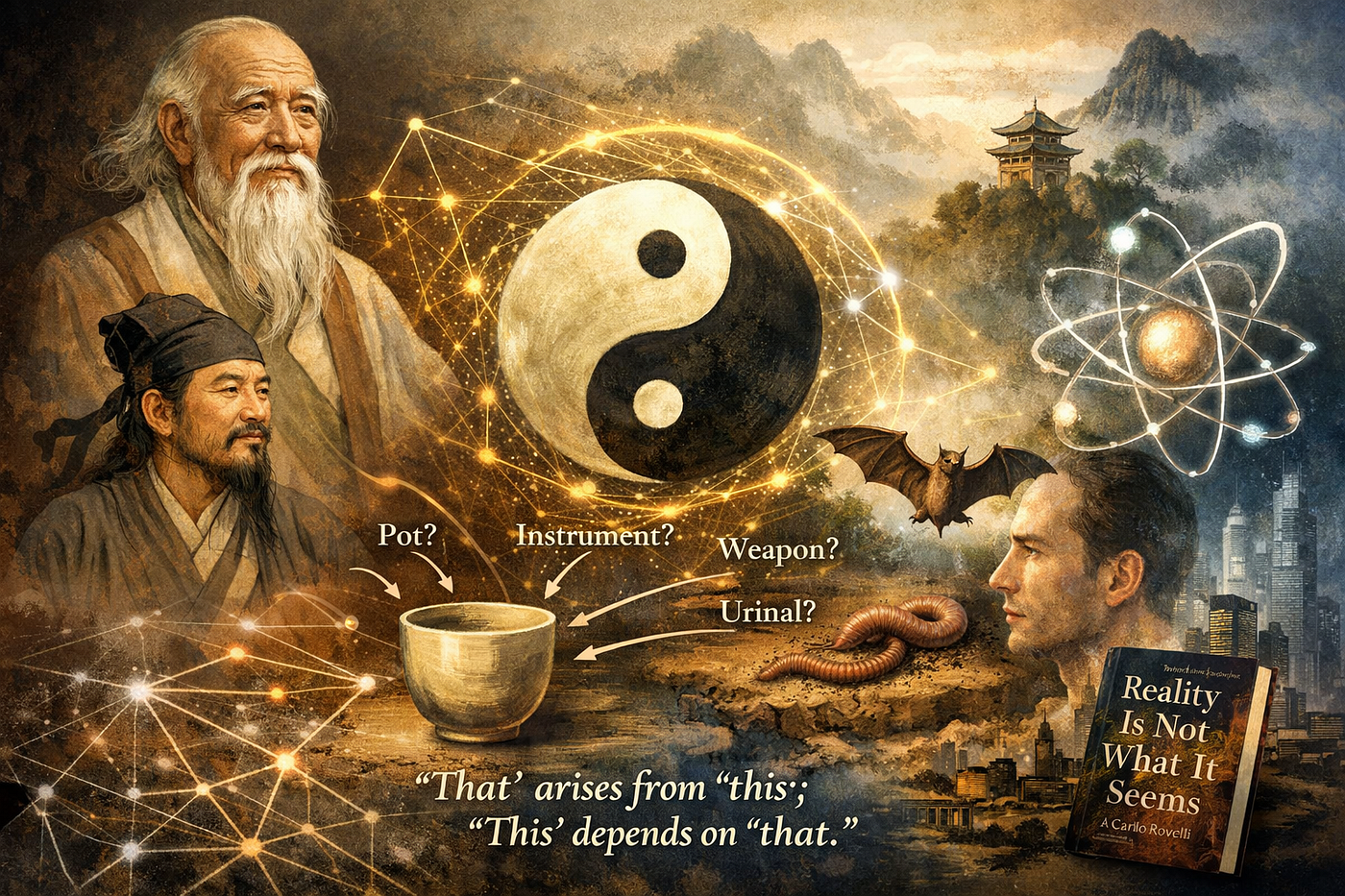
The Yin–Yang symbol itself visually expresses this insight. Within the black region of Yin there is a small white dot, and within the white region of Yang there is a small black dot.
This design illustrates an important principle: every extreme already contains the seed of its opposite. Midnight contains the beginning of dawn, and the height of summer already contains the seed of winter.
The symbol therefore rejects rigid dichotomies. Reality is not divided into isolated camps of absolute opposites. Instead, the opposites interpenetrate and generate each other.
Taoism Is Not Pure Non-Dualism
At the same time, it would be misleading to describe Taoism as purely non-dualistic. Some traditions of Eastern spirituality — especially Advaita Vedanta — emphasize the ultimate return to unity. Spiritual liberation is often described as union with Brahman, the dissolving of all distinctions into a single ultimate reality.
From this perspective, the world of multiplicity is often treated as a form of illusion.
Taoism takes a different approach. The Tao Te Ching famously states: “The Tao produced One; One produced Two; Two produced Three; Three produced all things.” The emergence of Two — Yin and Yang — is not described as a mistake or a fall from grace. It is simply the natural unfolding of the Tao.
In Taoism, polarity is not something to transcend or eliminate. It is the very condition that allows the world to exist.
The Problem of Absolute Unity
The emphasis on returning to absolute unity raises an interesting philosophical question. Many mystical traditions describe enlightenment as a return to the primordial bliss that existed before the world of distinctions appeared. In Hindu thought, this is sometimes expressed as merging with Brahman.
But if everything returns to perfect unity, what happens afterward?
Nothing.
Absolute oneness eliminates differentiation, tension, and contrast. Without these elements there can be no creativity, no development, and no learning. In this sense, perfect unity might resemble a form of spiritual death.
Even in Western philosophy and theology, some thinkers have questioned the attractiveness of eternal paradise. If heaven consists of an unchanging state of bliss without challenges or growth, it could eventually become a static and monotonous condition. A paradise of permanent perfection might turn into a form of cosmic stagnation.
Maya and the Divine Play
Hindu philosophy itself offers a fascinating way to approach this issue through the concepts of Maya and Lila. Maya refers to illusion — the idea that the phenomenal world is not ultimately real. This idea bears some resemblance to Buddhist teachings about the emptiness of phenomena.
Yet Hindu thought also introduces the concept of Lila, the divine play. The universe can be understood as a cosmic drama performed by the divine.
Without Maya — the veil that creates the appearance of separation — the drama could not take place. If every being were constantly aware of the ultimate unity of reality, the play would immediately collapse.
Philosopher Alan Watts described this mythologically as the “self-forgetting God.” The divine temporarily forgets its own identity in order to experience the richness and diversity of the world. What appears to be a tragedy — the loss of awareness of our divine nature — also makes the cosmic drama possible.
It is similar to actors performing in a play. If the actors suddenly remove their masks and remind themselves that they are merely performers, the drama would instantly come to an end. The illusion must remain intact for the story to unfold.
The Taoist Vision of the Cosmic Dance
Classical Taoism is closer to this vision of cosmic play than to the quest for a return to absolute unity.
In Taoism, Yin and Yang perform a continuous cosmic dance. Their interaction generates the extraordinary diversity of the world — mountains and rivers, storms and sunshine, birth and death, growth and decay.
The world is not a mistake to be escaped. Nor is it an illusion that must be dissolved. It is the living expression of the Tao.
Human wisdom therefore lies not in transcending the world but in participating in it harmoniously.
A Middle Path Between Dualism and Monism
Taoism ultimately occupies a subtle middle position between two extremes. It rejects the Western model of cosmic dualism, in which opposing forces struggle until one is permanently victorious. But it also rejects the idea that all distinctions must dissolve into an undifferentiated unity.
Instead, Taoism embraces polarity without hostility. Opposites depend on each other, generate each other, and transform into each other.
Reality is not a battlefield. Nor is it a static unity.
It is a living process — a dynamic dance of Yin and Yang from which the immense richness of the world continually emerges.
메타데이터
- post_id
- 22e6d4fcf8df
- slug
- is-taoism-dualistic-or-non-dualistic-22e6d4fcf8df
- url
- https://medium.com/@kleong54/is-taoism-dualistic-or-non-dualistic-22e6d4fcf8df
- canonical_url
- https://medium.com/@kleong54/is-taoism-dualistic-or-non-dualistic-22e6d4fcf8df
- author_url
- https://medium.com/@kleong54
- status
- ok
- fetched_at
- 2026-07-16 03:28:17