The Friday column: Alaska’s S-Corp and other tax expenditures
We look at the impact that the S-corp and other Alaska “tax expenditures” have on Alaska’s overall fiscal condition using the same approach…
The Friday column: Alaska’s S-Corp and other tax expenditures
We look at the impact that the S-corp and other Alaska “tax expenditures” have on Alaska’s overall fiscal condition using the same approach as various “budget hawk” groups apply at the federal level
One of the clearest memories I retain from both my undergraduate economics and law school tax courses is the discussion of “tax expenditures.”
According to the U.S. Congressional Joint Committee on Taxation (JCT), tax expenditures are defined as “revenue losses attributable to provisions of the Federal tax laws which allow a special exclusion, exemption, or deduction from gross income or which provide a special credit, a preferential rate of tax, or a deferral of tax liability. [They] include any reductions in income tax liabilities that result from special tax provisions or regulations that provide tax benefits to particular taxpayers.”
The primary reason they have stuck with me is that they act like stealth spending programs that bypass the normal appropriations process. Again, according to JCT, “tax expenditures are like direct spending programs that function as entitlements to those who meet the established statutory criteria.” They are the functional equivalent of government spending, except they don’t show up in the budget and aren’t required to be renewed as part of the annual appropriations process.
As my law school tax professor, a former Assistant Secretary for Tax Policy and Undersecretary in the U.S. Department of Treasury, would sometimes say, tax expenditures are “a lobbyists’ dream,” because once obtained, they can continue for decades without further review. Because they aren’t part of the annual budget process, they remain out of sight and out of mind both to Congressional appropriators and to those outside of government who regularly scour its budgets for issues.
They also remain out of sight when efforts are made to “cut the budget.” Because they aren’t included in the regular budget, they stay under the radar when those seeking to reduce spending look for targets.
The other reason they have stuck with me is their great significance. I don’t recall their exact size or the size of U.S. budget deficits when I first learned about tax expenditures, but I recall the two numbers being relatively close.
Their significance is even greater today. According to a recent summary from the Committee for a Responsible Federal Budget (CRFB), in its most recent annual report, JCT estimates that tax expenditures will total $2.3 trillion for the federal Fiscal Year (FY) 2026. That is nearly 25% larger than the $1.85 trillion the Congressional Budget Office projects as the overall U.S. budget deficit for the same period.
Put another way, if Congress closed all tax expenditures, the U.S. government would run a surplus rather than a deficit.
They are also huge compared to other spending categories. According to a chart included in the CRFB report:
At $2.3 trillion of net deficit impact in FY 2026, tax expenditures are far larger than almost all other parts of the federal budget. They are larger than all discretionary spending programs, all health care programs combined, and Social Security. If they were a line item in the budget, they would be the largest by more than $600 billion.
The reason that we raise them in this week’s column is that tax expenditures don’t exist only at the federal level. In various forms, they exist at virtually every level of government that collects taxes.
In 2014, the Alaska Legislature passed a law (codified at AS 43.05.095) requiring that, as occurs at the federal level, the Department of Revenue periodically prepare a report identifying the various tax expenditures (referred to in the statute as “indirect expenditures”) occurring at the Alaska state level.
As explained in DOR’s most recent report published earlier this month, as with federal tax expenditures, “an indirect expenditure is a provision of state law that results in foregone revenue to the state.”
As at the federal level, the relative size of these “indirect expenditures” in Alaska is huge. Here is a summary of the foregone revenue impact of the expenditures covered in DOR’s most recent report:
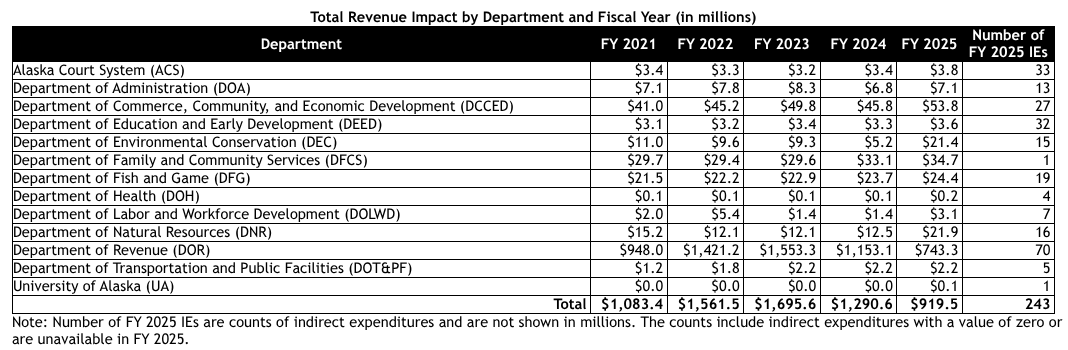
It should be noted that this estimate only includes a portion of the total impact. Some of the indirect expenditures, such as the recently much-discussed “S-Corporation Exclusion” from the state’s corporate income tax, are noted in the report but without an estimate of their cost. As the report explains, “While S-Corporations doing business in Alaska are required to submit a tax return, they do not report any income or income tax on the returns, so the estimated revenue impact is unavailable.”
The report also notes that “certain provisions have been excluded in accordance with confidentiality requirements.” And the numbers for FY2025 are incomplete. As the report notes, “Final values for FY 2025 indirect expenditure revenue impacts may increase when this additional data becomes available ….”
Even without the additional data, however, it is clear that, in the aggregate, the size of the expenditures is hugely significant. For example, here is how the state’s “indirect expenditures” compare with the level of cuts to the Permanent Fund Dividend (PFD) (i.e., indirect taxes targeted directly at Alaska households) since FY2017.
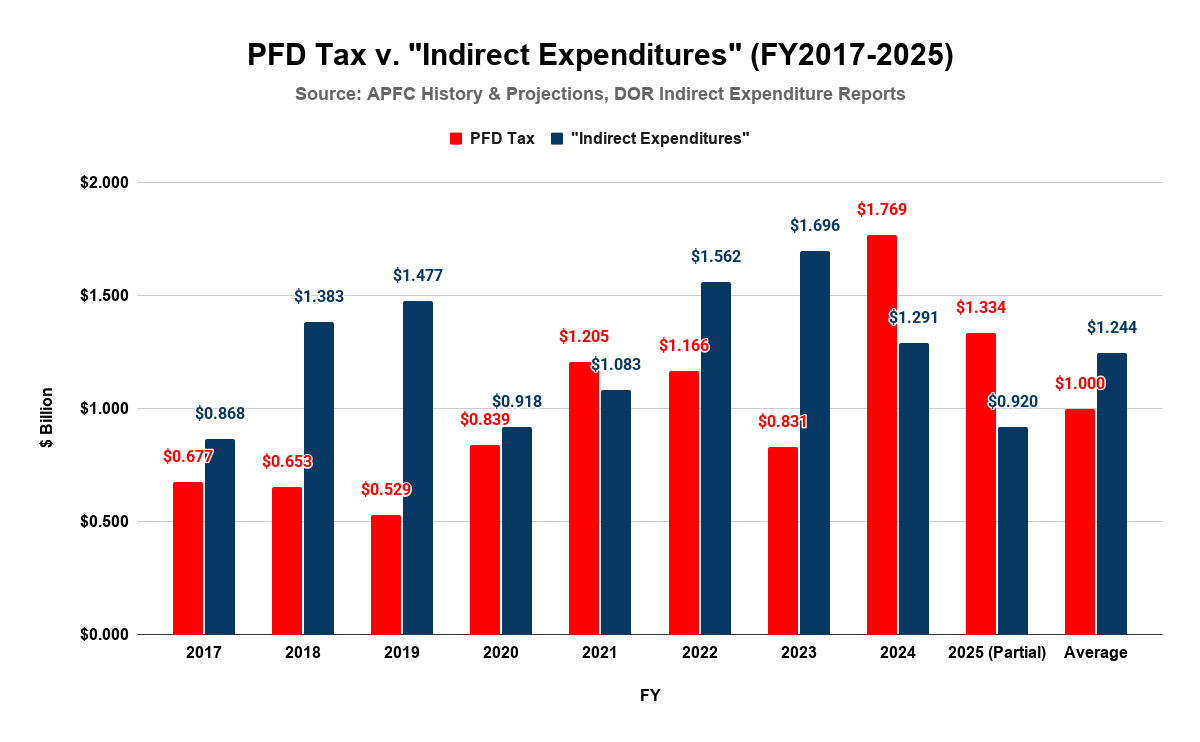
Even with only partial results for FY2025, the annual average size of indirect expenditures reported for FY2017 through FY2025 still exceeds that for PFD cuts over the same period.
As do others, we often use the level of PFD cuts as a proxy for Alaska’s annual deficit size. As at the federal level, if the Legislature closed all of the state’s tax expenditures, Alaska would be running a surplus, not a deficit. At the very least, it would eliminate the need for the PFD cuts the state has made over the period.
Following the publication of the periodic indirect expenditure reports by DOR, the Legislature’s Legislative Finance Division (LegFin) undertakes a review of them on a rolling basis. As set by statute (AS 24.20.235), the purpose of LegFin’s report is to analyze the expenditures based on certain criteria and make recommendations to the Legislature on whether they should be continued, modified, or terminated.
For example, in its most recent look at the “S” Corporation exclusion (2021), LegFin made the following recommendation:
Recommend termination. “S” corporations are exempt from the federal corporate income tax because income from these corporations is taxed under the personal income tax. Without a state personal income tax, these corporations receive the legal benefits of incorporation without any state tax liability.
Despite the recommendation, the exclusion has remained, protected by intense, behind-the-scenes lobbying from its major beneficiaries.
Going forward, both LegFin’s recommendations and DOR’s assessment of the overall cost of the state’s tax expenditures should be given much more attention.
As we explained in last week’s column, Alaska families are currently taxed at an average rate of more than 5% on adjusted gross income, which, based on combining state-level data from the Internal Revenue Service with that from the Tax Foundation, is among the highest, if not the very highest, average state household tax rate in the nation. (More on that in a future column.) And the size of the tax burden is growing. The current rate is more than double the average tax rate of less than 5 years ago.
At a time of significant outmigration and economic stress on middle-income Alaska families, the Legislature should make a serious effort to reduce those rates. As we also discussed in last week’s column, one way to do so is to expand the tax base to include non-residents. Another is to focus on the compelling need for oil tax reform. A third, longer-term approach is to review the Alaska Permanent Fund Corporation’s investment approach to ensure it is fully optimizing the Fund’s earnings potential.
Some also reasonably argue that the state should consider cuts to current state spending levels. We agree with that. But as many urge at the federal level, alongside cuts to direct expenditures, the state should also focus on reducing its indirect expenditures.
As LegFin’s previous analysis of the S-corp tax exclusion exemplifies, there are several areas in which the state is currently incurring indirect expenditures that may not serve a policy objective anywhere near as important as moderating the state’s current tax burden on Alaska families.
Rather than allowing inertia (and behind-the-scenes lobbying) to continue protecting those expenditures, the Legislature and the next Governor should bring them into the light and evaluate their impact relative to the contribution they would make if terminated, with the resulting proceeds used to lower the current tax burden on Alaska families.
메타데이터
- post_id
- 22f10a70b8ad
- slug
- the-friday-column-alaskas-s-corp-and-other-tax-expenditures-22f10a70b8ad
- url
- https://medium.com/alaskans-for-sustainable-budgets/the-friday-column-alaskas-s-corp-and-other-tax-expenditures-22f10a70b8ad
- canonical_url
- https://medium.com/alaskans-for-sustainable-budgets/the-friday-column-alaskas-s-corp-and-other-tax-expenditures-22f10a70b8ad
- author_url
- https://medium.com/@bgkeithley
- status
- ok
- fetched_at
- 2026-07-22 16:12:32