Is It Okay to Steal a Photographic Style?
Borrowing from another photographer is not the problem. Pretending you invented it is.
Is It Okay to Steal a Photographic Style?
Borrowing from another photographer is not the problem. Pretending you invented it is.
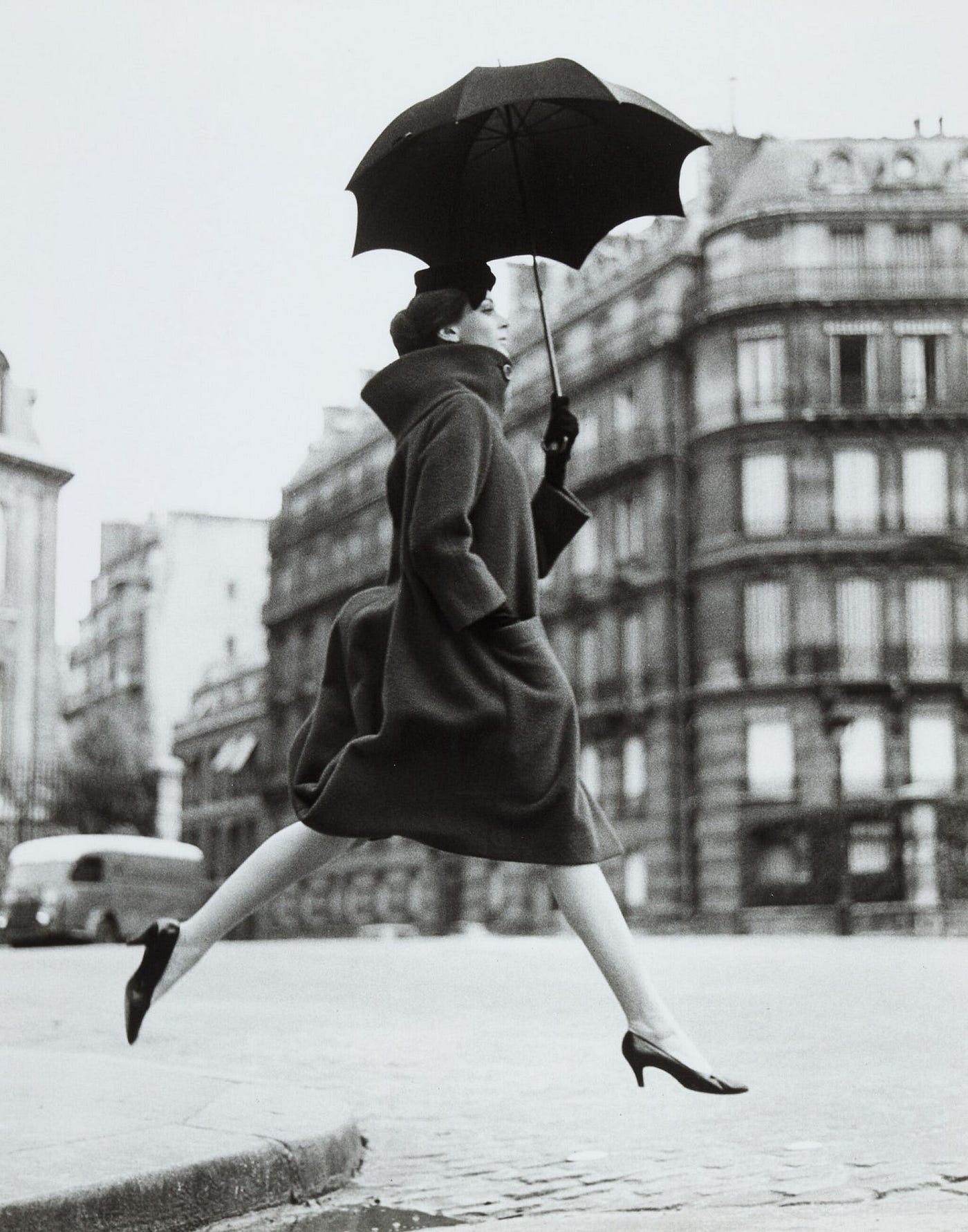
Carmen, Homage to Munkacsi, Coat by Cardin, Place François-Premier, Paris — ©Richard Avedon
A while back, I wrote about that famous photograph of Queen taken by Mick Rock. You know the one. The band members are stacked together, faces lifted, hands crossed, dramatic light falling across them in that very theatrical way. It became one of the defining images of the band, and later, a visual reference for the “Bohemian Rhapsody” video.
What I liked about Mick Rock’s story is that he didn’t pretend the idea fell out of the sky and landed on his camera. He readily admitted he borrowed, or “stole,” the lighting and pose from an old photograph of Marlene Dietrich. That honesty changes the whole discussion for me. He saw something, he absorbed it, he used it, and he acknowledged where it came from.
I think that matters.
I don’t have a problem with photographers borrowing a pose, a lighting pattern, a mood, or even the overall feel of another photograph. Photography has always worked that way to some degree. We study what came before us, whether we admit it or not. The problem comes when someone borrows heavily from another photographer and then acts as though they invented the whole thing.
That, to me, is where it starts to smell a little bad.
Richard Avedon did something similar, but he handled it beautifully. His 1957 photograph Carmen, Homage to Munkacsi, Coat by Cardin, Place François-Premier, Paris shows the model Carmen dell’Orefice moving through the street in a way that clearly refers back to Martin Munkácsi. Avedon didn’t bury the influence. He put the word “Homage” right in the title.

The Puddle Jumper — ©Martin Munkácsi
That tells me a lot. Avedon borrowed the energy, the movement, and the feeling of a fashion photograph breaking loose from the studio. But by naming Munkácsi, he made the influence part of the work instead of a secret hiding behind it.

A Great Day in Hip Hop — ©Gordon Parks
Gordon Parks did the same thing on a larger scale with A Great Day in Hip-Hop. In 1998, he photographed a huge group of hip-hop artists, producers, and influencers gathered on a Harlem stoop. The picture directly references Art Kane’s famous 1958 photograph, A Great Day in Harlem, which brought together jazz musicians at the same location.

A Great Day in Harlem — ©Art Kane
That is not stealing in the sneaky sense. That is borrowing with the lights turned on. Parks used Kane’s structure, location, and cultural idea, but he shifted the subject from jazz to hip-hop. He wasn’t saying, “Look at this idea I just invented.” He was saying, “Look at what this idea means now.”
That is a big difference.
Let’s pause for a second and talk about something that I think is wrong. Sherrie Levine took Walker Evans photos from a Walker Evans exhibition and displayed them as her own. She named the series After Walker Evans. I read one account that said she photographed his photographs, and another that said she just took the photographs and repackaged them.
The Walker Evans Estate claimed this was copyright infringement. They stopped Levine from selling the prints and acquired her work. The entire series is now in the collection of the Metropolitan Museum of Art.
Levine did not hide what she was doing. The title itself tells you the source. Whether you like the work or not, it forces you to think about authorship, ownership, and how much of a photograph belongs to the person who pressed the shutter.

One of Walker Evans photographs that Sherrie Levine appropriated — ©Walker Evans
Vik Muniz is another interesting example. In Action Photo, after Hans Namuth, he recreated Hans Namuth’s well-known photograph of Jackson Pollock painting. Muniz made his version using chocolate syrup, then photographed that recreation.

Action Photo, after Hans Namuth — ©Vik Muniz
That sounds odd, and it is. But again, the borrowing is out in the open. He used Namuth’s photograph as the starting point, then changed the material and the meaning. The original image was about Pollock, painting, motion, and mythology. Muniz’s version adds another layer by making the image out of something temporary and almost silly.

©Hans Namuth
These examples do not all do the same thing. Avedon borrowed a feeling. Parks borrowed a setup and a cultural structure. Levine borrowed the whole image. Muniz borrowed a famous scene and remade it through another process. But the common thread is that the borrowing was acknowledged.
That is the part I keep coming back to.
Personally, I would be careful about doing this in my own work. I would not wake up one morning and decide to copy someone’s lighting style just to pass it off as mine. That does not interest me. If a client came to me with a specific look in mind, and I knew that look came from another photographer, I might use it as a reference point. But I would want everyone involved to understand where that reference came from.
I could also see doing it if the borrowed style helped me say something true about the person in front of the camera. Maybe a certain kind of light, pose, or setting would express that person better than anything I came up with cold. In that case, I would not feel guilty about borrowing. I would feel guilty only if I pretended I had no idea where the idea came from.
There is another side to this too. Studying photographers this way can make you better. Not by copying them forever, but by figuring out how they made a photograph work.
Where was the light placed? Why did the pose feel natural or unnatural? Why did the background matter? Why did the photographer choose that distance, that lens, that moment, that expression?
Those are useful questions. They move you from looking at photographs as a viewer to studying them as a photographer. That is when you start to see the machinery behind the magic, and I mean that in a good way.
Most of us learn by imitation before we develop a voice of our own. A guitar player learns songs by other musicians. A painter studies older painters. A writer reads other writers and sometimes hears their rhythm coming through. Photography is no different, even though photographers sometimes act like every idea must be born in complete isolation.
It usually isn’t.
The better question is not, “Did this photographer borrow?” The better question is, “What did they do with what they borrowed?” Did they add something? Did they shift the meaning? Did they honor the source? Did they acknowledge the influence?
For me, that is where the line sits. Borrowing is fine. Studying is more than fine. It is one of the best ways to grow. But credit matters because it shows respect for the work that came before you.
And maybe that is the real lesson. Don’t just look at great photographs and admire them. Take them apart. Study them. Figure out why they work. Let them teach you something.
Then, when you borrow, be honest about it. Give credit where it belongs, then try to make something that could only have come from you.
Some of the Places You Can Find Me:
- My Website: https://www.anthonymorganti.com/
- My YouTube Channel: https://www.youtube.com/@anthonymorganti
- Medium: https://medium.com/@anthonymorganti
메타데이터
- post_id
- 2312fc4df88d
- slug
- is-it-okay-to-steal-a-photographic-style-2312fc4df88d
- url
- https://medium.com/@anthonymorganti/is-it-okay-to-steal-a-photographic-style-2312fc4df88d
- canonical_url
- https://medium.com/@anthonymorganti/is-it-okay-to-steal-a-photographic-style-2312fc4df88d
- author_url
- https://medium.com/@anthonymorganti
- status
- ok
- fetched_at
- 2026-06-09 15:37:30