The Future of Design Talent in 2026
Design is no longer a fixed function. It is a distributed capability and most organizations haven’t caught up.
The Future of Design Talent in 2026
Design is no longer a fixed function. It is a distributed capability and most organizations haven’t caught up.

For years, design followed a stable structure. Teams were built internally, roles were clearly defined, and growth came from adding more people. That environment no longer exists.
Design now operates in fast-moving, AI-supported, distributed systems. Priorities shift quickly, execution is no longer limited by team size, and the boundaries that once defined “the design team” have dissolved not because design matters less, but because it now happens everywhere.
Direction, not output
AI can generate layouts, flows, and variations in seconds. Product managers, engineers, and marketers are all part of design decisions. Figma’s growth makes this concrete:
When that many people across that many roles work inside the same platform, production is no longer the constraint. What matters now is judgment the ability to decide what should be built, to evaluate AI-generated work, and to maintain consistency across systems that dozens of contributors are simultaneously editing.
“Designers are no longer the gatekeepers of execution. They are responsible for something harder: ensuring that the abundance of production does not become an abundance of incoherence.”
Design & Technology
Three organizations. Three lessons.
Stripe
With ~8,500 employees and $5.1B in revenue, Stripe’s design function sits at roughly 1,100 people a deliberately lean ratio. Designers are embedded as strategic partners, not production resources. The Design Systems team lets product teams build faster without a designer in every decision. The result: faster, more precise decision-making.
Klarna
Between 2022 and 2024, Klarna reduced its workforce by 40%, attributing cuts in part to AI. Its AI assistant handled 2.3M conversations across 23 markets — equivalent to 700 agents, saving $40M annually. Within months, customer satisfaction dropped and complex interactions degraded. By mid-2025, the company reversed course. CEO Sebastian Siemiatkowski: “We focused too much on efficiency. The result was lower quality, and that’s not sustainable.”
Spotify
Spotify’s Squads and Tribes model is frequently cited as a clean example of flexible design at scale. The actual history is more complicated. Tribes became too large. The Chapter Lead role caused consistent burnout. The structure was eventually abandoned. What survived was simpler: cross-functional teams and communities of practice. Copying a structure without the culture to support it produces the appearance of change, not the substance of it.
The hidden risk: a weakening pipeline
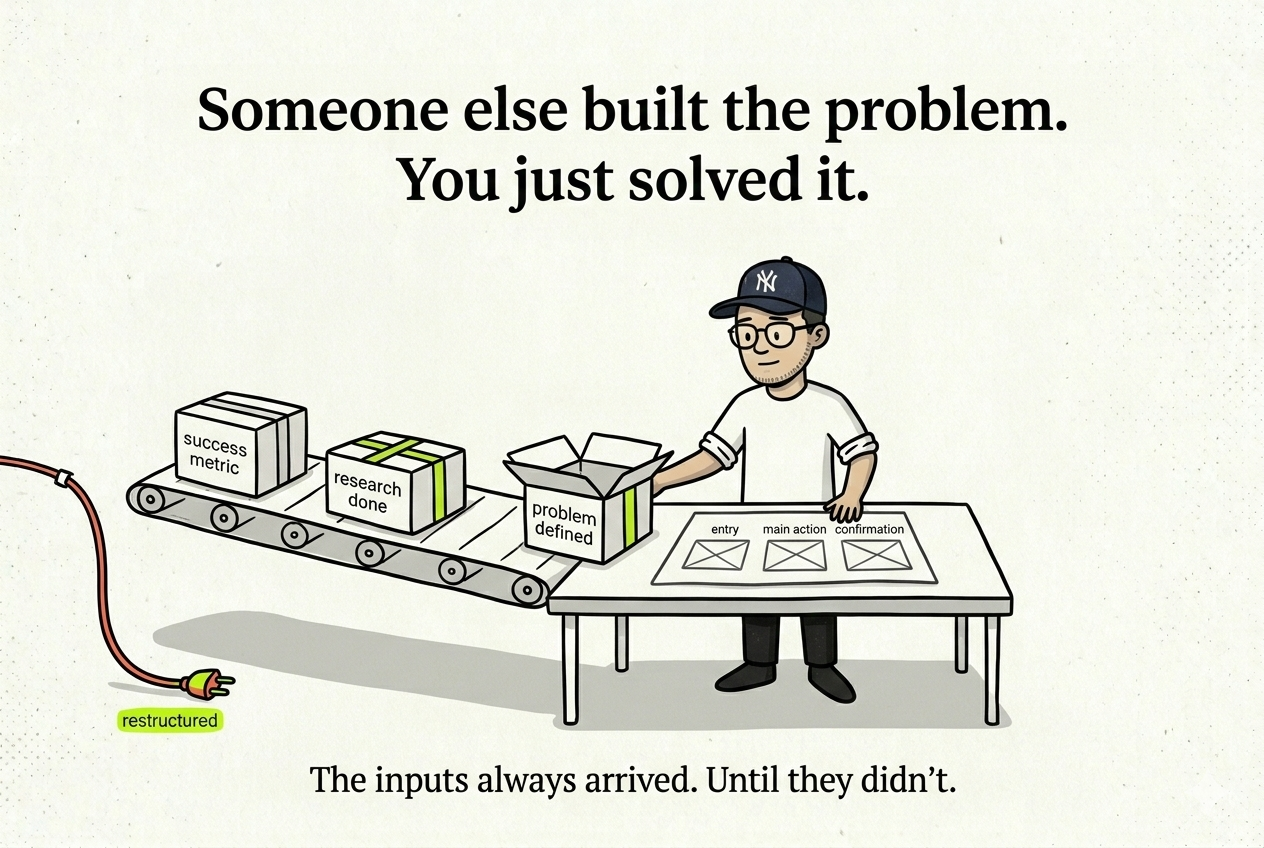
As AI replaces entry-level tasks the wireframes, early explorations, and iterative variations that junior designers once spent years producing fewer designers build the foundational experience that develops judgment. The pipeline for senior expertise is weakening quietly.
That kind of structural problem only becomes visible once it is already expensive to fix. The human role in design moves earlier in the process and becomes harder to measure: defining problems before they calcify, structuring systems that stay coherent, maintaining decision consistency across products evolving faster than any documentation can follow.
These tasks do not show up cleanly in a delivery dashboard. But they determine whether a product remains trustworthy and coherent over time.
Design in 2026 is not defined by team size or output volume. The organizations that understand this are not trying to produce more design. They are building the conditions for better decisions.
메타데이터
- post_id
- 2324fc10dbc2
- slug
- the-future-of-design-talent-in-2026-2324fc10dbc2
- url
- https://medium.com/@awn_82390/the-future-of-design-talent-in-2026-2324fc10dbc2
- canonical_url
- https://medium.com/@awn_82390/the-future-of-design-talent-in-2026-2324fc10dbc2
- author_url
- https://medium.com/@awn_82390
- status
- ok
- fetched_at
- 2026-06-09 15:37:30