Why Your 1099-K Doesn’t Match Your Bank Deposits (eCommerce Guide)
Understanding the 1099-K Gap Every eCommerce Business Runs Into.
Why Your 1099-K Doesn’t Match Your Bank Deposits (eCommerce Guide)
Why Your 1099-K Doesn’t Match Your Bank Deposits (eCommerce Guide)
Understanding the 1099-K Gap Every eCommerce Business Runs Into.
It’s a scenario we see all the time.
Sales are up. Orders are flowing. Revenue dashboards look strong.
Then year-end (or tax season) hits.
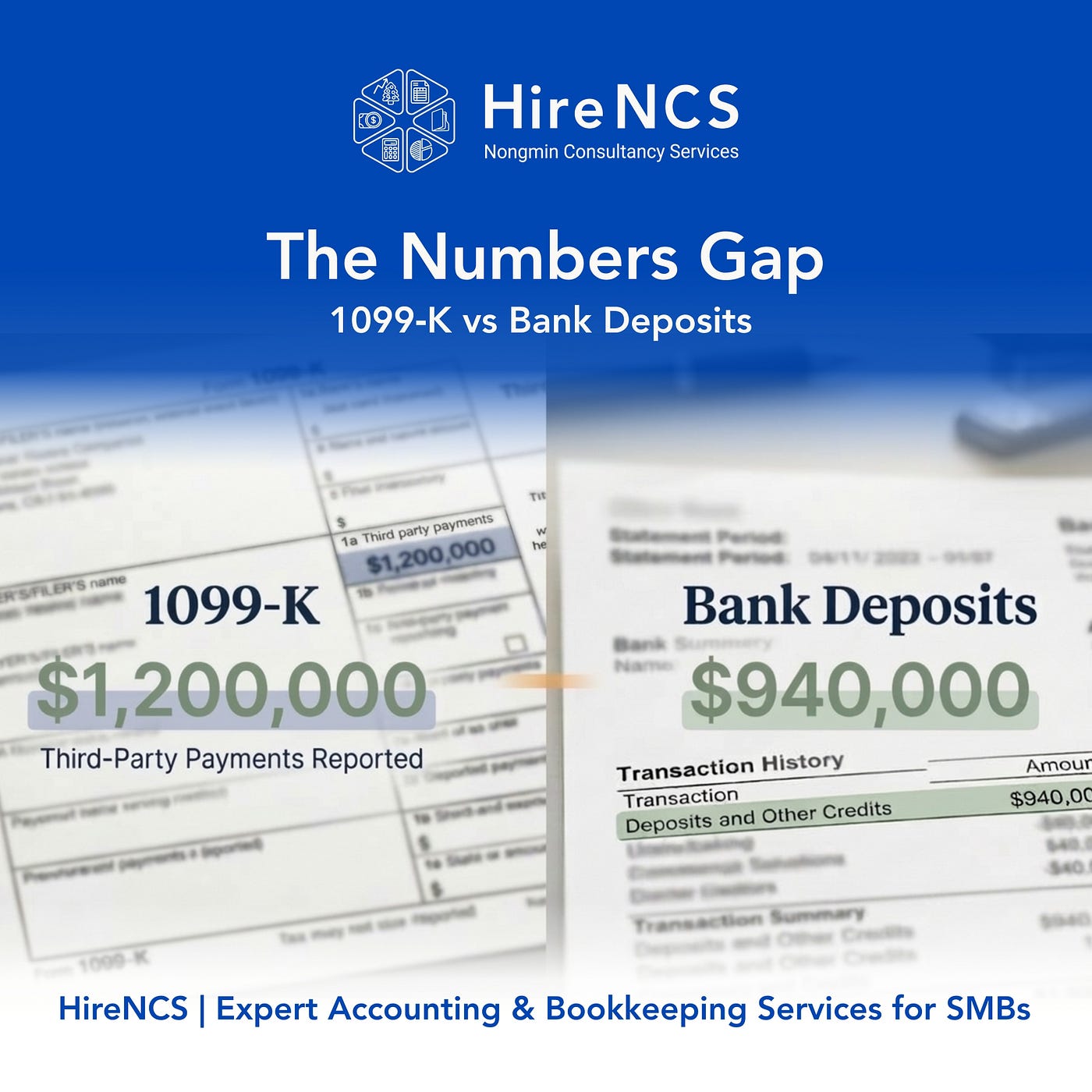
You open your 1099-K and see $1.2M in reported sales. You check your bank deposits for the year. Total cash received: $940,000.
That’s a $260,000 gap.
And the first question is almost always the same:
“Where did the money go?”
Closely followed by the more uncomfortable one:
“Is the IRS going to tax me on the full $1.2M?”
If you run an eCommerce business — especially across platforms like Shopify, Stripe, Amazon, PayPal, or marketplaces — this situation is not an exception. It’s the norm. And it’s not a sign that money is missing.
It’s a sign that gross activity is being confused with financial reality.
What the 1099-K Really Shows (and Why It Creates Confusion)
At its core, the 1099-K reports gross payment volume processed through a platform. That’s it.
It does not represent:
- What landed in your bank
- What you earned after fees
- What you actually kept as revenue or profit
Every dollar a customer pays — product price, shipping, sales tax — is included in the 1099-K. But many of those dollars were never yours to begin with, or were deducted before cash ever reached your account.
When business owners compare this gross platform number to net bank deposits, confusion is inevitable.
Where the Gap Really Comes From (Step by Step)
The gap between sales and cash doesn’t come from one big issue. It builds quietly and cumulatively across normal operations.
Let’s walk through a realistic example.
You run an eCommerce store using Shopify and Stripe:
- 1099-K shows: $1,200,000
- Bank deposits show: ~$940,000
Here’s how that difference forms.
1. Processing Fees Are Deducted Before You Ever See the Money
Every transaction carries a fee — 2.9%, 3.2%, sometimes higher depending on platform and payment method.
Individually small. Collectively massive.
On $1.2M in volume, that’s roughly $35,000–$40,000 deducted automatically — never hitting your bank.
Your effective starting point is already closer to $1.16M.
2. Refunds Reverse Cash, Not Just Sales
Refunds don’t feel like “sales activity,” but they hit cash immediately.
If you processed $150,000 in refunds:
- That money once came in
- Then left your bank
Now your position drops to about $1.01M — and many businesses underestimate how much refunds quietly erode cash.
3. Sales Tax Inflates the Top Line — but Isn’t Yours
One of the biggest distortions comes from sales tax.
Customers pay it. Platforms report it. But you don’t own it.
If $90,000 of your reported sales was sales tax, that amount:
- Shows in the 1099-K
- Flows through your systems
- Eventually goes to the state
Now that $1.01M drops closer to $920,000 in actual business revenue.
4. Timing Differences Make the Numbers Look “Wrong”
Not all sales convert to cash immediately.
Example:
- $60,000 in late-December sales
- Payout hits the bank in January
The 1099-K includes it. Your bank does not.
Suddenly, year-end deposits fall again — to about $860,000, even though nothing is missing.
5. Small Adjustments Add Up Fast
Chargebacks. Disputes. Marketplace adjustments. Currency differences.
Individually minor. Collectively $15,000–$25,000 per year for many businesses.
The Big Picture
You started with $1.2M in reported sales. You ended with $840K–$940K in deposits.
That’s the gap. And at no point was money actually missing.
Why This Gap Becomes a Real Business Problem
The danger isn’t the difference itself. It’s what happens when the difference isn’t understood.
1. Businesses End Up Paying Tax on Money They Never Made
When 1099-K totals are treated as revenue, income gets overstated.
A $200,000+ difference can translate into $50,000 or more in unnecessary tax exposure — without anyone realizing it until filings are underway.
Treating gross platform activity as income can quietly create unnecessary tax exposure — something many owners don’t realize until filings begin.
Understanding how businesses avoid painful tax penalties starts with getting reporting right.
2. Decisions Get Made on Inflated Performance
On paper:
- Revenue looks strong
- Margins appear healthy
In reality:
- Fees, refunds, and timing reduce actual margin
- A reported 20% margin may be closer to 12–14%
Businesses then scale ad spend, inventory, and headcount on thinner margins than they realize.
3. Cash Flow Starts Feeling Unpredictable
Revenue says one thing. The bank says another. When this gap isn’t reconciled consistently, cash starts feeling unpredictable — not because sales are weak, but because the numbers don’t tell one story.
Ongoing platform and bank reconciliation is what restores confidence in cash flow.
4. Year-End Turns Reactive and Stressful
When reconciliation only happens at tax time:
- Data is harder to trace
- Adjustments are rushed
- Errors become more likely
5. Confidence in Numbers Starts to Erode
When financial reports don’t feel reliable, decision-making slows.
Numbers stop guiding strategy and start creating friction.
In many cases, the issue isn’t the 1099‑K itself — it’s weak financial structure. This is exactly why cheap bookkeeping often becomes the most expensive mistake SMBs make.
What Smart eCommerce Businesses Do Differently
Experienced operators stop trying to “make the numbers match.”
Instead, they build processes that reflect how platforms like Shopify, Stripe, and Amazon actually operate, using platform-level eCommerce accounting and reconciliation to separate activity from real revenue.
They:
- Separate gross sales, true revenue, and cash received
- Reconcile at the platform level, not just the bank
- Track fees, refunds, and tax as core data, not afterthoughts
- Expect timing differences instead of treating them as errors
- Reconcile monthly, not once a year
Once this structure exists, the 1099-K stops being confusing — and starts being explainable.
The Real Shift
When businesses understand this gap:
- Numbers align
- Decisions become clearer
- Cash flow becomes predictable
- Year-end stops being a fire drill
Most importantly, they stop asking:
“Where did the money go?”
And start saying:
“I know exactly where it went.”
Most founders don’t struggle because sales are low — they struggle because no one is proactively monitoring how platform data, cash, and revenue interact.
This is one of the biggest signs your business needs structured bookkeeping support.
How We Approach This at HireNCS
At **HireNCS**, we see this issue differently.
Our approach isn’t just about recording transactions or “making numbers match.” It’s about building a financial structure that reflects how eCommerce businesses actually operate.
That means we focus on:
- Reconciling at the platform level, not just the bank (Shopify, Stripe, Amazon, marketplaces — not just deposits)
- Separating three critical views:
- Gross sales (platform activity)
- True revenue (after fees, refunds, and tax)
- Actual cash received (bank reality)
- Treating fees, refunds, and sales tax as core data, not cleanup items
- Accounting for timing differences upfront, instead of treating them as errors later
- Building repeatable monthly processes, so year-end is predictable — not reactive
When this structure is in place, the 1099-K stops being confusing. The “gap” becomes explainable. And financial reports start telling one consistent story.
That’s when numbers stop creating stress — and start supporting better decisions.
Still unsure whether your 1099‑K is overstating your income? A quick review can usually explain the gap.
👉 Talk to our eCommerce accounting team.
Final Thoughts
If your 1099-K shows more than what hit your bank account, it usually doesn’t mean money is missing.
It means you’re comparing a gross activity number to a net cash outcome — two figures that were never meant to match directly.
The clarity comes when you separate:
- What the platforms processed
- What the business actually earned
- What cash was ultimately received
Once those numbers are clearly aligned, taxes become more accurate, decisions become more confident, and cash flow becomes easier to manage.
And that’s when your financials stop feeling confusing — and start becoming a real tool for growth.
메타데이터
- post_id
- 23263dfc61b2
- slug
- why-your-1099-k-doesnt-match-your-bank-deposits-ecommerce-guide-23263dfc61b2
- url
- https://medium.com/@sndpnpaul/why-your-1099-k-doesnt-match-your-bank-deposits-ecommerce-guide-23263dfc61b2
- canonical_url
- https://medium.com/@sndpnpaul/why-your-1099-k-doesnt-match-your-bank-deposits-ecommerce-guide-23263dfc61b2
- author_url
- https://medium.com/@sndpnpaul
- status
- ok
- fetched_at
- 2026-06-29 22:44:20




