Your Tuner Is Lying to You
You passed the tuner test. The needle sat dead center. The note registered green, the readout said 0 cents, everything was correct. And the…
Your Tuner Is Lying to You
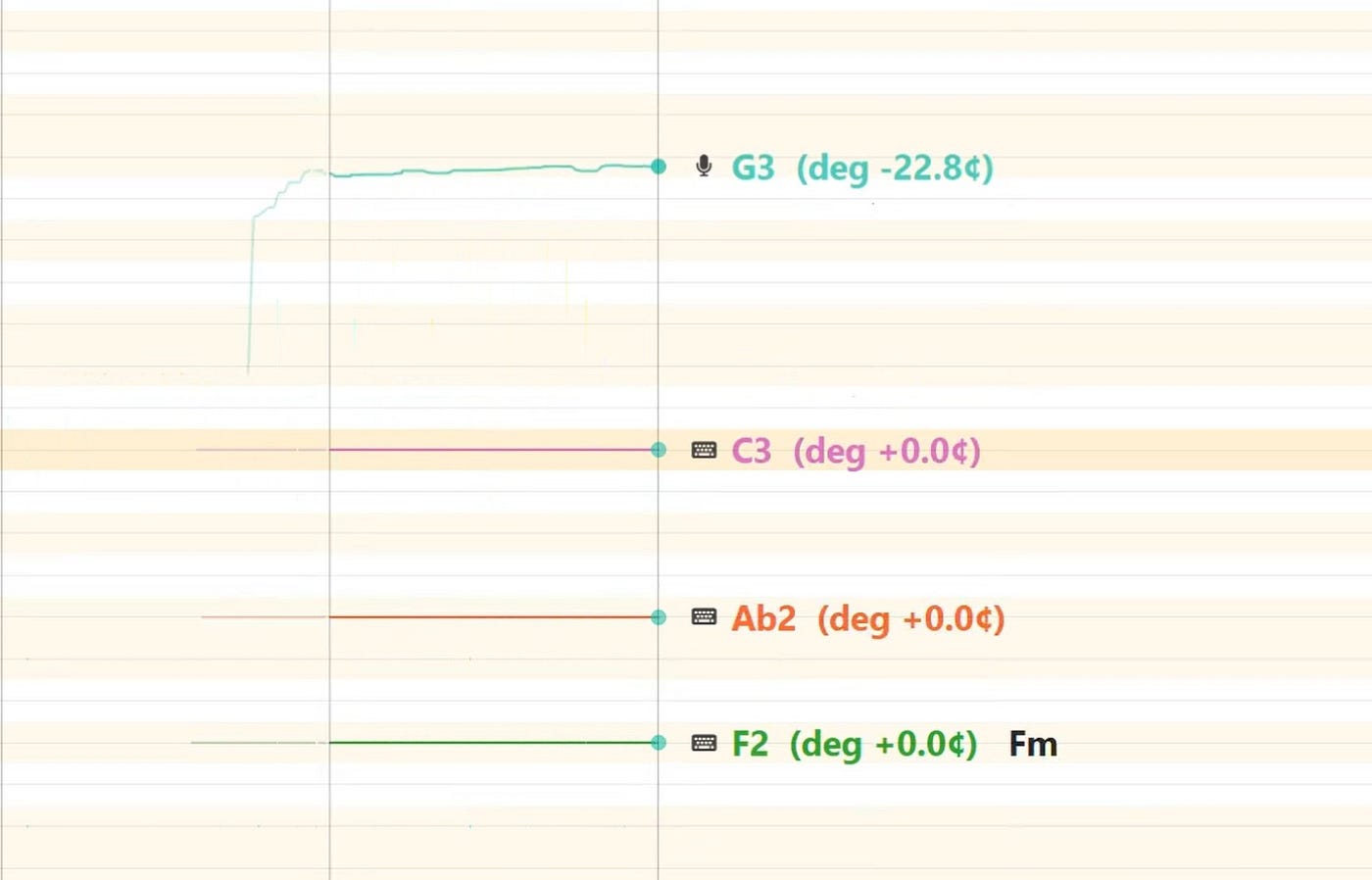
You passed the tuner test. The needle sat dead center. The note registered green, the readout said 0 cents, everything was correct. And the phrase still felt wrong.
That gap between what the tool said and what your ear heard is not an accident. It is structural. The tuner was built to answer a question that has nothing to do with what you were actually doing. You were singing, or bowing, or sliding a note through an ornament, and the tool was measuring something else entirely. Something simpler. Something that misses the point.
Pitch is not a point. It is a path.
What Does a Tuner Actually Measure?
A tuner measures one thing: whether a note’s fundamental frequency is close enough to a fixed equal-tempered reference pitch. That is useful. Before you play the first chord of a set, you want the guitar strings in tune. But the tool is designed for that moment, not for what comes after.

Twelve-tone equal temperament (12-TET) is a convention, not a law. It divides the octave into 12 equal semitones of 100 cents each. That system won out over other temperaments in Western music for practical reasons: it makes modulation between keys easier, it standardizes keyboard instruments, it simplifies ensemble tuning. But it is a compromise. Every major third in 12-TET is approximately 14 cents sharp of the pure harmonic ratio. String quartets and choral ensembles drift away from it constantly, by design.
The cent is a unit of relative pitch: 100 cents per semitone, 1,200 cents per octave. Trained musicians can detect pitch differences as small as 1–3 cents, while untrained listeners need 10 cents or more to notice a difference . That resolution matters. What doesn’t matter, for expressive music, is whether pitch sits static at the center of one of those equal-tempered slots.
A tuner takes a snapshot. It sees where the pitch is at a given instant and compares it to the nearest fixed reference. What it doesn’t see is what the pitch is doing. Whether it’s arriving, departing, oscillating, swelling, bending. The needle shows you the landing zone. It cannot show you the flight.
See how Chronos visualizes pitch in real time.
Why Are Singers Always “Off” By a Tuner’s Logic?
A professional opera singer in vibrato is, by a tuner’s standard, continuously off pitch. The pitch oscillates 34 to 123 cents above and below the target note, with standard vibrato typically running 20–40 cents above and below pitch center (Journal of Voice, 2015). A tuner’s acceptable range is perhaps 5 cents. The singer is almost never inside that window.
And yet. We call it beautiful.

Vibrato is not wobble. It is intentional, controlled pitch oscillation around a center note, produced by variations in subglottic air pressure and laryngeal muscle activity. The listener does not hear it as a deviation. The brain averages the oscillation and perceives the center. What creates the sensation of richness and warmth is the motion itself, not the landing point.
Put a vibrato singer in front of a standard tuner and the needle thrashes. It has no way to tell you that the pitch center is correct, that the oscillation is symmetrical, that the rate is even, that the depth is appropriate to the phrase. It just sees a value flying past several reference points in rapid succession. By its logic, the best singers in the world are always out of tune.
That’s not the singer’s problem. That’s the tool’s problem.
86% of non-musician listeners in a 2012 study detected differences between microtonal and equal-tempered melodies, demonstrating that pitch sensitivity extends well beyond what 12-TET acknowledges (PLOS ONE, 2012). People hear nuance. Tuners don’t report it.
Expressive Intonation Is Not a Deviation
In expressive music, intonation is not the absence of pitch deviation. It is the intentional shaping of pitch over time. A cello player bends slightly sharp on a leading tone, not because they’re out of tune, but because they understand tension and resolution. They’re using pitch the way a painter uses pressure: more of it, less of it, directional.

A 2024 study of 95 Swedish professional string teachers found that fine intonation is developed through ensemble listening and slow practice, not tuner use (SAGE Journals, 2024). The teachers described intonation as something developed intuitively, through the ear, through the body, through the social act of listening to others and adjusting in real time. Not through pass/fail feedback.

That finding makes intuitive sense to anyone who has played in a good string quartet or sung in a tight vocal ensemble. The ear is the instrument. The tuner is at best a pre-rehearsal check and at worst a distraction during practice.
Occasional singers can deviate 0–80 cents from a target pitch in tonal melodies without listeners perceiving them as out of tune (Bulletproof Musician). That range is not a failure tolerance. It’s a description of how pitch actually works for listeners. Context, motion, and phrasing carry as much weight as the frequency number itself.
The tuner does not know any of that. It knows: here is the target. Here is where you landed.
What Does Maqam Know That 12-TET Ignores?
In Arabic maqam, the same written note is not always performed at the same pitch. Its frequency shifts with melodic context, with the direction of the phrase, with the emotional weight carried by the moment. Maqam Rast and Maqam Bayati share some of the same notes on paper. They do not share them in practice. The pitch of the third degree of Rast changes depending on whether the melody is ascending or descending, and depending on what ajnas (tetrachord cells) are active at that moment (Maqam Lessons, 2009).

A 12-TET tuner cannot evaluate maqam intonation because it is using a different map. It’s not that the maqam player is deviating from the right answer. It’s that the tuner is built on a reference system that has no relationship to the pitch system being used. Asking a maqam tuner question with a 12-TET tuner is like checking the temperature in Fahrenheit and expecting the answer in Celsius without converting.
A 2024 systematic review of 326 academic articles found that intonation research is “primarily focused on Western educational contexts” (SAGE / International Journal of Music Education, 2024). Maqam, flamenco, Persian dastgah, Indian raga, and other oral pitch traditions are almost entirely absent from published academic intonation research. The tools that get built from that research reflect the same gap.
This isn’t a minor oversight. These traditions span hundreds of millions of practitioners. They carry sophisticated, internally consistent theories of pitch that Western equal temperament cannot describe. And the tools built around Western pitch assumptions fail them completely.
Not a small problem. A structural one.
What I Wanted to See
I’m drawn to music where the note is not a button but a gesture. Arabic classical, maqam, oud, ney, singing, bossa nova, flamenco. Music where the approach to a note matters as much as the arrival, where a phrase breathes in and out, where intonation carries emotion rather than just frequency information.
I practiced. I listened. I recorded myself. And I kept running into the same wall: I could hear something in my playing that felt wrong, or that I wanted to understand better, but none of the tools I had could show it to me.
The tuner said I was in tune. The recording didn’t lie, but it also didn’t explain. What I wanted was something that could show me what happened to the pitch while the note was alive, not just where it landed. I wanted to see a maqam glissando as a curve, not as a pass/fail test. I wanted to see the approach to a note, the settling-in, the vibrato pattern, the decay. The full sentence, not just the final word.
When I eventually built Chronos and ran a maqam phrase through it, the pitch curve looked nothing like what you’d see from a Western scale run. A Western scale run produces something close to a staircase: discrete steps, relatively flat plateaus at each pitch, clean transitions. A maqam glissando produces a flowing, continuous arc, with the pitch curving upward through microtonal space, settling briefly at a frequency that a 12-TET tuner would call “between notes,” and then continuing. The plateau is minimal or absent. The motion is the phrase. You cannot see any of this on a tuner needle.
I built Chronos over about a month and a half of daily work. It started from frustration. It became something that helped me, practically and, honestly, in ways that went beyond the practical. Seeing your own pitch move in real time, with no judgment attached to it, is a different kind of practice experience than passing or failing a test. It felt like getting a mirror after years of being handed grades.
Observation, Not Judgment
Most pitch tools do one of two things: they judge (the needle, the red/green indicator, the flat/sharp arrow) or they correct (Melodyne, Auto-Tune). Chronos does neither. It shows.
The question it answers is not “are you in tune?” The question is: “this is what happened.”
That distinction matters more than it sounds. A pass/fail system trains you to feel anxious during practice, to chase a number, to stop and restart rather than phrase through something. The anxiety that comes from constant correction feedback is real. String teachers know it. Singers know it. You’ve probably felt it: that hyper-self-consciousness mid-phrase that makes the phrase worse, not better.
A visualization that shows you what happened, without verdict, creates a different relationship with practice. You play. You look. You notice. You adjust. The loop is calmer, more observational, more like the process the Swedish string teachers described: listening, ensemble awareness, slow intentional repetition.
Most tuner feedback is retrospective anxiety. Good practice feedback is retrospective information.
Those are not the same thing.
Frequently Asked Questions
Why do I sound out of tune even when the tuner says I’m fine?
A tuner measures a static point. Your actual pitch moves continuously: in vibrato, in slides, in ornaments. That motion is not captured. You may be centering correctly on the pitch but approaching it in a way that sounds uncertain or wrong. Occasional singers deviate 0–80 cents from target pitch in tonal melodies without being perceived as out of tune (Bulletproof Musician). The path matters, not just the destination.
Can I use a regular tuner to practice maqam or Arabic music?
Not reliably. Maqam intonation is context-dependent. The same note changes pitch based on where it sits in a phrase and what emotional weight it carries. A 12-TET tuner evaluates against equal temperament, which is not the reference system maqam uses. Sami Abu Shumays documented this clearly: maqam pitch varies with melodic context, same note, different frequency, depending on phrase direction (Maqam Lessons, 2009). A pitch visualization tool that shows the full curve is more useful.
What is expressive intonation and why does it matter?
Expressive intonation is the intentional bending of pitch for musical effect: leaning sharp on a leading tone for tension, dropping slightly flat for a melancholic ornament, widening vibrato for intensity. A 2024 SAGE study found top string teachers develop this entirely through ear and ensemble listening, not tuner feedback (SAGE Journals, 2024). It matters because music that does not use it tends to feel correct but emotionally flat.
How do real-time pitch visualization tools differ from tuners?
A tuner gives a pass/fail verdict on where a note lands. A real-time pitch visualizer shows the continuous trajectory of pitch over time: approach, landing, vibrato, ornament, decay. For expressive music, the trajectory is the performance. The tool that shows you the path gives you more information than the tool that grades the destination.
Pitch Is a Path
The tools we have for measuring pitch were built by people thinking about a specific problem: is this instrument in tune before the performance begins? That’s a real problem. 12-TET solved it well enough for Western ensemble practice.
But expressive music asks a different question entirely. Not “did the note land?” but “how did it travel?” Vibrato, glissandi, ornaments, maqam inflections. These are not deviations from correct pitch. They are the music. Treating them as errors is not just wrong; it misrepresents what the music is doing.
What I wanted, and eventually built, was a mirror. Something that shows you what your pitch is doing without telling you whether it’s acceptable. Practice with that kind of feedback feels different. Calmer. More curious. More like listening than testing.
I built Chronos because I wanted that mirror, not a grade.
Pitch is not a point. It is a path.
Sources
-
Wikipedia. “Just-noticeable difference.” https://en.wikipedia.org/wiki/Just-noticeable_difference
-
Journal of Voice. “Vibrato in Professional Opera Singers: A Multicenter Study.” 2015. https://www.sciencedirect.com/science/article/abs/pii/S0892199715002064
-
Journal of Voice. “Systematic Review of Vibrato Extent in Singing.” 2022. https://www.jvoice.org/article/S0892-1997(22)00355-1/fulltext
-
PLOS ONE. “Effects of Culture on Musical Pitch Perception.” 2012. https://journals.plos.org/plosone/article?id=10.1371/journal.pone.0033424
-
SAGE Journals / Research Studies in Music Education. “Intonation Development in Professional String Teaching: A Study of 95 Swedish Teachers.” 2024. https://journals.sagepub.com/doi/abs/10.1177/19484992241266528
-
SAGE / International Journal of Music Education. “Intonation Education Research: A Systematic Review of 326 Articles.” 2024. https://journals.sagepub.com/doi/10.1177/02557614241237528
-
Maqam Lessons / Sami Abu Shumays. “Fuzzy Boundaries of Maqam Intonation.” 2009. https://www.maqamlessons.com/analysis/media/FuzzyBoundaries_MaqamIntonation2009.pdf
-
Bulletproof Musician. “How Perfect Does Your Intonation Have to Be?” https://bulletproofmusician.com/how-perfect-does-your-intonation-actually-have-to-be/
메타데이터
- post_id
- 232f41670329
- slug
- your-tuner-is-lying-to-you-232f41670329
- url
- https://medium.com/@nextbyrd/your-tuner-is-lying-to-you-232f41670329
- canonical_url
- https://medium.com/@nextbyrd/your-tuner-is-lying-to-you-232f41670329
- author_url
- https://medium.com/@nextbyrd
- status
- ok
- fetched_at
- 2026-07-10 15:20:15





