The Product Strategy Behind Blank Street’s Matcha Pivot
How a coffee chain found growth by following user behavior, social signals, and the identity people wanted to carry in their hands.
The Product Strategy Behind Blank Street’s Matcha Pivot
How a coffee chain found growth by following user behavior, social signals, and the identity people wanted to carry in their hands.
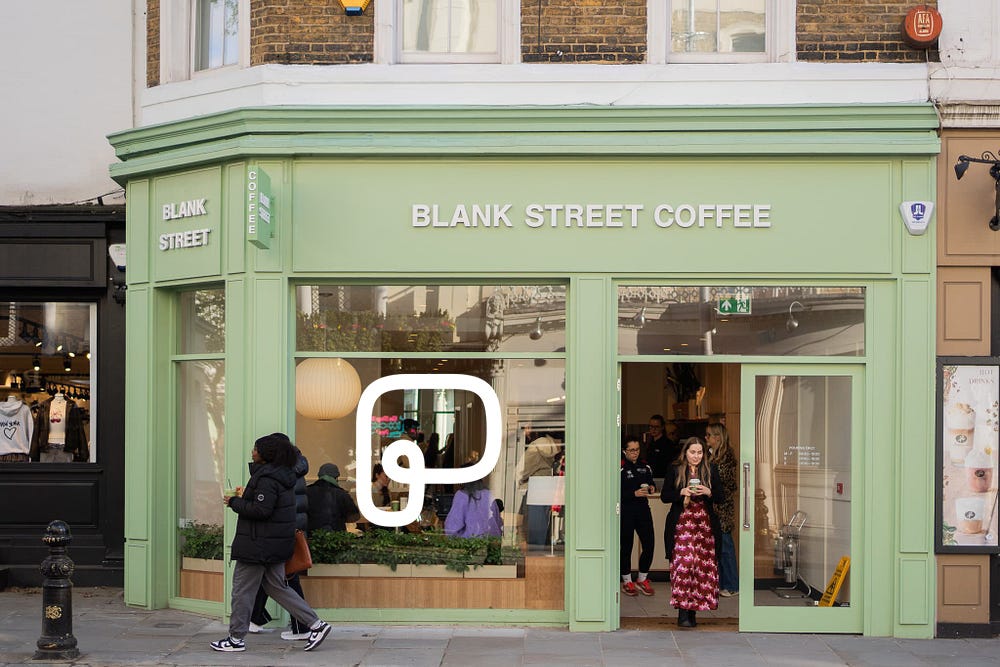
Walk through SoHo at 9 AM, and you’ll notice something strange. Nobody is just carrying coffee. They are carrying a personality.
The Starbucks cup says, I’m running late, and I need this to work. The Blue Bottle pour-over says, I have opinions about beans, and I want you to ask me what they are. The Blank Street cup, bright, colorful, and hard to miss on a subway platform, says, Look at what I’m drinking. Even Capital One has entered the space, turning bank branches into cafés and betting that if people are going to sit somewhere with a laptop for an hour, it might as well be somewhere with the company’s name on the wall.
None of these companies are only competing on caffeine anymore. They are competing on what the customer becomes, or gets to signal, when the cup is in their hand.
That is what makes Blank Street interesting from a product perspective. In New York City, coffee is rarely just coffee. It is culture, routine, convenience, taste, status, and identity all wrapped into one small purchase. For product managers, that matters because it shows how a company can grow in a market that already looks full.

Blank Street did not enter an empty category. It entered one of the most saturated coffee markets in the world. New Yorkers already had local cafés, global chains, specialty roasters, neighborhood staples, fast grab-and-go counters, and boutique coffee shops with strong opinions about beans. On the surface, there was no obvious gap.
So the product question is not simply, “How did Blank Street sell more coffee?” The better question is: how did Blank Street notice that the product people wanted was starting to change?
Blank Street’s original bet was simple: fast, approachable coffee at scale. The company used automated machines, smaller store footprints, and a model built for speed and efficiency. That made sense. In a city where people are always moving, speed is a real user need. Convenience is not a small feature in New York; it is often the product. But that was only the first layer.
The deeper product lesson begins when we stop looking at coffee as the product and start looking at the job the drink is being hired to do. In product terms, this is classic Jobs-to-be-Done thinking. People do not hire a product only for what it literally does. They hire it for what it helps them feel, signal, avoid, express, or become in a specific moment.
For coffee, the functional job is obvious: energy, taste, and convenience. But in a dense, image-aware city, there are other jobs underneath that. There is the routine job: the same drink, from the same place, on the same corner, that makes a chaotic week feel structured. There is the aesthetic job: a cup that works as an accessory before it works as a beverage. There is the social job: the quiet signal of taste, lifestyle, pace, or identity. There is also the emotional job: the small moment of control people get when the rest of the day feels rushed.
That is why Blank Street’s matcha pivot is more important than it may look at first. This was not just a company adding a popular drink to the menu. It was a company discovering that the strongest user behavior was not necessarily around coffee at all.
Blank Street’s original product was efficient coffee. But then a flavored matcha drink, reportedly created by someone on the London team, went viral. It was colorful, sweet, playful, and made for the phone screen. A weaker team might have treated that moment as a lucky social media spike. A more rigid team might have said, “That is not who we are. We are a coffee company.”
Blank Street appears to have done something more product-led. It treated the moment as a signal.

Product teams talk a lot about listening to users, but listening only matters if the team is willing to let user behavior change the roadmap. The matcha moment showed that customers were not only responding to caffeine, speed, or convenience. They were responding to a drink that felt expressive. It looked good in the hand. It photographed well. It carried a mood. It gave customers something to participate in and share.
In plain terms, the shift looked like this:
Coffee → Matcha → A lifestyle beverage company that still sells coffee
That is the real product strategy behind the pivot. Blank Street did not abandon coffee as much as it expanded its understanding of what the product could be. Coffee was the entry point. Matcha revealed the broader opportunity.
Today, matcha is reported to make up roughly half of Blank Street’s total sales. If that figure is accurate, then this was not a minor menu experiment. It was a product signal strong enough to reshape the business. The company found growth not by defending the original concept, but by paying attention to what customers were already telling them through behavior.
That is where many product teams struggle. They collect feedback, watch metrics, review customer comments, and discuss market shifts, but they still keep the original product idea protected. They treat unexpected behavior as noise because it does not fit the roadmap they already planned. Blank Street’s lesson is that sometimes the thing sitting beside your core product is actually the next version of the company.
The evidence was not hidden in a research deck. It was on the street. The drinks stood out. People carried them visibly. They showed up in photos, videos, and social feeds. The product had become part beverage, part accessory, part identity signal. In a category where coffee shops often compete on taste, quality, origin, or vibe, Blank Street found momentum by making the drink itself feel like something people wanted to be seen with.
That does not mean the drink quality does not matter. It means quality is not the whole strategy. In a saturated category, the functional job gets you into the market, but the emotional and social jobs often determine whether people remember you, repeat the purchase, and bring others with them.

What makes the story more useful for product leaders is what Blank Street reportedly did next. Rather than treating viral drinks as random creative ideas, the team began building more intentionally around them. Reports suggest their creative team develops a persona for each new flavor before launch: an imagined person, an aesthetic, a set of references, and the vibe the drink is supposed to carry.
That is not only marketing language. It is product thinking expressed through identity. It asks a sharper question than, “What flavor should we sell?” It asks, “Who is this for, what mood does it carry, and what would make someone proud to choose it in public?”
For product teams, that is a valuable shift. A feature is not only the thing the user clicks, buys, drinks, or opens. A feature can also be the feeling around the choice. It can be the story the user gets to tell themselves. It can be the signal they send to others. In consumer products especially, the visible part of the experience often matters more than teams want to admit.
Even Blank Street’s physical stores seem to reflect that learning curve. The earliest locations were built for speed and exit. They matched the original promise: fast coffee, small footprint, low friction. But as the brand evolved, newer spaces reportedly created more room for people to stay. That is another important product lesson. When user behavior shifts, the product environment may need to shift with it.
The original model solved for speed. The newer behavior suggested something broader: people did not only want to grab the product; some wanted to spend time inside the world of the brand. That is a roadmap insight. It shows a company revisiting its assumptions rather than treating the first version of the product as sacred.

Product managers, keep in mind, it’s not that every company should chase TikTok drinks or build colorful beverages. That would be the shallow takeaway. The deeper lesson is that teams need to understand the full stack of value their product creates.
The functional job answers: what does this product help the user do?
The emotional job answers: how does this product help the user feel?
The social job answers: what does this product help the user signal?
The behavioral signal answers: what are users already doing that tells us where the product may want to go next?
The roadmap question answers: what assumption should we revisit because of what we are now seeing?
Blank Street’s matcha pivot becomes useful when viewed through that lens. The company did not simply add a drink. It recognized that users were responding to a different kind of value. They wanted something fast, yes, but also expressive. They wanted something familiar enough to buy often, but distinct enough to notice. They wanted something that belonged to their routine and their image at the same time. That is the kind of insight product teams should pay attention to.
In crowded markets, differentiation rarely comes from function alone. Once the basic need is well served, the next layer of competition moves to meaning. The question becomes less, “Does this work?” and more, “Why would someone choose this when five other things also work?”
Blank Street’s answer was not only better coffee. It was a sharper understanding of the customer’s context. New York is dense, fast, visual, social, and status-aware. A product that succeeds there has to understand the city’s behavior, not just the category’s norms. What works in SoHo may not work in a quiet suburb. What feels expressive on a subway platform may feel unnecessary somewhere else. Good product strategy is not universal. It is built for a real customer in a real environment.

That may be the most important lesson in the story. Blank Street did not win by proving the coffee purists wrong on their own terms. It did not try to become the most soulful café, the most technical roaster, or the most traditional coffee brand. It accepted the trade-off. Automation gave it speed and scale, but cost it some warmth. Small stores gave it efficiency, but limited the old café experience. Colorful drinks gave it social energy, but moved the brand away from being only about coffee.
Those trade-offs are product strategy. They force a team to decide which customer behavior matters most and which criticism it is willing to absorb.
For product leaders, the Blank Street story is a reminder that user behavior is often more honest than user opinion. People may say they care most about quality, authenticity, or tradition. But their repeated choices may reveal that speed, visibility, convenience, novelty, and identity matter just as much. The job of a product team is not to shame those behaviors or ignore them. It is to understand them clearly.
That is how a coffee chain becomes a matcha company without announcing a dramatic pivot. The users move first. The signal appears. The team decides whether to follow it. Blank Street followed it.
The next time a product team is reviewing a roadmap, the sharper question may not be, “What feature should we build next?” It may be, “What behavior are users already showing us, and are we brave enough to let it change the product?”
Because in mature markets, growth often comes from the layer everyone else treats as decoration. The color, the ritual, the shareable moment, the identity, the reason someone chooses your product when the alternatives are perfectly fine.
In SoHo, that lesson might be sitting in someone’s hand at 9 AM. It might look like a cup of matcha. But for a product manager, it is something bigger: a reminder that the real product is not always what the company thought it was building.
Next time you’re in SoHo, look at the cup in your hand. It might be the most honest product research you’ll do all week.
Many thanks to Tremis Skeete, Executive Editor of Product Coalition, for his invaluable contributions to this story. A special shout-out to founder Jay Stansell for creating an environment that enhances product management education.
메타데이터
- post_id
- 233cccd91576
- slug
- blank-street-isnt-selling-coffee-anymore-it-s-selling-identity-233cccd91576
- url
- https://medium.productcoalition.com/blank-street-isnt-selling-coffee-anymore-it-s-selling-identity-233cccd91576
- canonical_url
- https://medium.productcoalition.com/blank-street-isnt-selling-coffee-anymore-it-s-selling-identity-233cccd91576
- author_url
- https://medium.com/@shairanshrawat2506
- status
- ok
- fetched_at
- 2026-07-08 17:17:42




