When Does an Angular Feature Become Too Big?
Most Angular Features Don’t Become Messy Overnight
When Does an Angular Feature Become Too Big?
Most Angular Features Don’t Become Messy Overnight
Nobody starts an Angular project intending to create a giant feature.
It happens gradually.
A new requirement arrives.
Another page is added.
A new workflow appears.
One more API endpoint.
A few more components.
A couple of shared services.
Everything feels reasonable.
Until one day you open the feature folder and realize it has become an application of its own.
**Not a Member? Read for FREE here.**
Growth Is Normal
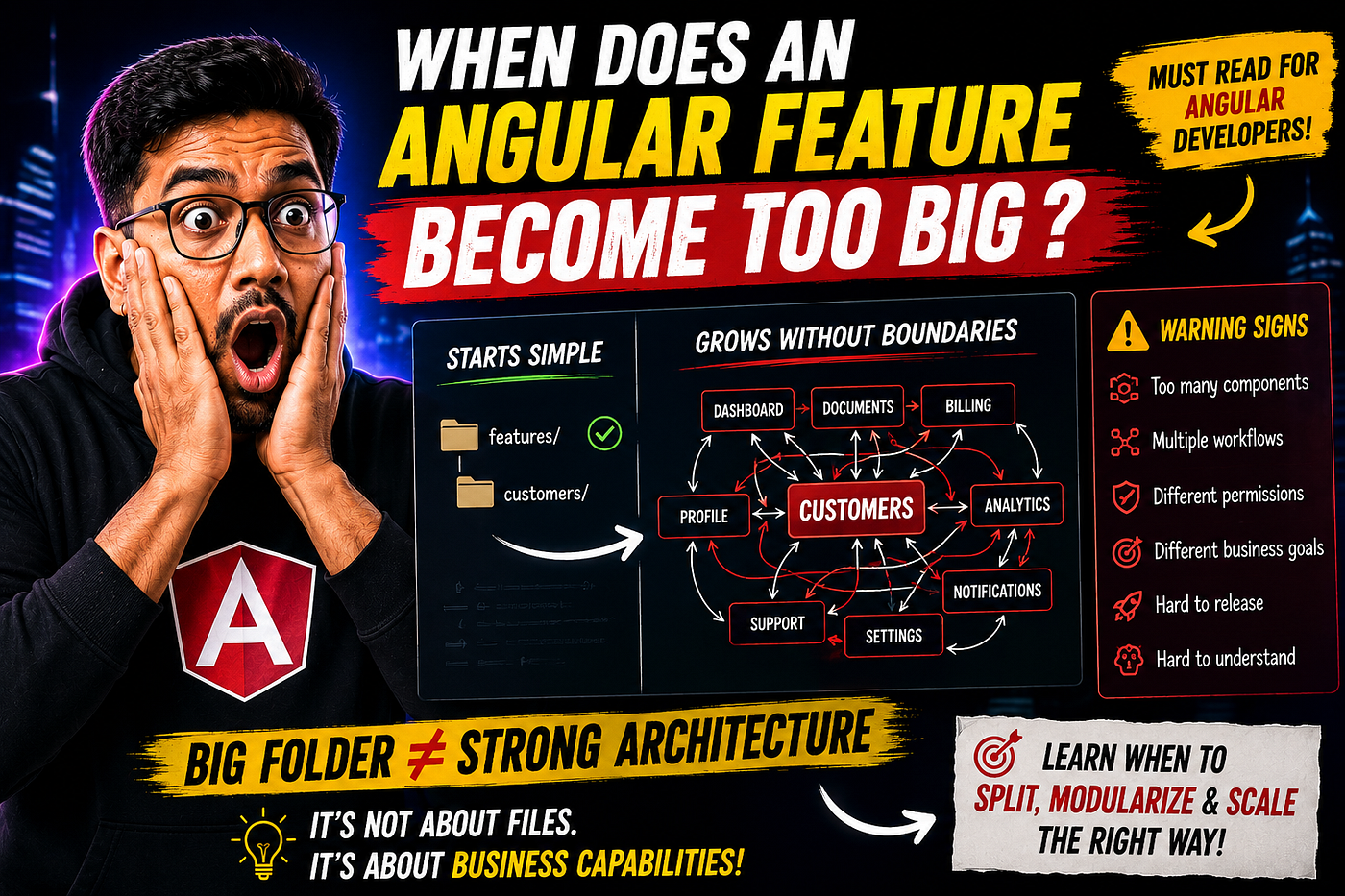
Imagine your project begins like this:
features/
 └── customers/
Everything related to customers lives together.
Perfect.
Then the business grows.
Soon you have:
- Customer Dashboard
- Customer Profile
- Customer Documents
- Customer Notifications
- Customer Analytics
- Customer Settings
- Customer Billing
- Customer Support
The folder still says “customers.”
The reality is very different.
The Folder Isn’t The Problem
Many teams think:
“The folder has become too large.”
That’s usually not the real issue.
The real question is:
Are we still talking about one business capability?
Or have multiple capabilities quietly merged together?
Watch For These Warning Signs
Large Angular features usually show the same symptoms.
- Hundreds of components
- Dozens of services
- Multiple stores
- Independent navigation
- Separate permissions
- Different business owners
- Different deployment priorities
These aren’t scaling problems.
They’re boundary problems.
Features Eventually Become Platforms
Imagine this:
Customer
 ├── CRM
 ├── Support
 ├── Billing
 ├── Marketing
 ├── Documents
 ├── Analytics
 └── Notifications
At this point…
“Customer” isn’t a feature anymore.
It’s a business domain.
Domains deserve their own boundaries.
One Team Or Five Teams?
A useful question:
Can one team comfortably own this feature?
If five independent teams constantly modify the same folder…
The architecture is probably signaling something.
Software boundaries often follow team boundaries.
Independent Change Matters
Suppose Billing needs weekly releases.
Analytics ships monthly.
Support deploys every day.
Should they all live inside the same feature?
Probably not.
Independent evolution is one of the strongest signals that boundaries need to change.
Don’t Split Too Early
This article isn’t suggesting splitting every feature.
Premature decomposition creates unnecessary complexity.
Too many tiny features become difficult to understand.
Architecture should evolve with the business.
Not ahead of it.
Think In Business Capabilities
Instead of asking:
“How many files are inside this folder?”
Ask:
“Does this represent one business capability?”
If the answer becomes “no”…
Your architecture has outgrown its current boundary.
Modern Angular Makes Splitting Easier
Standalone Components.
Lazy Routes.
Environment Providers.
Signals.
Feature Libraries.
Modern Angular encourages modular thinking.
The framework makes evolution easier.
Architects still need to decide when evolution is necessary.
A Practical Rule
When a feature develops:
- Independent workflows
- Independent ownership
- Independent releases
- Independent business goals
It’s probably no longer a feature.
It’s becoming a domain.
And domains deserve their own architectural boundaries.
Final Thoughts
Large Angular applications don’t fail because folders become big.
They struggle because business capabilities become mixed together.
Great architecture isn’t about creating more folders.
It’s about recognizing when one responsibility has quietly become many.
The healthiest Angular applications evolve alongside the business.
Their boundaries grow naturally.
Not because of file counts.
But because of ownership, responsibility, and independent change.
That’s how software stays understandable — even years after the first commit.
Connect with Me
If you enjoyed this post and would like to stay updated with more content like this, feel free to connect with me on social media:
- Twitter : Follow me on Twitter for quick tips and updates.
- LinkedIn : Connect with me on LinkedIn
- YouTube : Subscribe to my YouTube Channel for video tutorials and live coding sessions.
- Dev.to : Follow me on Dev.to where I share more technical articles and insights.
- WhatsApp : Join my WhatsApp group to get instant notifications and chat about the latest in tech
Email: Email me on dipaksahirav@gmail.com for any questions, collaborations, or just to say hi!
I appreciate your support and look forward to connecting with you!
메타데이터
- post_id
- 235c3972fc87
- slug
- when-does-an-angular-feature-become-too-big-235c3972fc87
- url
- https://medium.com/angular-engineering/when-does-an-angular-feature-become-too-big-235c3972fc87
- canonical_url
- https://medium.com/angular-engineering/when-does-an-angular-feature-become-too-big-235c3972fc87
- author_url
- https://medium.com/@dipaksahirav
- status
- ok
- fetched_at
- 2026-07-09 10:10:35