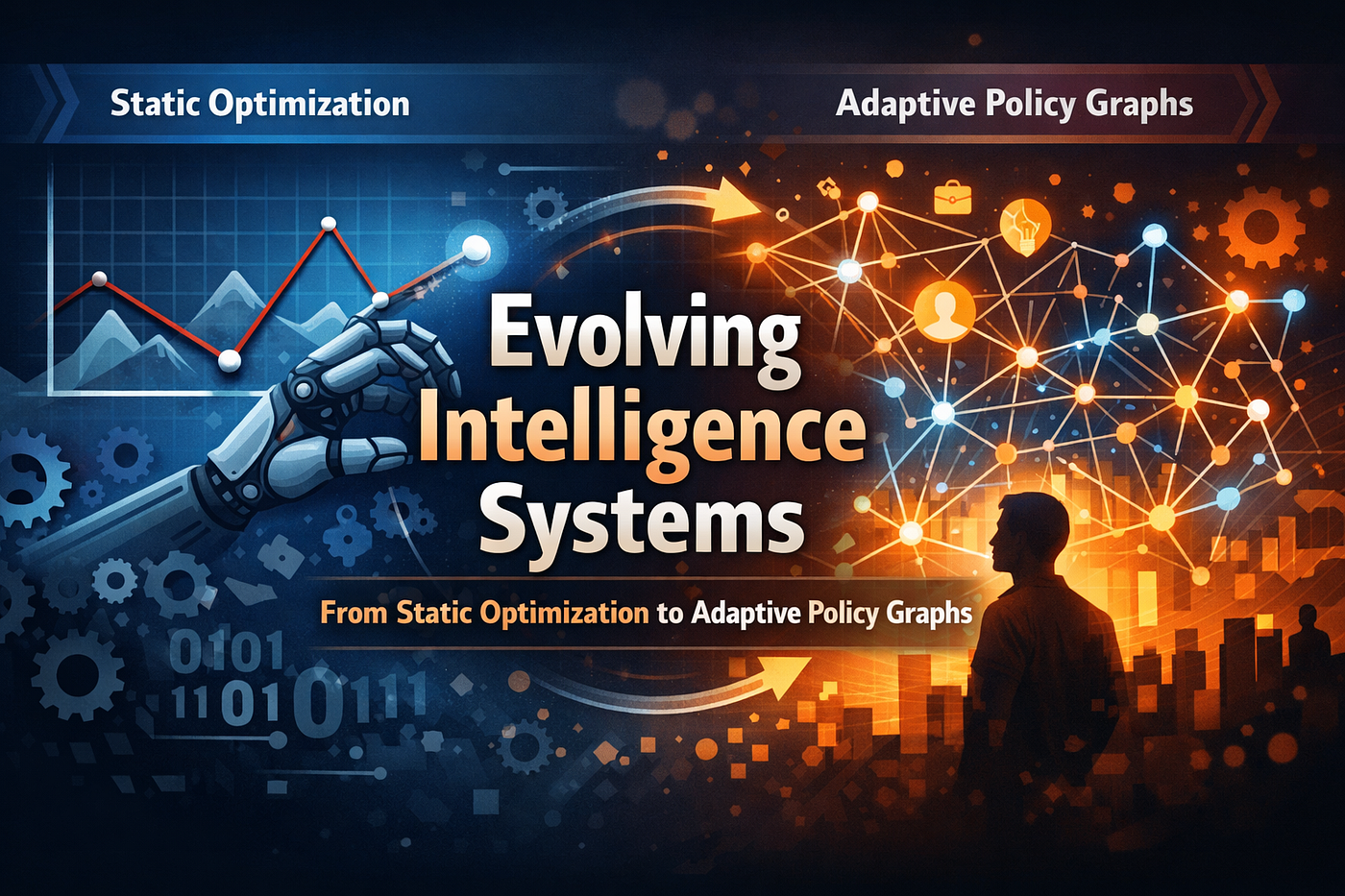
Evolving Intelligence Systems: From Static Optimization to Adaptive Policy Graphs
Disclaimer
Evolving Intelligence Systems: From Static Optimization to Adaptive Policy Graphs
Disclaimer
These are evolving research notes, not a finalized framework. The ideas presented here reflect ongoing architectural thinking around dynamic policy systems, evolutionary optimization, and temporal graph intelligence. Assumptions may evolve as the system understanding deepens.
1. The Real Problem: State Evolution, Not Prediction
Most machine learning systems assume:
- Static dataset
- Fixed objective
- Stable evaluation metric
But real organizational systems are dynamic:
- Decisions compound.
- Policies shift.
- Leadership changes.
- Feedback alters what “correct” means.
Consider a simple post:
“Due to X, leadership under Y decided to do Z for key account K.”
Inside this one sentence:
- Causal trigger (X)
- Authority structure (Y)
- Decision object (Z)
- Target entity (K)
- Temporal context
Over thousands of such posts, the system becomes a time-evolving intelligence mesh.
The real challenge is not classification.
It is:
How did the system reach its current state, and where is it trending?
2. From Text to Temporal Graph
Unstructured posts must be transformed into structured events:
(Event)
 ├── caused_by → X
 ├── decided_by → Leader Y
 ├── action → Z
 ├── target → Account K
 ├── time → T
Accumulated over time, these form a dynamic decision graph.
Typical implementation stack:
- NLP pipelines using PyTorch or TensorFlow
- Graph storage using Neo4j
But structure alone does not produce intelligence.
We must compute evolving state from compounding decisions.
3. Why Static Scoring Fails
A naïve policy score might look like:
ImpactScore =
    0.5 * Authority
  + 0.3 * Escalation
  + 0.2 * Recency
But:
- What if crisis periods increase recency importance?
- What if authority weakens during restructuring?
- What if cross-company interactions become dominant?
In dynamic systems, the definition of “correct decision” evolves after feedback.
Therefore:
The evaluation logic must adapt.
4. Genetic Algorithms — Used Properly
Genetic Algorithms (GA) are often misapplied for feature selection.
In dynamic policy systems, their real power lies in evolving decision logic.
Instead of evolving features, evolve parameters:
individual = [
    authority_weight,
    recency_decay_rate,
    escalation_weight,
    cross_company_multiplier,
    path_penalty
]
Each individual represents a scoring strategy.
Fitness is computed by:
- Applying this scoring logic to historical graph states.
- Predicting outcomes.
- Comparing against feedback.
- Returning a performance score.
The population evolves scoring strategies over time.
5. The Critical Shift: Fitness Is Not Static
In real systems:
- Feedback changes.
- Objectives shift.
- Risk tolerance evolves.
This transforms optimization into:
A dynamic adaptive tracking problem.
Mechanisms to handle this:
Sliding Window Evaluation
Fitness(t) = Performance over recent time windowRegime-Based Evaluation
Fitness = F(system_state, parameters)Different scoring logic for growth vs crisis phases.
Archive Memory
Store elite strategies from past regimes. Reintroduce them when similar patterns reappear.
6. Evolutionary Pressure: How Offspring Compete
Evolution requires structured competition:
- Tournament selection (localized survival)
- Rank-based selection (controlled pressure)
- Fitness sharing (diversity preservation)
- Steady-state replacement (continuous adaptation)
Too much selection → premature convergence. Too much mutation → chaos.
Balance is critical.
7. When GA Makes Sense
GA is appropriate when:
- Objective is non-differentiable
- Logic is hybrid (symbolic + numeric)
- Search space is combinatorial
- Interpretability matters
- Gradients are unavailable
GA is less suitable when:
- Feedback is immediate and dense
- Micro-level action tuning is required
In such cases, reinforcement learning may complement evolutionary logic.
A hybrid approach often works best:
- GA evolves macro strategy.
- Online learning refines short-term adaptation.
8. The Deeper Insight
What is being modeled here is not just optimization.
It is organizational learning.
- Decisions mutate.
- Strategies recombine.
- Feedback selects.
- Memory preserves.
- Environment shifts.
In static ML problems, convergence is the goal.
In dynamic intelligence systems, convergence may be undesirable.
The goal becomes:
Continuous adaptive alignment with evolving reality.
Genetic Algorithms, when applied at the logic layer rather than the feature layer, become tools for structured adaptation in complex policy graphs.
And when combined with temporal knowledge modeling, they allow us to build systems that evolve with the environments they model.
메타데이터
- post_id
- 235c5552efc8
- slug
- evolving-intelligence-systems-from-static-optimization-to-adaptive-policy-graphs-235c5552efc8
- url
- https://medium.com/@amanjn53/evolving-intelligence-systems-from-static-optimization-to-adaptive-policy-graphs-235c5552efc8
- canonical_url
- https://medium.com/@amanjn53/evolving-intelligence-systems-from-static-optimization-to-adaptive-policy-graphs-235c5552efc8
- author_url
- https://medium.com/@amanjn53
- status
- ok
- fetched_at
- 2026-07-13 06:23:13