The Three Horizons Framework: An Introduction
Ever feel like the world is changing too fast? Like the old ways don’t quite work anymore — but the new ways aren’t fully here yet? You’re…
The Three Horizons Framework: An Introduction
Ever feel like the world is changing too fast? Like the old ways don’t quite work anymore — but the new ways aren’t fully here yet? You’re not alone.
That uncomfortable space between “how things are” and “how they could be” is exactly where the Three Horizons framework lives. And it might just help you make sense of the chaos.

Let’s say, You want to change the food system, or make your business carbon neutral, or Maybe, you just want to figure out how your school could be more inclusive.
Whatever it is.
Incremental changes probably won’t be enough. There’s a tension between improving what’s working today and the need for radical transformation.
Have a look at the Innovation Matrix,

Innovation Matrix
So, How do you make radical change actually happen? This is where the three horizons can help.
What Actually Is the Three Horizons Framework?

Think of it as a simple map for understanding change — not by predicting the future, but by seeing patterns.
Let’s break it down.

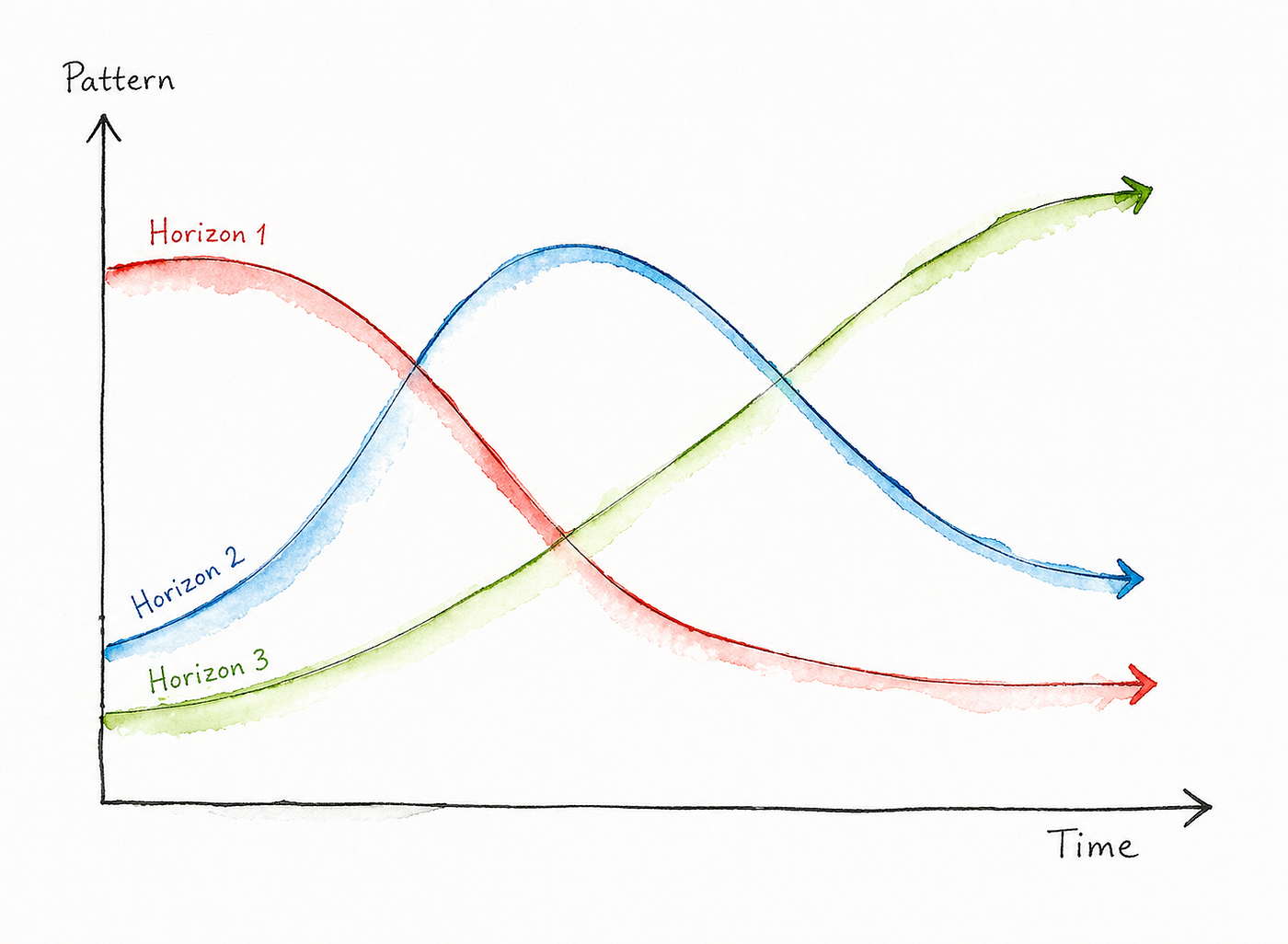
The framework has three lines, drawn across time (from today into the future). Each line represents a different way of doing things — a different “pattern.”
At any moment, three different “horizons” are alive at the same time.

You don’t wait for H1 to die before starting H3.
All three horizons exist together. Your job is to manage them wisely.
The Three Horizons as Three Voices in a Room
In any conversations you have about changing the future, you probably notice three perspectives showing up.
There’s the voice of :
- Manager
- Entrepreneur
- Visionary

As you would expect these three voices are often talking past each other, They don’t always realize that each is needed to create meaningful change.
So we need a way to discuss the future that brings these three perspectives together in a constructive way, one that recognises the value of each and gives us shared language for working together. This is what three horizons is for.
This framework starts the conversation among the voices of the three horizons and helps us build a map on any topic of concern, so that you can identify:
- Where you are
- Where you want to be
- How to get there
How Can We Use This?
Let me make it easy for you,
As part of the three horizons discussion you might draw it up on a wall adding post-its to the different horizons or simply use it as a structure to guide your conversation.

H1 = Present H2 = Transition H3 = Future
It is a simple framework to help guide conversations about the future towards meaningful action.
Real-World Examples
1. Netflix
H1 — DVD rentals by mail. Profitable, loved, but dying
H2 — Streaming as a small add-on. Clunky, low quality, few titles
H3 — Original content. Global streaming, no DVDs
Netflix didn’t kill H1 overnight. They managed the decline while fueling H2 to H3.
2. Electric Vehicles
H1 — Petrol cars. Still majority of revenue for automakers
H2 — Hybrids and early EVs. Low margins, range anxiety
H3 — Fully autonomous electric fleets Not mainstream yet
Tesla jumped early. Others are still stuck in H1 thinking.
3. Your Own Career
H1 — Your current job. H2 — Evening courses, freelance side projects, new skills. H3 — A completely different role or industry you’re not qualified for yet.
If you quit H1 too early, you starve. If you never start H2, you stop growing.
Why this framework works so well?
It is not just theory. It’s practical. And human.
Try the framework with your team, or even just for your own life. You might be surprised how much clarity appears when you start observing the patterns.
Here are some similar frameworks:
- Scenario Planning (broader, less structured)
- McKinsey’s Three Horizons of Growth (same name, slightly different flavour)

McKinsey’s three horizons of growth model
But Three Horizons wins on simplicity. You just need a pen, some sticky notes, and an open mind.
What are the Challenges you’re trying to solve?
메타데이터
- post_id
- 235eb68306bb
- slug
- the-three-horizons-framework-an-introduction-235eb68306bb
- url
- https://medium.com/@anamikachandrakar97/the-three-horizons-framework-an-introduction-235eb68306bb
- canonical_url
- https://medium.com/@anamikachandrakar97/the-three-horizons-framework-an-introduction-235eb68306bb
- author_url
- https://medium.com/@anamikachandrakar97
- status
- ok
- fetched_at
- 2026-06-27 07:40:21