What AI Music Is About to Teach Us About Being Human
The Internet has solved the content problem. Big time. At any moment, anyone can generate a song, a painting, a video, a blog post, a…
What AI Music Is About to Teach Us About Being Human
The Internet has solved the content problem. Big time. At any moment, anyone can generate a song, a painting, a video, a blog post, a voiceover, an image, or an entire album in a matter of seconds. The barriers that once separated creators from consumers are collapsing so quickly that it feels as if creativity itself has become a commodity. We’re drowning in content.
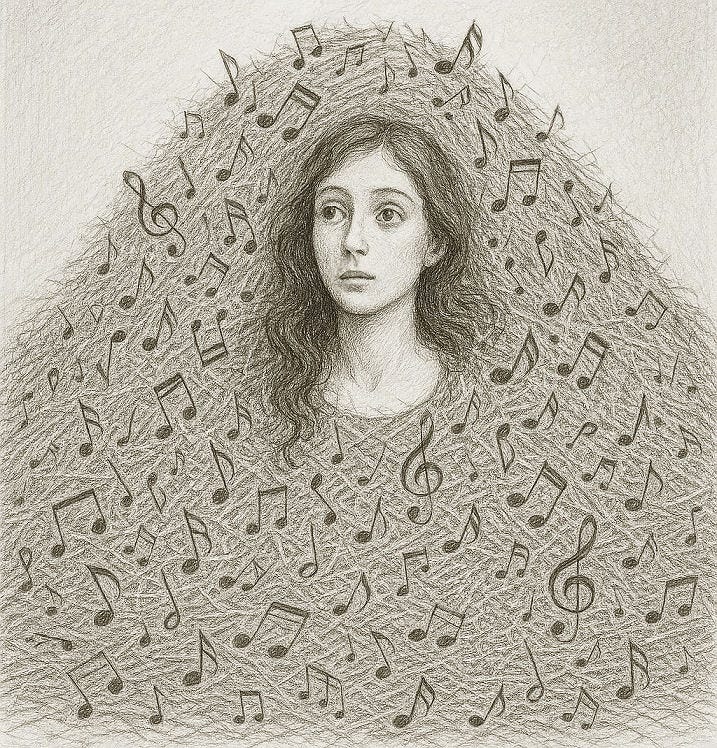
As a long-time songwriter, my main expertise is in the world of music, where an average of 4,400 new tracks are uploaded to global streaming services every hour. Recent industry reports indicate that as much as 86% of these songs generate zero to ten streams annually. A significant portion of this volume consists of AI-generated tracks. If you listened continuously to music every waking hour, you’d still only get through a tiny fraction of all the uploaded songs. And the number of uploads keeps rising.
Is this really what we want? On the one hand, I don’t want any gatekeepers telling me or anyone else that this or that song is not good enough to be shared with the world. On the other hand, how will we be able to find the golden needles in this gigantic haystack going forward? Where do we find music that speaks to heart and soul?
Content vs. Connection
The fact of the matter is that the easier content becomes to produce, the more valuable genuine human connection becomes. Music has never been important because it is merely sound arranged in a pleasing pattern. If that were the case, a sufficiently advanced algorithm would already have replaced every songwriter on earth. What gives music value is not the arrangement of notes, but the human experience behind them. We care about songs because we care about people and feel a connection.
When I write a song, I am not trying to solve a technical problem, I am trying to capture something that feels important in the moment. Every lyric reflects a thought, an observation, a memory, a fear, a hope, or a question that mattered to me at a particular point in my life. Every melody becomes attached to a state of mind. Years later, I can revisit an old song and remember exactly who I was when I wrote it. In that sense, songwriting is a form of documentation, or a way of leaving traces. “I was here. This is what I thought. This is what I felt.”
All in the numbers?
I’m certainly not racking up streams by the millions or even thousands, so this may be easy for me to say, but numbers don’t tell the whole story. Streaming numbers obviously have their place, especially if you are trying to build a career, but they tell us remarkably little about the actual value of music. A stream is not a unit of artistic impact, just a database event. One stream might represent a listener who sits alone at night with headphones on, paying attention to every single word, because the song speaks directly to something they are going through. Another might come from somebody who has the music playing in the background while cleaning the kitchen or scrolling through their phone. Streaming services count both exactly the same. Human beings do not.
Given the choice, I would much rather have four listeners who genuinely connect with one of my songs than four hundred who barely notice it. One of the most meaningful responses I have received recently came from a listener who told me she cried while listening to one of my songs because it expressed something she had never been able to put into words herself (thank you, MZ!). That single message was worth more to me than a thousand passive streams. It represented the entire reason I started writing music in the first place. Music is one of the ways human beings communicate experiences that are difficult to communicate any other way.
A lesson learned?
I believe the rise of AI may end up teaching us something important. For decades, the commercial music industry has increasingly focused on optimization. Songs became products, success became measurable. Careers were built around understanding what worked and repeating it. Then generative AI arrived and demonstrated just how much of that process could be automated. Suddenly, anyone could generate something that sounded professional, catchy, polished, and commercially viable. The magic trick became visible. We were forced to confront an uncomfortable question: if a machine can generate something that sounds good in seconds, what exactly are we valuing when we listen to music?
My suspicion is that listeners will increasingly arrive at the same answer. They are not ultimately looking for content; they are looking for connection. The more synthetic content floods streaming services, the more valuable authenticity becomes. Am I perhaps too optimistic when I believe that the easier it is to manufacture a convincing song, the more people will care about whether there is an actual person behind it? The flood of AI-generated music may therefore have the opposite effect from what many predict. Rather than replacing human creativity, it may remind us why we valued it in the first place.
AI is not The Devil
I have no problem with using technology as a tool, including AI. Multitrack recording was once new technology, and so were synthesizers, drum machines, and digital audio workstations. The question is not whether technology belongs in music, but rather where the human being remains in the process.
For me, the answer starts with the creative core. The idea should come from you. The lyric should mean something to you personally, as should the melody. Technology can help shape and develop those ideas, but it should not replace them. If you hand the entire creative process over to an algorithm, you may end up with content, but you risk losing the connection that made the process worthwhile in the first place.
What if you can’t write or play?
Are you a songwriter if AI wrote the lyric and composed the music for you? 100% no! If you take pride in a fully AI-generated song, that is a really weird delusion. But I’m sure you’re not like that. Like me, you’re probably an artist at heart. A person with real emotion and stories to tell or feelings to share. Excellent. You can write it all down and use AI or a good lyricist to help you make it into a song lyric, no problem.
Perhaps you have stories to tell but lack formal musical training. Or perhaps you can neither read notation nor play an instrument. Don’t assume composition is therefore beyond your reach! There is a reason tools such as Margido Melodizer exist. This Windows tool is far more interesting than systems that generate complete songs. Why? Because it does not do the work for you; it helps you do the work yourself! In reality, composition begins with making creative decisions. If a tool helps you experiment with melodies, move individual notes, explore alternatives, and gradually shape an idea until it feels like your own, then you are not outsourcing creativity. You are exercising it.
The lesson hidden inside the AI revolution is that the future does not need more content. We already have more content than any human being could consume in a hundred lifetimes. What we need are more people willing to share something genuine about themselves. Music has always been one of humanity’s most powerful ways of doing exactly that. The technology may change, but that purpose has not. Nor should it. Go create! Make an impact, no matter how small!
메타데이터
- post_id
- 235fe1858ca0
- slug
- what-ai-music-is-about-to-teach-us-about-being-human-235fe1858ca0
- url
- https://medium.com/@margidosoftware/what-ai-music-is-about-to-teach-us-about-being-human-235fe1858ca0
- canonical_url
- https://medium.com/@margidosoftware/what-ai-music-is-about-to-teach-us-about-being-human-235fe1858ca0
- author_url
- https://medium.com/@margidosoftware
- status
- ok
- fetched_at
- 2026-06-10 12:26:30






