Before GitHub There Was the Atari ST GEM— My First File Repository
I’ve been making a concerted effort to get to grips with GitHub, Git, and the whole world of version controlled repositories. Committing…
Before GitHub There Was the Atari ST GEM— My First File Repository
I’ve been making a concerted effort to get to grips with GitHub, Git, and the whole world of version controlled repositories. Committing files, pushing changes, organising projects into something resembling a coherent structure. It all feels very modern and very deliberate, and I’ve been quietly proud of the progress.
Then I remembered the Atari ST.
Because the truth is, I’ve been here before. Not with the terminology, not with the tooling, and certainly not with anything as sophisticated as Git. But the fundamental idea — organising files and folders on a storage medium into a structured, meaningful collection that you could navigate and build on — that I figured out in the early 1990s, on my Atari ST computer running TOS, with a couple of floppy disk drives and entirely too much free time.
Meet the Atari ST Desktop
For anyone under a certain age, a quick bit of context. The Atari ST was a home computer that enjoyed its heyday through the late 1980s and into the early 1990s. It ran an operating system called TOS — The Operating System, which is either a brilliantly confident name or a sign that nobody in the room was feeling particularly creative that day — and it came with a graphical desktop interface called the GEM Desktop.
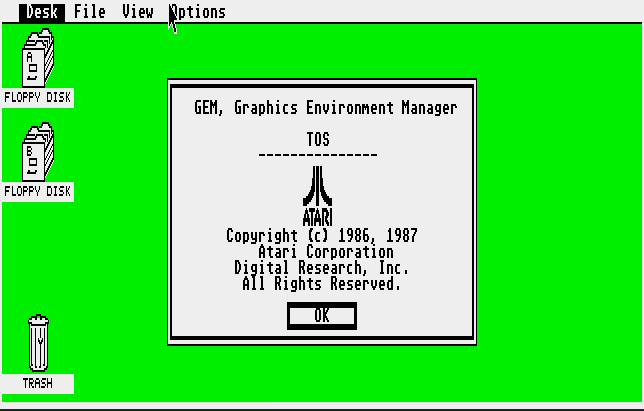
Now by modern standards the GEM Desktop was not exactly feature rich. But it had windows. It had icons. It had a menu bar. And crucially, it had two floppy disk drive icons sitting right there on the desktop — Drive A and Drive B — which in the early 1990s felt genuinely futuristic. You could put a floppy disk into Drive A, another into Drive B, and suddenly you had what I can only describe in retrospect as a two node file system.
Floppy Disk A and Floppy Disk B — My First Repositories
Here’s the thing about the Atari ST setup that I only appreciate fully now. Those two floppy disk drives weren’t just storage — they were an invitation to organise. And organise I did, with the dedication that only a teenager with no social obligations and a growing games collection can truly muster.

I had floppy disks for everything. But the ones I’m most nostalgic about were the ones that housed what I can only describe as my personal gaming knowledge base. One disk was the catalogue — a carefully maintained record of every game in my collection, which ones I owned, and crucially, which ones I had completed. This was important information. In the pre-internet era, knowing you’d finished a game was a point of pride, and having it written down — well, stored on a floppy — made it official.
The folder structure was meticulous. By my standards at the time, anyway. Directories named by genre or platform, files inside them with game titles, notes on completion status. If you squint hard enough and ignore the complete absence of version control, commit history, or any form of backup strategy, it was basically a repository. I’m choosing to squint hard.
The Cheat Codes Library — Essentially My First Private Repo
If the games catalogue was my public facing documentation, then my cheat codes and trainers disk was my private repository. This was not for sharing.
For context, in the early 1990s cheat codes and trainers — small programs that modified a game’s memory to give you infinite lives, unlimited ammo, or the ability to skip levels entirely — were currency. You got them from magazines (ST Format — what a magazine), from friends, from the kid at school who seemed to know everything about everything and was suspiciously well supplied with floppy disks. And once you had them, you kept them safe.
My cheat disk was organised with the same energy I now try to bring to my GitHub repositories, except with considerably more at stake emotionally. Lose that disk and you lost hours of accumulated knowledge. There was no cloud backup. There was no redundancy. There was just you, your floppy, and the faint anxiety that the magnetic coating might one day let you down.
Looking at it now, it was essentially a private repo full of scripts and tools that modified program behaviour. Which, when I put it that way, sounds considerably more impressive than “teenager hoarding cheat codes on a floppy disk.” I’m going with the impressive version.
What the Atari ST Actually Taught Me
Here’s where I try to make this more than just nostalgia, and I promise it isn’t too much of a stretch.
The habits I was developing on that Atari ST desktop — organising files logically, separating different types of content into their own storage, maintaining something that could be navigated and built upon over time — are genuinely the same instincts that make someone good at managing repositories today. The tooling is almost unrecognisably different. The underlying thinking really isn’t.
Version control didn’t exist in my workflow back then. If I overwrote a file I’d lost it. If the floppy disk developed a bad sector — and they did, frequently and without warning — whatever was on it was gone. There was no git history to roll back to, no remote copy sitting safely on a server somewhere. Just the slightly sick feeling of realising your carefully curated cheat codes for Dungeon Master were gone forever.
Modern tools solve all of that. GitHub gives you history, redundancy, collaboration, and the ability to roll back a mistake rather than just live with it. VSCode makes working with those files intuitive. Git gives the whole thing structure and meaning. But none of those tools create the organisational instinct from scratch — that part you either have or you develop, and apparently some of us were developing it on a GEM Desktop in the early 1990s without realising it.
Coming Full Circle
There’s something I find genuinely amusing about sitting at my desk in 2025, carefully organising repositories on GitHub, and realising that the mental model I’m working from is at least partly derived from a beige Atari ST and a shoebox full of floppy disks.
The Atari ST is long gone. The floppy disks are almost certainly landfill by now. The cheat codes they contained are freely available on the internet, which rather takes the mystery out of it. But the habit of thinking in files and folders, of wanting things organised and findable and structured — that stuck around, apparently waiting for the right tools to come along.
GitHub was worth the wait but I still miss the busy Bee cursor icon!

메타데이터
- post_id
- 236de1c128ee
- slug
- before-github-there-was-the-atari-st-gem-my-first-file-repository-236de1c128ee
- url
- https://medium.com/@iainwall/before-github-there-was-the-atari-st-gem-my-first-file-repository-236de1c128ee
- canonical_url
- https://medium.com/@iainwall/before-github-there-was-the-atari-st-gem-my-first-file-repository-236de1c128ee
- author_url
- https://medium.com/@iainwall
- status
- ok
- fetched_at
- 2026-06-21 07:44:09