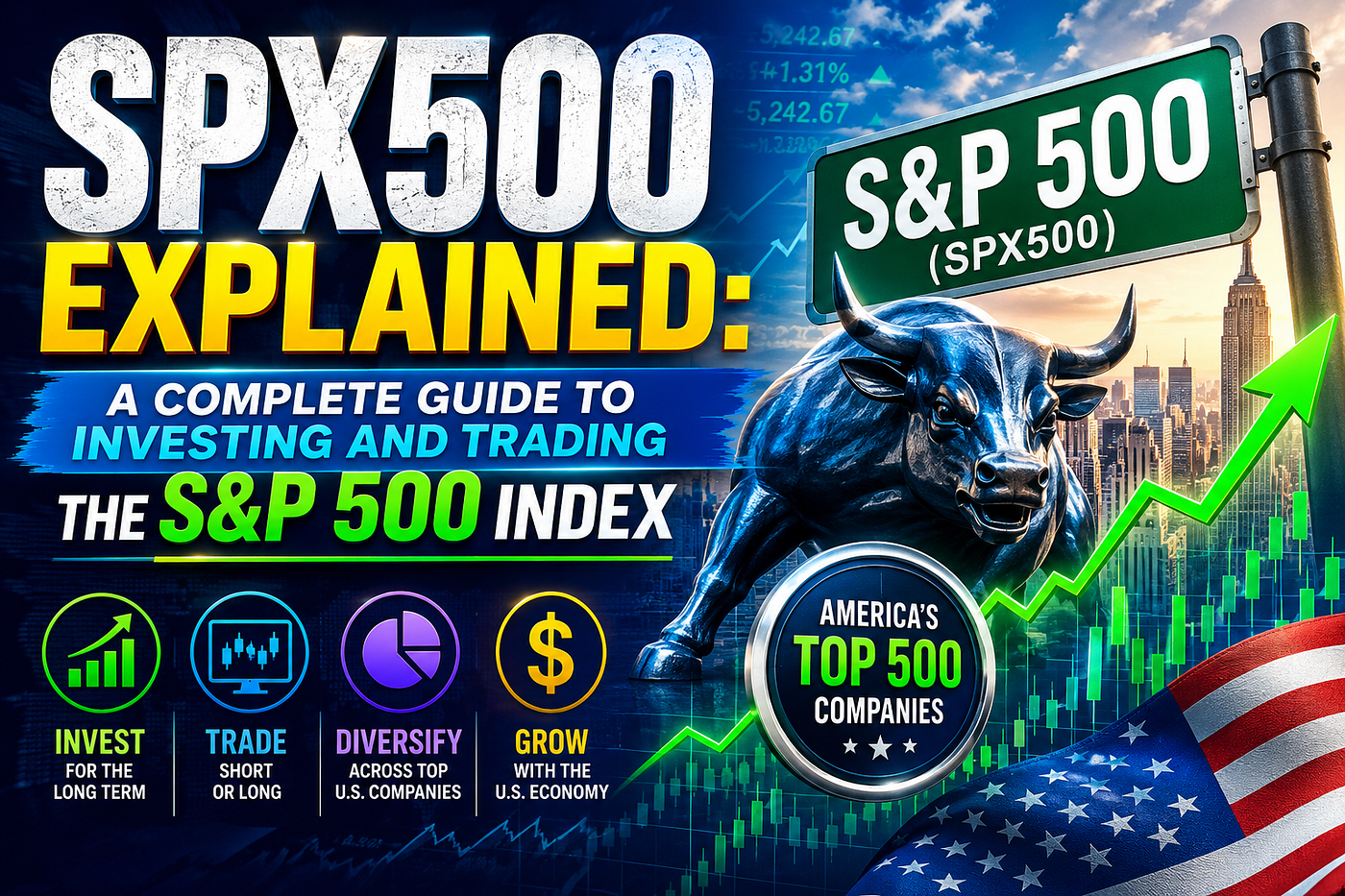
SPX500 Explained: A Complete Guide to Investing and Trading the S&P 500 Index
Introduction
SPX500 Explained: A Complete Guide to Investing and Trading the S&P 500 Index
SPX500
Introduction
SPX500 is one of the most widely followed stock market indices in the world. It represents the performance of 500 of the largest publicly traded companies in the United States and serves as a benchmark for the overall health of the U.S. economy. Investors, traders, fund managers, and financial institutions closely monitor the SPX500 because it reflects the strength of major sectors, including technology, healthcare, finance, consumer goods, industrials, and energy.
Whether you are a beginner looking to understand the stock market or an experienced trader seeking to improve your investment strategy, learning how the SPX500 works can provide valuable insights. The index is often used to measure market sentiment, identify long-term investment opportunities, and manage diversified portfolios.
This guide explains what the SPX500 is, how it is calculated, the factors that influence its performance, popular trading strategies, investment options, benefits, risks, and the outlook for the future.
What Is the SPX500?
The SPX500, commonly known as the S&P 500 Index, tracks the performance of 500 leading U.S. companies listed on major stock exchanges. Unlike narrower indices that focus on a specific industry, the SPX500 provides broad exposure across multiple sectors of the economy.
The index is considered one of the most reliable indicators of the U.S. equity market because it includes companies with large market capitalizations and significant economic influence. Businesses within the index are selected based on factors such as market value, liquidity, public float, and financial stability.
Many investment funds, exchange-traded funds (ETFs), and index funds are designed to mirror the performance of the SPX500, making it one of the most popular benchmarks for investors worldwide.
History of the SPX500
The origins of the SPX500 date back to the mid-twentieth century when financial analysts sought a broader measure of the U.S. stock market than earlier indices.
Over the decades, the index has expanded alongside the American economy. It has witnessed major events, including economic recessions, technology booms, financial crises, global pandemics, and periods of strong economic growth. Despite temporary downturns, the SPX500 has historically delivered solid long-term returns, making it a preferred investment vehicle for individuals and institutions.
Its resilience has reinforced its reputation as one of the world’s leading stock market benchmarks.
How the SPX500 Is Calculated
The SPX500 uses a market capitalization-weighted methodology. This means that larger companies have a greater influence on the movement of the index than smaller companies.
Several key factors determine the index value:
Market Capitalization
Companies with larger market values receive higher weightings.
Free Float
Only shares available for public trading are included in the calculation.
Share Price Changes
Price movements of constituent companies directly affect the index.
Corporate Actions
Stock splits, mergers, acquisitions, and dividend adjustments are incorporated to maintain the accuracy of the index.
Because of this methodology, movements in major technology and financial companies can significantly impact the overall SPX500.
Why Investors Follow the SPX500
The SPX500 is popular for several reasons.
Broad Diversification
The index covers multiple industries, reducing reliance on any single company or sector.
Economic Indicator
It provides insight into the overall strength of the U.S. economy.
Long-Term Growth Potential
Historically, the SPX500 has generated attractive long-term returns despite periods of market volatility.
High Liquidity
Investment products linked to the index are among the most actively traded financial instruments.
Global Influence
Financial markets worldwide often react to movements in the SPX500.
Major Sectors Represented
The SPX500 includes companies from diverse sectors, creating balanced market exposure.
Key sectors include:
- Information Technology
- Financial Services
- Healthcare
- Consumer Discretionary
- Consumer Staples
- Industrials
- Energy
- Utilities
- Communication Services
- Materials
- Real Estate
This diversification helps reduce sector-specific risks while reflecting the broader economy.
Factors That Influence the SPX500
Numerous economic and financial variables affect the direction of the SPX500.
Interest Rates
Central bank decisions often influence borrowing costs, corporate earnings, and investor sentiment.
Inflation
Higher inflation can reduce corporate profitability and affect stock valuations.
Corporate Earnings
Strong earnings reports generally support higher index levels.
Economic Growth
GDP expansion usually benefits businesses and boosts investor confidence.
Employment Data
Healthy labor markets often signal economic strength.
Geopolitical Events
International conflicts, trade policies, and political uncertainty can increase market volatility.
Investor Sentiment
Market psychology frequently drives short-term price movements.
Ways to Invest in the SPX500
Investors can gain exposure to the SPX500 through several methods.
Index Funds
These funds aim to replicate the performance of the index while maintaining low management costs.
Exchange-Traded Funds (ETFs)
ETFs provide flexibility because they trade throughout the day like individual stocks.
Futures Contracts
Professional traders use futures for speculation and portfolio hedging.
Options
Options allow investors to manage risk or speculate on future price movements.
Contracts for Difference (CFDs)
Some brokers offer CFDs that allow traders to speculate on price changes without owning the underlying assets.
Each investment vehicle suits different financial goals and risk profiles.
Trading Strategies for the SPX500
Successful traders use a combination of technical analysis, market research, and disciplined risk management.
Trend Following
Many traders buy during upward trends and sell during downward trends.
Swing Trading
Positions are typically held for several days to capture medium-term price movements.
Day Trading
Short-term traders capitalize on intraday price fluctuations.
Breakout Trading
This strategy focuses on price movements beyond established support or resistance levels.
Long-Term Investing
Many investors consistently invest over time to benefit from market growth and compounding returns.
Risk Management
Every investment carries risk, including the SPX500.
Effective risk management includes:
- Setting clear investment objectives.
- Diversifying across multiple asset classes.
- Using stop-loss orders when appropriate.
- Avoiding excessive leverage.
- Reviewing portfolios regularly.
- Maintaining realistic expectations.
Successful investors understand that preserving capital is as important as generating returns.
Common Mistakes to Avoid
Many investors reduce their long-term performance by making avoidable mistakes.
These include attempting to time the market perfectly, reacting emotionally to short-term volatility, concentrating investments in one sector, ignoring economic developments, and neglecting portfolio reviews.
Maintaining discipline and following a well-defined investment strategy can significantly improve long-term results.
Future Outlook for the SPX500
The long-term outlook for the SPX500 remains positive, supported by innovation, technological advancement, and the resilience of leading U.S. businesses.
Artificial intelligence, cloud computing, renewable energy, biotechnology, automation, and digital finance continue to create growth opportunities for many companies within the index. Although short-term market fluctuations are inevitable, diversified portfolios built around the SPX500 have historically rewarded patient investors.
Global economic conditions, interest rate policies, corporate earnings, and technological innovation will continue to shape future performance. Investors who remain focused on long-term fundamentals rather than short-term market noise are often better positioned to achieve sustainable investment success.
Conclusion
The SPX500 remains one of the most important stock market indices for investors seeking diversified exposure to the U.S. economy. Its broad representation of leading companies, historical growth, and global influence make it a valuable benchmark for both active traders and long-term investors.
Understanding how the SPX500 works, the factors that drive its performance, and the strategies used to invest in it can help you make better financial decisions. By combining disciplined risk management with a long-term perspective, investors can take advantage of the opportunities offered by one of the world’s most influential stock market indices.
To learn more about the SPX500, technical analysis, market trends, and professional investment strategies, visit **https://finance.rajeevprakash.com/**
메타데이터
- post_id
- 2373f16031de
- slug
- spx500-explained-a-complete-guide-to-investing-and-trading-the-s-p-500-index-2373f16031de
- url
- https://medium.com/@astrolife36_29926/spx500-explained-a-complete-guide-to-investing-and-trading-the-s-p-500-index-2373f16031de
- canonical_url
- https://medium.com/@astrolife36_29926/spx500-explained-a-complete-guide-to-investing-and-trading-the-s-p-500-index-2373f16031de
- author_url
- https://medium.com/@astrolife36_29926
- status
- ok
- fetched_at
- 2026-07-14 10:09:25