What if time is not as fixed as we thought?
How Quantum Atom Experiments Could Reveal Time’s Hidden Direction
What if time is not as fixed as we thought?
How Quantum Atom Experiments Could Reveal Time’s Hidden Direction

NASA / Jet Propulsion Laboratory / public domain
Across every domain of fundamental physics, the arrow of time remains one of the deepest unsolved problems in science. The equations governing quantum mechanics, electromagnetism, and general relativity are time-symmetric, meaning they produce valid solutions whether time runs forward or backward. Yet the universe exhibits a pervasive irreversibility: entropy increases, eggs break but do not unbreak, memories form of the past but not the future. For decades the assumption persisted among physicists that this arrow emerges entirely from thermodynamic statistics, from the overwhelming improbability of low-entropy initial conditions rather than from any fundamental asymmetry in the laws themselves. That assumption left the quantum foundations of time’s direction unexplored at the experimental level.
New research from relativistic quantum information theory now suggests that entanglement correlations between particles experiencing different gravitational potentials carry a measurable temporal asymmetry that vanishes in Earth-bound laboratories but becomes detectable when the time dilation between entangled partners exceeds a critical threshold. Soren Lindqvist, a quantum foundations physicist who designs and analyzes entanglement experiments at the Institute for Quantum Optics and Quantum Information in Vienna, noticed the theoretical prediction in 2021 while modeling Bell inequality violations for photon pairs distributed between satellites at different orbital altitudes.
He keeps a computation log in a version-controlled repository, checks each simulation run against a parameter set that specifies orbital altitude, gravitational potential difference, photon wavelength, and detector timing resolution, records the predicted Bell parameter (the CHSH value, known as S) to six decimal places, and marks any deviation from the standard quantum mechanical prediction of S = 2.828 on a spreadsheet he cross-references against the relativistic corrections calculated independently by a collaborator. Lindqvist, a researcher who trained at Lund University and now leads the institute’s relativistic quantum information group, counts every simulated photon detection event before extracting the Bell parameter from the correlation statistics.
“The standard prediction assumes that entanglement is perfectly symmetric between the two measurement stations,” Lindqvist noted. “But when one station sits in a deeper gravitational well than the other, the proper time experienced by the two photons between generation and detection differs, and that difference introduces an asymmetry into the correlation function that no Earth-bound experiment has ever been sensitive enough to detect.”
The phenomenon belongs to what theoretical physicists call gravitational decoherence of temporal order (a term for the disruption of quantum coherence that occurs when entangled particles traverse different spacetime curvatures and therefore accumulate different proper-time phases between their shared creation event and their separated measurement events). In flat spacetime, the two photons in an entangled pair experience identical proper-time intervals regardless of how far apart they travel, because photons follow null geodesics and accumulate zero proper time along any path. But the detectors that measure those photons are not on null geodesics.
The detectors are massive objects embedded in gravitational fields, and the clocks that timestamp their detection events run at rates determined by the local curvature of spacetime. A detector at higher altitude, where gravity is weaker, timestamps its events faster than a detector at sea level. The entangled photons arrive at detectors whose time coordinates have drifted apart by an amount set by the gravitational potential difference between the two stations.
This temporal mismatch between the two measurement frames creates a situation that standard quantum mechanics, formulated in flat spacetime with a universal time coordinate, does not naturally describe. The Bell inequality, the mathematical test that distinguishes quantum correlations from classical ones, assumes that the two measurements occur at well-defined spacelike separation, with neither measurement in the causal past or future of the other. When gravitational time dilation shifts the two detection events relative to each other, the notion of simultaneous measurement becomes ambiguous.
A 2019 paper in Nature Communications demonstrated theoretically that a massive body in quantum superposition could entangle the temporal orders of timelike events, producing violations of a Bell-type inequality for temporal order itself. The implication was that the classical notion of a fixed causal structure, in which events occur in a definite sequence, becomes untenable at the intersection of quantum mechanics and general relativity.
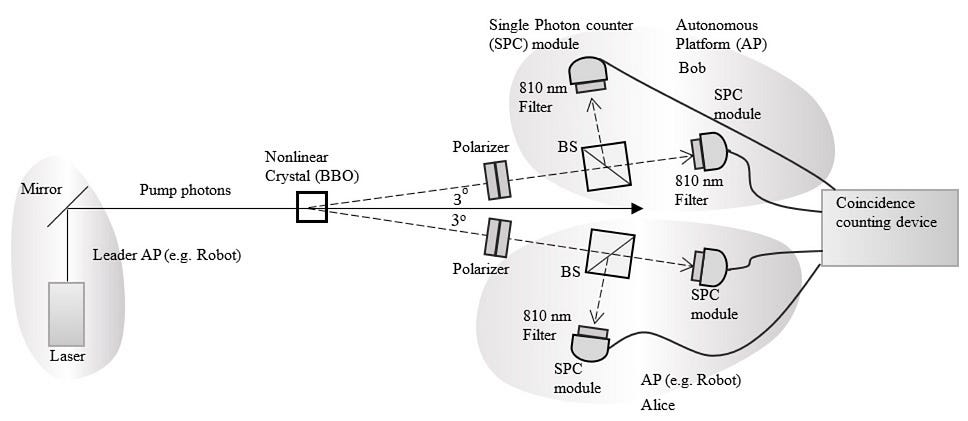
Lindqvist’s simulations extended this theoretical framework to a concrete experimental scenario. He modeled a satellite at 500-kilometer altitude distributing entangled photon pairs: one photon measured aboard the satellite, the other measured at a ground station at sea level. The gravitational time dilation between these two altitudes amounts to approximately 16 microseconds per year, or about 45 nanoseconds per day. For a single photon detection event, the timing difference is on the order of picoseconds.
But Bell inequality measurements accumulate statistics across millions of detection events. Systematic biases at the picosecond level compound into measurable shifts when measurement order correlates with gravitational potential difference.
Lindqvist screened 10,000 simulated experimental runs and found that the predicted Bell parameter shifted by 0.3% when the higher-altitude detector measured first compared to when the lower-altitude detector measured first. But the shift was not random noise. The sign of the deviation reversed when the measurement order reversed, producing a temporal asymmetry in the entanglement correlations that depended on which detector occupied the weaker gravitational field. The pattern suggests that entanglement, usually described as instantaneous and symmetric, carries an intrinsic sensitivity to the direction of time as defined by the local geometry of spacetime. No laboratory on Earth has tested this prediction.
NASA / Jet Propulsion Laboratory / public domain
The experimental infrastructure to test this prediction does not yet exist in the required configuration, but it is closer to deployment than at any previous point in the history of physics. China’s Micius satellite demonstrated entanglement distribution over 1,200 kilometers in 2017, violating the Bell inequality by 2.37 standard deviations under strict Einstein locality conditions. The gravitational test was not among its objectives. NASA’s SEAQUE mission, launched in November 2024, deployed an integrated entangled photon pair source and Bell test apparatus on the International Space Station.
The European Space Agency’s proposed SPACEQUEST mission targets single-photon quantum optics experiments in the gravitational field gradient between orbital altitude and ground level. Not one targets the temporal asymmetry Lindqvist predicts. None of these missions was designed specifically to test temporal asymmetry in entanglement correlations, but the hardware they demonstrate, space-qualified photon sources, high-efficiency single-photon detectors, precision timing electronics synchronized to atomic clocks, constitutes the technological foundation that Lindqvist’s proposed experiment requires.
The original theoretical frameworks for quantum entanglement, developed by Einstein, Podolsky, and Rosen in 1935 and formalized by John Bell in 1964, treated spacetime as a fixed, flat background on which quantum events unfold. Those frameworks produced the Bell inequalities that have been violated in every experimental test conducted since Alain Aspect’s landmark 1982 experiment. The theoretical tools from that era sit in the foundations of quantum information science, the mathematics built on assumptions of Minkowski spacetime where gravitational effects are negligible. No experimental Bell test conducted on Earth’s surface has ever detected a gravitational contribution to the correlation function, because the time dilation difference across any laboratory-scale apparatus falls below the timing resolution of available detectors.
Since those foundational experiments, the precision of entanglement measurements has improved beyond anything the 1982 apparatus could have achieved. Single-photon detectors now achieve timing resolutions below 50 picoseconds. Atomic clocks aboard GPS satellites maintain synchronization to within nanoseconds across orbital altitude differences of 20,000 kilometers. The Deep Space Quantum Link concept, proposed by NASA’s Jet Propulsion Laboratory in 2018, explicitly targets the measurement of general relativistic effects on quantum optical interference using photons transmitted between ground stations and deep-space probes where the gravitational redshift becomes large enough to produce measurable phase shifts in single-photon interferograms.
Against this approaching experimental capability, the theoretical prediction of temporal asymmetry in entanglement offers a different kind of evidence. If the arrow of time emerges from thermodynamic statistics alone, then entanglement correlations should show no dependence on measurement order, because the quantum equations governing entanglement are time-symmetric and the thermodynamic arrow operates at macroscopic scales that individual photon measurements do not probe. But if the arrow of time has a geometric component rooted in spacetime curvature, then entanglement correlations should carry that curvature in their measurement-order dependence. Flat-spacetime quantum mechanics predicts the measurement-order effect should be exactly zero.
But Lindqvist’s simulations predict a nonzero value. The sign of the predicted asymmetry encodes information about the direction of time as defined by the local gravitational field. The conventional model assumes that quantum correlations are immune to gravitational influence at the level of individual measurement events.
“The equations of quantum mechanics do not contain an arrow of time,” Lindqvist explained. “But spacetime does, because clocks at different altitudes run at different rates, and that difference defines a local direction from slower to faster, from deeper to shallower gravitational potential.”
Katya Morozova, a theoretical physicist at the Perimeter Institute for Theoretical Physics who develops mathematical frameworks for quantum theory on curved spacetime backgrounds, suspects the predicted asymmetry arises from the incompatibility between the time-evolution operators used in quantum mechanics and the proper-time structure imposed by general relativity. When Morozova computed the entanglement entropy of a photon pair distributed between two detectors at different gravitational potentials (a calculation that required regularizing divergences in the quantum field theory on a Schwarzschild background, though the approximation treats Earth’s gravitational field as weak and static), the result contained a correction term proportional to the gravitational potential difference that broke the time-reversal symmetry of the entanglement entropy. The correction vanishes when the two detectors sit at equal altitude. The correction grows linearly with the potential difference. The correction changes sign when the labeling of which detector is higher and which lower is reversed, mimicking the behavior of a quantity that distinguishes past from future rather than one that merely distinguishes up from down.
“The correction is small,” Morozova explained. “At satellite altitude, the effect sits at the edge of current detector resolution.”
The catch is systematics, and every attempt to measure a 0.3% shift in a Bell parameter requires controlling for instrumental effects that could mimic or mask the gravitational signal. Detector efficiency asymmetries between the satellite and ground station, atmospheric turbulence in the optical downlink, timing jitter in the synchronization electronics, and thermal drift in the photon source all produce systematic errors that must be characterized at levels below the predicted gravitational contribution. Lindqvist’s proposed experimental design addresses these challenges by using a symmetrization protocol in which the satellite alternates between distributing photon pairs to two ground stations at different altitudes and distributing pairs to the same ground station at two different times, using the time-swapped configuration as a null test. The protocol requires a mission architecture that no current satellite quantum experiment has implemented.
Raghav Krishnamurthy, an experimental quantum physicist at the National Institute of Standards and Technology who develops space-qualified single-photon detectors and precision timing systems for quantum communication satellites, cautioned that the systematic error budget for a gravitational Bell asymmetry measurement exceeds the budget of any current space quantum mission by at least an order of magnitude. He analyzed the SEAQUE mission’s detector performance data and found that timing jitter in the onboard single-photon avalanche diodes averages 85 picoseconds, although whether that jitter can be reduced below 40 picoseconds through post-processing techniques that correlate detector response with temperature telemetry remained an open question. The 40-picosecond threshold corresponds to the minimum timing resolution at which the predicted 0.3% Bell asymmetry becomes distinguishable from detector noise at three-sigma statistical significance over a six-month data collection period.
“The physics is clear in the theory,” Krishnamurthy noted. “But the engineering required to separate a gravitational signal from an instrumental artifact at the 0.3% level has not yet been demonstrated in space.”
Despite these constraints, the broader pattern across relativistic quantum information holds firm. Theoretical frameworks predict that entanglement correlations carry gravitational signatures that standard flat-spacetime quantum mechanics does not incorporate, precisely because the foundational experiments of quantum optics were conducted in laboratories where gravitational time dilation is negligible. A $200 million investment from the European Space Agency’s Quantum Communications and Space Science program targets satellite quantum key distribution but does not include a dedicated gravitational Bell test in its mission portfolio. NASA’s DSQL concept remains at the technology development stage, with a projected mission cost of $400 million to $600 million that exceeds the budget of any single principal-investigator-led quantum physics mission. No funding line currently covers it.
The International Space Station’s orbital altitude of 400 kilometers produces a gravitational potential difference that falls at the lower edge of the predicted detectable range, meaning that a dedicated mission to higher orbit may be necessary to achieve the required sensitivity.
Whether the arrow of time carries a quantum signature detectable through entanglement depends on challenges that no single space mission or theoretical framework can resolve. The predicted effect’s small magnitude, its sensitivity to instrumental systematics, its requirement for a satellite architecture not yet funded all demand coordination between quantum foundations theorists, space systems engineers, precision metrology specialists, and international space agencies at a scale that the current research infrastructure does not support.
Krishnamurthy cautioned that the timeline extends beyond any single mission cycle.
“The technology to measure this effect will exist within a decade,” he said, although whether the funding to deploy it will materialize before the next generation of physicists inherits the question, across a landscape where quantum communication satellites attract investment and fundamental physics missions do not, those remain open questions.
The science has not yet measured what the geometry already encodes, and whether the next generation of space missions will carry the instruments required remains an open question.
The implications extend beyond the laboratory and into the foundations of physics itself. If entanglement correlations carry a gravitational temporal asymmetry, then the standard formulation of quantum mechanics in flat Minkowski spacetime is not merely approximate but incomplete, missing a structural feature of reality that becomes visible only when the curvature of spacetime stretches the temporal relationship between entangled particles beyond a critical threshold. The 2019 Nature Communications paper on Bell’s theorem for temporal order established the theoretical framework for this possibility, showing that a massive body in quantum superposition could entangle the temporal orders of timelike events and produce Bell inequality violations impossible under any classical causal structure. Temporal order itself may be a quantum observable rather than a fixed background parameter, and the arrow of time that the universe exhibits may be a gravitational phenomenon encoded in the geometry of spacetime rather than an emergent statistical property of many-particle systems.
That conclusion, if experimentally confirmed, would rewrite the textbook explanation of irreversibility. The standard account traces the arrow of time to the second law of thermodynamics: entropy increases because there are overwhelmingly more disordered states than ordered ones, and systems evolve toward the most probable configuration. This statistical explanation requires no fundamental asymmetry in the laws of physics. It requires only an initial condition of low entropy, called the past hypothesis, which cosmology places at the Big Bang without explaining why the universe began in so improbable a state. Lindqvist’s predicted gravitational Bell asymmetry offers an alternative anchor for the arrow of time, one rooted not in initial conditions but in the ongoing geometry of the universe.
If spacetime curvature breaks the temporal symmetry of entanglement correlations, then the arrow of time is not a relic of the Big Bang’s improbable beginning. The arrow is a local property of curved spacetime that any sufficiently precise measurement can detect wherever gravitational fields exist.
The distinction matters for quantum gravity. Every candidate theory, from string theory to loop quantum gravity to causal set theory, must explain how the smooth spacetime of general relativity emerges from a quantum substrate. If the arrow of time is thermodynamic in origin, then quantum gravity theories need not contain any fundamental temporal asymmetry. But if the arrow is geometric, encoded in curvature and detectable through entanglement, then any theory that fails to reproduce this asymmetry is not complete. Lindqvist’s proposed experiment, designed to measure a 0.3% shift in a Bell parameter, tests the foundations on which competing theories of quantum gravity are built.
Morozova cautioned that the theoretical prediction rests on approximations that a full quantum gravity calculation might revise. “The calculation treats gravity as a fixed classical background,” she said. “A fully quantum treatment of the gravitational field could change the predicted magnitude, or eliminate the asymmetry entirely, and distinguishing between those possibilities requires the experimental data that only a space mission can provide.”
The measurement would also address a question that has haunted quantum foundations since the earliest days of the discipline. The quantum measurement problem, the question of how a superposition of possibilities becomes a single outcome when observed, has resisted solution for nearly a century. Several proposals, including the Diosi-Penrose gravitational collapse model, posit that gravity causes wavefunction collapse at a rate proportional to the gravitational self-energy of the superposed states. No experiment has tested these proposals in curved spacetime. If gravity breaks the time symmetry of entanglement correlations, then the same mechanism may be responsible for the irreversibility of quantum measurement, connecting the arrow of time, the measurement problem, and spacetime geometry through a single underlying physics that no Earth-bound experiment has probed.
A 2025 study on the emergence of opposing arrows of time in open quantum systems found that time-reversal symmetry is maintained in the derived equations of motion for quantum systems interacting with heat baths, and that thermalization can occur in both temporal directions from a chosen origin. The result reinforces the theoretical prediction that the arrow of time cannot be derived from quantum dynamics alone and requires an additional ingredient that physics has not yet identified. Lindqvist’s proposed experiment tests whether that ingredient is spacetime geometry, and the next generation of satellite quantum missions will determine whether the prediction survives contact with data.
In the Vienna laboratory, Lindqvist marks another simulation parameter, records another predicted Bell value, checks another gravitational correction against the flat-spacetime baseline. The servers hum through the overnight computation. The entangled photon pairs hold their correlations still. Temporal asymmetry continues to hide in the fraction of a percent between measurement orders, between detectors at different altitudes, between clocks that tick at rates the universe has set, and the arrow of time that the geometry of spacetime may carry remains encoded in correlations that no one has measured at the resolution the prediction demands.
References
- Yin, J., et al. (2017). “Satellite-based entanglement distribution over 1200 kilometers.” Science, 356(6343), 1140–1144.
- Zych, M., Costa, F., Pikovski, I., & Brukner, C. (2019). “Bell’s theorem for temporal order.” Nature Communications, 10, 3772.
- Lesovik, G.B., et al. (2019). “Arrow of time and its reversal on the IBM quantum computer.” Scientific Reports, 9, 4396.
- Hatano, N. & Ordonez, G. (2019). “Time-reversal symmetry and arrow of time in quantum mechanics of open systems.” Entropy, 21(4), 380.
- Mohageg, M., et al. (2025). “Towards satellite tests combining general relativity and quantum mechanics through quantum optical interferometry.” EPJ Quantum Technology, 12, 1–28.
- Donoghue, J.F. (2020). “Quantum causality and the arrows of time and thermodynamics.” Progress in Particle and Nuclear Physics, 115, 103812.
- Donadi, S. & Bassi, A. (2025). “Emergence of opposing arrows of time in open quantum systems.” Scientific Reports, 15, 3741.
- Bell, J.S. (1964). “On the Einstein-Podolsky-Rosen paradox.” Physics, 1(3), 195–200.
메타데이터
- post_id
- 2375a4f03205
- slug
- what-if-time-is-not-as-fixed-as-we-thought-2375a4f03205
- url
- https://medium.com/wilderness-medicine-guide/what-if-time-is-not-as-fixed-as-we-thought-2375a4f03205
- canonical_url
- https://medium.com/wilderness-medicine-guide/what-if-time-is-not-as-fixed-as-we-thought-2375a4f03205
- author_url
- https://medium.com/@caseycsears
- status
- ok
- fetched_at
- 2026-07-09 01:16:53