The Festival That Happened to Us: TAC, Our City of Art
In its Delhi-coded chaos, TAC became the most honest reflection of the art scene in a city where everything is both incomplete & in motion.
The Festival That Happened to Us: TAC, Our City of Art
By the time you located the Illustrator’s gallery, three things had already happened:
- Someone had smudged hot pink across a stranger’s tote
- You’d inhaled paint and the subtle smell of coffee more than air
- You’d stopped trying to find logic.
There were maps handed at the entrance, but no directions leading you deeper into the warm-blooded sprawl of bodies, brushes, and the chaotic buzzing question of “where am I supposed to be?” But here’s the trick: at TAC Fest, “supposed to” had no jurisdiction.

Paint fumes mingled with espresso steam and nervous laughter. Zines spread loose like ideas. You couldn’t tell where paths ended and footnotes began — the booths bled into conversations and banter, the conversations bled into memories and beautiful stickers, and the memories bled back into paint at the Print Zone.
In all its chaos, slight misdirections, and marketing, TAC became probably the most honest reflection of the art scene in a city where everything is both incomplete and in motion. Delhi isn’t known for hosting art — it houses it quietly, behind closed doors, then watches it get run over by the crowd. But TAC did feel different in all the multitudes it tried to contain within it. The most meaningful structure there became spaces, from near a wonky wooden bench, some shade, food from a cafe, to steps at the stage acting as chairs, and the audacity to stay.
I wasn’t there to observe art. I was there to catch what escaped from it. I arrived four days late, in thought and in writing. Not physically late to the act of witnessing, but emotionally late to the act of making sense. When an event refuses to tidy itself up, any documentation must be built from its debris — the half-remembered gesture, the residual scent of ink and espresso, the half-heard question that stays like a burr under the skin:
“Why does this matter?” “Who is this for?” “Am I part of this, or am I just holding space for it?”
It matters because it exists. It is for whoever chooses to enter without needing to control the narrative. And yes, you are part of it. Whether you intended to be or not.

We sat on the surprisingly warm wooden bench, paint pens scattered like stars . People walked in and around, slow and careful, as if the cement floors would give. There was quiet caution in their interruption, “Hii, Can we join you?” That led to so many conversations, I lost track of time.
Someone told me: “I feel like the purpose of art is nothing but joy.” Shreeja has been an artist herself, for a considerable amount of time, and though her career has taken an off path from art, she still tries to be in touch with art as much as possible. TAC became part of her solo adventures every weekend from Sonipat to Delhi. She goes off, looking for art with “cats drawn in a way that they don’t look like cats, but you can tell they’re cats.”
At 1pm the illustrator’s gallery hums before the formal quiet sets in. Someone laughs near the entrance, a laugh that doesn’t care about timing, and I catch it in my notebook, trying to hold onto its resonance before it scatters. Eventually, people drift in small clusters, orbiting artworks like moons, examining brush strokes, tracing the rough edges of paper with fingers that hover but do not touch.
Vippu’s voice cuts through the quiet:
“I’m literally feeling like I’m back in my school, where I used to paint, sit in a room during my summer holidays. And for, like, two and a half months, that’s all I did. And, I painted bedsheets. I painted cushion covers and all of that. And that’s my childhood memory. My favorite time was spent in my art room, always.”
I pause near a painting too, blue and vibrant, it reminds me of my childhood bedroom and her words echo in my head. I realize that the TAC entryway was fashioned into some sort of portal that turned us all back into the children who knew nothing but crayons and red, blue, green on the walls. The gallery bends in unexpected ways. Corridors narrow, then open suddenly into rooms that smell differently — dusty wood, and fresh paint.

Time seems elastic here. Moments stretch, linger, then compress. I catch myself pausing mid-step, staring at a corner where the ceiling meets the wall, where a subtle imperfection catches the light just so. I think of the people who will never notice it, the ones who will, and how differently that small detail resonates in each mind.
The stalls are dense. Zines, prints, and scattered stickers lie across tables with no discernible order. Conversations overlap, tension and excitement vibrating in the air like electricity. I crouch near a spread of stained-glass , trying to catalogue it mentally, but I am distracted by voices.
Sahil, speaking softly, almost as an aside:
“The accessibility here then brings into more understanding of like: *Hey, art is not just one thing. Art is not just X, Y, Z.* Photography, talking, feeling, post-making, everything is art. **So, I think the understanding of democratization of things, also brings you an understanding of how much around us is art too.”

I feel my own orbit intersecting theirs dozens of times in the event, under the “Bad Art is also Art” installed on the wall, in the line to get our prints for a tote bag. There is a peculiar community in this. The hum of conversation, running into people again and again, the subtle scrape of a chair, the tilt of a head. TAC, from that moment, becomes a city of its own, the event feeling like an ecosystem of people- both young and older alike.
Nearby, a woman leans over to read a zine page aloud, her voice lilting. I can’t catch all the words, but I note the cadence, the way meaning lives in pauses and breaths. The space, in that way, is alive — not just as a container for art, but as a node in a network of perception and affect.
On the terrace, lives the community zone, wind lifts the edges of papers left on the railing, paint markers dry slower, the miniature art gallery becomes a point within the TAC city. Delhi stretches beneath, indifferent and humming. Here, the gallery ceases to be a room and becomes a threshold: between below and above, between observer and observed, between the self and the people who unknowingly shape its atmosphere.
Sitting on the terrace where the community zone overlooks the entire event by herself, a psychologist I failed to catch the name of, but remember asking “Do you think art likes you back?”:
“Oh, definitely. I think it loves you back. If you just hold that hand that art offers you, it can just… hug you very warmly, you know? It love you in a very warm way, you just have to take that step”
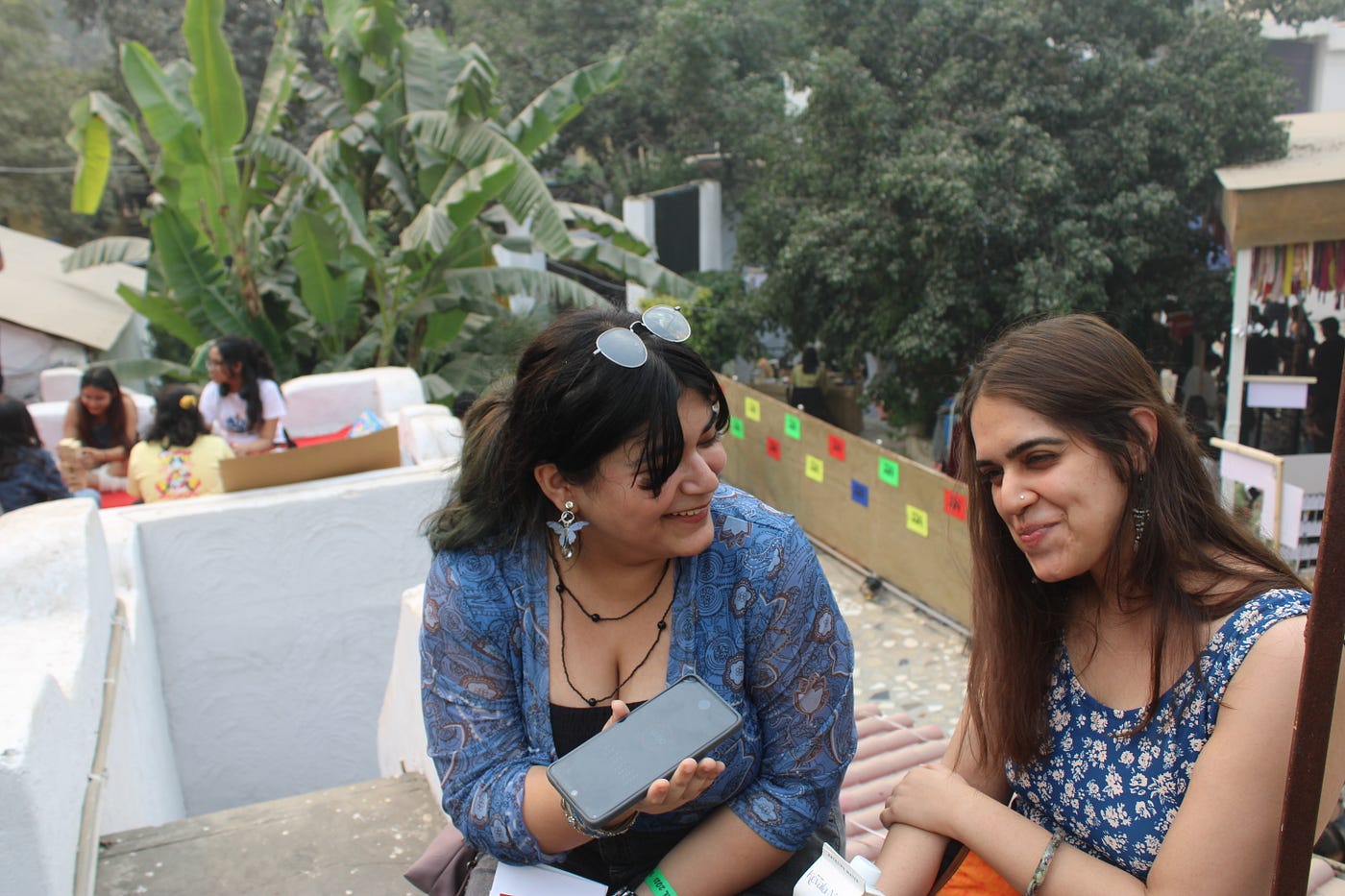
I write it down, but it feels inadequate. It is not just the words, it is the rhythm of her posture, the tilt of her head, the way introversion shows up even when she joins me and a group of people into making doodles on the wooden bench. Memory and presence fold into one another.
Somewhere in there, I meet two people who laugh a lot with me, Gunjan and Suma, and they tell me (while figuring out the paint makers) that:
“ (laughs) I think everyone here is very, like, like everyone is an artist. And I, I just love art. I’m not an artist. Actually I feel the opposite sometimes, but I just love art. But, also everyone is an artist. (laughs) Yeah, everyone is an artist”

The air grows warmer as more people arrive. Conversations layer atop one another, like the low hum of bees in a hive. I am reminded, again, that TAC sits within Delhi, a city already dense with life, history, and contradiction. On the streets outside, chaos is normative: honking, hawkers, informal economies, protests, everyday collisions of lives. Inside TAC, that energy of Delhi is contained, curated but never entirely subdued. You hear the cadence of a familiar dialect in a conversation, sense the frayed humanity beyond the perfect lighting or staged installation. TAC mirrors the city’s vibrancy, but it also offers a controlled lens: a microcosm that hints at Delhi’s multiplicities without ever fully capturing them.
What strikes you is the tension between the community within TAC and the notion of what we are taught art should be. We learn that art is rarefied, that it is untouchable, that it demands reverence and distance. TAC contradicts this. Here, art lives in gestures, in exchanges, in the way a visitor leans too close to a painting, picks up the prints, or scribbles a thought on a shared table. The community is porous: artists and audiences intermingle, conversations spill over curatorial boundaries, and nobody is merely a passive observer. TAC as a city within Delhi is thus a contradiction made material: structured yet alive, curated yet communal, a lesson in how art can be both taught and untaught simultaneously. Despite the frustrations, and instances of mismanaged queues, mistakes with the ink and timing, it manages to challenge the myth that art must be separate from daily life.
Manvi’s words arrive like a gentle admonition:
“ I feel just included in the sense that it feels like an art space because it’s all you had ever wanted as a child. I’ve been an art kid since I was born, and this just feels like home. Like a sense of belongingness.”

The act of talking to people, and writing here becomes an excavation of experience: not a report, but layering of perception, memory, and affect. I am taught that Art is not isolated. It lives in response, in friction, in the interstitial spaces between strangers.
The final Print rooms are narrower, darker, and crowded. I notice the unspoken economy of space: how proximity and distance shape meaning, how thresholds between observation and participation blur. I leave the last room quicker, reluctant to forget the rhythm that has been constructed outside in the sunlight and human noise .
Zahvi and Nikita tell me, almost beneath the hum of the space:
“But it’s been a long time ki mujhe woh feeling aayi hai to do something, to create something kyunki I’m working in corporate toh mujhe time hi nahi milta. Main yahan pe soch rahi hoon, “Shit, main kya kar rahi hoon? Mujhe kuch banana chahiye, mujhe kuch karna chahiye, mujhe aise events me aana chahiye ya phir aise events organize karne chahiye.
And this is like, this is so much fun. Yeah, this is so much fun. So much fun. My unexpected feeling would be dipping my hands in those paint boxes jo bahar rakhe hain and just… Oh, Skateboarding! I really want to just like throw paint, and skate.”

A stifled laugh near the miniature gallery punctuates the space. It signals surprise, a disruption of expectation, evidence of how affective registers — humor and curiosity — mediate interaction with material culture.
By the time the last print dries, the sun has tilted in the sky. TAC is no longer merely a collection of galleries and rooms; it is a living archive of movement, conversation, and memory. The voices I’ve collected are so big in number, yet a lot of them remain beyond the writing of this — Shreeja, Vippu, Sahil, Manvi, Zahvi, Nikita, the psychologist on the terrace, the sisters in the gallery linger like constellations across a shifting sky, illuminating the ways in which this “festival” refuses to be neat. TAC is a city that teaches you how to inhabit it, how to negotiate its corridors and terraces, its microclimates of smell, color, and sound. It demands attention to the small gestures: the tilt of a head, the pause over a page, the smile that lingers when no one is watching.
I will maintain this stance: the platform facilitated a meeting, but it did not dictate the rhythm; that belonged to those inhabiting the space, improvising, observing, and reimagining what art can be.

This is the tension TAC inhabits: it is structured, curated, it plays into the elitism of art spaces of Delhi and yet it was irreducibly alive; a festival, a city, a conversation, a community. In the laughter that drifts from the terrace, in the nervous handling of paint pens, in the quiet admiration of a print, TAC is teaching a lesson that slides past formal pedagogy: art is relational, affective, and communal.
And as I step out into Delhi again, the streets roaring with their usual chaos, I carry the echoes of TAC with me — the half-heard phrases, the scattered zines, the warmth of a community that refused to be incidental. TAC is a city within a city, a network of presence and participation that challenges the hierarchies and distances we are taught to impose on art. It exists because people inhabit it fully, and in inhabiting it, it inhabits them in return.
The festival that happened to us is not just a memory; it is a method. TAC, in its porous, breathing architecture, teaches us how to measure time not by schedules or maps, but by gestures, attention, and affect. It reminds us that art is never separate from life — it is threaded through every conversation, every gesture, every moment in which we choose to pay attention, to linger, and to participate.

I leave the space heavy with words, sketches, and half-formed thoughts. Outside, the city is loud again. Cars and horns replace whispers and paint fumes. But inside me, the echoes continue, forming constellations of moments, voices, and fragments that cannot be untangled.
Visuals/Photography By: Navya Chandna
메타데이터
- post_id
- 237b9448706c
- slug
- the-festival-that-happened-to-us-tac-our-city-of-art-237b9448706c
- url
- https://medium.com/@byeva/the-festival-that-happened-to-us-tac-our-city-of-art-237b9448706c
- canonical_url
- https://medium.com/@byeva/the-festival-that-happened-to-us-tac-our-city-of-art-237b9448706c
- author_url
- https://medium.com/@byeva
- status
- ok
- fetched_at
- 2026-06-29 01:02:39





