Milvus vs Pinecone vs Weaviate: Which Vector Database Is Best for AI?
Artificial Intelligence applications are rapidly transforming how organizations build search engines, recommendation systems, AI…
Milvus vs Pinecone vs Weaviate: Which Vector Database Is Best for AI?
Artificial Intelligence applications are rapidly transforming how organizations build search engines, recommendation systems, AI assistants, and intelligent automation tools. At the center of many of these systems lies a relatively new but powerful piece of infrastructure: the vector database.
Traditional databases were designed to store structured data and retrieve it through exact matches or SQL queries. However, modern AI systems work differently. Instead of relying only on keywords, they convert data into vector embeddings — numerical representations of text, images, audio, and video. These embeddings capture semantic meaning, allowing machines to understand relationships between pieces of information.
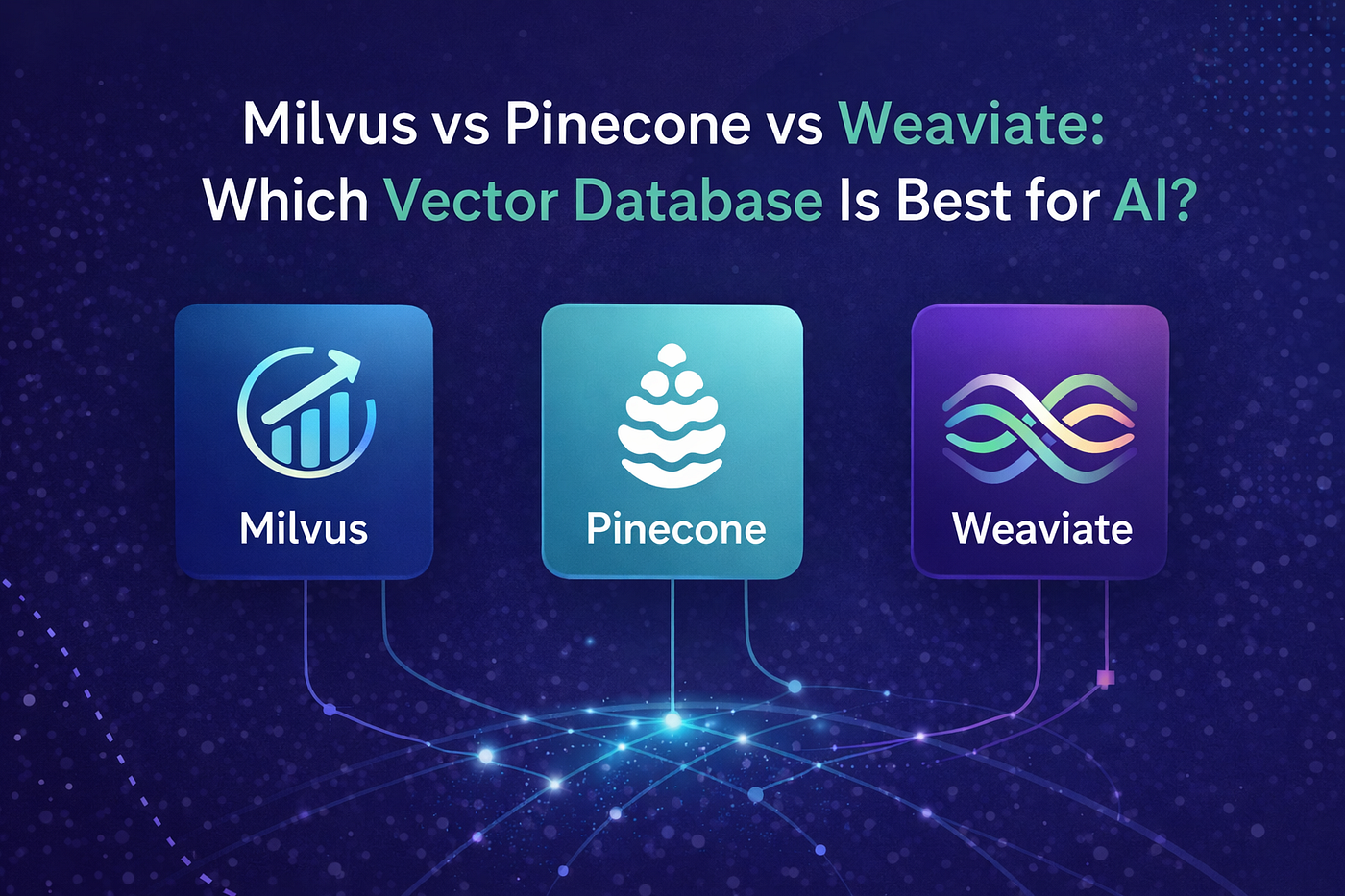
To efficiently store and search these embeddings, developers use vector databases such as Milvus, Pinecone, and Weaviate. These systems power a wide range of modern AI workloads, including Retrieval-Augmented Generation (RAG), semantic search, recommendation engines, and AI agents.
In this article, we’ll explore how vector databases work, what makes these three platforms unique, and how to decide which one is best suited for your AI application.
Understanding Vector Databases in Modern AI
Before comparing the platforms, it’s important to understand why vector databases have become essential in AI architecture.
When machine learning models process data — whether text from documents, product descriptions, images, or audio — they convert that data into numerical vectors. These vectors can contain hundreds or even thousands of dimensions. The distance between vectors represents semantic similarity.
For example:
- Two sentences with similar meanings will produce vectors located close to each other in vector space.
- Two completely unrelated concepts will produce vectors that are far apart.
Vector databases store these embeddings and allow developers to perform similarity search, which means retrieving vectors that are closest to a query vector.
This capability is critical for systems such as:
- AI document search engines
- Chatbots with external knowledge bases
- Recommendation systems
- Image similarity search
- Fraud detection and anomaly detection
Many modern Retrieval-Augmented Generation (RAG) pipelines rely heavily on vector databases. In these systems, documents are embedded and stored in a vector database. When a user asks a question, the system retrieves the most relevant documents from the database and provides them to a language model for generating accurate answers.
Without vector databases, this type of semantic retrieval would be extremely inefficient.
Milvus: A High-Performance Open-Source Vector Database
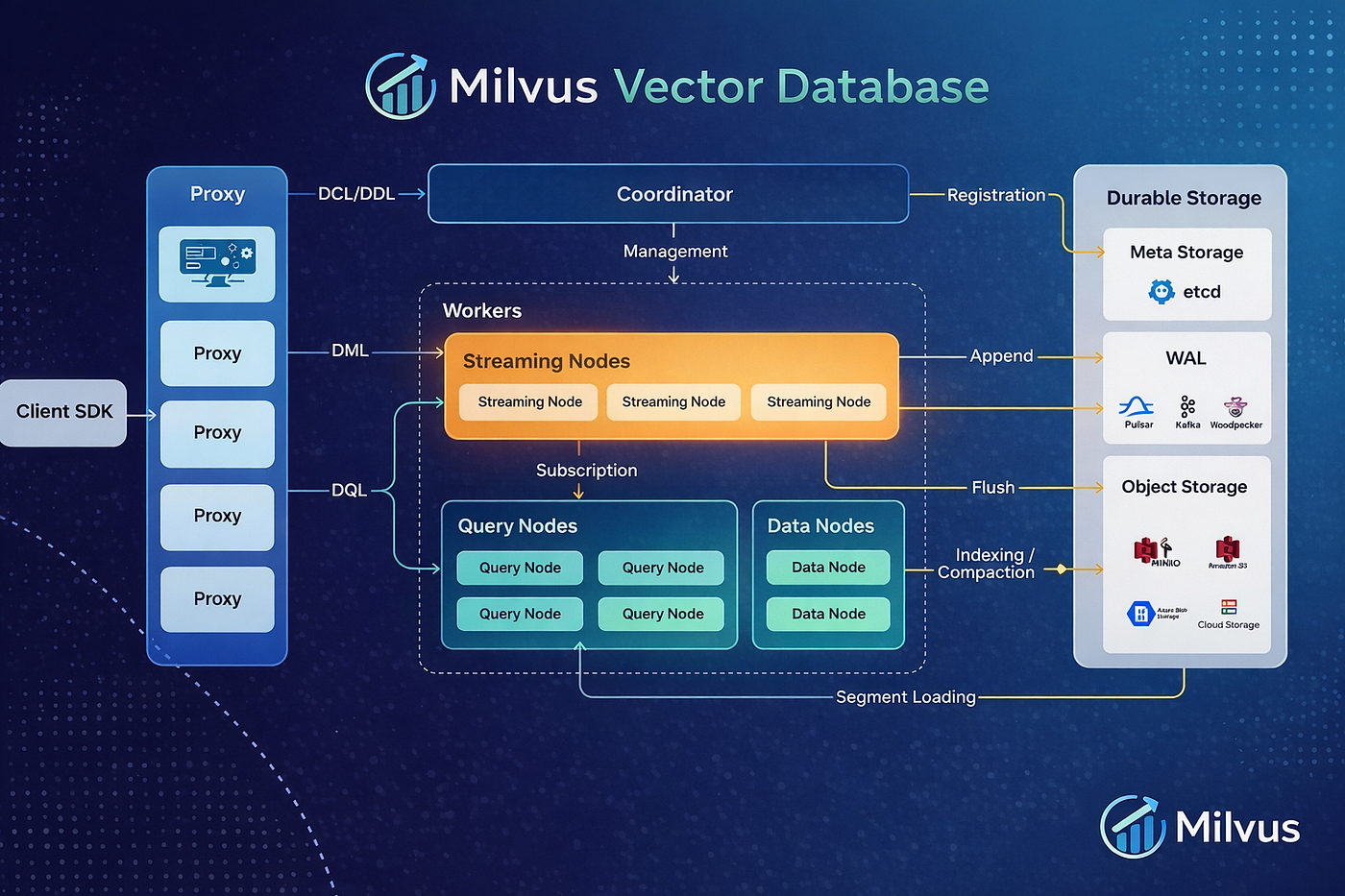
Milvus is one of the most widely used open-source vector databases designed for large-scale AI workloads. It was originally developed by Zilliz and later contributed to the Linux Foundation’s LF AI & Data initiative.
Milvus was built with scalability as a core design principle. Unlike lightweight vector search libraries that run on a single machine, Milvus supports distributed deployment and can scale to billions of vectors. This makes it especially useful for enterprises building large AI search systems or recommendation engines.
One of Milvus’s biggest strengths is its support for multiple indexing algorithms. Vector indexing structures such as HNSW, IVF, and PQ help accelerate similarity search across massive datasets. These indexes allow developers to balance accuracy and performance depending on the requirements of their applications.
Another important capability is Milvus’s ability to support hybrid search. Developers can combine vector similarity queries with structured filters, enabling more refined results. For example, a system might search for documents similar to a query vector while filtering by category, language, or timestamp.
Milvus also integrates well with AI frameworks and tools commonly used in modern AI development. Libraries such as LangChain, LlamaIndex, and Haystack support Milvus as a backend vector store. This makes it easy to incorporate Milvus into RAG pipelines and AI agent workflows.
Because Milvus is open source and self-hosted, it provides organizations with full control over their infrastructure. However, this also means teams need to manage deployment, scaling, and operations themselves. For large companies with DevOps resources, this flexibility can be a major advantage.
Our platform also provides a ready-to-deploy VM environment for Milvus, helping developers launch vector search infrastructure quickly.
Link: https://techlatest.net/support/milvus_support/
Pinecone: A Fully Managed Vector Database
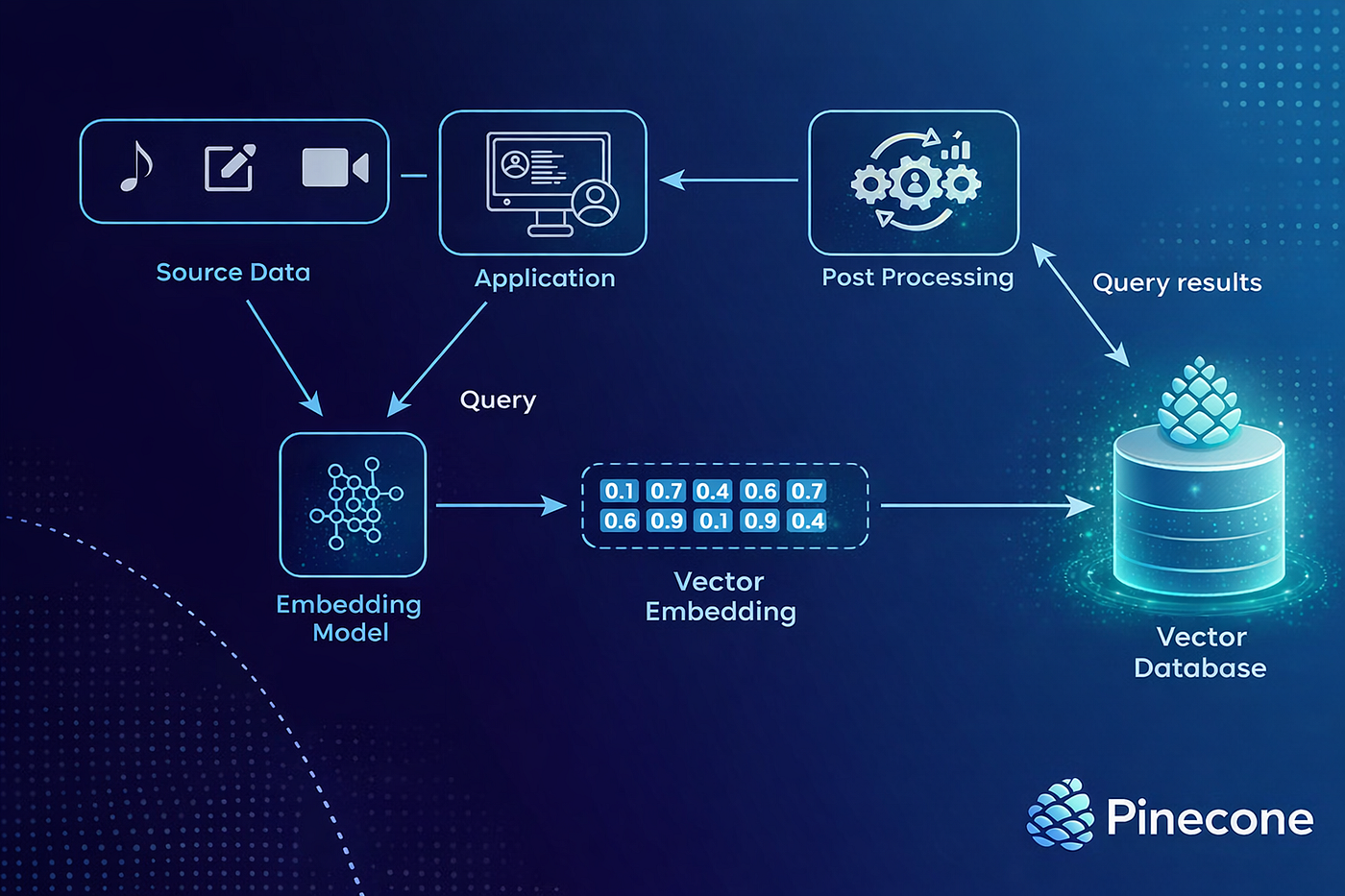
Pinecone takes a very different approach compared to Milvus. Instead of focusing on open-source flexibility, Pinecone focuses on simplicity and managed infrastructure.
Pinecone is a fully managed vector database offered as a cloud service. Developers do not need to configure clusters, manage storage, or optimize indexes. The platform automatically handles scaling, replication, and performance optimization.
This approach makes Pinecone particularly attractive for startups and teams that want to move quickly without worrying about infrastructure management. Instead of spending time configuring databases, developers can focus on building AI features.
Another key advantage of Pinecone is its extremely low latency. The system is designed to provide fast vector search even when handling large numbers of queries. This makes it well-suited for production AI systems such as chatbots, recommendation engines, and real-time search applications.
Pinecone also provides straightforward APIs that make integration with AI frameworks very simple. Developers can easily store embeddings, run similarity queries, and retrieve relevant results without dealing with complex database configurations.
However, because Pinecone is a managed service, users have less control over the underlying infrastructure. Pricing can also increase as workloads scale, which may be a consideration for organizations processing extremely large datasets.
Despite these limitations, Pinecone has become one of the most widely adopted vector databases in production AI systems.
Weaviate: Combining Vector Search with Structured Data
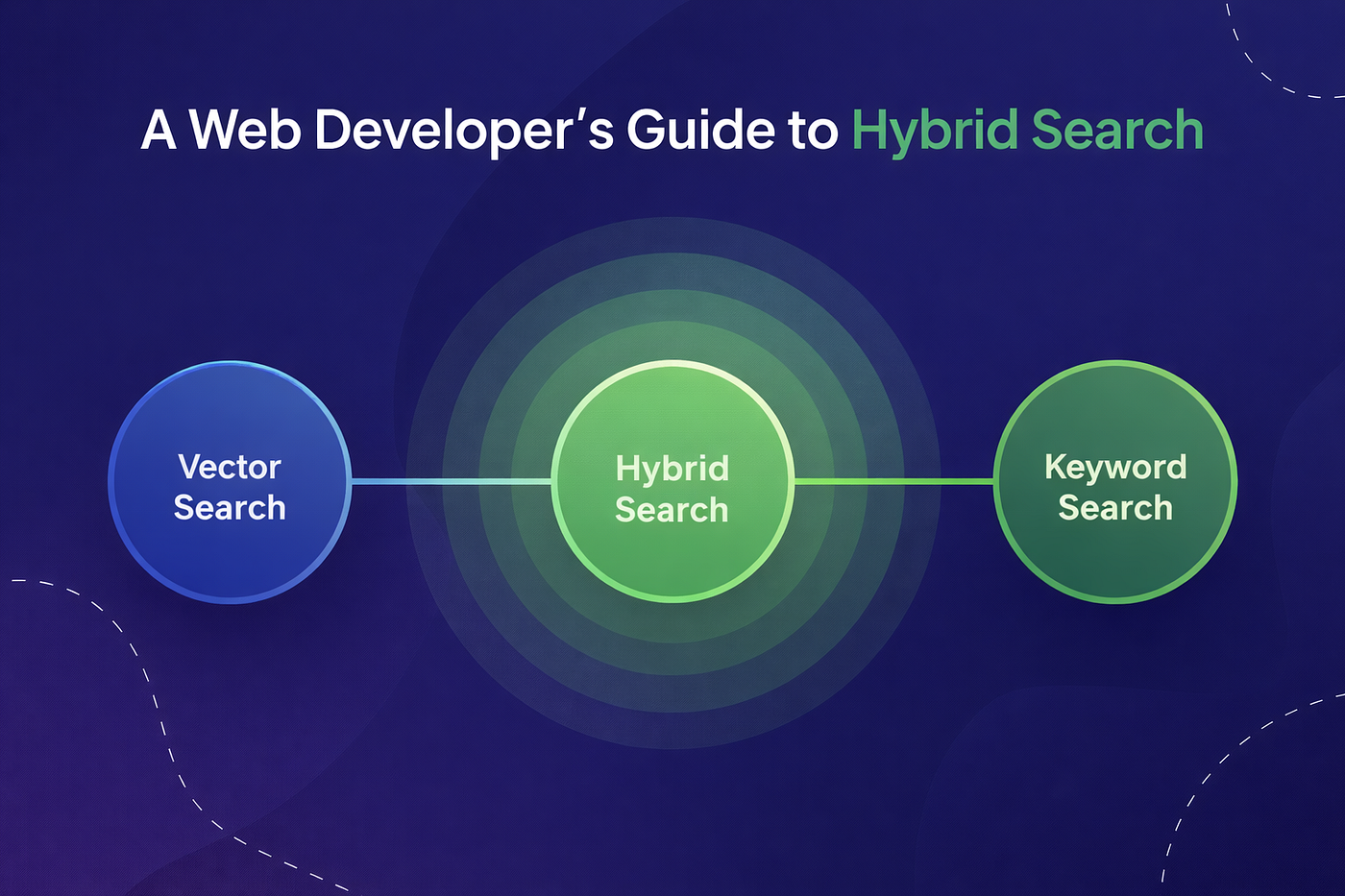
Weaviate offers a unique approach that combines vector search with structured data relationships.
While many vector databases focus primarily on similarity search, Weaviate also supports graph-like data structures and hybrid search capabilities. This allows developers to query both semantic similarity and traditional database fields simultaneously.
For example, an application could search for documents similar to a query vector while also filtering based on metadata such as author, category, or date. This hybrid approach makes Weaviate particularly useful for knowledge management systems and enterprise search platforms.
Weaviate also supports GraphQL APIs, giving developers a flexible way to query complex datasets. In addition, the platform includes built-in modules for machine learning models, allowing automatic generation of embeddings during data ingestion.
Another important feature is Weaviate’s support for multimodal data. Developers can store embeddings generated from text, images, or audio and perform cross-modal searches. For example, a user could search for images using a text query.
Weaviate can be deployed either as a self-hosted open-source system or through managed cloud services. This flexibility allows teams to choose the deployment model that best matches their infrastructure strategy.
Comparing Milvus, Pinecone, and Weaviate
Although all three systems are vector databases, their design philosophies differ significantly.
Milvus focuses on high scalability and performance. It is best suited for organizations working with extremely large datasets or building enterprise AI platforms that require distributed infrastructure.
Pinecone focuses on simplicity and managed operations. It allows developers to deploy production-ready vector search systems quickly without worrying about infrastructure complexity.
Weaviate focuses on hybrid search and data relationships. It provides a powerful combination of semantic search and structured querying that is particularly useful for knowledge management applications.
From a deployment perspective, Milvus and Weaviate can both be self-hosted, while Pinecone is primarily offered as a managed service. This difference can strongly influence the choice depending on whether an organization prefers full infrastructure control or a managed cloud solution.
Real-World AI Applications
Vector databases are used across many industries and AI applications.
Search engines use them to power semantic search that understands user intent rather than relying on exact keywords.
Recommendation systems use vector similarity to identify products or content that are closely related to user preferences.
AI assistants rely on vector databases to retrieve relevant documents during conversations, enabling systems like RAG-based chatbots.
Computer vision applications use vector databases to perform image similarity search, allowing systems to identify visually similar images or detect anomalies.
Because of these capabilities, vector databases have become foundational components in modern AI infrastructure.
Which Vector Database Should You Choose?
Choosing the right vector database ultimately depends on the scale of your system, your infrastructure preferences, and the complexity of your queries.
Organizations building large-scale AI platforms with billions of embeddings often prefer Milvus because of its distributed architecture and open-source flexibility.
Startups and development teams that want a fast path to production frequently choose Pinecone because it removes the operational complexity of running a vector database.
Projects that require hybrid search or knowledge graph-like relationships often benefit from Weaviate’s flexible data modeling capabilities.
In practice, many organizations experiment with multiple vector databases before selecting the one that best matches their performance and operational requirements.
Get $1,000 Free Azure Credits for TechLatest Cloud Solutions (Limited-Time Offer)
We’re offering eligible users & organizations $1,000 in free Azure credits to deploy TechLatest AI labs, BI stacks, cybersecurity environments, and LLM solutions — with zero upfront cloud costs.
This is a limited-time, first-come, first-served opportunity.
Limited-Time Azure Credits Offer
You can use $1,000 in Azure free credits with any TechLatest solution — including:
• AI & LLM development environments • Private GPT deployments • Cybersecurity labs • Business Intelligence stacks
Submit the form to claim credits: 👉 https://www.techlatest.net/free_azure_credits/.
Conclusion
Vector databases have quickly become a fundamental component of modern AI systems. As applications like AI agents, RAG pipelines, and semantic search engines continue to grow, the need for efficient embedding storage and retrieval will only increase.
Platforms such as Milvus, Pinecone, and Weaviate each offer unique strengths. Milvus excels in scalability and performance, Pinecone simplifies infrastructure management, and Weaviate provides powerful hybrid search capabilities.
Rather than searching for a single “best” vector database, developers should evaluate their specific requirements — including scalability, operational complexity, and query flexibility — before making a decision.
As the AI ecosystem evolves, vector databases will continue to play a central role in enabling intelligent applications that understand data at a semantic level rather than relying solely on traditional keyword-based search.
Thank you so much for reading
Like | Follow | Subscribe to the newsletter.
Catch us on
Website: https://www.techlatest.net/
Newsletter: https://substack.com/@techlatest
Twitter: https://twitter.com/TechlatestNet
LinkedIn: https://www.linkedin.com/in/techlatest-net/
YouTube:https://www.youtube.com/@techlatest_net/
Blogs: https://medium.com/@techlatest.net
Reddit Community: https://www.reddit.com/user/techlatest_net/
메타데이터
- post_id
- 237ee2d869f0
- slug
- milvus-vs-pinecone-vs-weaviate-which-vector-database-is-best-for-ai-237ee2d869f0
- url
- https://towardsdev.com/milvus-vs-pinecone-vs-weaviate-which-vector-database-is-best-for-ai-237ee2d869f0
- canonical_url
- https://towardsdev.com/milvus-vs-pinecone-vs-weaviate-which-vector-database-is-best-for-ai-237ee2d869f0
- author_url
- https://medium.com/@techlatest.net
- status
- ok
- fetched_at
- 2026-07-21 09:33:07