A Modern Framework for Setting Goals & Achieving Them
Bringing ancient goal-setting wisdom into the 21st century.
A Modern Framework for Setting Goals & Achieving Them
Bringing ancient goal-setting wisdom into the 21st century.
For the past several weeks, I have been using my app religously to train my focus and complete my tasks. Now I am at a crossroads that I feared was inevitable: to what purpose am I being productive?
My first priority when building Focuswell was to just give myself structure and routine, and become aware of how I actually spend my time. Now that my tool effectively does that for me, the next iteration is naturally: how do I optimize this?
I believe the answer has something to do with the topic of goal-setting. I need a goal-settingframework to tie into Focuswell, so I can measure whether I am making meaningful progress towards my objectives -or simply keeping busy!
What I know to be true in general is that people who accomplish the things they set out for themselves usually retort that they always had a clear vision of what they wanted to achieve:
Arnold Schwarzenegger: “Vision is the most important thing. Vision is purpose and meaning. To have a clear vision is to have a picture of what you want your life to look like and a plan for how to get there.”
Steve Jobs: “If you are working on something exciting that you really care about, you don’t have to be pushed. The vision pulls you.”
Albert Einstein: “Imagination is everything. It is the preview of life’s coming attractions.”
A **vision **is a vivid picture of the future you want to create, a long term guiding ideal that gives meaning and direction to your goals. So, one must have a vision of where one wants to go, and any framework for achieving things must begin with vision as the highest pillar.
How is that different from a goal? A goal is a clearly defined outcome you commit to achieving through deliberate action and measurable progress.
They are intrinsically linked: goals without vision are very difficult to sustain and achieve; vision without goals is just make-belief!
So lets say I have a vision of creating powerful tools for behavior change and putting it into the hands of people so they can take control of their lives. How do I set effective goals to achieve this? I need a guideline. A framework is a structured system or method that guides how you define, plan, and execute goals.
Some popular examples of goal-setting frameworks are:
- SMART Goals: Create goals that are Specific, Measurable, Achievable, Relevant, and Time-bound — a framework popularized by George T. Doran in 1981 to make goal setting practical and clear.
- OKRs (Objectives and Key Results): Set an inspiring Objective and define 3–5 measurable Key Results to track progress — introduced at Intel by Andy Grove and later popularized by John Doerr at Google.
To my surprise, there are not that many more popular goal-setting frameworks! (There are niche ones like WOOP but it doesn’t meet my criteria of being widely adopted). I thought I could easily find a goal-setting framework that connected vision to daily actions (particularly in the personal development realm), but I surprisingly could not. So I’m forced to exercise a little creativity and create such a goal-setting framework for my app! Below is the documentation of my thought process in precisely achieving that.
Challenge 1: Picking The Right Time-Horizons for Goal-Setting
We need the right time horizons that effectively connect vision to daily actions, but which are neither high-maintenance nor overwhelming. They have to strike the right balance between planning and execution. I warn this because I came across a promising framework in the past that was wholly impractical. It was the goal-setting framework devised by Gary Keller and Jay Papasan in the book The ONE Thing. Here is a visual of what it looked like:

I initially thought it was brilliant and comprehensive. I created a Google Spreadsheet, and then even an app (I think it’s still works: https://theonethingapp.vercel.app/)..) I thought I had finally arrived at the goal-setting framework I could use for the rest of my life and be done with it!
Unfortunately, it didn’t last. It’s one of those things that sounds perfectly reasonable on paper but collapses under real-life conditions. I would be surprised to find anyone who still uses this framework consistently from the time they discovered it until now (I doubt even the authors do!). The overhead, maintenance, and constant micro-decisions make it unsustainable. It demands more time managing the system than executing towards the goals themselves. Or perhaps I wasn’t “disciplined” enough to follow it day-in and day-out. But I would counter that people reading self-help books like this usually lack discipline, that’s why they’re seeking help. So for a solution to require discipline to work is a bit silly.
So, for a goal setting framework to be practical and reliable, it must be: simple, flexible, and oriented toward execution.
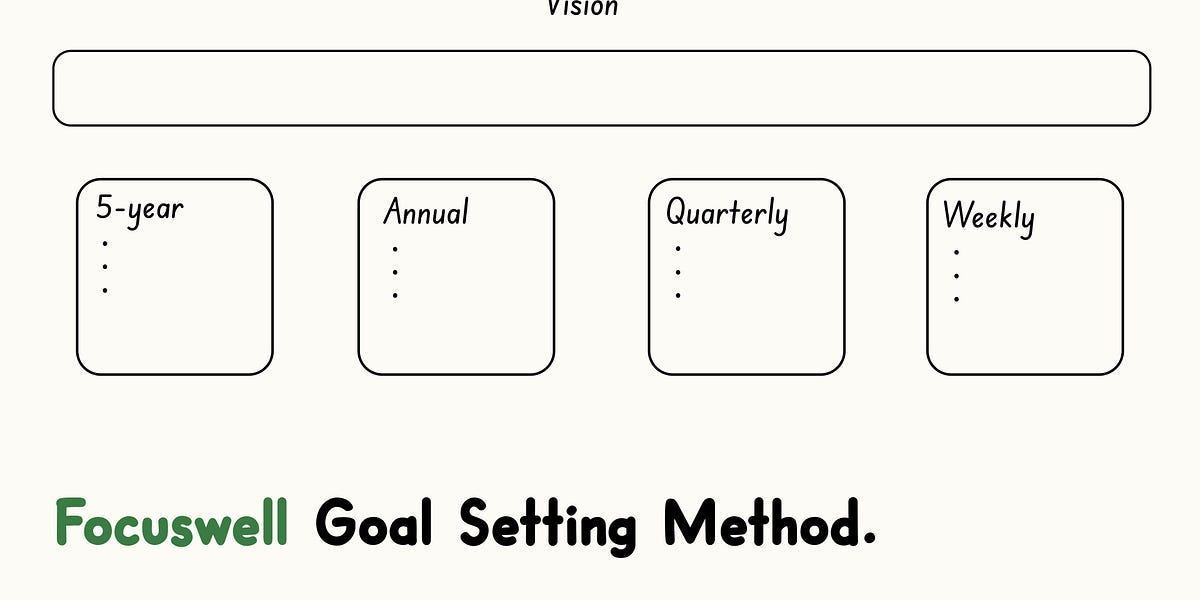
Below is what I propose and my reasoning.

Vision
A vision is the foundation upon which every other goal rests on. It provides critical meaning and direction. It is not a destination but a lifelong theme that reflects core values and purpose. Brining it to mind should make one emotional.
5-Years
5-years is a practical horizon to make something tangible out of the vision. It is sufficient time to do substantial things like change careers, build a business, or master a new skill.
Annual
A year provides more immediate structure and urgency. It is sufficiently long enough to make something worthwhile, but short enough to maintain focus. The annual cycle is also deeply cultural and we associate it with renewel and intention setting.
Quarterly
Quarters nicely slices yearly goals into four pieces, bringing it more into the present. Ninety days is long enough to ensure sustained focus towards a goal but also flexibility and adaptly when things don’t go as planned. It strikes the right balance between planning and doing, between reflection and action.
Weekly
Weekly goals give immediate focus for quarterly goals, making it apparent what the immediate steps are. It keeps execution consistent, ensuring steady progress without constant re-evaluation. Weekly goals provide the right balance of anchoring and flexibility for daily tasks.
And that’s it! I will call it the Focuswell Goal Setting Method (to make it easier to re-reference). I admit there is a level of arbitrariness to it all. For example, it can certainly be 4 years instead of 5. But I think it’s important to realize that the real problem to solve is to not to find the objectively correct answer, but something reasonable to build structure around -a system to reliably do day-in and day-out. The execution is far more important than the idea!
Speaking of arbitraries, three is a lucky and whole number, and it feels like the right number for how many objectives to list for each of these goal types (e.g. 3 weekly objectives).
I think this framework strikes the right balance between planning and execution. But the only way for me to figure that out for sure is to test it in real-life!
Challenge 2: Making It Fool-Proof
So I think in theory, my framework makes sense… but I’m not interested in theory, I’m interested in practice! What could go wrong?
The most glaring problem is consistency. What to do if someone forgets to set goals a particular week? How do you keep the person from becoming discouraged and abanadoning the whole thing? How to continue forward when things are NOT accomplished, so that the whole system doesn’t collapse?
It is helpful to start with the assumption that people will not be consistent. This is very different from the general approach that assumes people must possess discipline in order to build discipline. A real Catch-22 if you will (but many “gurus” are rich precisely because they sell these bullocks).
A person who is not consistent needs someone to hold them accountable. We naturally see this work well in the school and workplace — others pull us forward. But assigning everyone who uses Focuswell a coach to make sure they don’t fall behind is unrealistic. So what’s the second best thing?
That’s right! (I assume you got it) It is AI.
Here is how I imagine AI picking up the slack and increasing the likelihood of success. The algorithm goes as follow:
- Vision: The vision statement has to be initially written by the user but remains the same after. It can then be refined or re-written, but it does not require updating at a regular cadence.
- 5-Year: The user can write this, or it can be generated by the AI based on the vision. Then the user may make any edits they want.
- Annual: The user can writes this, or it can be generated by the AI based on the vision and the 5-year goals. Then the user can make any edits they want.
- Quarterly: The user can writes this, or it can be generated by the AI based on the vision, the 5-year and the annual goals. Then the user can make any edits.
- Weekly: The user can writes this, or it can be generated by the AI based on the vision, the 5-year, the annual and the quarterly goals. Then the user can make any edits.
The whole idea behind this is that we know it is a lot easier to proof-read a draft than it is to write the draft. It might be hard for someone to write three weekly goals every week, but it’s a lot easier for them to edit three goals pre-determined based on their previous inputs and data.
This is what it looks like in practice:

This method also examplifies that idea that execution is the easy part. Figuring out the what is the difficult part, but with a little bit more assistance, we are not totally left on our own.
Putting It Together
Now my task list is tied to an overarching goal-setting framework, optimizing my productivity like I imagined it to.
Moreover, at the end of the day, I generate an AI-powered summary of my work completed, and it ties it back to my goals, highlighting whether I’m being productive or just busy.

My new goal-setting framework and the related features I implemented into my app give me the perfect balance of focus and flexibility now; planning and execution. But I guess the real test of whether it really works is whether I accomplish the goals I set out for myself. Let’s see!
메타데이터
- post_id
- 239b0ec0a043
- slug
- a-modern-framework-for-setting-goals-achieving-them-239b0ec0a043
- url
- https://medium.com/@techandsundry/a-modern-framework-for-setting-goals-achieving-them-239b0ec0a043
- canonical_url
- https://medium.com/@techandsundry/a-modern-framework-for-setting-goals-achieving-them-239b0ec0a043
- author_url
- https://medium.com/@techandsundry
- status
- ok
- fetched_at
- 2026-08-20 04:41:35