Invincible Season 4 Review: The War Arrives, and Almost Everything Works
Let’s get the caveat out of the way first: Invincible Season 4 is very, very good. That’s not the same as perfect, and the show’s die-hard…
Invincible Season 4 Review: The War Arrives, and Almost Everything Works
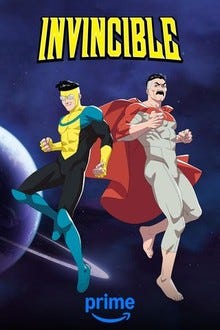
Let’s get the caveat out of the way first: Invincible Season 4 is very, very good. That’s not the same as perfect, and the show’s die-hard fans — eager to crown it the uncontested king of adult superhero animation — deserve honesty about where it stumbles alongside celebration of where it soars. Because it does soar. It just doesn’t always do it gracefully.
The season enters carrying the weight of years of promise. Since Season 1’s gut-punch finale, the Viltrumite War has loomed over everything — the existential threat that the show has circled, teased, and meticulously laid the groundwork for. Widely regarded as the pinnacle of the Invincible comics, this war threatens a calamitous invasion of Earth, demanding a season capable of matching that pedigree. The pressure to deliver was immense. For the most part, Kirkman and showrunner Simon Racioppa meet it.
Mark Grayson’s main arc this season is about the psychological weight of being a hero — making choices that range from bad to worse and living with the consequences. Steven Yeun does brilliant work conveying that weight through his voice alone. Mark sounds older, more tired, defeated even when he’s winning. He’s no longer an idealistic teenager; he’s someone who understands that every decision carries unintended consequences. That maturation in the character writing is the season’s greatest strength, and it’s precisely what elevates Invincible above most of its peers — superhero stories that confuse power escalation with character growth.
The season’s other MVP is its villain. Lee Pace’s Thragg is emotionally subdued and simply terrifying — a Hannibal Lecter-like stoicism that offers a villain worthy of years of buildup. His tyrannical aura and voice blend into a deadly concoction that adds damning gravitas to the very concept of a Viltrumite victory. For anyone who doubted the hype, Thragg arrives in the final two episodes and delivers comprehensively — rocking Omni-Man’s world, ripping Great Thaedus’ head off his shoulders, and standing still to absorb a full punch from Invincible in one of the most menacing impact frames the show has ever produced.
The Viltrumite War sequences are staggering in scope — intergalactic in scale yet startlingly intimate in execution, with every fight carrying genuine consequences. The animation in these battles showcases speed brilliantly — skipping frames and holding on certain shots to convey power before impact in a way that, short of watching anime, is difficult to find in western animation. Sandra Oh, as Debbie, is nothing short of a gift — her confrontation with Nolan over his piss-poor apology stands as one of the most emotionally satisfying moments the series has delivered, improving significantly on how the comics handled the same material.
Now. The problems.
The episodes not focused on the Viltrumite War feel inconsequential in comparison. Season 1 had the ability to make secondary plotlines feel integral to the overall narrative, but this season’s side plots are a different matter — leaving the pacing sluggish in the wrong places, creating the feeling of waiting through scenes to get back to the characters who actually matter. It’s a structural issue that the show has never fully resolved, and Season 4 is the most glaring example yet.
Then there’s the animation — that long-running, uncomfortable conversation the fandom perpetually avoids having at full volume. By far the most common criticism of Invincible is that its animation is subpar, and it’s a valid one. As the show’s action becomes increasingly earth-shattering in narrative terms, it’s becoming distractingly difficult to watch battles loaded with momentum lose steam to obvious animation shortcuts. A now-viral moment during the Viltrumite War — a character disappearing mid-flight, not behind debris but simply erased from frame — encapsulates the broader issue. Some scenes show shifts in character models during fast action, repeated motion cycles in fights, and space battles that suffer from inconsistent lighting that makes characters look pasted in rather than inhabiting the world. The show’s budget is reportedly $10 million per episode — a significant portion of which clearly goes toward the celebrity voice cast rather than the animation pipeline itself. The result is a show that sounds like a prestige production and occasionally looks like one too, except when it doesn’t.
Critics at Polygon and Inverse have noted a sense that Kirkman and Racioppa may be rushing through what should be the show’s most important storyline, with the season’s dithering focus preventing it from reaching the greatness it clearly has within reach. That’s the nagging feeling that lingers after the finale — not disappointment exactly, but the awareness that a slightly more disciplined, slightly better-animated version of this same season would be an all-time achievement in superhero storytelling rather than a very good one.
The finale, meanwhile, opts for an epilogue-style close with minimal action — Invincible dealing with PTSD from his battle with Thragg, seeing visions of his loved ones being killed in sudden panic attacks. It’s a quietly devastating choice that trusts the audience to feel the weight of the war without needing one more explosion to punctuate it. For a show sometimes accused of pacing issues, this finale has remarkable restraint — and it works.
9.5 / 10
The Comparison Neither Show Deserves to Be Part Of
It’s worth pausing — now that both of Prime Video’s flagship superhero properties have concluded or completed their latest arcs — to observe just how wide the gap between them has become.
The Boys and Invincible started their runs as companions in the same genre-deconstruction space, though operating from different emotional philosophies. The Boys came in angrier, louder, more politically immediate. Invincible came in quieter but no less brutal, with a genuine belief in heroism even as it interrogated it. The contrast in 2026 is stark.
Where The Boys embraces cynicism as its operating mode, Invincible maintains the belief that its characters’ choices — and the weight they carry — actually matter. That distinction, seemingly philosophical, has enormous practical consequences for how the writing functions. The Boys Season 5’s characters can repeat mistakes without consequence, reverse arcs without earning it, and deploy shock content without thesis — because in a cynical world, nothing needs to be earned. Invincible Season 4, even with its flaws in pacing and animation, operates on the belief that consequence is everything. Mark is tired because the show remembers everything that happened to him. Nolan faces real friction for his crimes because the writers understand that accountability requires time, not just a touching scene.
One show arrived at its ending having largely forgotten what made it great. The other, still mid-run, is in the uncomfortable but exciting process of becoming greater than it’s ever been. That’s the difference between a show that trusted its cynicism to coast, and one that trusts its characters to carry the weight.
메타데이터
- post_id
- 239ddb2cc7f7
- slug
- invincible-season-4-review-the-war-arrives-and-almost-everything-works-239ddb2cc7f7
- url
- https://medium.com/@arham6054/invincible-season-4-review-the-war-arrives-and-almost-everything-works-239ddb2cc7f7
- canonical_url
- https://medium.com/@arham6054/invincible-season-4-review-the-war-arrives-and-almost-everything-works-239ddb2cc7f7
- author_url
- https://medium.com/@arham6054
- status
- ok
- fetched_at
- 2026-06-24 04:09:36