Stop Assuming Your AI Stack Is Safe Because You Didn’t Get Hacked — Here’s Why 2,500 Companies Are…
A breach from March only hit the public eye in August. In the meantime, over 2,500 companies had no clue their AI infrastructure…
Stop Assuming Your AI Stack Is Safe Because You Didn’t Get Hacked — Here’s Why 2,500 Companies Are Only Finding Out Now (And What to Do Instead)
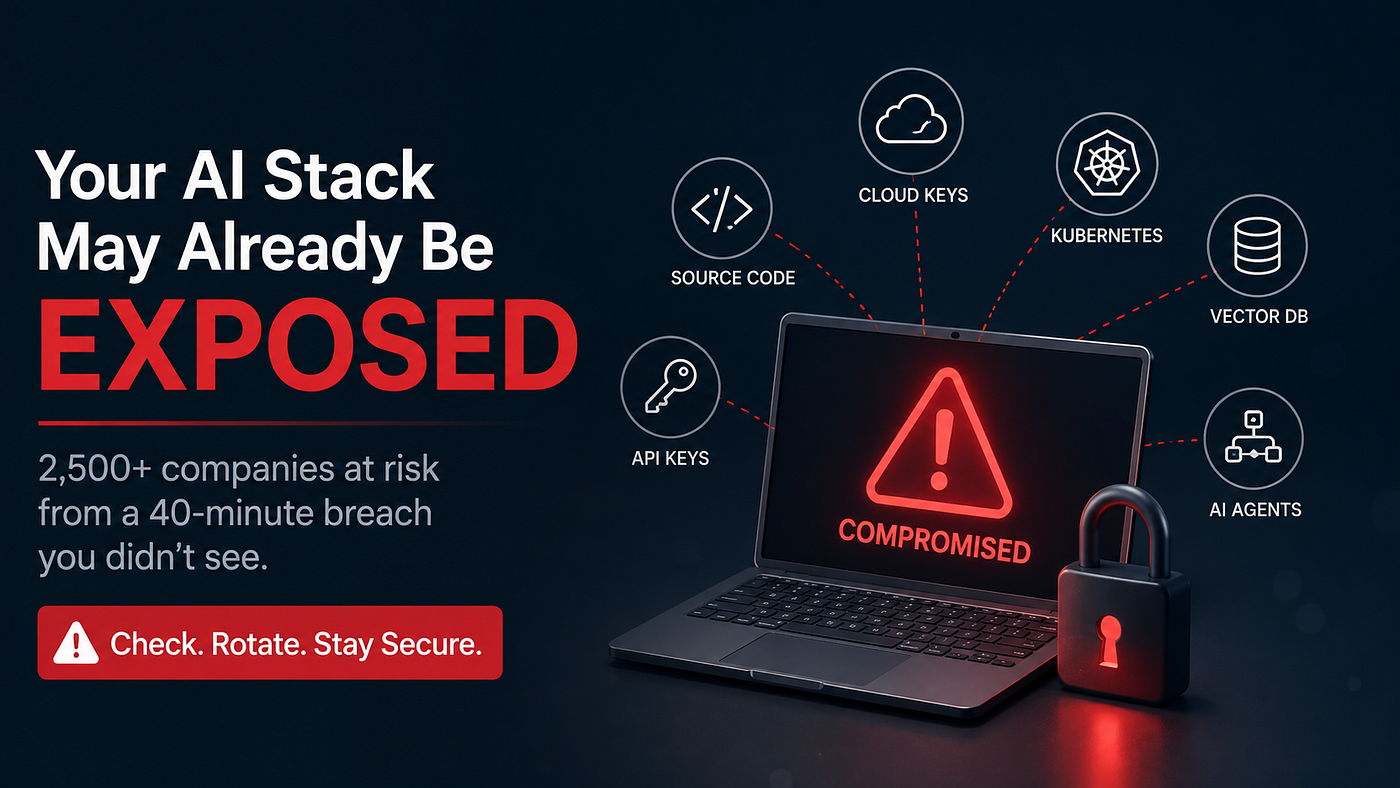
Image generated with ChatGPT. One poisoned AI dependency can expose thousands of systems — here’s what developers need to check now.
A breach from March only hit the public eye in August. In the meantime, over 2,500 companies had no clue their AI infrastructure credentials were already out there.
If your company uses LiteLLM anywhere, even as a hidden dependency, you need to give this five minutes of your time today. Not next quarter.
What actually happened
Security firm CloudSEK just disclosed what they’re calling the biggest AI supply-chain breach of 2026 so far. A group known as Team PCP hit LiteLLM back in March 2026. It’s a popular open-source framework used to route calls across different AI models.
The attackers used a chain of trusted tools to get inside. Specifically, they hit Trivy and Checkmarx KICS, two scanners used in LiteLLM’s own build pipeline. Two bad versions of the LiteLLM package, 1.82.7 and 1.82.8, sat on PyPI for about 40 minutes before someone pulled them.
Forty minutes seems fast. But it was plenty. CloudSEK’s data shows over 2,500 organizations and roughly 434,000 CI/CD pipelines — the automated systems that build and deploy code — were likely touched.
Why this is bigger than a normal breach
One poisoned package, live for under an hour five months ago, is still claiming victims today.
That’s just how supply-chain attacks work. Most affected companies didn’t even install the bad package on purpose. They used LiteLLM as a dependency, buried several layers deep in their software, which is exactly why nobody noticed for so long.
CloudSEK’s list of high-confidence matches includes giants like Nvidia, Amazon Web Services, Cisco Systems, Salesforce, Siemens, Samsung, and X. It also covers dozens of firms in finance, defense, and manufacturing. Being on the list isn’t proof you were hacked. CloudSEK is clear that a match means you’re at risk, not necessarily compromised. Still, these companies have a lot of work to do to make sure no damage was done.
The part that makes this a live threat, not a closed case
The FBI put out a FLASH advisory in July 2026. They warned that the people behind this are likely to use stolen credentials long after the first hit. This is the detail that turns a past event into a current crisis.
Credentials stolen during that 40-minute window don’t just expire. Unless a company manually rotates them, they stay usable forever. It doesn’t matter how much time has passed.
What CloudSEK found exposed
The leaked data includes cloud credentials, source-code repos, Kubernetes configs, and model API endpoints. It also hit vector databases, GPU access, and agentic workflow setups.
This matters. It’s not just a few leaked passwords. It’s the glue holding a modern AI deployment together. This is the exact layer where one bad key can give a stranger quiet access to the models and data a company runs in production.
What to actually check this week
If you use LiteLLM anywhere, check if your build systems pulled versions 1.82.7 or 1.82.8 back in March 2026. Rotate any credentials that touched those pipelines. Do it even if you don’t see one specific piece of evidence that you were hit.
CloudSEK has a searchable list of flagged organizations. Checking if your company is on it is a good start, but it’s no substitute for auditing your own logs. If you’re on the list, or if you just can’t prove you aren’t, prioritize rotating your API keys and any secrets that lived in those CI/CD pipelines.
Honest limitations
CloudSEK is a private firm. Their “high-confidence match” method is detailed in their report, but no separate research team has replicated it yet. Being named is a signal to investigate, not a final verdict.
No named companies have confirmed a successful breach yet. There’s a big difference between “credentials might have been exposed” and “an attacker actually used them.” Mixing the two overstates what we actually know.
This only covers the LiteLLM incident. It doesn’t fix every AI supply-chain risk you have. A clean bill of health here doesn’t mean your entire dependency chain is safe.
The question worth asking
If a key stolen in 40 minutes back in March is still dangerous in August, how many other “closed” security issues in your stack are actually still wide open?
메타데이터
- post_id
- 23be7e7c1d9f
- slug
- stop-assuming-your-ai-stack-is-safe-because-you-didnt-get-hacked-here-s-why-2-500-companies-are-23be7e7c1d9f
- url
- https://medium.com/ai-tomorrow/stop-assuming-your-ai-stack-is-safe-because-you-didnt-get-hacked-here-s-why-2-500-companies-are-23be7e7c1d9f
- canonical_url
- https://medium.com/ai-tomorrow/stop-assuming-your-ai-stack-is-safe-because-you-didnt-get-hacked-here-s-why-2-500-companies-are-23be7e7c1d9f
- author_url
- https://medium.com/@milandanushka
- status
- ok
- fetched_at
- 2026-08-16 09:37:49