History Matters — Heresy and Criticism by Robert M. Grant
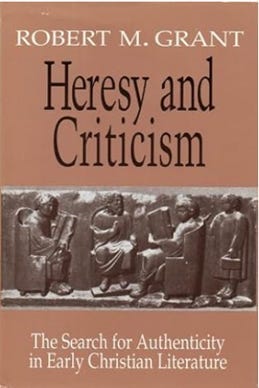
Heresy and Criticism: The Search for Authenticity in Early Christian Literature by Robert M. Grant
History Matters — Heresy and Criticism by Robert M. Grant
Heresy and Criticism: The Search for Authenticity in Early Christian Literature by Robert M. Grant
There is a popular myth that appeals to modern people. The myth is that up until quite recently, Christians were naïve, trusting, and unconcerned about the provenance of their religious doctrines. This myth fuels the regular announcement that the gospels were “anonymous” and that various letters of Paul were “forged.” These claims are announced as facts and are presented as the latest discovery from the world of scholarship.
Modern people like recent discoveries. We love thinking that we know things that no one else knows. The excitement of recent discoveries attracts viewers to videos like this one:

C.J. Cornthwaite describes himself in this way:

Clearly, Cornthwaite is a fundamentally confused person. He self-describes as a former Evangelical who is now an agnostic, but considers himself a Christian because his feelings and desire to remain in the Christian community trump the evidence that he rejects the core Christian claim that Jesus rose from the dead.
He lost his faith in the typical way, i.e., by exposure to 19th-century German Liberal Theology (which he confuses with “scholarship”). He doesn’t seem to be aware that he has replaced his Christian beliefs with a belief system invented by German universities in the 19th century.
He lost his faith in the usual way. He was let in on the secret that his sacred sola scriptura had not descended from Heaven as a pristine product of pure divine inspiration but had been subjected to the Sturm and Drang of historical circumstances. Because he lacked a theology of the church, he was unable to recognize the church as an agent of history, leaving his faith without an anchor.
Now he shares the things he learned in school with everyone who will listen. In this video, Cornthwaite explains that the Pastoral letters (1 and 2 Timothy and Titus) are not reflected in any writing until the second century. The implication is that they are not Pauline, that they were forged, and, therefore, that Christianity is based on a lie.
Cornthwaite presents this as cutting-edge information, fresh from his Ph.D. program, that is being withheld from the people in the pulpits, except on his YouTube channel (and a few like it).
The problem is that it isn’t cutting-edge at all. The myth is false. Christians have been interested in the authenticity of Christian texts from the very beginning. This isn’t surprising, since the educated class in the ancient world knew that forgeries were common and sought to distinguish authentic material from false. Christians inherited the techniques used to sort out forgeries from the authentic writings of Homer and Hippocrates and turned them against the forgeries of heretics to determine what counted as authentic Christian writings.
- Executive Summary
Robert McQueen Grant (November 25, 1917 — June 10, 2014) has been described as “one of the most influential historians of early Christianity in the 20th century.” Grant taught from 1944 to 1988, including at the University of Chicago Divinity School. He wrote over thirty books and many articles. He was remembered by colleagues as combining a range of interests, clarity of prose, and precision in historical facts.
The characteristics of range and clarity are demonstrated in this book. Grant takes the reader through the first centuries of Christian history, from Homer to Marcion to Galen to Origin. Grant’s thesis is that the ancient world knew that there were many forgeries pretending to be the writings of great poets and philosophers. The educated class developed techniques to sort out the forgeries. Upon the advent of Christianity, heretics initially used these techniques to attack Christian writers. After suffering this attack, Christians began using the same technique to prove that the heretical texts were forgeries and that Christian texts weren’t.
This is a fascinating book. I’ve read it twice, and the overturning of the conventional trope that early Christians were naïve stuck with me. Grant’s prose is clear, and his knowledge is encyclopedic. His casual observations are memorable. The topic and writing are scholarly, but these days, when Bart Ehrman’s “Forgery” is a best seller, there should be an interest in the other side.
- Authenticity and Heresy in Early Christianity
Grant begins by observing that the Christian tradition began with the Gospel, i.e., the reports of Jesus’ words and deeds. This made the struggle over the contents of such reports ground zero for Christianity. After Christians began putting these reports in writing, heretics began producing their own writings to support their preferred understanding of the Gospel. These writings were often attributed to the early leaders of the Christian movement.
The authenticity of the texts ascribed to Christian figures became “a matter of practical concern before the first century was over.” (p. 4) Canonical Christian texts repeatedly warn against forgeries.
Literary heresies particularly flourished in Rome in the second century. Rome was the home to Gnostics, like Valentinus, and other heretics, such as Marcion. These heretics were adept at altering Christian texts to suit their mythologies. They also forged completely new texts to the same end. Gnostics “employed current methods of literary criticism in their venture” (p. 7). “They raised questions about the text, the authorship, and the meaning of biblical books because they wanted to get rid of unattractive doctrines.”[1]
The questions raised by the heretics forced the Catholic Church to compile lists of accepted books and to share the traditions associated with them.[2] Grant discusses Papias of Hierapolis in Phrygia, who, in the late first century or early in the second century, wrote a “widely read” book entitled Exegesis of the Dominical Oracles that described his memories about the traditions on the writing of the gospels. Papias explained that the Gospel of Mark had been written by a disciple of Peter,[3] while Matthew had been written in Hebrew before Mark.[4]
Papias’ description of Mark was corroborated by Justin Martyr in the mid-second century. Also in the second century, Dionysius of Corinth, around 160 A.D., condemned interpolations of his own letters during his lifetime.
- Literary Criticism in Early Christian Times
In his second chapter, Grant discusses the practice of literary criticism in antiquity. Literary criticism was a weaponized art in an environment where forgery was common. By the first century, Homer’s Iliad and Odyssey were supplemented by dozens of other works ascribed to Homer. There were also debates about whether Hesiod or Homer came first, which books had been written by Pythagoras, which books of Aristotle were authentic, and which books of Hippocrates were written by Hippocrates.
In this environment, the ancients developed a “critical method” based on the “methods of refutation and confirmation taught in the schools of rhetoric.” (p. 30.) Refutation involved showing that a text was unconvincing, contradictory, unsuitable, impossible, or inconsistent. (p. 31.) In essence, this approach involved critically reading the text to determine whether it was fiction, accurate, anachronous, etc.
Grant ends the chapter with the question of whether there was a pagan canon. His answer is negative. Pagans did not compile lists of authentic texts the way Christians did. The Christian canon was formal and authoritative. Grant closes by making a key observation:
The question of authenticity (“apostolicity”) was involved, but the primary basis for acceptance or rejection was conformity with Christian doctrine, not authenticity.
In other words, texts were accepted as canonical because they fit the tradition. This is something that modern critics do not understand because (a) they don’t think there is a tradition (insofar as they reject the tradition) and (b) their formative position was sola scriptura as if the scriptures preceded the tradition.
- Marcion’s Criticism of Gospel and Apostle
In Grant’s narrative, the second-century Roman heretic, Marcion of Sinope, plays a seminal role. Grant follows Harnack’s analysis of Marcion’s theology. Grant indicates that Marcion came from a long-established church–the church in Pontus had been addressed by 1 Peter — and that Marcion was presumably “led to separate the gospel from the Jewish Bible” because of the “violent struggle between Roman troops and Jewish nationalists” in 132 AD. (p. 34.)
Grant’s presentation of Marcion’s theology accepts the premise that Marcion altered Luke’s gospel, although he argues that Marcion would not have known Luke as “Luke”; he would have known it as “To Theophilus I and II, although Marcion had no use for Acts. (p. 34.) Marcion’s writing was influenced by contemporary Roman scholarship by which scholars were “zealously deconstructing the philosophies that supposedly underlay Greek poetry” to demythologize the poems and show that all gods were originally human. (p. 34–35.)[5]
Grant does a far better job of showing, from Tertullian, the way Marcion interpolated Luke than David Litwa did. Nonetheless, after demonstrating the reconstruction, Grant notes that there was a “remarkable variety” within Marcionite texts which resulted in a “high level of uncertainty about what Marcion wrote.” (p. 62.)
Grant discusses whether Marcion had a version of “proto-Luke.” He was skeptical:
But whereas one can imagine how he moved from his own Paul to his own Gospel, it is much harder to see how could have gone from primitive Luke as his source to his ideal Paul. There is hardly anything in this Gospel that could start his theological quest, unless the words “Christ Jesus a saving spirit” really comes from the beginning of the book and are not a theological interpretation of 1 Corinthian 115:45. (P. 44.)[6]
Concerning the issue of whether Marcion interpolated Luke, Grant concludes:
It has become conventional for modern scholars to reject the unanimous consensus of early patristic writers that Marcion edited the Gospel of Luke. One wonders how such certainty could have arisen. Both the Fathers and Marcion himself lived in the world of Greco-Roman literary scholarship, and there is nothing irrational about either the editorial process or the patristic claim.” (p. 46.)
Grant wrote this book in 1993. There have been no advances in either the available documents or the “science” of literary criticism that justify this change in scholarly opinion. The only thing that has changed is the culture, which has cultivated a taste for deconstructing anything orthodox.
- The Hidden Agenda of Ptolemaeus
Ptolemaeus was the disciple of the second-century Gnostic Valentinus. Valentinus wrote “The Letter to Flora,” which is a specimen of Gnostic theology. Grant suggests that “sister Flora” may have been the whole Roman church, rather than a person.
Gnostics operated at the extreme edge of allegorization rather than the critical method. Gnostics would give orthodox texts meanings unrelated to their literal meaning.[7]
Apart from how they presented their theologies, Gnostics and Marcionites inhabited much of the same doctrinal space. Ptolemaeus proposed that the Jewish law came from the Jewish Creator God, aka the Demiurge. Both Gnostics and Marcion argued that references to the Mosaic law had been interpolated into Paul’s letters and the gospels. (p. 51.)
Grant concludes this chapter by observing that by the middle of the first century, “literary criticism among Christians had reached a stalemate.” (p. 58.) Marcion had failed to convince Catholic leaders that he could prove that Jewish elements had been added to Christian texts, and the Gnostics’ “exegesis was correlated with his ingenious theology.” (Id.) What they did was to force Christians to pay attention to the smallest details of their texts.
- Galen’s Literary and Logical Criticism
Galen is famous as an ancient medical doctor, but he was also a literary critic. The two were related, since Galen’s avocation was to separate the many spurious books ascribed to Hippocrates from his genuine works. Galen was active in the second half of the second century, which made him roughly contemporaneous with Irenaeus. Galen “moved in high society” but knew Christians. Galen served Emperor Marcus Aurelius, who was protecting Christians of senatorial rank.
That deserves a moment of reflection — In about one hundred years, the obscure Jewish sect had penetrated the top levels of Roman society.
Grant writes that Galen and his critical method “exercised strong influence on the Jewish Christian heretics who were concerned with logic, biblical criticism, and theology.” (p. 60.) These heretics were Adoptionists (i.e., Christians who believed that Jesus was only a human being until he was “adopted” by the JCG as his “son.”)
Galen influenced Adoptionist heretics with his use of logical proofs. The logical proofs involved phrasing claims as “conditional propositions (i.e., if, then) or disjunctions (either/or). (p. 67.) Adoptionists would use these logical techniques to criticize the orthodox position. They would then correct manuscripts that contained the illogical claims. Then, like Marcion, they would claim that their corrected texts reflected the original text that had been corrupted by the Catholics.[8]
- The Syllogistic Exegesis of Appelles
Appelles was a disciple of Marcion. In the last half of the second century, Appelles departed from Rome and Marcionism, although he kept many of Marcion’s doctrines.
Appelles’ approach was to take Galen’s logical criticism and apply it to Christian scriptures in his “Syllogisms.”[9] Among other things, Appelles showed that Moses was inconsistent and self-contradictory, which is a form of “refutation.” (p. 79.) Origen responded to Appelles in the third century, which suggests that Appelles’ arguments were still bothering Christians for decades after he died.
Appelles’ arguments provoked sustained debates on a variety of quotidian biblical controversies, such as the size of Noah’s Ark. This brought discussions about the Trojan Horse into play. Clement of Alexandria opined that the Trojan Horse was a metaphor: “mankind embraces in one body an army of different spirits.” (p. 86.)
We don’t often think of Christian bishops debating Homer, but why wouldn’t they? They were part of Roman culture, and this was the coin of public discourse.
- The Orthodox Counterattack
According to Grant, from the second century onward, canon, authorship, and exegesis were topics of discussion for heretics and orthodox alike. By 181 A.D., Christians, such as Theophilus, bishop of Antioch, were using their opponents’ critical weapons. Various techniques were used to defend orthodox doctrines. These techniques included allegorization of problematic passages and demonstrating that Christian texts were consistent with Christian doctrine.
The “Orthodox Counterattack” included figures like Irenaeus, Origen, and Jerome. These figures were prompted by Marcion and the Gnostics to engage in an intensive study of scripture. (p. 93.)
Ultimately, heretical doctrines were far more exposed to refutation. Heretical doctrines could be shown to be inconsistent and illogical. They could also be shown to be later than orthodox texts.[10]
- Conclusion
By the fourth century, the tools of literary criticism were being used by Christian bishops. Grant observes:
Christians were no longer willing to accept documents uncritically just because they were said to be ancient or even orthodox. Indeed, such a period of simple acceptance, if it really existed did not last long.
I haven’t answered Cornthwaite’s concerns about the authenticity of the Pastoral letters except on a meta level. The answer is that orthodox Christians have been listening to and responding to literary criticism of their texts from the beginning. The Pastoral Letters were part of this process. Cornthwaite may know the arguments against the Pauline provenance of those letters, but I doubt that he knows the Christian response. Based on history, I am sure that there is such a response. Until that response is known, conclusive judgment is not possible.
I admit that the Christian response may not prove persuasive for anyone trained in 19th-century German liberal textual criticism, which starts with the presumption against the supernatural. As a matter of history, we might find the Christian arguments to be weak. However, the Christian argument involves a supernatural dimension. As a Catholic, I believe that the supernatural dimension involves the Body of Christ and the Holy Spirit. Perhaps the Pastoral letters are not authentically Pauline. If so, so what? If the Holy Spirit communicates that Pastoral letters are inspired, then that is determinative.
Whether that is the case is not something that a college degree can qualify someone as an expert.
Footnotes:
[1] This objective seems not to have changed. 21st-century critics are also motivated by a desire to change doctrines. See, for example, David Litwa’s Marcion.
[2] This seems to be a recurrent theme in Christian history, namely, heretics would challenge something that had become accepted sotto voce as a tradition. Only after the challenge would the Catholic Church be roused to make an explicit definition of something that had previously been implicit.
[3] Grant suggests that perhaps Papias’s source knew 1 Peter 5:13 (“13 She who is in Babylon, chosen together with you, sends you her greetings, and so does my son Mark”), which, if true, would authenticate 1 Peter as an early source. Also, I wonder why more hasn’t been made of the statement that Mark is Peter’s “son.”
[4] The accuracy of Papias’s recollections is questioned. Matthew contains Mark, which implies that Mark came first, and there are reasons to believe that Matthew was written in Greek. Nonetheless, Papias is an early witness to the existence of gospels bearing the names of Mark and Matthew
[5] This sounds modern, but it shows how long this approach has been around. Augustine’s City of God interacts with Varro, who had the same idea.
[6] Litwa’s reconstruction of Marcion’s Gospel corroborates this insight. Litwa’s reconstruction ends up with a Marcionite church that looks like one that a Woke Christian might belong to. It is hard to see from Marcion’s anodyne and essentially watered-down Gospel how anyone would jump to a hidden God behind God.
[7] For example, the thirty Aeon’s are to be found in the first thirty years of Jesus’s life and raising of the 12-year-old Tabitha by Jesus is really an account of the 12th Aeon.
[8] This approach is also used by Muslims and Mormons with respect to the Christian Bible.
[9] Eusebius gives an account of a Christian named Rhodo’s conversation with Appelles about Appelles’ inability to explain how his mystery God could be the one, uncreated God. Rhodo was a disciple of Tatian, who was a disciple of Justin Martyr. Grant points out that Tatian, the author of the Diatessaron (the compilation f a single gospel from the four gospels) became a heretic.
[10] Tertullian bases one of his arguments against Marcion on the priority of the Gospel of Luke to that of Marcion’s unnamed Gospel.
메타데이터
- post_id
- 23bf077ae770
- slug
- history-matters-heresy-and-criticism-by-robert-m-grant-23bf077ae770
- url
- https://medium.com/@peterseanEsq/history-matters-heresy-and-criticism-by-robert-m-grant-23bf077ae770
- canonical_url
- https://medium.com/@peterseanEsq/history-matters-heresy-and-criticism-by-robert-m-grant-23bf077ae770
- author_url
- https://medium.com/@peterseanEsq
- status
- ok
- fetched_at
- 2026-07-10 04:31:59