Why Your Antidepressant Probably Wasn’t Chosen For You
By Aryamaan Balain, Age 14, Maple Ridge BC
Why Your Antidepressant Probably Wasn’t Chosen For You
By Aryamaan Balain, Age 14, Maple Ridge BC
Half of people prescribed antidepressants do not respond to their first medication. The average patient spends two years cycling through drugs that do not work, experiencing failed treatments, worsening symptoms, and serious side effects along the way. In the most severe cases, patients give up on treatment entirely.
Most people assume this is just how depression treatment works. It is not. The biological mechanism explaining why patients respond differently has been documented in peer reviewed literature for over 40 years. We already have the science to do better. We are just not using it.

The Problem Nobody Is Talking About
Depression is one of the most common medical conditions on earth. Over 300 million people worldwide live with it. In Canada alone, antidepressants are the third most prescribed drug class. And yet the process for choosing which antidepressant to prescribe looks almost identical to what it looked like 30 years ago.
A patient comes in. A doctor asks about their symptoms. A prescription gets written. The patient waits 4 to 6 weeks to see if it works. If it does not, they try another one. Then another. The average patient tries 3.5 different medications before finding something effective.
This is not a funding problem. It is not a research gap. It is a failure to use information that already exists.
The Gene Your Doctor Is Not Testing
Your liver contains an enzyme called CYP2D6. It metabolizes the majority of commonly prescribed antidepressants including most SSRIs and SNRIs. A second enzyme called CYP2C19 controls the metabolism of several other major antidepressants. Together these two enzymes account for the breakdown of over 60% of all psychiatric medications.
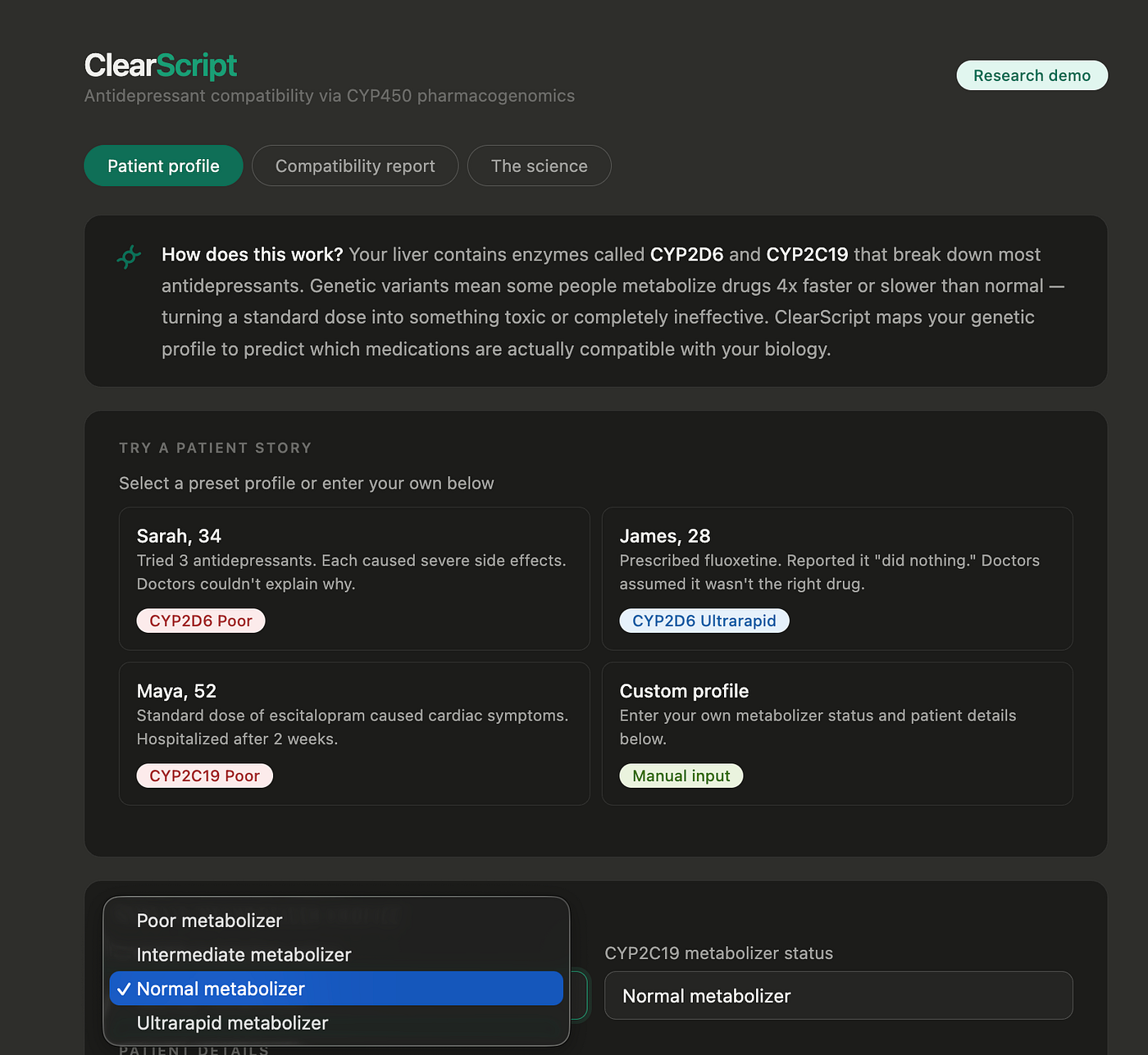
Genetic variants in these enzymes mean different people break down the same drug at completely different speeds. Every person on earth falls into one of four metabolizer categories based on their genetics.
Poor metabolizers barely process the drug at all. It accumulates in their bloodstream at four to five times the intended level, turning a standard dose into something toxic. They experience severe side effects from a dose their doctor considered completely routine.
Intermediate metabolizers have reduced enzyme function. Their drug clearance is slower than expected, their therapeutic window is narrow, and their side effect risk is elevated even at doses considered standard.
Normal metabolizers process the drug exactly as expected. Standard dosing produces standard outcomes. This is the profile that almost every prescription implicitly assumes every patient has.
Ultrarapid metabolizers do the opposite of poor metabolizers. Their enzyme is overactive due to gene duplication. The drug clears their system so fast it never reaches therapeutic levels. The medication appears to do nothing. To their doctor, they look identical to someone the drug simply does not work for. But the biological reason and the correct clinical response are completely opposite.
The Cruel Irony
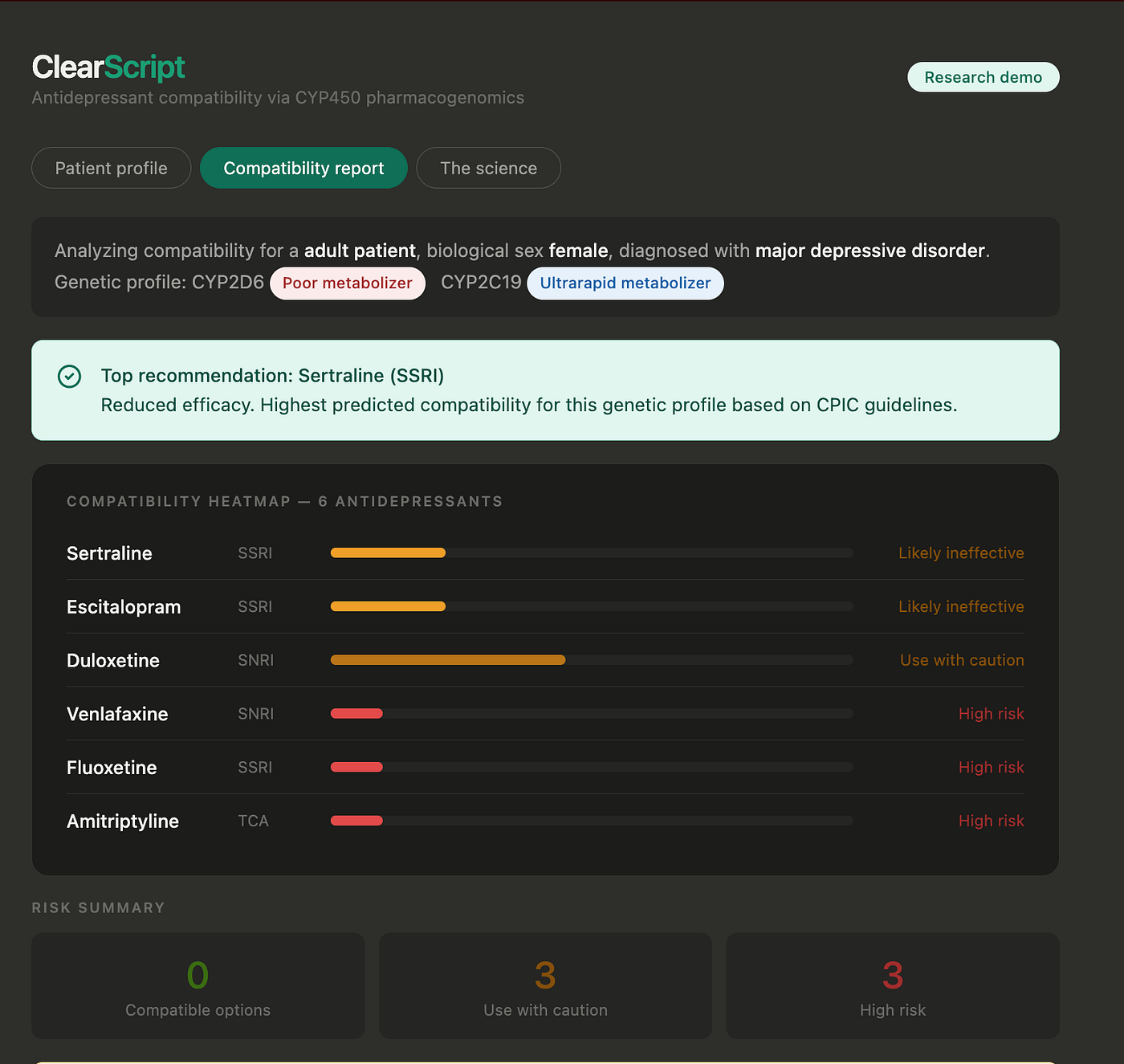
A poor metabolizer and an ultrarapid metabolizer tell their doctor the exact same thing. The medication is not working. But one of them has too much drug in their system and one of them has too little. Without genetic information, a physician cannot tell the difference.
One needs a lower dose or a completely different drug. The other needs a higher dose or a drug that uses a different metabolic pathway entirely. Prescribing the same solution to both of them is not just ineffective. It can be actively harmful.
This is happening to real patients every day. And the genetic test that would distinguish between them has existed for years.
Why Existing Solutions Are Not Enough
There are companies working in this space. GeneSight by Myriad Genetics is the most clinically validated pharmacogenomic test for psychiatric medication in North America. It has been used by over one million patients and covers the major genes involved in antidepressant metabolism.
But it costs up to $2000 without insurance coverage. It takes 5 to 7 business days to return results. The output is a dense PDF report designed for physicians, not patients. And it is almost entirely inaccessible outside the United States private healthcare system.
Genomind covers 24 genes relevant to psychiatric medication response. But it requires physician ordering, the results are difficult for patients to interpret, and there is no interactive experience or real time visualization of any kind.
The CPIC guidelines, published by the Clinical Pharmacogenomics Implementation Consortium, are the gold standard peer reviewed framework for translating genetic variants into drug dosing recommendations. They are free, rigorous, and updated regularly. But they are raw clinical text with no interface. They require a trained pharmacist or geneticist to interpret. They are completely inaccessible to patients and most general practitioners.
Every existing solution either locks the information behind cost and clinical gatekeeping, or publishes it in a format that only specialists can use. Nobody has built the bridge between the science and the patient.
What I Built
I am Aryamaan Balain, a 14 year old from Maple Ridge, BC. I built ClearScript because I believe the way we prescribe antidepressants today is one of the most quietly devastating failures in modern medicine, and because the data to fix it has existed for over two decades.
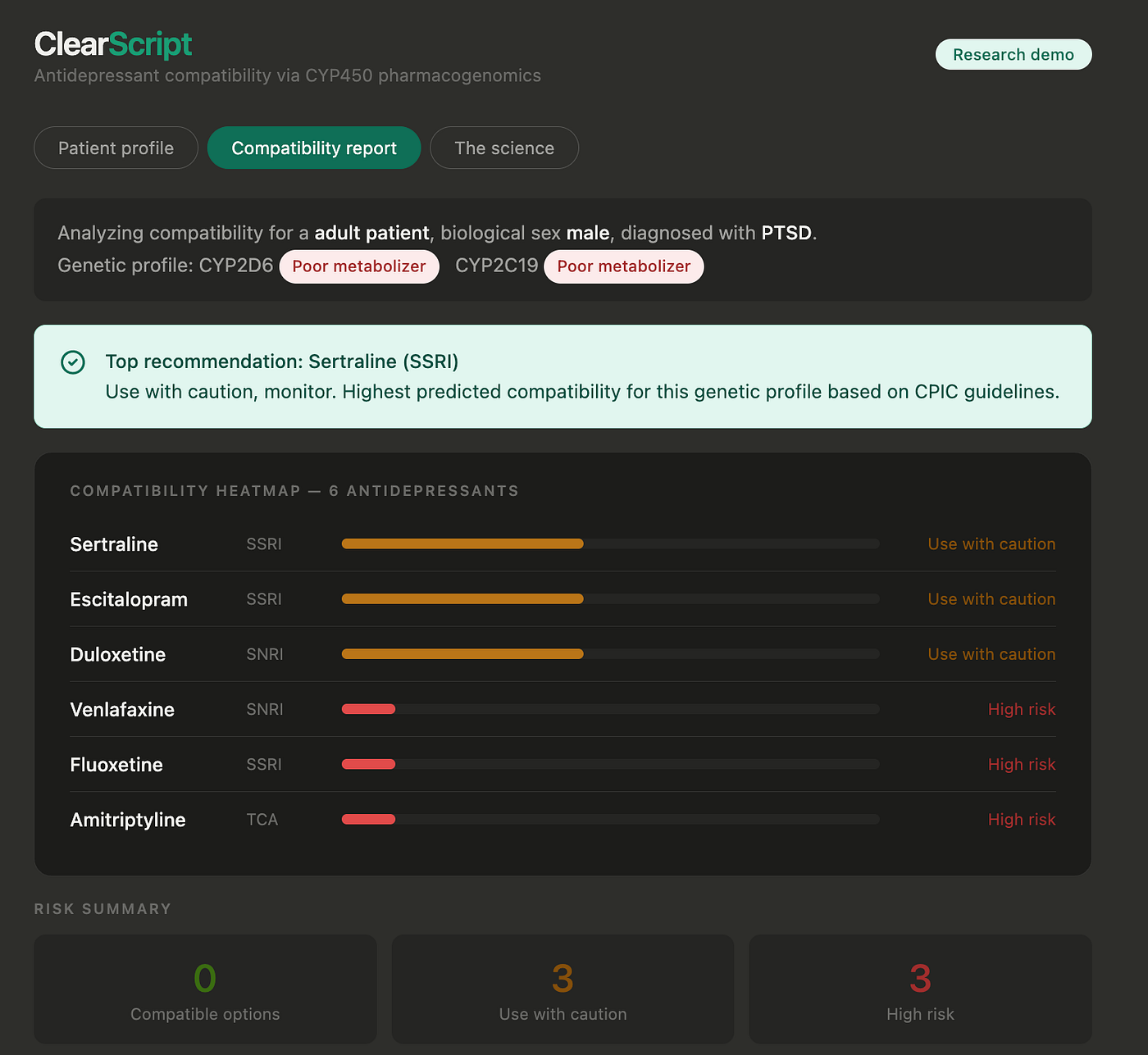
ClearScript is an interactive pharmacogenomics tool that takes a patient’s CYP2D6 and CYP2C19 metabolizer profile and generates a real time antidepressant compatibility analysis across six major medications including fluoxetine, sertraline, escitalopram, venlafaxine, duloxetine, and amitriptyline.
You input your metabolizer status. Within seconds, a heatmap populates showing all six antidepressants color coded from compatible to high risk based on your specific genetic profile. You receive a top medication recommendation with clinical rationale, a side effect risk score, and a plain language summary card that translates the clinical output into something a patient can actually understand.
The entire system is built on CPIC guidelines. This was a deliberate technical decision. The relationships between CYP450 genotype and antidepressant metabolism are not uncertain enough to require statistical machine learning. They are documented precisely in peer reviewed clinical consensus. Using a rule based classification system grounded in CPIC means every output is transparent, auditable, and scientifically defensible.
What This Feels Like in Practice
Imagine a patient who has been prescribed fluoxetine for three months. It has not worked. Their doctor is considering switching to a different medication.
They input their CYP2D6 metabolizer status into ClearScript. They are an ultrarapid metabolizer. The heatmap shows fluoxetine in the red zone. Not because fluoxetine is a bad drug, but because their liver clears it so fast it never builds up to therapeutic levels in their bloodstream. The tool shows sertraline, which uses a different metabolic pathway, sitting in the green zone.
That single piece of information changes the entire clinical picture. It does not replace the physician. It gives the physician and the patient the biological context they were never given before.
The Bigger Picture
ClearScript is not a medical device. It is not a diagnostic tool. It is a prototype of what precision psychiatry infrastructure could look like when pharmacogenomics is fully integrated into standard psychiatric care.
A world where a psychiatrist opens a dashboard before writing a prescription, inputs a patient’s genetic profile, and receives an evidence based compatibility analysis in real time is not science fiction. The science already exists. What has been missing is the interface.
My cousin went through a hard time in his life. Antidepressants helped him get through it. But the process of finding the right one was longer and harder than it needed to be. For every person who eventually finds what works, there are thousands who cycle through medications for years, or give up entirely.
That is the problem ClearScript was built to make visible. And it is a problem that, unlike most problems in medicine, we already have the tools to solve.

ClearScript is a research demo built on CPIC pharmacogenomic guidelines. It is not a medical device and should not be used to make real clinical decisions. Always consult a licensed physician before making any medication changes.
Aryamaan Balain is a 14 year old student from Maple Ridge, BC, Canada, and a member of The Knowledge Society.
메타데이터
- post_id
- 23cb23685baa
- slug
- why-your-antidepressant-probably-wasnt-chosen-for-you-23cb23685baa
- url
- https://medium.com/@aryamaan.balain/why-your-antidepressant-probably-wasnt-chosen-for-you-23cb23685baa
- canonical_url
- https://medium.com/@aryamaan.balain/why-your-antidepressant-probably-wasnt-chosen-for-you-23cb23685baa
- author_url
- https://medium.com/@aryamaan.balain
- status
- ok
- fetched_at
- 2026-06-13 16:23:23



