Social Media Has Turned War Into Content
How social media turned global conflict into a fight for attention, emotion, and narrative control
Social Media Has Turned War Into Content
How social media turned global conflict into a fight for attention, emotion, and narrative control
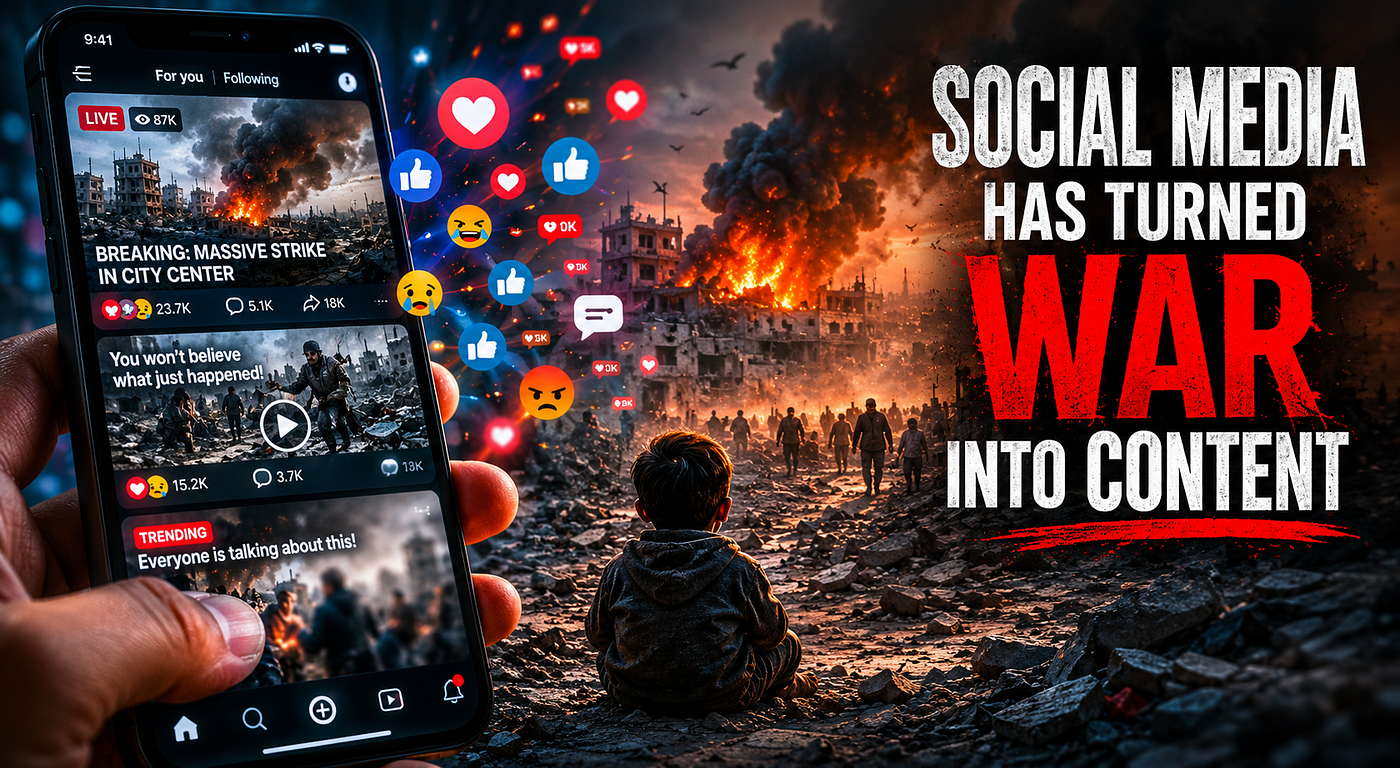
For years, we have been told that social media is simply a window into the world. It helps us stay informed, exposes injustice, and gives ordinary people a voice. That narrative has been repeated so often that many people now accept it without question.
But what if it is no longer true?
The more I watch global conflicts play out online, the more convinced I become that social media has moved beyond the role of observer. These platforms are no longer just documenting events as they happen; they are influencing how those events are perceived, discussed, and remembered.
That is an important difference. Observers report on events, participants shape them, and if we are honest about the role social media now plays during conflicts, it is becoming increasingly difficult to argue that these platforms are merely watching from the sidelines.
The Lie We Keep Telling Ourselves
Every major conflict now seems to follow the same pattern. A strike occurs, videos begin circulating online, and within hours millions of people around the world have already chosen a side. Social media feeds quickly fill with outrage, accusations, emotional appeals, amateur analysis, and competing versions of reality, each presented with absolute certainty.
What makes this remarkable is how little information is often available at the time these judgments are made. Many of the people weighing in have only a limited understanding of the history behind the conflict. Some are relying on unverified reports. Others are consuming information filtered through accounts that already reflect their preferred worldview.
Yet that rarely slows anyone down. Opinions are formed almost instantly, and they are rarely tentative. They arrive fully formed, leaving little room for complexity, context, or the possibility that the situation may be more complicated than a viral post can capture.
Then comes the part that deserves greater scrutiny: many participants begin to believe they are helping simply by taking part in the online battle. The act of posting, sharing, and arguing starts to feel like a meaningful contribution, even when it adds more heat than light to the conversation.
Outrage Has Become a Weapon
Wars have always been fought with weapons, but in the digital age they are increasingly fought with something else: outrage.
Governments know this, political actors know this, and activists know this. That is why so much effort is devoted not only to military strategy but also to shaping narratives online. Winning public sympathy can generate pressure, influence policy decisions, strengthen alliances, and alter how a conflict is perceived far beyond the battlefield. In that sense, emotions have become valuable strategic assets.
The problem is that social media platforms are uniquely designed to amplify those emotions. Their algorithms reward content that provokes strong reactions, whether those reactions are anger, fear, outrage, or indignation. The more emotionally charged a post is, the more likely it is to spread.
What struggles to gain the same attention is nuance. Context rarely goes viral. Patience rarely trends. The careful examination of a complicated issue is no match for a post that triggers an immediate emotional response.
As a result, billions of people now participate in online environments where the most divisive content often receives the greatest visibility. It should not surprise us, then, that public conversations around conflicts become increasingly polarized or that finding common ground becomes more difficult. The platforms may not create the conflict itself, but they often intensify the emotions surrounding it.
We Have Mistaken Performance for Participation
One of the strangest developments of the digital age is the growing belief that broadcasting emotions online is a form of meaningful action. People repost content, change profile pictures, add hashtags, and join online battles with strangers they will never meet, often leaving the interaction with a quiet sense that they have contributed something significant.
Perhaps some do, but most do not.
More often, what we are left with is a cycle where real human suffering is turned into a stream of content, consumed and recirculated at speed until it blends into everything else competing for attention. Conflicts begin to resemble spectacles, something to be watched, reacted to, and moved past when the next story arrives.
Those directly affected remain inside the reality of the conflict. Everyone else engages from a distance, expressing outrage in ways that feel immediate but rarely translate into anything beyond the screen.
That observation may sound cynical, but it is becoming increasingly difficult to dismiss.
The Platforms Are Not Neutral
This is where the debate becomes uncomfortable. Social media companies often present themselves as neutral platforms, as though they simply host conversations without shaping them. But neutrality is harder to defend when the systems themselves consistently reward the most inflammatory content.
No platform can reasonably claim to be neutral if the content that performs best is the content that provokes outrage. When engagement becomes the primary metric, attention inevitably takes priority over understanding. And when attention becomes the currency, emotional intensity tends to outperform nuance every time.
At that point, the incentives start to matter as much as the intentions. These platforms may not set out to amplify conflict, but they are built in a way that benefits from it. Conflict keeps people scrolling. Division keeps people engaged. Rage keeps people online.
That does not mean social media companies are responsible for wars or political crises. But it does mean they operate within a system where instability and emotional escalation are not just side effects; they are part of what drives visibility and, ultimately, profit.
That reality deserves far more scrutiny than it usually receives.
The Counterargument
The obvious response is that social media has also exposed atrocities, challenged propaganda, and given ordinary people a voice. And that is true.
There is no serious argument against the fact that these platforms have, at times, brought important truths to light and drawn attention to stories that might otherwise have been ignored or suppressed. But that only tells part of the story.
A tool can be useful and still create harm in ways that cannot be ignored. Cars, for example, provide mobility and convenience, but they also introduce risk. The existence of benefit does not erase the consequences that come with it.
The real question, then, is not whether social media can inform people. It clearly can. The question is whether the way it is structured, its incentives, its algorithms, and its rewards actually improve public understanding in the long run or gradually distort it.
And on that point, looking at the state of online discourse today, the answer becomes harder to dismiss.
The Conflict After the Conflict
The most worrying consequence may be what happens after the shooting stops. Physical conflicts eventually come to an end. Information wars often do not. What lingers are the narratives, the grievances, and the mistrust that take root long after ceasefires are signed.
In some cases, the digital conflict outlives the physical one, continuing to shape how communities see each other long after the events themselves have faded from the news cycle.
That should concern anyone who genuinely cares about peace, because peace is not sustained by silence alone. It depends on understanding, and understanding takes time. It requires patience, context, and a willingness to sit with complexity rather than rushing toward certainty.
Social media, by design, moves in the opposite direction. It rewards immediacy over reflection, certainty over doubt, and simplicity over nuance. Those differences are not minor. They shape the way entire conflicts are interpreted and remembered, and over time they make it harder for the kind of understanding peace depends on to take root.
An Uncomfortable Possibility
Perhaps the most uncomfortable possibility is that social media is no longer just changing how we experience conflict. It may be changing the nature of conflict itself.
Not through weapons or military command, but through something far more subtle: a global environment where outrage travels faster than facts, tribal instinct spreads more easily than understanding, and attention has quietly become more valuable than truth.
It is an argument many readers will resist. Some will insist social media is nothing more than a tool. Others will argue that responsibility lies entirely with individuals, not platforms. And those objections are fair, at least on the surface.
But they also avoid a harder question. If a system consistently rewards division, amplifies outrage, and profits from emotional escalation, at what point does it stop being accurate to describe it as neutral?
And if these platforms are not only reflecting global conflicts but, in some cases, intensifying them, then the more important question may not be whether social media helps us understand the world.
It may be that it is quietly making the world harder to heal.
메타데이터
- post_id
- 23cd3bfd4b99
- slug
- social-media-has-turned-war-into-content-23cd3bfd4b99
- url
- https://medium.com/@gifteric2001/social-media-has-turned-war-into-content-23cd3bfd4b99
- canonical_url
- https://medium.com/@gifteric2001/social-media-has-turned-war-into-content-23cd3bfd4b99
- author_url
- https://medium.com/@gifteric2001
- status
- ok
- fetched_at
- 2026-06-15 20:49:13