Rare Disease Therapeutics: 2025 Deal Trends and Outlook
Executive Summary The global rare-disease treatment landscape is rapidly evolving, driven by strong therapy pipelines, regulatory support…
Rare Disease Therapeutics: 2025 Deal Trends and Outlook
Executive Summary The global rare-disease treatment landscape is rapidly evolving, driven by strong therapy pipelines, regulatory support, and high unmet medical needs. Biologics, including monoclonal antibodies, gene therapies, and enzyme-replacement treatments, are emerging as key modalities. Licensing, acquisitions, and partnerships are playing an increasingly central role, as pharmaceutical companies seek to address long-standing unmet needs. Together, these trends make 2025 a pivotal year for rare-disease drug development and deal-making, presenting new opportunities for developers, investors, regulators, and patient communities.
This report analyzes licensing activity in 2025, focusing on deal structures, therapeutic mechanisms, financial benchmarks, strategic drivers, and challenges unique to rare disease transactions.
1. Introduction
The rare-disease treatment market is set for strong growth, driven by new therapy pipelines, government support, and unmet medical needs. Valued at USD 216.2 billion in 2024, it is projected to grow at 11.6% CAGR to USD 374.4 billion by 2030. Biologics, which made up around 58% of the market in 2024, are a major driver, with new approvals highlighting the growing role of monoclonal antibodies, gene therapies, and enzyme-replacement treatments in addressing complex rare diseases [1] .
The growth outlook is further supported by strong regulatory incentives such as orphan-drug designations, faster review pathways, and market exclusivity, which motivate pharma and biotech companies to expand their rare-disease pipelines. Alongside this, licensing, acquisitions, and partnerships are playing an increasingly important role, as major pharma firms actively acquire rare-disease biotech companies or license promising therapies to meet persistent unmet medical needs [2] . Reflecting this broader push from regulators, the UK Medicines and Healthcare products Regulatory Agency (MHRA), has introduced new measures to accelerate rare-disease drug development. These include flexible licensing pathways, adaptive trial designs, a new “investigational marketing authorization,” greater use of real-world evidence, and stronger patient involvement. In its November 2025 policy paper, the MHRA noted the urgency for reform, highlighting that about 3.5 million people in the UK live with a rare disease while more than 95 percent lack an approved treatment. The proposed framework aims to address this gap and could shape future M&A activity and regulatory strategies across the rare-disease sector. In its November 2025 policy paper, the MHRA noted the urgency for change: around 3.5 million people in the UK have a rare disease, yet more than 95% lack an approved therapy. The new framework aims to address this gap and could also influence future M&A activity and regulatory strategies in the rare-disease sector [3].
Together, these factors, including strong biologics pipelines, high willingness to pay, lower competitive pressure and market exclusivity [4] , shorter development pathways, higher approval success for genetic and monogenic disorders, regulatory incentives [5] , growing clinical trials [6] , and increased big pharma licensing and acquisition activities [7] , make 2025 a pivotal year for rare-disease drug development and licensing. This report examines the licensing landscape in rare diseases during 2025.
2. Rare Disease Therapeutic Landscape in 2025
The Rare Disease Therapeutic Landscape in 2025 is being revolutionized by key scientific and market drivers, as detailed below.
1. Scientific and Technological Drivers 2025 saw rapid adoption of:
a. AAV and Lentiviral Gene Therapies: AAV (Adeno-Associated Virus) and lentiviral gene therapies remain core modalities in rare-disease development. A 2025 review shows AAV therapies advancing across neuromuscular, hemophilia, lysosomal, ocular, and CNS disorders, reflecting growing confidence in vector-based delivery [8,9] . Pipeline data also indicate that oncology and rare diseases dominate gene-therapy R&D, with 52% of rare-disease gene-therapy programs falling within oncology, consistent with previous-quarter trends [10] . Overall, the global AAV gene-therapy market is projected to continue strong growth [11] .
— Relevant Deal: In 2025, confidence in AAV-based rare disease programs was reinforced by Regenxbio’s partnership with Nippon Shinyaku for CNS-delivered AAV therapies targeting monogenic MPS disorders, structured as a $110 million upfront payment with more than $700 million in potential milestone payments, supported by strong biomarker clarity and rare pediatric disease incentives. [12]
b. CRISPR/Cas Gene Editing Approaches: Gene-editing therapies continue to expand rapidly, with CRISPR and other editing modalities now prominently represented among new clinical-stage assets in 2025. Regulatory progress has accelerated this momentum — the MHRA’s 2024 approval of Casgevy, the first CRISPR-based treatment for sickle cell disease and β-thalassemia, set a major global precedent [13] . Investment has surged as well, with the Alliance for Regenerative Medicine reporting record 2024 funding, fueling clinical development and manufacturing scale-ups [14] . Key players like CRISPR Therapeutics and Vertex are advancing Casgevy’s rollout, Intellia is progressing NTLA-2002 toward potential approval, and Bluebird Bio remains active in Rare Disease Cell & Gene Therapies (CGTs). Market forecasts reinforce the strong trajectory: the CGT market is expected to surpass $40 billion by 2027 [13] , while the Rare Disease Genome Editing segment is projected to grow from US$ 4.64 billion in 2024 to US$ 10.5 billion by 2035 [15] .
— Relevant Deals: — Gene-editing momentum in rare diseases continued in 2025, highlighted by Chiesi’s partnership with Arbor Biotechnologies valued at over $2 billion, including upfront and milestone payments, to develop a CRISPR-based knockout therapy for the monogenic metabolic disorder primary hyperoxaluria type 1 (PH1) [16] .
c. RNA Therapeutics (siRNA, ASO, mRNA): RNA based therapies are increasingly important in rare disease pipelines. A 2025 review highlighted major advances in RNA therapeutics, including siRNA, antisense oligonucleotides (ASOs), mRNA and emerging RNA editing approaches, with improved delivery and stability overcoming historical barriers [17] .
— Relevant deal: RNA-based therapeutic momentum in rare diseases was reinforced in 2025 by Vertex’s collaboration with Orna Therapeutics, which included a $65 million upfront payment, up to $635 million in milestones for sickle cell disease and β-thalassemia, and additional option-related milestones that could bring the total deal value to several billion dollars, to develop LNP-delivered RNA therapies for monogenic blood disorders [18] .
d. Multispecific Antibodies & Targeted Protein Degraders (TPDs): The development of multispecific biologics and novel modalities such as targeted protein degraders (TPDs) is rising. A 2025 industry‑wide biologics‑innovation report identified multispecific antibodies (msAbs) and TPDs as among the fastest‑growing modalities, with many deals and early‑stage programs initiated between 2024 and 2025. TPDs in particular are gaining traction: a 2025 update notes that several PROTAC degraders have advanced into clinical trials highlighting real momentum behind protein‑degradation as a therapeutic strategy [19,20] .
e. Novel platform technologies: There is growing innovation in delivery platforms aimed at improving tissue specificity, for example, new AAV capsids engineered for better tropism or non‑viral delivery systems. One 2024–2025 review described improvements in vector design, including for Central Nervous System (CNS), ocular, liver and muscle targets [21] . Additionally, the “next‑generation therapy” market analysis lists a shift toward non‑viral vector systems (e.g. LNPs) and improved delivery routes, supporting broader tissue targeting [22] .
2. Commercial and Market Drivers Here are the key commercial and market drivers shaping the rare-disease landscape, as outlined below.
a. Big Pharma expanding into rare diseases to offset patent cliffs / diversify pipelines: Big pharma’s interest in rare diseases and platform biotechnologies is accelerating, driven not only by strong scientific innovation but also by the looming patent cliff. Between now and 2033, more than USD 400 billion in revenue is projected to be at risk as top-selling drugs such as Keytruda, Eliquis, and Opdivo lose exclusivity, prompting companies to aggressively diversify pipelines through rare-disease and advanced-therapy assets. This has fueled a wave of high-value transactions, including AstraZeneca’s USD 1.05 billion acquisition of Amolyt Pharma, Merck KGaA’s USD 3.4 billion purchase of SpringWorks Therapeutics, and Novartis’ USD 1.7 billion acquisition of Regulus Therapeutics to expand its RNA-therapy capabilities. Investor interest is similarly rising as platform-biotech companies with scalable, multi-asset potential gain prominence. Despite progress, significant white space remains: more than 10,000 rare diseases affect an estimated 400 million people globally, yet only about 5 percent have an approved therapy — underscoring the strong commercial and clinical rationale behind the sector’s ongoing dealmaking momentum [23,4,24] .
b. Strong regulatory incentives (Orphan Drug Designation, Priority Review Vouchers): Strong regulatory incentives continue to play a central role in accelerating orphan-drug development. Rare-disease programs benefit from streamlined clinical expectations, enhanced U.S. Food and Drug Administration (FDA) flexibility, and several built-in advantages that meaningfully reduce development risk [25] . Market exclusivity remains the most powerful incentive, offering extended protection that drives sustained investment in rare-disease R&D [5] . Expedited pathways are widely leveraged, with nearly 90 percent of orphan-drug candidates qualifying for at least one fast-track mechanism such as Priority Review, Fast Track, or Breakthrough Therapy [26] . Additionally, some approvals generate Priority Review Vouchers, which can be redeemed or sold, further increasing the financial and strategic value of pursuing orphan-drug designations[27] .
c. High willingness to pay and premium pricing for orphan therapies: Orphan therapies consistently command higher prices, supported by strong payer willingness to reimburse treatments for severe, underserved conditions. Evidence shows that launch prices for orphan drugs are several times higher than those of non-orphan products, reflecting the combination of small patient populations, limited therapeutic alternatives, and significant unmet clinical need. With manufacturers benefiting from market exclusivity and minimal competition, pricing power remains substantial, enabling companies to recover R&D investment despite targeting narrow indications [28,4,29] .
d. Lower competitive pressure and clearer pathways to market leadership: Orphan-drug markets typically face far less competition because regulatory incentives grant periods of marketing exclusivity in regions such as the US and EU. This protection prevents generic or similar products from entering the market during that window, keeping the competitive landscape intentionally limited [30] . Combined with small patient populations and significant unmet need, this structure often gives orphan therapies near-monopoly conditions, allowing companies to maintain stronger pricing power and operate with reduced competitive pressure [4,31] .
e. Higher success/approval rates for genetic and monogenic (or enriched) disorders: Orphan-drug programs targeting genetic and monogenic diseases consistently show stronger clinical success than non-orphan assets. One analysis reports that these programs have an approval probability of roughly 30 percent from Phase I, significantly higher than many broader therapeutic areas [25] . Their success is reinforced by features common in rare-disease development, including smaller and more homogeneous patient populations, well-defined disease mechanisms, and clinical endpoints that allow clearer detection of treatment effects. These factors together support higher technical and regulatory success rates across many genetic and monogenic rare-disease programs [29] .
3. Deal Landscape and Trends in 2025
1. Overall Deal Volume and Types Licensing deals in rare diseases in 2025 can be grouped into [32] :
Table 1: Deal trend in rare diseases
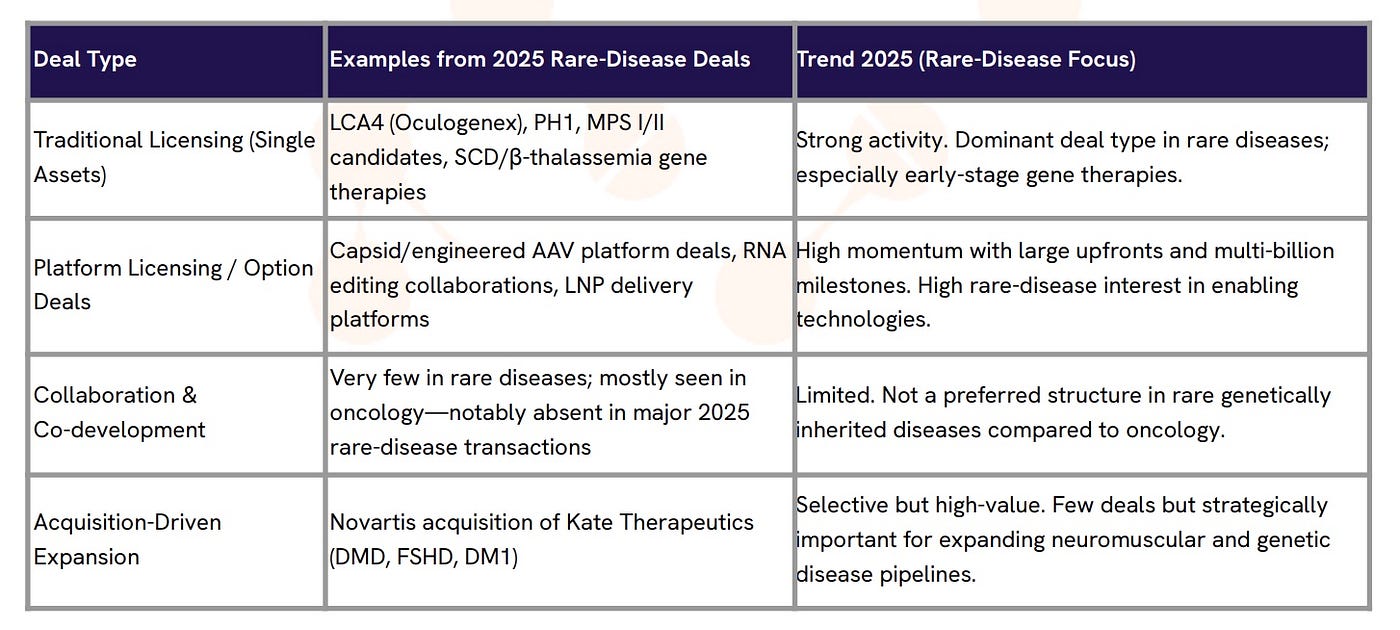
2. Phase-Wise and Indication-Wise Insights from Recent Rare Disease Agreements Across recent rare-disease–relevant agreements, a clear phase-wise pattern emerges in which the majority of industry activity is concentrated in the preclinical to early-clinical stages, particularly for advanced modalities such as AAV gene therapy, LNP-RNA platforms, in vivo CAR-T technologies, and genome-editing approaches. Companies consistently acquire or partner on programs before or soon after entering first-in-human studies, reflecting strong confidence in genetically defined rare diseases where early biological validation is highly predictive of downstream success. Indication-wise, deal flow is dominated by rare neuromuscular and CNS disorders, ophthalmic genetic diseases, metabolic and hepatic monogenic conditions, and rare hematologic or immunological diseases, reflecting both high unmet need and suitability for targeted genetic interventions. Late-stage rare-disease assets represent only a small fraction of transactions, indicating that most strategic value in this space continues to be captured at early stages where modality leadership, delivery technologies, and platform scalability drive partner interest [32] .
4. Drivers of Major Rare-Disease Deals in 2025
Below is an analysis of selected major rare-disease licensing deals, highlighting key strategic drivers for each transaction.
1. MeiraGTx — Lilly: Asset: AAV-AIPL1 gene therapy for Leber Congenital Amaurosis (LCA4) Deal Value: $75M upfront + $400M+ milestones [33]
a. Strong Regulatory Acceleration & Incentives: AAV-AIPL1 (LCA4 program) received Orphan Drug Designation + Rare Pediatric Disease Designation (RPDD) from FDA and EU Orphan Designation [34] .
b. High Unmet Need in AIPL1-LCA4 congenital blindness and Positive Clinical Results: Leber congenital amaurosis (LCA) is an ultra-rare congenital blindness with no approved treatments. Children are blind at birth due to mutations in AIPL1, a single gene [35] . This can create strong motivation for both investment and premium pricing. Additionally, Phase 1/2 data showed 11/11 children treated with AAV-AIPL1 gained meaningful visual function [36] .
c. Higher probability of success in monogenic diseases: Monogenic rare disorders like LCA4 offer predictable biology and clearer efficacy signals, giving them significantly higher clinical and regulatory success rates than non-genetic diseases [25] .
d. Access to a Specialist AAV Ophthalmology / Gene-Therapy Platform: The deal grants Lilly access not just to AAV-AIPL1, but MeiraGTx’s broader ophthalmology gene therapy assets — including novel capsids, promoters, and even a “riboswitch” platform for controlled gene expression [33] .

2. Arbor Biotechnologies — Chiesi Asset: CRISPR Cas12i2 mRNA therapy (ABO-101) for Primary Hyperoxaluria Type 1 (PH1) Deal Value: $115M upfront/near-term; >$2B total [16]
a. Regulatory Acceleration Through ODD + RPDD: ABO-101 has received FDA Orphan Drug Designation and Rare Pediatric Disease Designation, increasing deal value and reducing risk for Chiesi [37] .
b. Higher Success Rates in Genetic & Monogenic Disorders: Monogenic nature of PH1 increases clinical predictability and regulatory support, raising the likelihood of successful development [25,16] .
c. First-in-Class CRISPR Cas12i2 Knockout Therapy for a Severe Ultra-Rare Disease: A first-in-class CRISPR knockout approach offers a differentiated, potentially curative option in a high-mortality rare disease [37] .
d. Addresses a severe unmet need in PH1: ABO-101 targets a life-threatening, monogenic ultra-rare disease with no curative therapies, creating strong clinical and commercial motivation for the deal [37] .

3. Regenxbio — Nippon Shinyaku Assets: RGX-121 (MPS II) & RGX-111 (MPS I) Deal Value: $110M upfront + $700M milestones [12]
a. Strong Regulatory Support & Rare-Disease Designations: Both MPS I and MPS II programs (RGX-111, RGX-121) hold Fast Track and Regenerative Medicine Advanced Therapy designations, Orphan Drug Designation and Rare Pediatric Disease Designation [12] .
b. High Unmet Need in Severe Pediatric Neurodegenerative Disorders: MPS I and MPS II are life-threatening pediatric lysosomal storage disorders with rapid neurocognitive decline and limited efficacy from existing enzyme replacement therapy, creating a clear unmet need for CNS-targeted AAV gene therapy [38] .
c. Higher Probability of Success Due to Monogenic Biology: Both indications are monogenic diseases (IDUA mutation in MPS I; IDS mutation in MPS II), providing predictable pathophysiology, validated biomarkers (GAG reduction), and strong natural-history datasets — all drivers of higher clinical and regulatory PoS in rare genetic programs [38,25] .
d. Strategic expansion of Nippon Shinyaku into CNS-delivered AAV therapies using REGENXBIO’s NAV vectors: REGENXBIO’s NAV AAV platform has precedent in crossing biological barriers and delivering gene therapy broadly. Licensing to Nippon Shinyaku enables leveraging that vector expertise to deliver CNS-relevant AAV gene therapies, expanding their rare-disease portfolio beyond small-molecule or enzyme-replacement approaches [12] .

5. Major Deals/Agreements in Rare Disease program in 2025
Table-2 : Licensing & Collaboration Deals

Table 3: Acquisition deals in rare diseases space in 2025

Conclusion:
The rare disease licensing landscape in 2025 was characterized by high-value platform collaborations, increased investment in genetic medicine, and strong interest from large pharmaceutical companies seeking resilient pipelines. Despite scientific and commercial challenges, rare diseases continue to offer compelling opportunities due to favorable regulatory pathways and differentiated market dynamics. However, persistent hurdles such as complex manufacturing, limited natural history data, and reimbursement uncertainty continue to shape dealmaking strategies in this space. Overall, licensing remains a critical mechanism for aligning biotech innovation with industrial scale, ensuring that transformative therapies reach patients with rare conditions and accelerating progress in areas of profound unmet need.
Reference
- Grand View Research. 2025. Rare Diseases Treatment Market (2025–2030) Size, Share & Trends Analysis Report. Grand View Research.
- Grand View Research. 2024. Rare Diseases Treatment Market To Reach US$ 374.39 Billion By 2030. Press release, December.
- Morgan Lewis. 2025. Major Overhaul of UK Rare Disease Regulation: MHRA Proposes Enhanced Framework. As Prescribed blog post, 12 November.
- Simoens, S. 2011. Pricing and reimbursement of orphan drugs: the need for more transparency. Orphanet Journal of Rare Diseases, 6:42. doi:10.1186/1750–1172–6–42.
- Schumm, S., Helman, A., MacKenzie, E. et al. 2025. Strategies to Better Align Innovations with Disease Burden and Unmet Need — Aligning Investments in Therapeutic Development with Therapeutic Need: Closing the Gap. Washington (DC): National Academies Press (US).
- Grand View Research. 2025. Rare Disease Clinical Trials Market to Reach US$ 19.02 Billion by 2030. Press release. March.
- BiopharmaBoardroom. 2025. 2025 M&A Outlook: Transforming Biopharma and Biotech Through Strategic Innovation. 03 November.
- Byrne, B.J., Flanigan, K.M., Matesanz, S.E., Finkel, R.S., Waldrop, M.A., D’Ambrosio, E.S., Johnson, N.E., Smith, B.K., Bönnemann, C., Carrig, S., Rossano, J.W., Greenberg, B., Lalaguna, L., Lara-PezzI, E., Subramony, S., Corti, M., Mercado-Rodriguez, C., Leon-Astudillo, C., Ahrens-Nicklas, R., Bharucha-Goebel, D. & George, L.A. 2025. Current clinical applications of AAV-mediated gene therapy. Molecular Therapy, 33(6), 2479–2516. doi:10.1016/j.ymthe.2025.04.045
- Hwu, W.-L. 2024. Gene therapy for ultrarare diseases: a geneticist’s perspective. Journal of Biomedical Science, 31, 79. doi:10.1186/s12929–024–01070–1
- American Society of Gene & Cell Therapy. 2025. 2025 Q2 Landscape Report. ASGCT.
- BioSpace. 2025. AAV Gene Therapy Market Size Worth USD 23,546.27 Million by 2034. Press release, 20 November.
- REGENXBIO & Nippon Shinyaku. 2025. REGENXBIO and Nippon Shinyaku Announce Exclusive Partnership to Advance Gene Therapies for MPS Diseases. News release.
- Lottering, B. 2025. Cell and Gene Therapy Landscape in 2025: A Snapshot of Progress and What to Watch. GeneOnline, 31 March.
- Alliance for Regenerative Medicine. 2025. 2024 Sector Snapshot. Press report, January.
- Market Research Future. 2025. Rare Disease Genome Editing Market Forecast to 2035. Market Research Future report.
- Chiesi Group & Arbor Biotechnologies. 2025. Chiesi Group and Arbor Biotechnologies Announce a Global Strategic Partnership to Develop Novel Rare Disease Gene Editing Programmes. Press release, 06 October.
- Makkar, S.K. et al. 2025. Advances in RNA‑based therapeutics: current breakthroughs and the path ahead. RNA Therapeutics Review [online]. PMC Journal — In Process.
- Orna Therapeutics & Vertex Pharmaceuticals. 2025. Orna Therapeutics Establishes Strategic Collaboration with Vertex Pharmaceuticals to Develop Next-Generation Approaches for Sickle Cell Disease (SCD) and Transfusion-Dependent Beta Thalassemia (TDT). Press release, 7 January.
- Boston Consulting Group (BCG). 2025. Emerging New Drug Modalities in 2025. BCG report, 09 October.
- Kacin, E. et al. 2025. Molecular Design of Novel Protein‑Degrading Agents. PMC — full‑text article, PMC12196083.
- Bara-Ledesma, N., Viteri-Noel, A., Lopez Rodriguez, M., Stamatakis, K., Fabregate, M., Vazquez-Santos, A. & Gomez del Olmo, V. 2025. Advances in Gene Therapy for Rare Diseases: Targeting Functional Haploinsufficiency Through AAV and mRNA Approaches. International Journal of Molecular Sciences, 26(2), 578.
- 24LifeSciences. 2025. Gene Therapy Market Regional Analysis, Demand Analysis and Competitive Outlook 2025–2032. 24LifeSciences Report (Report ID: 24LS‑8110).
- Jenkins, R. 2025. Patent Cliff in Pharma: Navigating Disruption and Creating Opportunity. Global Pricing Innovations, 13 August.
- Inside Precision Medicine. 2025. Five Key Startups Shining the Light on Rare Diseases. Inside Precision Medicine, 31 March.
- L.E.K. Consulting. 2025. Opportunities for Rare Diseases to Drive Growth in Big Pharma. Executive Insights, 1 December.
- Agnopharma. 2025. Orphan Drug Product Development: Incentives and Outsourcing Considerations. Blog post.
- MedPath. 2025. FDA Analysis Reveals Decade of Growth in Rare Pediatric Disease Drug Development Through Priority Review Voucher Program. MedPath, 2025.
- Althobaiti, H., Seoane-Vazquez, E., Brown, L. M., Fleming, M. L. & Rodriguez-Monguio, R. 2023. Disentangling the Cost of Orphan Drugs Marketed in the United States. Healthcare, 11(4), 558. doi:10.3390/healthcare11040558.
- ZS. 2025. Rare Disease Pharma Innovation: How to accelerate drug development and access. ZS Insights.
- Prism Biopharma. 2025. Orphan Drugs: Incentives and Challenges in Rare Disease Treatment. Prism Biopharma blog, 2 June.
- Shelley, S. 2014. The maturing rare-disease market. Pharmaceutical Commerce, 28 October.
- Kirkpatrick, P. 2025. Dealmaking focuses on bright spots in the cell and gene therapy landscape. Biopharma Dealmakers (Nature), 01 December. doi:10.1038/d43747–025–00117-y
- MeiraGTx. 2025. MeiraGTx Enters into Strategic Collaboration with Eli Lilly and Company to Develop and Commercialize Genetic Medicines in Ophthalmology. GlobeNewswire, 10 November.
- FirstWordPharma. 2025. Company’s AAV-AIPL1 Gene Therapy for Inherited Retinal Disease Granted IND by FDA. FirstWordPharma.
- MeiraGTx. 2025. AIPL1 Retinal Dystrophy — Programs & Pipeline. MeiraGTx.
- MeiraGTx. 2025. MeiraGTx Announces The Lancet Publication of Data Demonstrating the Efficacy of rAAV8.hRKp.AIPL1 for the Treatment of Leber Congenital Amaurosis 4 (LCA4) Retinal Dystrophy. Press release, 21 February.
- Arbor Biotechnologies. 2025. Arbor Biotechnologies Announces FDA Orphan Drug and Rare Pediatric Disease Designations Granted to ABO-101 for the Treatment of Primary Hyperoxaluria Type 1 (PH1) and Upcoming Presentations at the 20th Meeting. Press release.
- Zanetti, A. & Tomanin, R. 2024. Targeting Neurological Aspects of Mucopolysaccharidosis Type II: Enzyme Replacement Therapy and Beyond. BioDrugs.
- VectorY Therapeutics & Shape Therapeutics. 2025. VectorY Therapeutics and Shape Therapeutics Announce Option and License Agreement to Advance Vectorized Antibodies for Neurodegenerative Diseases Using an AAV5-Derived CNS Capsid. Press release, 18 September.
- PharmCube. 2025. Keyi Licenses BCMA/CD19 CAR-T to US Firm in USD 2.1 B Deal. PharmCube News, 24 July.
- JCR Pharmaceuticals & Alexion. 2025. JCR Pharmaceuticals Enters License Agreement with Alexion for Proprietary JUST-AAV Capsids to Be Used in the Development of Genomic Medicines. News release, 8 July.
- Sangamo Therapeutics & Eli Lilly. 2025. Sangamo Therapeutics Announces Capsid License Agreement With Lilly to Deliver Genomic Medicines for Diseases of the Central Nervous System. Press release, 03 April.
- Gilead Sciences (Kite). 2025. Kite to Acquire Interius BioTherapeutics to Advance In Vivo Platform. News release, 21 August.
- AbbVie. 2025. AbbVie Completes Acquisition of Capstan Therapeutics. Press release, 19 August.
- AstraZeneca. 2025. Acquisition of EsoBiotec Completed. Press release. 20 September.
- BioSpace. 2025. Roche Buys Poseida for Up to $1.5B, Leaning Into Off-the-Shelf CAR-T. BioSpace, 20 November.
메타데이터
- post_id
- 23ef79c44c7b
- slug
- rare-disease-therapeutics-2025-deal-trends-and-outlook-23ef79c44c7b
- url
- https://medium.com/@social.media_810/rare-disease-therapeutics-2025-deal-trends-and-outlook-23ef79c44c7b
- canonical_url
- https://medium.com/@social.media_810/rare-disease-therapeutics-2025-deal-trends-and-outlook-23ef79c44c7b
- author_url
- https://medium.com/@social.media_810
- status
- ok
- fetched_at
- 2026-06-09 15:37:30





