What If the Convicted Person Was Innocent? The Scott Peterson Case Is Raising That Question Again
A new documentary doesn’t prove Scott Peterson’s innocence , but it reminds us why every justice system must remain open to new evidence.
What If the Convicted Person Was Innocent? The Scott Peterson Case Is Raising That Question Again
A new documentary doesn’t prove Scott Peterson’s innocence , but it reminds us why every justice system must remain open to new evidence.
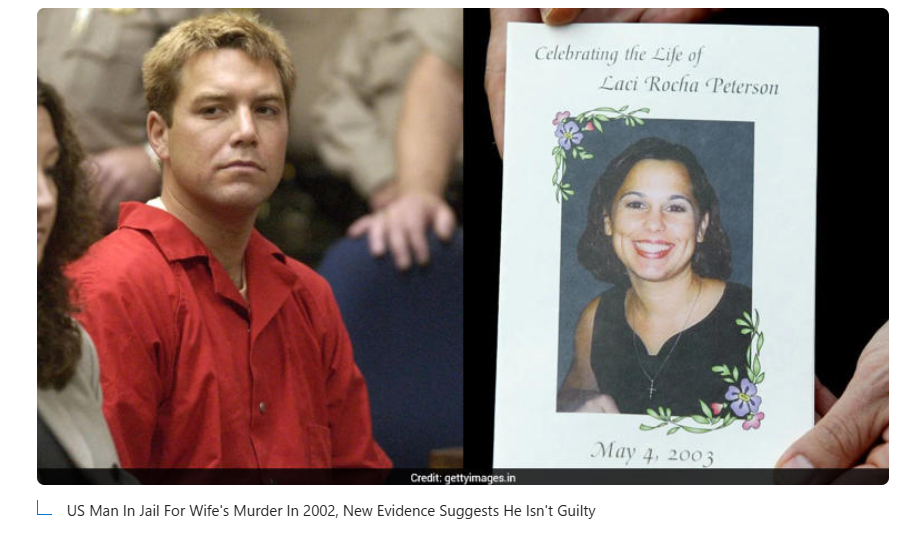
For more than two decades, the names Scott Peterson and Laci Peterson have remained among the most recognizable in American criminal history.
The case had everything that captures public attention — a missing pregnant woman, an extramarital affair, an emotional trial, extensive media coverage, and a murder conviction that many believed ended the story forever.
In 2004, Scott Peterson was convicted of murdering his wife, Laci Peterson, who was eight months pregnant, and their unborn son, Conner. The prosecution argued that Scott wanted to free himself from family responsibilities and continue his relationship with another woman. The jury agreed, and Peterson was sentenced to death. Years later, his death sentence was overturned, but his conviction remained intact, and today he continues to serve life imprisonment in California.
For most people, the case appeared settled. Until now.
A newly released documentary, Scott Peterson: The New Evidence, has reopened public discussion by presenting previously unseen material, fresh expert analysis, and alternative interpretations of some of the evidence used during the original investigation.
The documentary does not declare Scott Peterson innocent.
Instead, it asks an important question:
What if investigators — or the public — missed something?
That question matters far beyond this single case.
One of America’s Most Watched Murder Trials
When Laci Peterson disappeared on Christmas Eve in 2002 from her home in Modesto, California, the nation followed every development.
Volunteers searched neighborhoods.
Television stations covered the investigation daily.
Her smiling photographs appeared on newspaper front pages across America.
Months later, the bodies of Laci and her unborn son were discovered near the San Francisco Bay — the same area where Scott Peterson admitted he had gone fishing on the day she disappeared.
That coincidence became one of the strongest pillars of the prosecution’s case.
Another major factor was Scott’s affair with massage therapist Amber Frey.
Prosecutors argued that Scott had grown tired of married life and saw his unborn child as an obstacle. They presented the affair as evidence of motive.
Although there was no eyewitness who saw the murder take place and no confession, prosecutors built a compelling circumstantial case.
The jury ultimately found him guilty.
Why Is the Case Being Discussed Again?
The new documentary revisits evidence that has long been debated by Scott Peterson’s legal team.
Rather than introducing a dramatic “smoking gun,” it raises several questions about whether some assumptions made during the original investigation deserve another look.
Among the issues discussed are:
1. The Fishing Boat Theory
According to prosecutors, Scott transported Laci’s body in his small fishing boat and disposed of it in San Francisco Bay.
The documentary recreates the journey and questions whether such an act could realistically have occurred in daylight without attracting attention.
Retired investigators and legal experts featured in the documentary argue that maneuvering a body from such a small vessel would have been physically difficult and potentially unstable.
This doesn’t prove the prosecution was wrong.
But it challenges whether the theory was as straightforward as many people assumed.
2. The Missing Forensic Evidence
Investigators discovered strands of Laci’s hair wrapped around pliers found beneath a seat in Scott’s boat.
During the trial, this evidence supported the prosecution’s theory.
However, the documentary notes something equally important.
Investigators reportedly found no blood, tissue, or other biological evidence on those tools. Trial testimony also described the pliers as rusty and apparently unused for a long period.
Again, this does not establish innocence.
But it raises questions about how individual pieces of evidence should be interpreted.
3. The Secret Boat
Prosecutors argued that Scott secretly purchased the fishing boat because it would later be used to dispose of Laci’s body.
The documentary presents handwritten notes allegedly written by Laci suggesting she knew about the boat.
If authentic, those notes challenge an important element of the prosecution’s narrative — that the purchase itself demonstrated premeditation.
4. The Abduction Theory
Perhaps the most controversial aspect of the documentary involves an alternative explanation for Laci’s disappearance.
It revisits reports of a burglary occurring across the street from the Peterson home around the time she vanished.
According to the documentary, several witnesses reported seeing a suspicious van in the neighborhood. One witness, identified as a reserve police officer, allegedly claimed to have seen a pregnant woman being forced into the vehicle.
The documentary also notes that the van was later found burned and that a police dog reportedly tracked Laci’s scent toward that area.
These claims have existed for years but were never accepted by the jury as creating reasonable doubt.
The documentary argues they deserve renewed consideration.
Circumstantial Evidence Is Still Evidence
One misunderstanding often appears whenever high-profile cases are revisited.
People assume that because there was no DNA, no confession, or no eyewitness, the conviction must have been weak.
That isn’t true. Courts regularly convict defendants based on circumstantial evidence.
A chain of independent facts can sometimes be stronger than a single eyewitness, whose memory may be unreliable.
In Scott Peterson’s case, prosecutors relied on numerous circumstances:
- His affair.
- Inconsistent statements.
- His fishing trip.
- The location where the bodies were found.
- His behavior after Laci disappeared.
The jury considered the entire picture — not one isolated fact.
That is why overturning such convictions is extremely difficult.
The Court of Public Opinion
The Peterson trial also demonstrated the enormous influence of media coverage.
Television networks covered nearly every detail. Millions formed opinions long before the trial concluded.
Scott Peterson’s calm demeanor during interviews was interpreted by many as a lack of emotion.
His affair further damaged public sympathy. Whether those observations reflected guilt or personality became almost impossible to separate.
This phenomenon still exists today. Public opinion often reaches a verdict long before a courtroom does.
But, courts are expected to rely only on admissible evidence.
That distinction remains essential in any democracy.
Why Post-Conviction Reviews Matter
Some people believe that once a conviction is entered, the legal process should end.
History suggests otherwise. Across the United States and many other countries, individuals have been exonerated years — even decades — after conviction.
DNA testing has cleared prisoners who had spent decades behind bars.
Some convictions were overturned because of mistaken eyewitness identification. Others involved false confessions, prosecutorial misconduct, or advances in forensic science.
These cases remind us that justice is not weakened by re-examining evidence.
It is strengthened. If a conviction is correct, further scrutiny should reinforce public confidence.
If mistakes occurred, correcting them becomes a moral obligation.
A Lawyer’s Continued Belief
Scott Peterson’s longtime attorney, Mark Geragos, has publicly maintained his belief that Peterson is innocent.
He says that after handling thousands of criminal cases over several decades, experienced lawyers develop instincts about their clients.
That opinion, however, is exactly that — an opinion.
Ultimately, legal decisions must rest on evidence rather than personal belief.
Does the Documentary Change the Verdict?
Legally, no. Scott Peterson remains convicted.
His appeals have repeatedly failed, and courts have not overturned the verdict.
Public discussion generated by a documentary does not replace judicial review.
However, documentaries often encourage people to revisit complex cases with fresh eyes.
Sometimes they reveal genuinely overlooked facts. Other times they simply remind us that criminal investigations are rarely as straightforward as they appear.
The Bigger Lesson
Whether Scott Peterson is guilty or innocent remains a legal question.
The documentary alone cannot answer it.
But it does remind us of something important. Justice should never become afraid of questions.
Every legal system should be willing to re-examine evidence whenever credible new information emerges.
That does not mean every convicted person deserves a new trial. Nor does it mean every documentary uncovers the truth.
It simply means that truth is more important than finality.
A justice system earns public trust not because it never makes mistakes, but because it is willing to correct them when they occur.
That principle protects everyone — not only the accused, but also victims, families, and society itself.
Because in the end, the goal of a criminal trial is not merely to secure a conviction.
It is to discover the truth. And whenever new evidence invites us to look again, justice should never refuse to listen.
( News Resources: NDTV 24/7)
[embed]Writer Journal: Your Writing Awaits a Publication! A Call to Writers.medium.com
메타데이터
- post_id
- 23f2a75f683a
- slug
- what-if-the-convicted-person-was-innocent-the-scott-peterson-case-is-raising-that-question-again-23f2a75f683a
- url
- https://medium.com/writer-journal/what-if-the-convicted-person-was-innocent-the-scott-peterson-case-is-raising-that-question-again-23f2a75f683a
- canonical_url
- https://medium.com/writer-journal/what-if-the-convicted-person-was-innocent-the-scott-peterson-case-is-raising-that-question-again-23f2a75f683a
- author_url
- https://medium.com/@AuthorPeter
- status
- ok
- fetched_at
- 2026-07-16 04:05:14