How AI is Transforming DevOps in 2026
In 2026, Artificial Intelligence will no longer be just a futuristic concept in software development. It has become a core part of modern…
How AI is Transforming DevOps in 2026
In 2026, Artificial Intelligence will no longer be just a futuristic concept in software development. It has become a core part of modern DevOps practices. Businesses across industries are using AI-powered automation to improve deployment speed, reduce downtime, strengthen security, and increase operational efficiency.
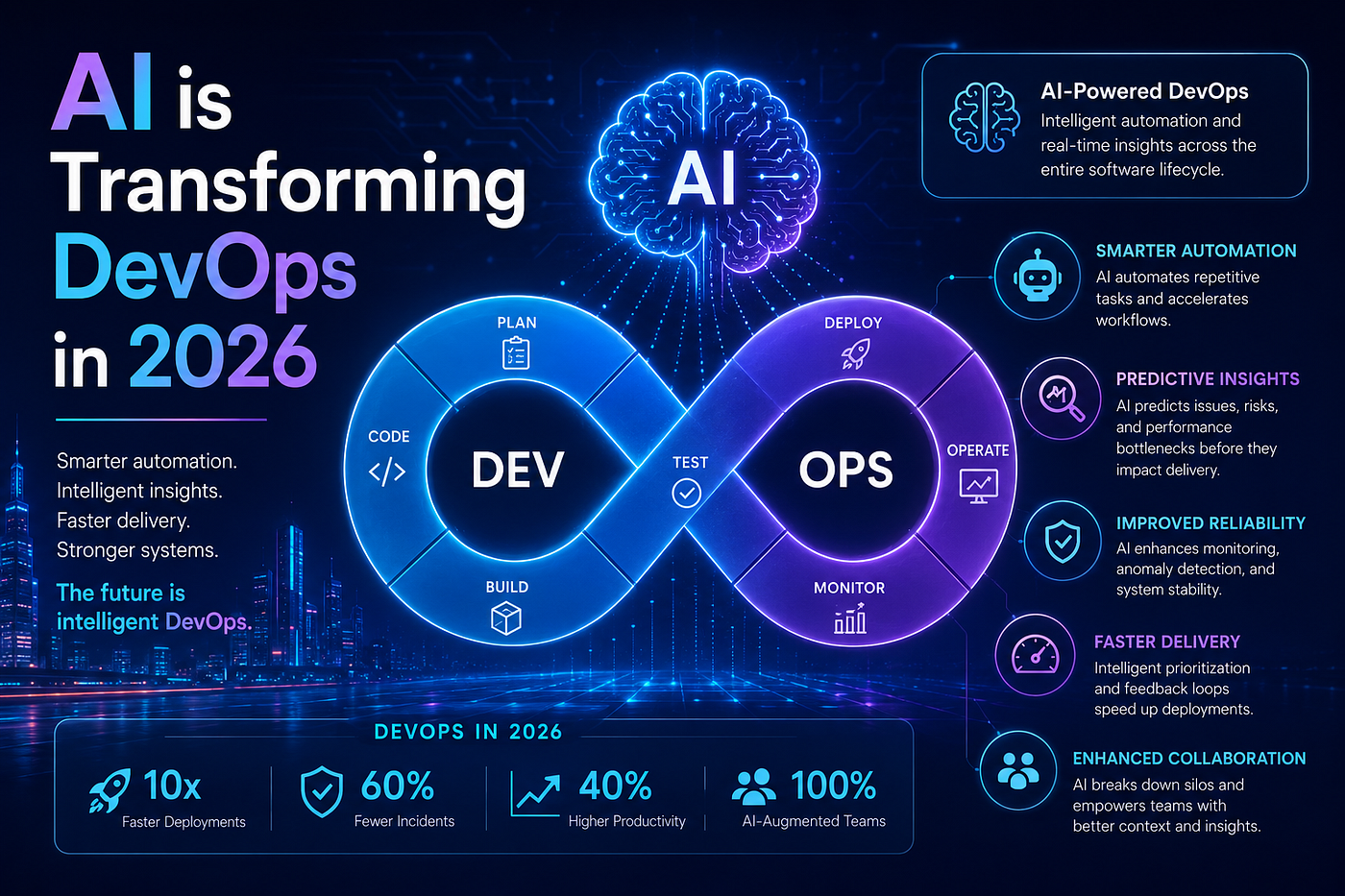
As organizations continue to adopt cloud-native technologies, Kubernetes, and microservices, AI is helping teams manage complex infrastructure with greater accuracy and less manual effort. Companies looking for scalable infrastructure solutions are increasingly partnering with professional DevOps experts to stay competitive in the digital era.
Understanding the Evolution of AI in DevOps
DevOps has always focused on collaboration, automation, and continuous delivery. However, traditional automation still required manual monitoring, scripting, and troubleshooting. In 2026, AI-driven systems can now analyze huge amounts of operational data, predict failures, automate fixes, and optimize performance in real time.
This transformation is helping businesses accelerate software delivery without compromising reliability or security.
Modern organizations are integrating AI into:
- **CI/CD pipelines**
- **Infrastructure monitoring**
- Security operations
- Incident management
- **Cloud optimization**
- Predictive analytics
- Automated testing
Businesses working with experienced providers of **DevOps Consulting Services** are gaining faster adoption of these advanced technologies while reducing operational complexity.
Key Ways AI is Transforming DevOps in 2026
1. Intelligent Automation in CI/CD Pipelines
AI-powered CI/CD pipelines can now identify bottlenecks, predict deployment risks, and optimize release cycles automatically. Instead of relying only on predefined scripts, AI systems learn from historical deployment data and improve over time.
Benefits include:
- Faster software releases
- Reduced human errors
- Automated rollback detection
- Smarter build optimization
- Improved deployment success rates
A modern **DevOps consulting company** helps organizations implement intelligent automation frameworks that improve development efficiency and deployment reliability.
2. Predictive Monitoring and Incident Detection
Traditional monitoring tools generate thousands of alerts daily, making it difficult for teams to identify real issues quickly. AI-driven observability platforms now analyze patterns and detect anomalies before they impact users.
AI can:
- Predict infrastructure failures
- Detect unusual traffic behavior
- Identify performance degradation
- Reduce alert fatigue
- Improve root cause analysis
This proactive monitoring approach helps businesses minimize downtime and improve customer experience.
3. AI-Powered Security and DevSecOps
Cybersecurity threats are becoming more advanced every year. AI is playing a major role in strengthening **DevSecOps **practices by identifying vulnerabilities in real time.
AI-based security tools can:
- Detect suspicious activity
- Scan infrastructure continuously
- Identify configuration issues
- Prevent unauthorized access
- Automate compliance checks
Organizations investing in a professional **DevOps Consulting Service** can integrate AI-powered security into every stage of the software development lifecycle.
4. Smarter Infrastructure Management
Managing cloud infrastructure manually can be time-consuming and expensive. AI-driven infrastructure management platforms now optimize cloud resources automatically based on usage patterns.
Key improvements include:
- Automated scaling
- Cost optimization
- Resource allocation
- Energy efficiency
- Self-healing infrastructure
This is especially valuable for businesses operating large multi-cloud or hybrid cloud environments.
5. Faster Root Cause Analysis
When system failures occur, identifying the root cause quickly is critical. AI tools analyze logs, metrics, traces, and application behavior to pinpoint problems within seconds.
Instead of spending hours investigating incidents manually, teams can resolve issues faster and improve system reliability.
Many enterprises using advanced **DevOps Service** solutions are adopting AI-assisted troubleshooting to reduce operational delays and improve productivity.
6. Enhanced Developer Productivity
AI-powered coding assistants and automation tools are helping developers write cleaner code faster. These systems suggest improvements, automate repetitive tasks, and detect bugs during development.
This leads to:
- Improved code quality
- Faster development cycles
- Better collaboration
- Reduced manual work
- Increased innovation
AI is allowing DevOps teams to focus more on strategic initiatives instead of repetitive operational tasks.
The Role of AI in Cloud-Native DevOps
Cloud-native environments are becoming increasingly complex due to containers, Kubernetes clusters, serverless architectures, and distributed applications. AI simplifies cloud-native operations by automating infrastructure decisions and optimizing application performance.
Organizations adopting cloud-native strategies often rely on expert **DevOps Consulting partners** to implement scalable AI-enabled workflows efficiently.
These solutions help businesses:
- Improve application availability
- Reduce infrastructure costs
- Accelerate deployments
- Enhance scalability
- Strengthen cloud security
Why Businesses Are Investing in AI-Driven DevOps
In 2026, businesses are prioritizing AI-powered DevOps because it provides measurable operational and financial benefits.
Major advantages include:
Improved Operational Efficiency
AI automates repetitive tasks and reduces manual intervention across development and operations teams.
Faster Time to Market
Organizations can release new features and updates much faster with intelligent deployment pipelines.
Better Reliability
Predictive analytics help teams identify issues before they become critical outages.
Reduced Costs
AI-driven optimization reduces unnecessary cloud spending and infrastructure waste.
Enhanced Customer Experience
Faster applications, fewer outages, and improved security directly impact user satisfaction.
Companies looking for enterprise-grade solutions often partner with providers offering **DevOps Consulting Services USA** to accelerate digital transformation initiatives.
Challenges of Implementing AI in DevOps
Despite the benefits, AI adoption in DevOps also comes with challenges.
Some common obstacles include:
- Lack of AI expertise
- Integration complexity
- Data quality issues
- High initial investment
- Resistance to organizational change
Businesses should adopt a phased implementation strategy and work with experienced DevOps professionals to ensure successful AI integration.
Future of AI in DevOps Beyond 2026
The future of AI in DevOps will continue evolving rapidly. Over the next few years, we can expect:
- Fully autonomous infrastructure management
- AI-driven software architecture optimization
- Advanced self-healing systems
- Intelligent cloud governance
- Hyper-automated security operations
As AI technologies mature, DevOps teams will become more strategic, data-driven, and innovation-focused.
How SquareOps Helps Businesses Embrace AI-Driven DevOps
**SquareOps** helps organizations modernize infrastructure, streamline automation, and implement scalable DevOps solutions tailored for modern cloud environments.
From CI/CD automation to Kubernetes management and cloud optimization, the company supports businesses in building efficient, secure, and AI-ready DevOps ecosystems.
Organizations seeking reliable DevOps transformation strategies can benefit from expert guidance, automation frameworks, and scalable cloud-native solutions.
Conclusion
AI is transforming DevOps in 2026 by making software delivery faster, smarter, and more reliable. From predictive monitoring to automated security and intelligent infrastructure management, AI-driven DevOps is helping businesses improve operational efficiency while accelerating innovation.
As digital transformation continues to grow, organizations that adopt AI-powered DevOps strategies will gain a significant competitive advantage in scalability, security, and performance.
메타데이터
- post_id
- 23f74cc05b68
- slug
- how-ai-is-transforming-devops-in-2026-23f74cc05b68
- url
- https://medium.com/@ankush_16452/how-ai-is-transforming-devops-in-2026-23f74cc05b68
- canonical_url
- https://medium.com/@ankush_16452/how-ai-is-transforming-devops-in-2026-23f74cc05b68
- author_url
- https://medium.com/@ankush_16452
- status
- ok
- fetched_at
- 2026-07-15 06:24:20




